Get in touch with FlexBlanket Company

Industrial Heating Blanket Manufacturer for Drums, IBC Totes, Pipes and Gas Cylinders
FlexBlanket is an industrial heating blanket manufacturer in Qingdao building electric industrial heating blankets and flexible heaters to your container, pipe or vessel, from a 4 L pail up to a 1,250 L intermediate bulk container. Seven product lines cover freeze protection, viscosity control, controlled warm-up and composite curing. Send dimensions, target temperature, operating conditions and your local voltage, and a process engineer sizes the heater before anything is quoted.
A process engineer reviews every drawing and every set of vessel dimensions before a quotation is issued.
Standard Parameters
- Engineer-reviewed quote within 24 business hours
- 7–15 day standard lead time
- 120 VAC and 230 VAC as standard
- 24-month warranty
Seven Industrial Heating Blanket Lines for Containers, Pipes, Cylinders and Curing
Each line below is a full product family with its own model codes, wattages and fitted dimensions. Every one of them can also be built to a non-standard size, voltage or wattage on your drawing. Ingress ratings quoted on these lines are classified to IEC 60529.
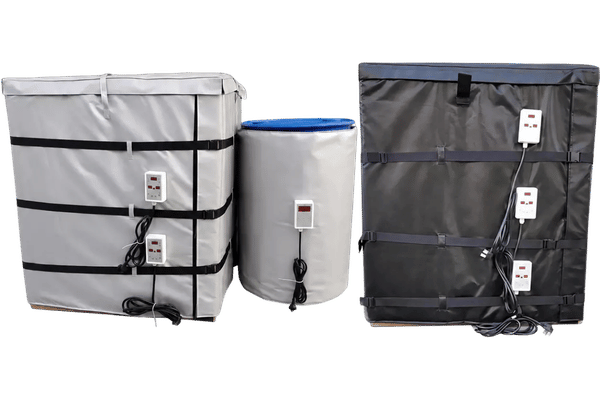
Container Heaters
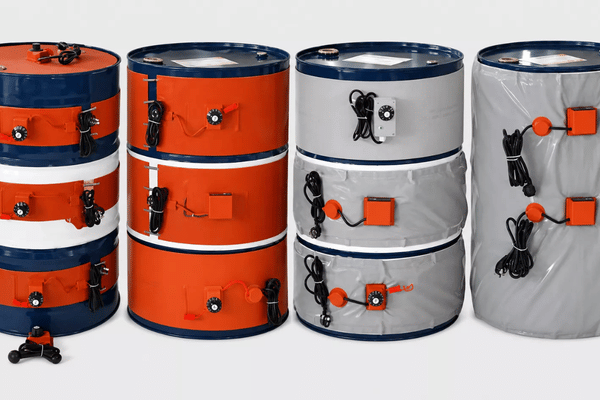
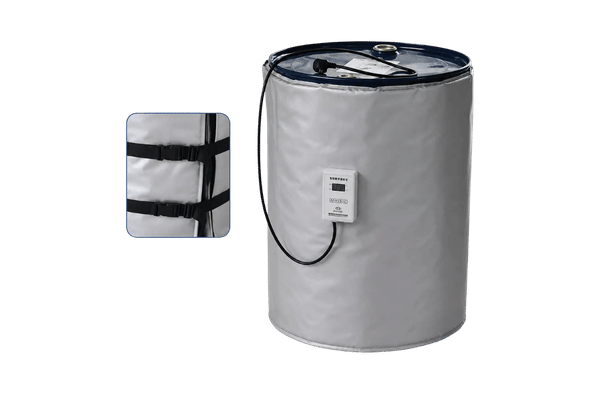
- IBC totes at 1,000 L and 1,250 L, two independently controlled heating zones
- Drums and barrels at 60 L, 120 L and 200 L
- Pails and buckets at 4 L, 8 L and 19 L
- Working range −20 °C to 130 °C, IP42, digital thermostat with over-temperature cut-out
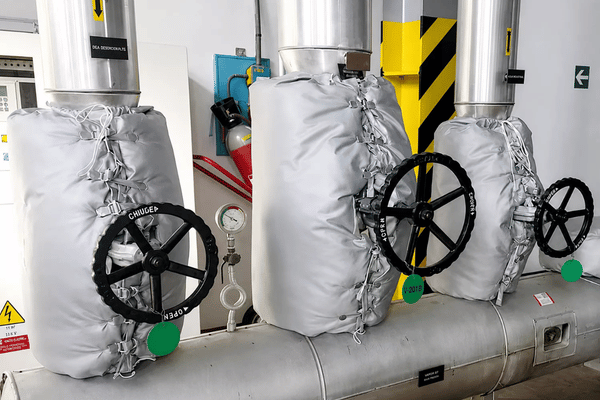
Pipe and Process Heating
- Built to your pipeline drawing, including valves, elbows, flanges and pumps
- An industrial heating blanket for pipe work is cut to the run, so valves and flanges keep their own removable pieces and a single fitting never has to stretch over two shapes
- An outdoor heating blanket for pipes meets rain, ultraviolet and site handling, which is why the jacket here is Teflon-coated fiberglass rather than a light coated polyester
- Core temperature limits of 220 °C silicone, 300 °C stitched construction and 400 °C high-silica
- Minimum bend radius 0.5 cm for tight routing
- Triple safety system: PID control, live current and temperature monitoring, mechanical over-temperature switch
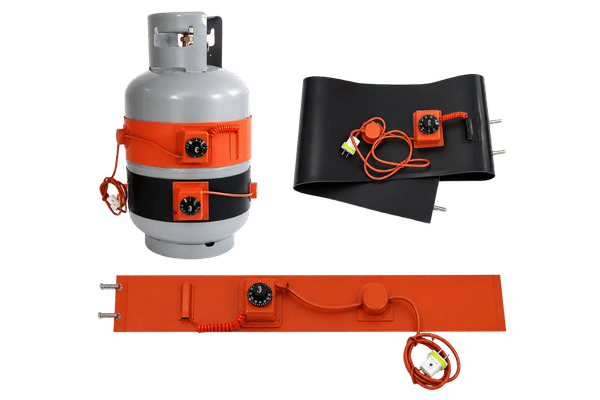
Silicone and Flexible Heaters
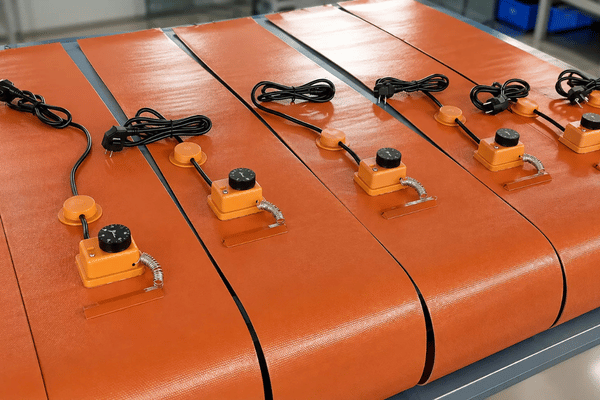
- Thickness 0.8–3.0 mm at a power density of 1.0–3.0 W/cm²
- Working range −60 °C to 250 °C, IP65
- Insulation resistance at or above 300 MΩ, withstand voltage tested at 2,500 V
- 12, 24 and 48 VDC as well as 120 and 230 VAC
- Supplied as a bonded silicone rubber heater pad or as a wrapped build, with lead exit set to your assembly at drawing review
- Uniform heat across flat, curved and irregular surfaces on process equipment, laboratory rigs and medical devices
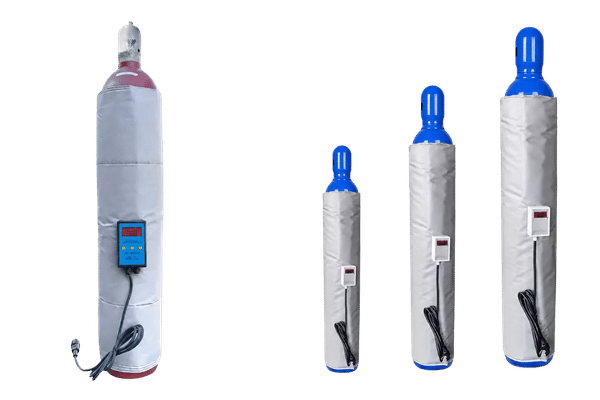
Gas Cylinder and Propane Tank Heaters
- Cylinder jackets at 1,050 × 860 mm, 800 W, with or without fiberglass insulation
- Propane tank blankets for 20 lb, 30 lb and 40 lb tanks at a fixed 32 °C (90 °F) ± 5 °C
- Compatible gases include nitrogen, oxygen, propane, SF₆, WF₆ and BCl₃
- IP40, digital adjustable thermostat, over-temperature protection
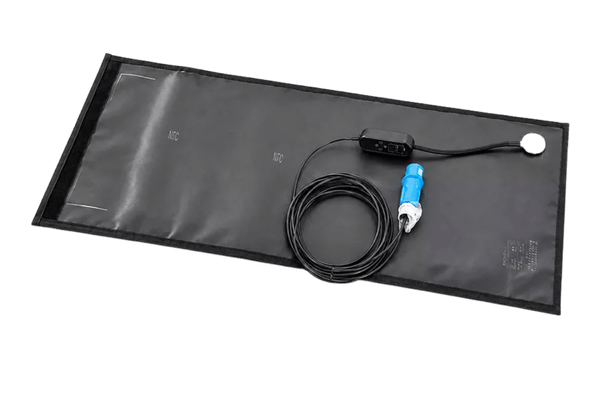
Composite and Wind Turbine Blade Curing Blankets
- Conformal blankets for epoxy and prepreg cure profiles on curved blade surfaces
- Built to the repair footprint rather than to a catalog size
- Sensor layout set with the cure profile at drawing review
- Compatible with vacuum-bag repair sequences
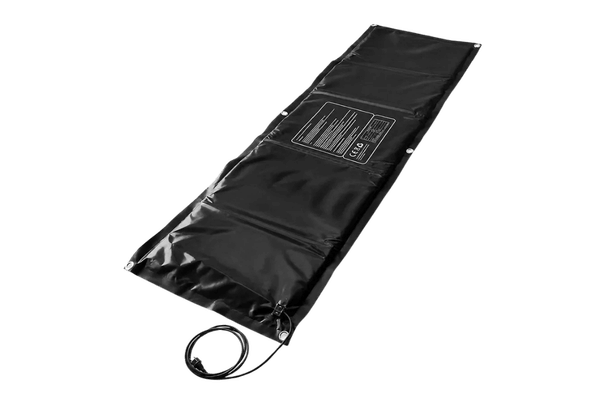
Ground Thawing Blankets
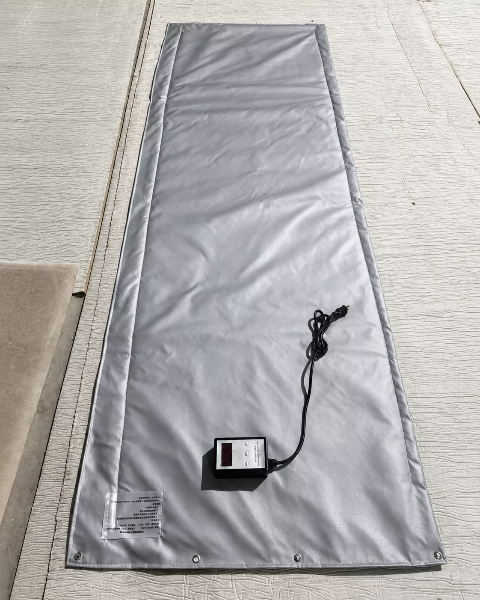
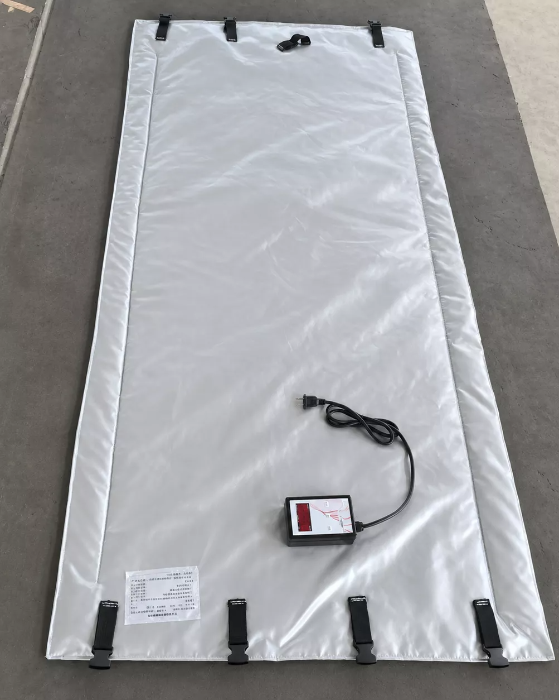
- 3,100 × 1,100 mm at 1,500 W, fixed 70 °C (158 °F)
- IP67 construction for wet and muddy sites
- Durable PVC face with a safety-grounded heating system
- Blankets link together to cover larger pours and excavations
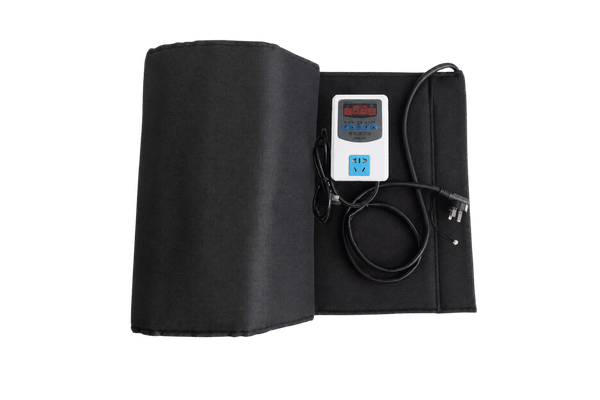
Custom Heating Blankets and OEM
- Non-standard dimensions, voltages, wattages and sensor positions
- Private-label builds with your branding on the product and packaging
- Design, prototype and production run handled on the same floor
- Drawing review and heater sizing before a quotation is issued
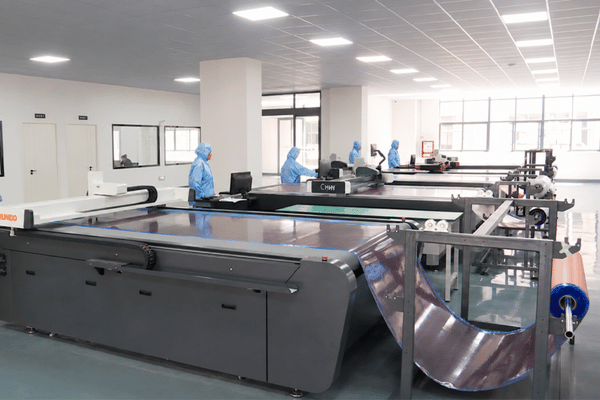
Machines and Test Equipment on Our Floor
PRODUCTION
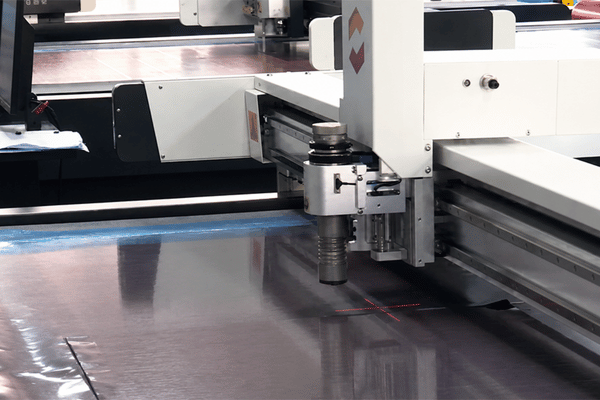
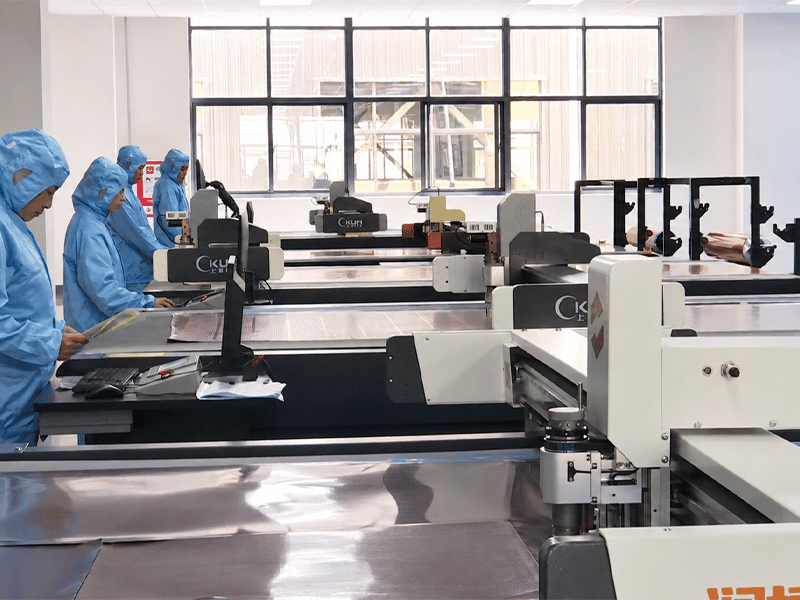
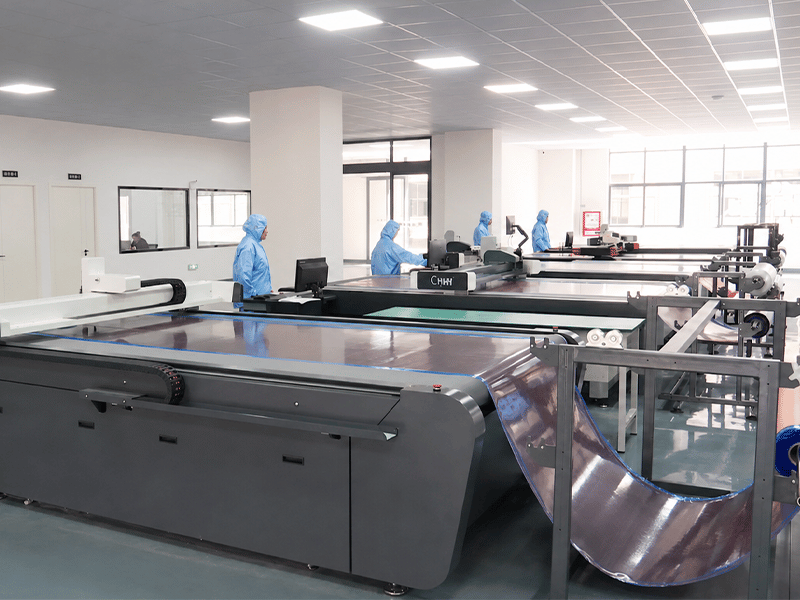
- Laser cutting machines
- Die cutting machines
- Wire winding machines
- Flat vulcanizing presses
- Industrial high-temperature ovens
ELECTRICAL TEST
- DC resistance testers
- Multi-channel temperature testers
- Withstand voltage testers
- Power-on test equipment
- Leakage current testers
- Insulation resistance testers
Standard Specifications Across the Range
The table below is the single place to check whether a standard build already fits your vessel. Figures are manufacturer specifications from our own product drawings and factory test records.
| Specification | Our specification |
|---|---|
| Container range | 4 L (1 gallon) pails up to 1,250 L (330 gallon) IBC totes |
| Supply voltage | 120 VAC and 230 VAC; 12, 24 and 48 VDC on flexible heaters |
| Container heater working range | −20 °C to 130 °C (−4 °F to 266 °F) |
| Silicone rubber heater working range | −60 °C to 250 °C (−76 °F to 482 °F) |
| Silicone heater thickness and power density | 0.8–3.0 mm (0.031–0.118 in) at 1.0–3.0 W/cm² (6.5–19.4 W/in²) |
| Pipe blanket core temperature limits | 220 °C (428 °F) silicone, 300 °C (572 °F) stitched, 400 °C (752 °F) high-silica |
| Minimum bend radius | 0.5 cm (0.20 in) on pipe and vessel jackets |
| Ingress protection | IP40 cylinder jackets, IP42 container heaters, IP65 silicone heaters, IP67 ground thawing blankets, to IEC 60529 |
| Electrical strength | Insulation resistance at or above 300 MΩ; withstand voltage tested at 2,500 V on silicone rubber heaters |
| Surface temperature uniformity | ± 2 °C on the Teflon-coated fiberglass pipe jacket and ± 5 °C on silicone rubber heaters, as manufacturer datasheet figures |
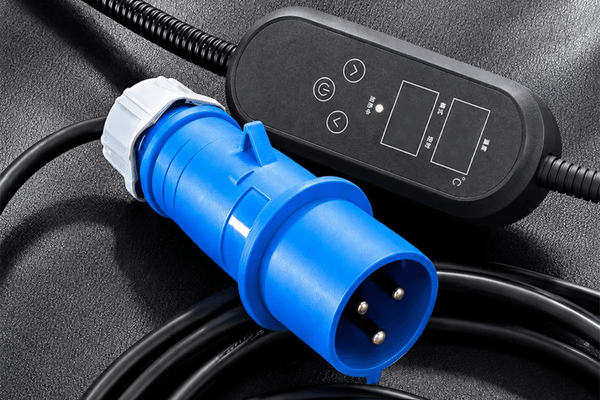
| Power cable | 2 m (6.5 ft) as standard, with 10 A, 15 A and 16 A plug options |
| Standard lead time | 7–15 days |
A uniformity figure only travels between suppliers when the conditions travel with it: setpoint, ambient temperature, blanket size, the load behind it, sensor count and placement, and stabilization time. We supply those conditions with the quotation rather than asking you to compare bare numbers.
Heater Sizing Worksheet
Enter vessel volume, starting temperature, target temperature and warm-up window to see the heat load your application needs and which of our model codes already covers it.
Blanket Construction: Jacket, Insulation and Heating Element
Three layers decide how a blanket behaves in service: the outer jacket that meets the environment, the insulation that decides which way the heat goes, and the flexible heating element that generates it. Each component is chosen against the duty rather than against a house standard, which is what keeps output consistent from one unit to the next. The table sets out what we build in each layer and what each option is for.
| Layer | Option | Purpose | Where it is used |
|---|---|---|---|
| Outer jacket | Teflon-coated polyester | Chemical splash resistance with a wipe-clean face | Container heaters, cylinder jackets |
| Outer jacket | Silicone-coated polyester | Flexibility at low ambient temperature | Drum, pail and tote heaters |
| Outer jacket | Teflon-coated fiberglass | Higher continuous service temperature on process lines | Pipe and vessel jackets |
| Outer jacket | PVC | Site abuse and standing water | Ground thawing blankets |
| Insulation | High-density polyester | Directs heat inward and cuts surface loss | Container and drum heaters |
| Insulation | High-performance fiberglass | Insulated cylinder builds where surface temperature matters | Gas cylinder jackets |
| Element | Silicone-insulated resistance wire | Even coverage across a wrapped surface | Container, drum and tote heaters |
| Element | Reinforced alloy wire | Long service life on process piping | Pipe heating blankets |
| Element | Fiberglass-reinforced silicone rubber sheet | Thin section and high power density on flat or curved surfaces | Silicone rubber heaters |
| Element | Infrared carbon fiber | Gentle, even low-temperature heating | Honey and food-grade pail heaters |
HOVER TO REVEAL PARAMETERS
Fluid properties set the same ceiling from the other side. Viscosity, specific heat, flash point and corrosivity all bear on the maximum power density and jacket temperature a given application can accept, which is why we ask what is inside the vessel before we quote a wattage.
- Close contact between the jacket and the vessel wall is what gives efficient heat transfer; a gap turns installed wattage into surface loss
- Thin sections with little thermal mass behind them take a lower density than a full container
- Adhesive-mounted heaters are limited by the adhesive rather than by the silicone
- Flammable or heat-sensitive contents pull the jacket temperature down before the wattage question is even reached
- An uneven thermal load, or an element overlapped on itself during fitting, creates a hot spot regardless of the rating
- The jacket material decides the ingress rating the finished unit can be classified to under IEC 60529, which is why a washed-down process line and a dry indoor cabinet do not take the same face
Why Power Density Is the Number to Watch
The heat flow density, in watts per square centimeter at the heater face, determines the expected lifetime of a flexible heater. If too much heat is produced too quickly for heat to get out, the wire temperature will climb until the silicone carbonizes, making the installation’s effective ceiling, not that of the heater alone, the design limit.
We size power density against the load that will sit behind the heater, not against the maximum the material can survive. A heater bonded to a thin panel with no thermal mass behind it gets a very different figure from the same heater clamped to a full drum, and that judgement happens at drawing review before anything is quoted.
The Four Heating Duties and How Each Changes the Specification
Heater selection starts with the material and the heating objective, because freeze protection, viscosity maintenance, controlled warm-up and phase change are four different duties with different risk and energy boundaries. Getting the duty right settles the setpoint, the control method and the jacket before anyone talks about wattage.
| Duty | The real requirement | Effect on the build | Matching FlexBlanket line |
|---|---|---|---|
| Freeze protection | Hold the contents above their freeze point through a cold spell | Low fixed setpoint, thermostat control, insulation matters more than wattage | Propane tank blankets, IBC tote heaters, pipe blankets |
| Viscosity maintenance | Keep a thick fluid pourable and pumpable at the discharge point | Moderate setpoint held continuously, even coverage across the wetted wall | Drum heating blankets, silicone drum bands |
| Controlled warm-up | Bring a cold container to working temperature inside a shift | Higher installed wattage, two-zone control on tall vessels, over-temperature cut-out | Two-zone IBC tote heaters, drum heaters |
| Phase change and cure | Drive a material through melting, crystallization or a cure profile | Profile control rather than a single setpoint, sensor placement decides the result | Composite curing blankets, honey and food-grade pail heaters |
Two Cases Where the Setpoint Matters More Than the Wattage
Diesel exhaust fluid freezes at 12 °F (−11 °C), and the 32.5 percent urea concentration set by ISO 22241 is the eutectic mix that produces that lowest possible freeze point. Freezing does not spoil the fluid; it expands by up to 7 percent, which is what threatens a full tote. American Petroleum Institute guidance ties shelf life to storage temperature — properly stored fluid keeps for twelve months or longer, while fluid held at 86 °F (30 °C) or above lasts about six months — so a DEF tote heater has a ceiling as well as a floor and is there to keep the fluid usable and protect the vessel rather than to rescue it.
Honey runs the opposite risk. Thermal processing work that held honey at 40, 60, 80 and 100 °C found no significant change in hydroxymethylfurfural or diastase activity through 95 hours at 40 °C, while 60 °C and above produced a steady rise in hydroxymethylfurfural and a fall in diastase activity as holding time increased. Our honey pail heater is fixed at 38 °C (100 °F) ± 5 °C for exactly that reason.
Hover to view DEF limits
DEF Thermal Constraints
- The control target for DEF is a narrow warm band, not the top of the heater’s range
- Since a full or near-full tote is what is actually at risk of splitting during a freeze, the level of DEF in the tank must be factored in.
- DEF totes sit outdoors at diesel fleet and automotive service sites, so ambient exposure drives the insulation decision as much as the wattage does
- ISO 22241-3 records that solutions held between 10 and 90 °F keep at least a one-year shelf life
Duty and Material Selector
Answer four questions about the material, the vessel and the outcome you need, and the selector returns the heating duty, the control approach and the product family that fits.
Custom and OEM Heating Blankets Built to Your Drawing
Most of what leaves our floor is not a catalog size. The sequence below is the same whether you need one non-standard jacket or a private-label run under your own brand.
-
Send what you have
Vessel or pipe dimensions, target temperature, operating conditions and your local voltage. Drawings help but are not required to start.
-
Engineering review
A process engineer sizes the heat load, sets the power density against the load behind the heater, and flags anything in the application that changes the jacket or the control method.
-
Written quotation
Within 24 business hours, with the model code or the custom build sheet, the control option and the lead time.
-
Sample or first article
Samples are available before you commit to a production order, so the fit and the control behavior are confirmed on your vessel rather than on paper.
-
Production and electrical test
Every unit passes DC resistance, withstand voltage, leakage current and insulation resistance checks before packing. If a unit measures outside its build sheet, it is reworked or remade against the same written acceptance criteria.
-
Packing and export documents
Proforma invoice, sales contract, commercial invoice, packing list and certificate of origin ship with the order, plus the other customs-clearance documents your import requires.
REVEAL COMPLIANCE & QUOTATION
Placing product on the market under your own name changes who carries the compliance obligations, and in the European Union it makes that party the manufacturer. Testing done on a base model does not automatically extend to every custom voltage, controller, connector or geometry, so the test scope for a private-label build is set separately at quotation.
Inputs That Make the First Quotation the Right One
| Input | What to specify | Why it changes the build |
|---|---|---|
| Vessel or pipe dimensions | Diameter, height or run length, and any obstructions such as valves or flanges | Decides the fitted pattern and whether a single jacket or a segmented set is needed |
| Target temperature | The setpoint and the tolerance you can accept around it | Sets the control method, from a fixed thermostat to PID profile control |
| Operating conditions | Lowest ambient temperature, indoor or outdoor, wash-down or standing water | Decides insulation thickness and the ingress protection rating |
| Local voltage and plug | 120 VAC, 230 VAC or a DC supply, and the plug standard on site | Fixes the element resistance and the fitted cable and plug |
| Material in the vessel | What it is, its viscosity behavior and any temperature limit it carries | Sets the maximum power density and the jacket material |
| Quantity and branding | Run size, and whether the product and packaging carry your brand | Decides tooling, labeling and the documentation set |
Quotation, Lead Time, Samples and Payment
Price follows vessel size, installed wattage, jacket material, control option and quantity rather than a fixed price list, because almost every build is dimensioned to a specific vessel. Your figure comes back in a written quotation.
| Driver | Effect on cost | How to reduce it |
|---|---|---|
| Heated area | The dominant driver; cost scales with the fitted surface | Heat only the wetted wall rather than the full vessel where the duty allows |
| Control option | A fixed thermostat is the lowest cost; PID with monitoring is the highest | Match the control to the duty; freeze protection rarely needs profile control |
| Jacket material | High-temperature fiberglass and PTFE constructions cost more than coated polyester | Specify the jacket against the real service temperature, not the peak the element is capable of reaching |
| Zones and sensors | Each independent zone adds element, wiring and control | Single-zone is enough on short vessels; reserve two-zone for tall totes |
| Quantity | Setup and tooling are shared across the run | Group sizes into one order where the same pattern repeats |
Send the vessel dimensions, target temperature, operating conditions and local voltage, and a process engineer returns a quotation within 24 business hours together with the sizing basis. Expedited scheduling is available and feasibility is confirmed at drawing review.
| Order stage | Working days | Scope |
|---|---|---|
| Quotation | Within 24 business hours | Heat-load sizing, model code or custom build sheet, control option, lead time |
| Sample or first article | Confirmed with your quotation | Fit and control behavior verified on your vessel before a production commitment |
| Standard production | 7–15 days | Build, electrical test and packing after the specification is approved |
Lead time starts when the specification is approved and excludes freight and customs clearance. Payment is by T/T bank transfer, with the terms set in your quotation.
Quality Control, Test Equipment and Documentation
Every unit is electrically tested before it is packed, and the test set is the same one that sits behind an electrical safety assessment. What follows is our own factory testing, described so you can see exactly which checks a unit has passed.
How Every Order Is Checked
- 1 Element resistance is measured against the build sheet before assembly continues
- 2 First article is checked against your dimensions and setpoint before the batch runs
- 3 Every finished unit passes withstand voltage, leakage current and insulation resistance checks
- 4 Multi-channel temperature testing confirms the controller and cut-out behave as specified under power
Measured thresholds we build to
- Insulation resistance at or above 300 MΩ on silicone rubber heaters
- Withstand voltage tested at 2,500 V on silicone rubber heaters
- Over-temperature protection fitted as standard across the container and cylinder lines
- Ingress protection from IP40 to IP67 depending on line, to IEC 60529
Documented material and product evidence
- EC Certificate of Conformity AMS190415927C to the RoHS Directive 2011/65/EU, issued by Annmos (Shanghai) Co., Ltd. on 18 April 2019, covering the silicone drum heater band models SRHB-125×1740, SRHB-200×860 and SRHB-250×1740
- SGS test report AJFS2411014511FF, 6 December 2024, on the PTFE fabric we buy: Fed. Test Method Standard 191A Method 5903.1 vertical flame test returned 0 s afterflame, 0 s afterglow and an 11 mm (0.43 in) average char length on a 627 g/m² fabric. The same vertical flame method is published by ASTM as D6413. The report is held by the fabric manufacturer and covers the material, not the finished assembly.
Electrical resistance trace heating systems for industrial and commercial use, including the surface heaters and heater panels this range belongs to, are addressed by IEC/IEEE 62395-1:2024, which sets out general and testing requirements for the equipment class.
Industries We Supply
Removable electric heating jackets show up wherever a vessel, line or cylinder has to hold a temperature that the surrounding air will not hold for it. A reliable heating solution in one sector is rarely the same build as in another, which is why our lines differ by jacket, control method and ingress rating. These are the sectors those lines are built for.
SYSTEM / APPLICATIONS OVERVIEW
-
01 Chemical processing
Resins, adhesives, coatings and reactive intermediates held at a working temperature in drums and totes.
-
02 Oil and gas
Line freeze protection and process temperature maintenance on pipework, valves and instrument runs.
-
03 Food and beverage
Honey, oils, syrups and chocolate brought back to a pourable state without overshooting the material’s limit.
-
04 Pharmaceutical
Reactor and vessel temperature control where the profile matters as much as the setpoint.
-
05 Semiconductor
Temperature-controlled transfer of photoresists and process chemicals, and gas cylinder pressure stability.
-
06 Battery manufacturing
Slurry heating and temperature control through mixing and coating.
-
07 Wind energy
Blade repair and composite curing on curved surfaces that no flat platen will reach.
-
08 Construction
Ground thawing and cold-weather concrete work on open sites.
-
09 Water treatment
Freeze protection for dosing lines, tanks and outdoor treatment equipment.
-
10 Aerospace
Fuel line heating and thermal maintenance on ground equipment.
-
11 Agriculture and apiary
Gentle low-temperature warming for honey and other heat-sensitive natural products.
-
12 Storage and logistics
Holding product temperature through storage and transport in cold climates.
SPECIFICATION DIRECTIVES
-
Indoor gas cabinets take IP40 cylinder jackets with over-temperature protection, because the risk there is a control failure rather than water ingress.
-
Open construction sites take IP67 ground thawing blankets at a fixed 70 °C, because standing water and site traffic are what a lighter build fails against.
-
Food and apiary work sets its ceiling from the material rather than the vessel, which is why the honey pail heater is fixed at 38 °C instead of left adjustable.
When a Heating Blanket Is Not the Right Answer
A removable electric blanket is one method among several, and there are applications where another route is the correct specification. Each row gives the situation, why it works against you, and what to do instead. Where the boundary is a trade-off rather than a hard limit, the row says what the alternative buys you and what it costs you.
| Situation | Why it works against you | What to do instead |
|---|---|---|
| A classified hazardous location, such as a Class I Division 1 or Division 2 area or an equivalent zone | Electrical equipment in a classified location has to be approved for that specific location and gas group; a general-purpose heater does not meet that test | Specify equipment approved for your area classification, or relocate the heated vessel outside the classified boundary |
| A United States workplace installation where 29 CFR 1910.303 applies | Electric equipment there has to be approved, and 29 CFR 1910.399 defines that through three routes: a Nationally Recognized Testing Laboratory listing, inspection by another Federal, State or local authority, or, for custom-made equipment, a manufacturer’s determination of safety resting on test data the employer keeps available for inspection. Our heaters carry no Nationally Recognized Testing Laboratory listing | Settle with your safety lead which route your site will accept before you specify, because the third route places the record-keeping duty on the employer. Test documentation for the build is scoped in the quotation. OEM and private-label buyers who market under their own brand normally handle listing at their own certification stage |
| A long straight pipe run needing continuous freeze protection over hundreds of meters | Wrapped jackets are built to a drawing, so a very long uniform run turns into a large number of fitted pieces | Use trace heating cable along the run and keep removable jackets for valves, flanges, pumps and instrument enclosures where a cable cannot conform |
| Expecting an insulation blanket alone to keep contents warm | Passive insulation slows heat loss but cannot add heat, so the contents drift to ambient temperature in the end | Use a powered heating blanket where the contents must sit above ambient, and keep insulation-only covers for holding a temperature that is already being maintained |
| An uneven or partly empty vessel where the jacket cannot sit flat | An overlapped element or an unloaded area concentrates heat and creates a hot spot whatever the rating says | Fit the jacket to the wetted height, or specify a zoned build so the empty section is not energized |
| An ultra-thin heater for a vacuum chamber or a tightly packed assembly | Our flexible heaters are fiberglass-reinforced silicone rubber from 0.8 mm upward, which is thicker than some assemblies allow | Polyimide flexible heaters are the right class for sub-millimetre sections; that is a different construction rather than a thinner version of ours, and the two are not interchangeable |
| Direct contact with the process fluid | External jackets heat through the vessel wall, so a fluid that needs heat introduced into the body of the liquid will not be served by a wrap | Use an immersion or in-line heater for that duty; an external jacket is not a substitute for one, and the two are different product classes rather than variants of each other |
Engineering Tools & Calculators
Determine the exact heating requirements, verify global power compatibility, and select the right product family for your specific industrial application before issuing an inquiry.
Heater Sizing Worksheet
Calculate the precise heat load required for your vessel dimensions and target warm-up window.
Voltage and Plug Compatibility Check
Verify local supply voltages and specify the correct industrial plug standard for your destination site.
Duty and Material Selector
Input your process medium and conditions to find the optimal heating jacket configuration and control method.
Industrial Heating Blanket FAQs
An industrial heating blanket is a fitted jacket built to a vessel, pipe or cylinder and rated for a process duty: supply voltage, installed wattage, ingress protection, a control method and an over-temperature cut-out. A household electric blanket is a bedding product with none of those ratings. The two share a word and nothing else.
In an industrial setting it means a jacket built for site or plant conditions rather than for indoor convenience: an abrasion-resistant outer face, a stated ingress protection rating, a grounded heating system and an over-temperature cut-out. Our ground thawing blankets are rated IP67 and our container heaters IP42, both to IEC 60529.
Every line is built for 120 VAC or 230 VAC, and silicone rubber heaters are also built for 12, 24 and 48 VDC. Plug options cover 10 A, 15 A and 16 A standards, and the fitted cable is 2 m as standard. Tell us the site voltage and the plug standard and the element is wound to match.
Power density sets how fast heat crosses the heater face, and the load behind the heater sets how fast the contents actually rise. A full drum has far more thermal mass than a thin panel, so the same heater produces very different warm-up times on each. Our sizing worksheet works from vessel volume and the warm-up window you need rather than from the heater rating alone.
No. We manufacture in Qingdao, China and sell factory-direct, which is what makes custom sizes, custom voltages and private-label runs practical at quantities a brand-name supplier would decline. Export documents ship with every order so your customs broker has what it needs.
Yes, and that is most of our output. Send vessel or pipe dimensions, target temperature, operating conditions and your local voltage, and a process engineer sizes the heat load and returns the build sheet with the quotation within 24 business hours. Drawings help but are not required to start.
Our silicone drum heater band line holds EC Certificate of Conformity AMS190415927C to the RoHS Directive 2011/65/EU, issued by Annmos (Shanghai) Co., Ltd. on 18 April 2019 and covering models SRHB-125×1740, SRHB-200×860 and SRHB-250×1740. That certificate addresses restricted substances rather than electrical safety, and it does not extend to our other product lines. Our heaters do not carry a Nationally Recognized Testing Laboratory listing and are not intended for classified hazardous locations, so confirm those requirements before you specify.
Element resistance is checked against the build sheet, and every finished unit passes withstand voltage, leakage current and insulation resistance testing plus a powered temperature check. On silicone rubber heaters we build to insulation resistance at or above 300 MΩ and a withstand voltage test at 2,500 V. This is our own factory testing, not third-party certification.
We quote a 7 to 15 day standard lead time, excluding freight and customs clearance, starting from specification sign-off. We can accommodate expedited scheduling, with feasibility at drawing review. Your quotation will indicate when your schedule is fixed.
No single freeze-protection method wins everywhere. The choice turns on how critical the vulnerable area is, climate severity, run geometry, available power, maintenance access and installation constraints. Long uniform runs favor trace cable; valves, flanges, pumps, instrument enclosures, drums and totes favor a removable jacket that can be taken off for service and refitted.
Container and cylinder heaters work from −20 °C to 130 °C, and silicone rubber heaters from −60 °C to 250 °C. Ingress protection runs from IP40 on cylinder jackets through IP42 on container heaters and IP65 on silicone heaters to IP67 on ground thawing blankets, all to IEC 60529.
A proforma invoice, sales contract, commercial invoice, packing list and certificate of origin ship with every order, along with the other customs-clearance documents your import requires. Material or test documentation beyond that is scoped in the quotation.
Yes, including your branding on the product and packaging. Note that placing product on the market under your own name makes that party the manufacturer for European Union purposes, and that testing on a base model does not automatically extend to every custom voltage, controller, connector or geometry. The test scope for a private-label build is set separately at quotation.