Get in touch with FlexBlanket Company

Updated Aug 2026
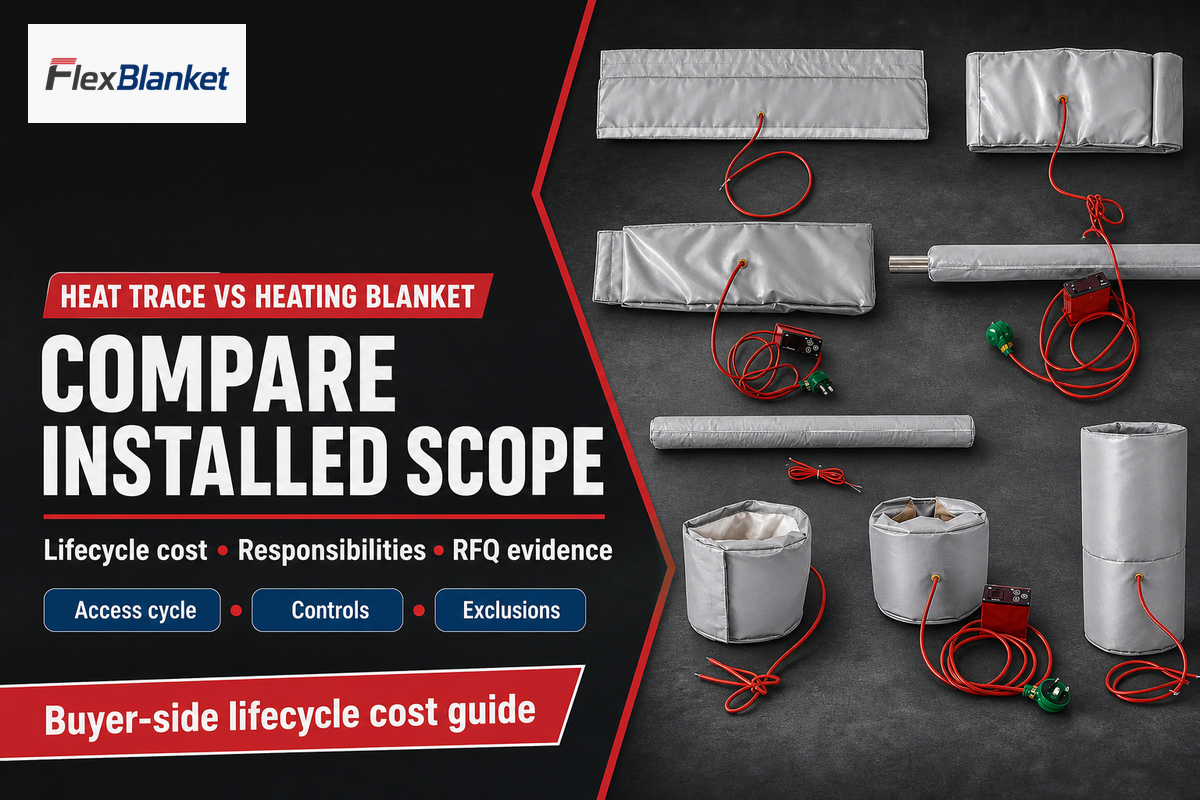
Heat Trace vs Heating Blanket is an installed-scope and lifecycle-cost comparison, not a heater-price contest. For ordinary-location electrical resistance heating, cable trace distributes heat along a run while an active fitted blanket heats a defined surface zone, but the commercial decision depends on equal controls, insulation, access-cycle work, documents, exclusions, and acceptance evidence.
Direct answer
Compare heat trace and heating blankets only after both quotations include the same thermal duty, heated geometry, electrical connections, controls, insulation, planned access, replacement boundary, documentation, and acceptance tests. A lower heater price is not a lower lifecycle cost when one bid leaves installed work or maintenance responsibility outside its scope.
Quick Decision Inputs
| Thermal duty | Freeze protection, temperature maintenance, or controlled warm-up |
| Technology scope | Ordinary-location electrical resistance cable or active surface blanket |
| Geometry | Linear run, repeated fittings, or irregular service node |
| Control target | Heater, pipe wall, or process-fluid temperature |
| Lifecycle | Installation, access, repair, insulation reinstatement, and replacement scope |
Scope before comparison
Skin-effect, impedance, induction, steam, glycol, and other systems require a broader method study. OSHA-classified locations and fire-protection piping also require their own approval route. Do not use the matrix below to bypass those gates.
Protecting pipes from freezing is one common duty, but systems that prevent freezing and systems that maintain a process temperature answer different design questions. Industrial electrical heating starts with that duty boundary, whether the asset is a water pipe, a chemical line, or an instrument connection.
Heat Trace vs Heating Blanket Quote Scope at a Glance

Within ordinary-location electrical resistance heating, cable heat trace places a resistance element along a pipe, whereas an active industrial heating blanket spreads a heated surface over a defined fitted zone. An insulation blanket without a heating element is a different product: it slows heat loss but cannot add heat to the system. Search results also use phrases such as heat blanket for pipes, pipe insulation blankets, and industrial heating blanket for pipe, but those phrases can describe active heating, passive insulation, or a combined assembly.
| Quote field | Cable proposal must state | Blanket proposal must state | Comparison boundary |
|---|---|---|---|
| Heated geometry | Run length, routing, fittings, and excluded nodes | Measured zone, closure, clearances, and excluded surfaces | Nominal pipe size is not a complete scope |
| Thermal duty | Heat-loss basis and circuit output | Heat-loss basis and module output | Both use the same design conditions |
| Connections | Power kits, splices, end seals, and terminations | Leads, connectors, junctions, and terminations | Excluded electrical work is priced separately |
| Controls | Circuit, sensor, panel, alarm, and monitor scope | Module, sensor, controller, alarm, and monitor scope | The controlled object must match |
| Insulation | Material, thickness, jacket, removal, and reinstatement | Integrated and separate insulation responsibilities | Blanket does not automatically mean insulated |
| Access cycle | Opening, inspection, repair, and restoration work | Removal, storage, inspection, and reinstallation work | Use the same event count and labor rate |
| Replacement boundary | Circuit, segment, termination, or accessory | Fitted module, lead, sensor, or control item | Record what one failure forces the buyer to replace |
| Documents | Circuit schedule, layout, certificates, tests, and manuals | Drawing, fit record, certificates, tests, and manuals | Brochures are not acceptance records |
| Exclusions | Field labor, protection, insulation, commissioning, and spares | Field labor, protection, insulation, commissioning, and spares | An unpriced exclusion remains buyer cost |
Normalize Search Language Before Requesting Quotes
Search vocabulary mixes industrial methods, residential uses, product construction, and sales language. The following corrections prevent a familiar phrase from becoming an unverified design input.
| Search-language group | Phrases a buyer may encounter | Scope correction |
|---|---|---|
| Technology family | heat trace system; electrical heat trace; electric heat trace; industrial heat trace; electric heating cable; self-regulating heat trace cable; heat tape for pipes; resistive | Name the actual resistance-heating technology, circuit design, and approval scope instead of treating these labels as interchangeable. |
| Freeze language | pipe freeze protection; pipe protection; water lines; exposed pipes; metal pipes; valves from freezing; temperatures drop; solution for preventing; expensive repairs | Replace the general freeze concern with a minimum temperature, ambient condition, wind or washdown exposure, pipe material, insulation construction, and flow state. |
| Residential or building use | roof; gutter; de-ice; crawl space; common applications; common uses of heat | These words can point to building products outside this industrial process-pipe comparison. Do not transfer their installation rules or listings. |
| Product and accessory wording | pipe heater; heating products; heat trace products; heating solutions; heat trace solutions; connection kits; silicone rubber; heat-conductive | Request the heater construction, leads, terminations, controls, insulation, environmental rating, and acceptance evidence for the quoted assembly. |
| Numeric and control wording | 120V; 140°F; °C; desired temperature; temperature control; hazardous environments; self-limit | A search-result voltage or temperature is not a project specification. Confirm supply, design temperature, sensor objective, area classification, and the exact meaning of self-limiting behavior. |
| Action and sales wording | use heat trace; working with heat trace; preferred choice; reliable solution; right product; reducing energy | Treat these as prompts for evidence, not conclusions. The preferred method follows heat loss, control, approval, installation, access, and lifecycle records. |
Start With Thermal Duty
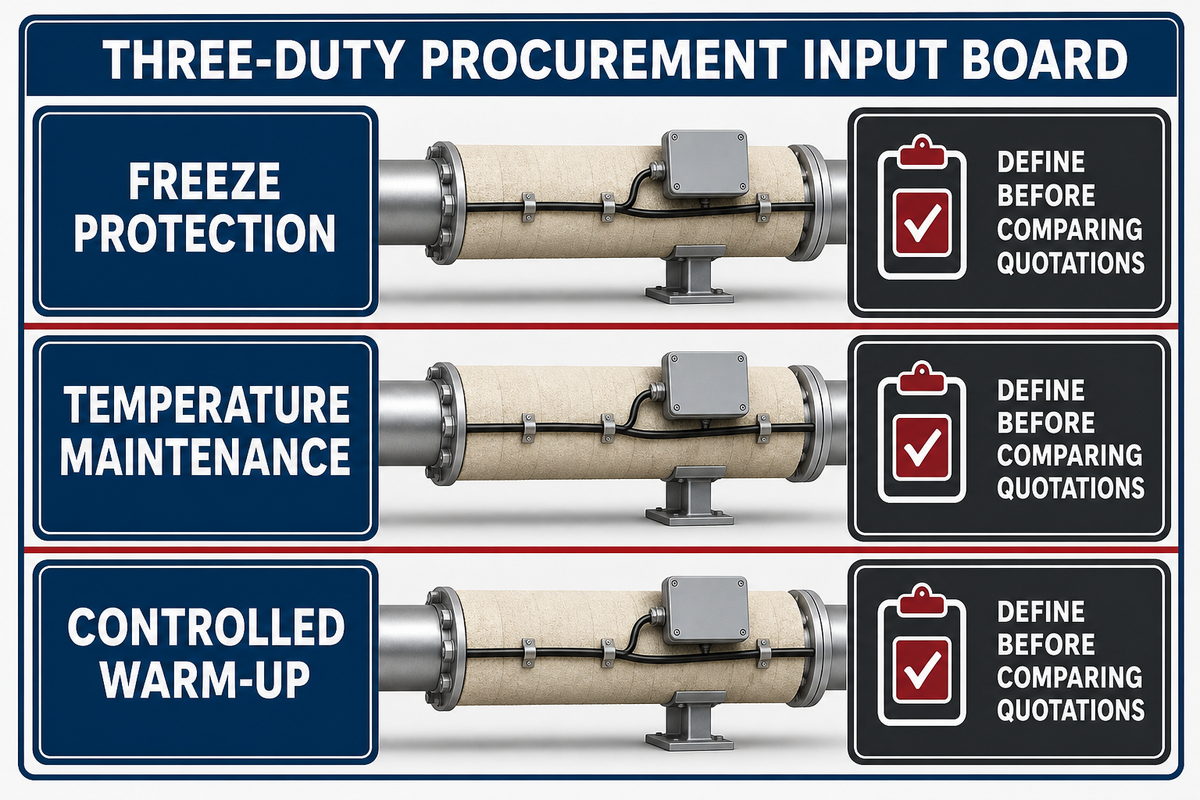
Thermal duty determines what the heating system must do before cable length, blanket area, wattage, or thermostat choice enters the discussion. Freeze protection holds a minimum boundary, temperature maintenance offsets continuing heat loss, and controlled warm-up adds mass, heat capacity, elapsed time, flow, and possible phase-change terms.
Oak Ridge National Laboratory’s MEASUR insulated-pipe calculator treats heat loss as a multivariable problem: pipe and insulation dimensions, material properties, surface and ambient temperatures, convection, radiation, wind, efficiency, and length all matter.
That model changes the buying question. “How many watts?” is not an input; it is a result of defined conditions. A buyer should first record the minimum ambient temperature, wind or washdown exposure, the fluid state, the desired pipe or process temperature, the insulation construction, and the time objective.
📐 Engineering note
Sensible-heat estimates use mass × specific heat × temperature change. Actual warm-up time also needs available power and heat losses; phase change or reaction requires additional terms. Use the duty and temperature-difference worksheet to prepare inputs, not to claim a finished heater size.
Plant engineers evaluating a stagnant line, a recirculating line, and a batch warm-up should not submit one heating objective for all three. Identical pipe diameters can produce three different control and power questions because flow removes heat, a static section can cool locally, and a warm-up target adds stored energy.
Record Geometry as an RFQ Cost Input
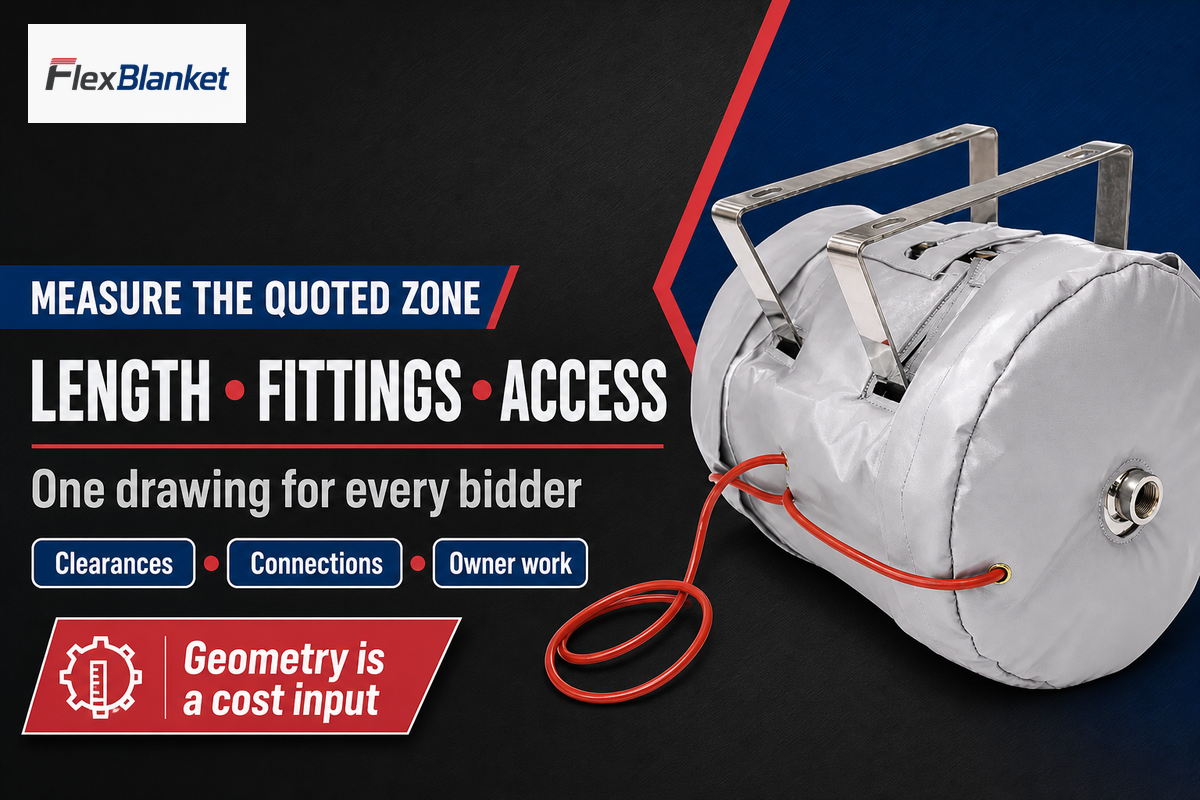
Geometry changes quoted labor, connections, controls, insulation work, access time, and replacement scope. Long repetitive runs and short irregular service nodes may require different measured records, but this cost guide does not select a heating method. Give every bidder the same lengths, fittings, clearances, removal direction, access frequency, and excluded surfaces.
At a chemical plant, a quote based only on straight-run length can omit measured valve, flange, support, termination, and access work, creating hidden cost and rework risk. For a FlexBlanket quotation or any competing bid, the buyer should attach a drawing, bill of materials, connection count, insulation boundary, and owner-supplied field-work list; otherwise procurement is comparing different installed systems.
For a fitted-module quotation, review fitted-module construction and quoted inclusions. Method screening remains the job of the site’s dedicated comparison tool; this article owns only lifecycle cost and RFQ comparability.
Map the Hidden Heat-Path Bottlenecks
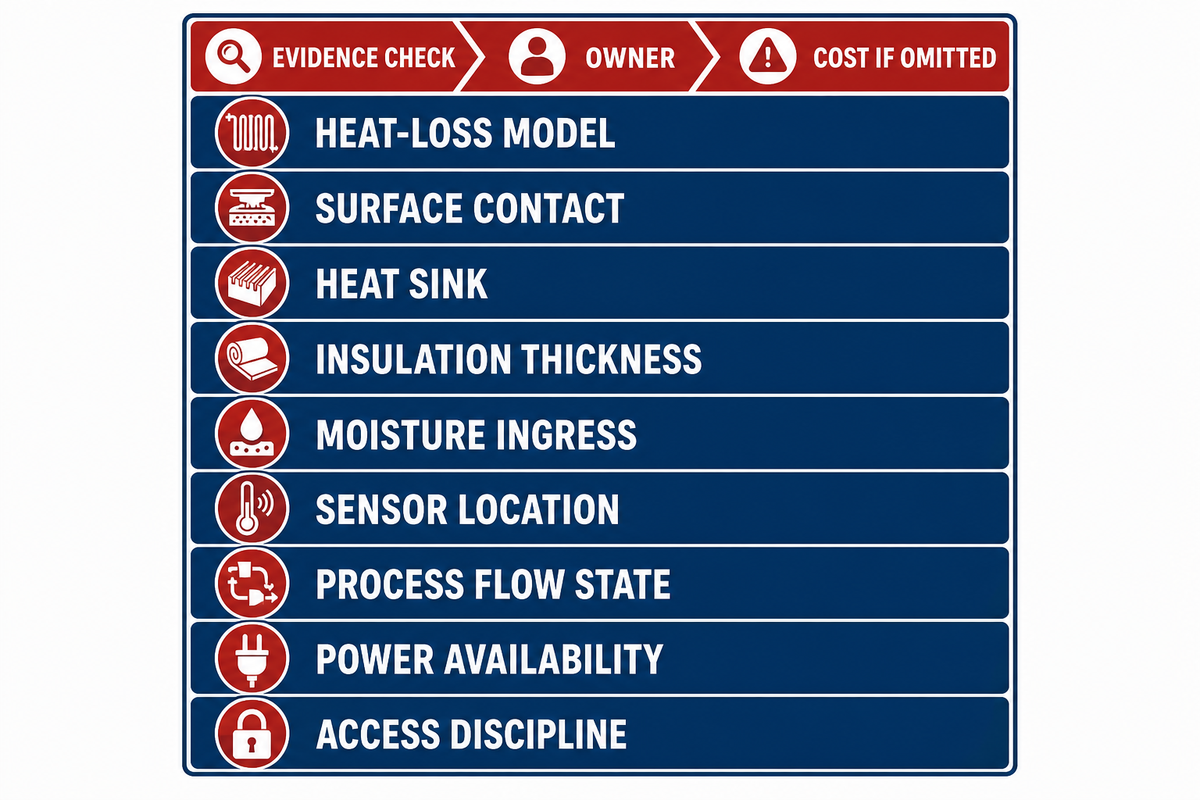
Visible heating hardware isn’t always the binding constraint. Pipe-wall conduction, local heat sinks, gaps in contact, insulation thickness, wet insulation, damaged weather barriers, wind, process flow, and misplaced feedback sensors can dominate the result. More heater output can’t correct every weak link in that chain.
Unpriced-Scope Responsibility Register
Use the Unpriced-Scope Responsibility Register to assign an evidence check and an accountable buyer role to every constraint. Procurement can then expose insulation, sensing, electrical, and maintenance work that one quotation includes while another silently transfers it to the owner.
| Unpriced responsibility | Evidence check | Owner | Cost if omitted |
|---|---|---|---|
| Heat-loss model | Inputs, assumptions, and result | Process / mechanical engineering | Redesign or inadequate duty |
| Surface contact | Fit drawing or installed inspection | Supplier and QA | Rework at local hot or cold zones |
| Heat sink | Supports, flanges, brackets, and mass | Mechanical engineering | Additional zones or site changes |
| Insulation thickness | Specified and installed thickness | Insulation contractor and QA | Extra material, labor, or energy |
| Moisture ingress | Weather barrier and inspection record | Maintenance | Insulation replacement and corrosion exposure |
| Sensor location | Controlled object and installed position | Controls and instrumentation | Relocation, retesting, or process risk |
| Process flow state | Static, intermittent, or flowing duty | Operations | Control changes and additional verification |
| Power availability | Voltage, circuit, protection, and load record | Electrical engineering | Panel, circuit, or distribution work |
| Access discipline | Removal, storage, reinstallation, and test record | Maintenance and QA | Repeat labor and damaged-zone replacement |
Does heat trace cable need insulation?
Heat trace cable normally works as part of an insulated system when the design depends on limiting environmental heat loss. Insulation type, thickness, weather protection, temperature rating, and installation instructions remain project inputs. An uninsulated cable may produce heat, yet the pipe can still lose energy faster than the system can replace it.
U.S. Department of Energy process-heating resources treat heat containment and loss reduction as plant-level efficiency work. National Insulation Association’s installation guide also keeps joints, weather sealing, damage, and maintenance within the insulation system’s lifecycle.
Control Zoning and Sensor Architecture
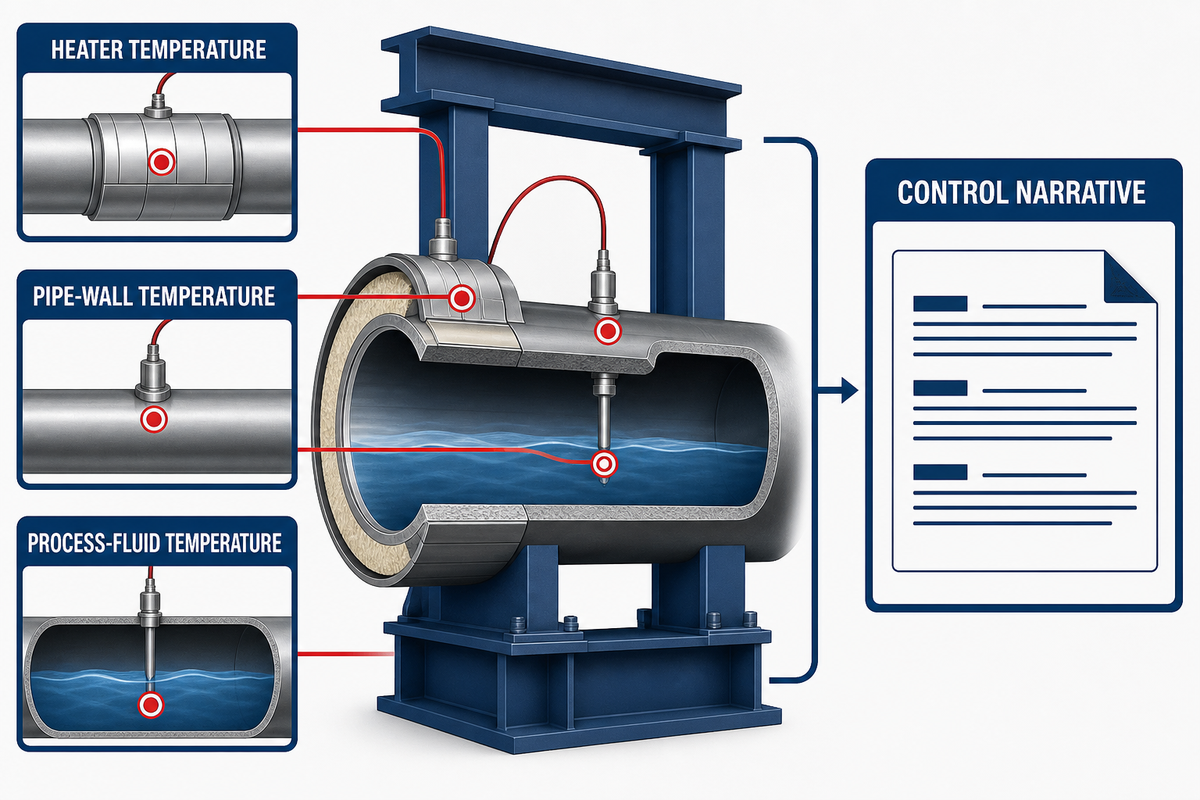
Control architecture begins by naming the controlled object. Heater temperature, pipe-wall temperature, and process-fluid temperature are different measurements. Cable circuits and fitted blanket zones may also respond differently to flow, ambient exposure, and heat sinks, so a thermostat location that works for one zone can misrepresent another.
One Nuclear Regulatory Commission event record documented cold pipe sections associated with temperature-element placement and insulation configuration. That lesson is bounded: a sensor isn’t useful merely because it’s installed; its position must represent the feedback objective and the insulated heat path.
Does the installation need a thermostat or controller?
Many installations need a thermostat, controller, monitor, alarm, or over-temperature function, but the exact combination follows the duty and instructions. Self-regulating heating cable changes local output as temperature changes; it doesn’t choose circuit length, power protection, sensor placement, insulation, area approval, or the process-fluid limit.
Constant-wattage cable and an active blanket can both need independent zones when static and flowing sections behave differently. Procurement should ask for the control narrative: what starts and stops power, what temperature is measured, how alarms are handled, and what test proves each zone is ready.
Decision point
If one sensor can’t represent every zone, split the feedback problem before comparing heater prices. A lower-cost heater attached to the wrong control architecture isn’t the lower-cost system.
Access-Cycle Cost After Installation
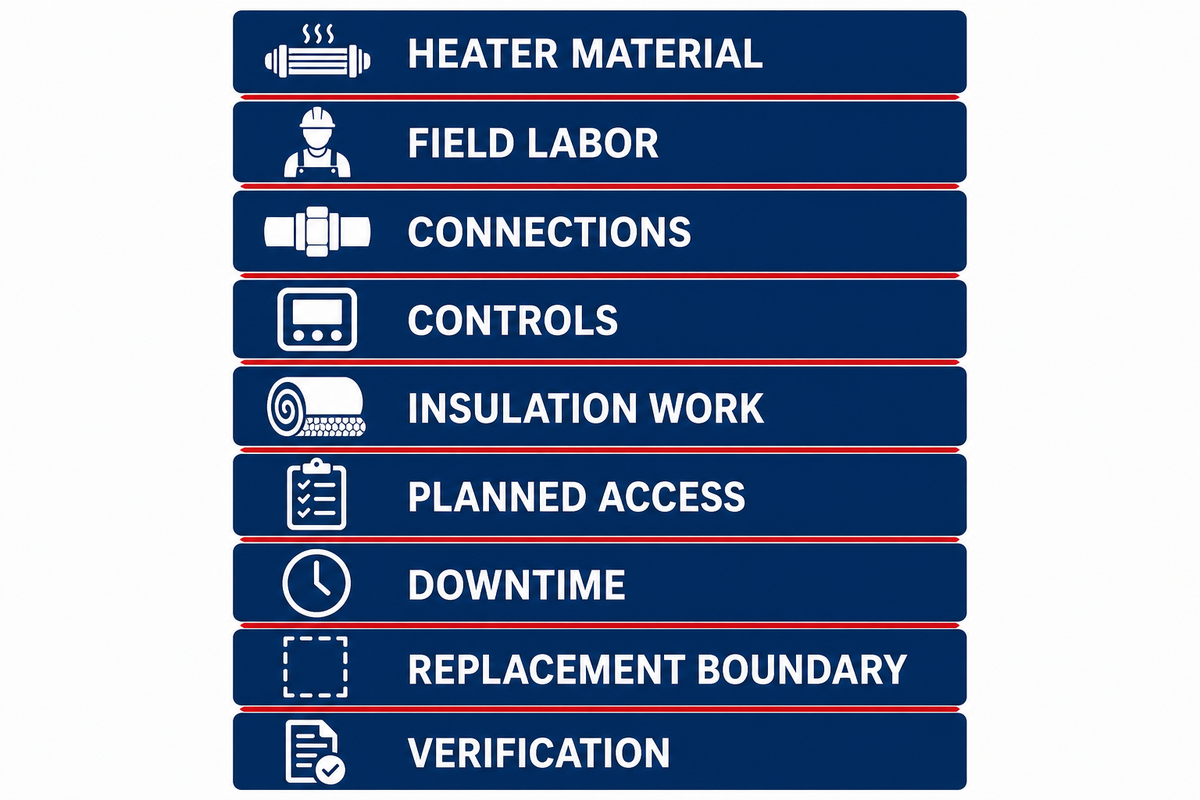
Access-cycle cost compares the work that occurs after purchase: routing or fabrication, power connections, end seals, controls, insulation removal and reinstatement, planned access events, downtime, inspection, and damaged-zone replacement. Public evidence doesn’t support one universal price or payback, so the ledger uses buyer-entered values only.
Access-Cycle Cost Ledger
Finance and procurement should normalize both proposals to the same time window and responsibility split. Leave an input blank until the supplier, installer, insulation contractor, maintenance team, or plant owner accepts it in writing.
| Cost field | Cable proposal input | Blanket proposal input | Evidence owner |
|---|---|---|---|
| Heater material | Buyer enters quoted line items | Buyer enters quoted modules | Supplier |
| Field labor | Routing and fastening scope | Fit and closure scope | Installer |
| Connections | Power kits, splices, and end seals | Leads, connectors, and junctions | Electrical contractor |
| Controls | Circuit and panel scope | Module and zone scope | Controls engineer |
| Insulation work | Install, open, and restore | Integrated or separate scope | Insulation contractor |
| Planned access | Hours per event × events | Hours per event × events | Maintenance |
| Downtime | Buyer enters approved rate | Buyer enters approved rate | Finance / operations |
| Replacement boundary | Circuit, segment, or accessory | Module or related control item | Supplier and maintenance |
| Verification | Electrical, insulation, and functional tests | Fit, electrical, insulation, and functional tests | QA |
This ledger doesn’t calculate a return on investment without buyer data. If the plant enters the same labor rate, access count, downtime rate, and time window for both options, the comparison becomes auditable. If one proposal leaves a field out, treat the omission as an unresolved scope item rather than a saving.
The National Insulation Association installation guide keeps joints, weather sealing, damage, and maintenance inside the insulation lifecycle. Use that boundary to assign reinstatement responsibility, not to estimate a universal payback.
Safety and Approval Boundaries
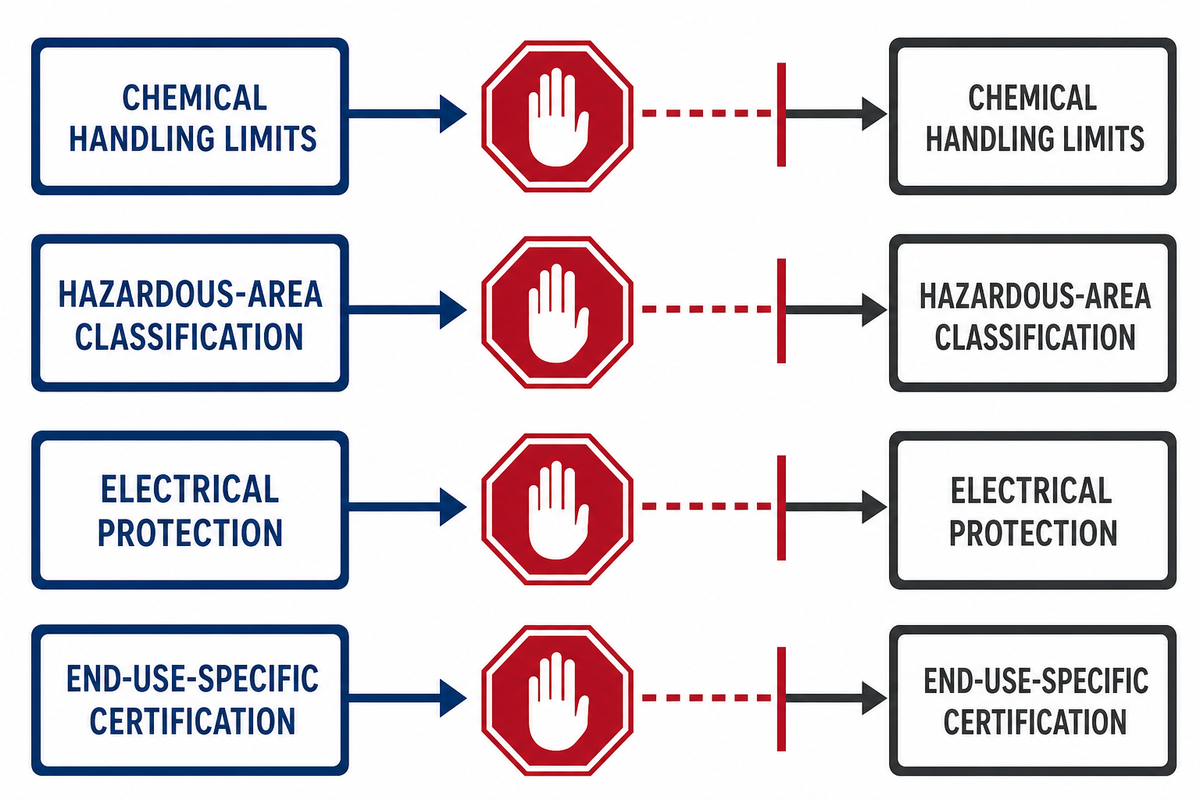
Safety approval can end the price comparison before geometry or cost is discussed. Chemical handling limits, hazardous-area classification, maximum exposure temperature, electrical protection, and end-use-specific certification answer different questions. A blanket enclosure rating, a cable technology name, or a generic listing must never stand in for the exact project approval. The OSHA and UL examples below apply to United States projects; other destinations require the applicable national rules and certification route.
OSHA’s mandatory Safety Data Sheet Appendix D places handling and storage in Section 7, physical and chemical properties in Section 9, and stability and reactivity in Section 10. Those sections can expose freezing point, viscosity, flash point, auto-ignition temperature, decomposition temperature, incompatibilities, and conditions to avoid. They inform review; they do not certify a heating method.
For hazardous locations, OSHA 29 CFR 1910.307 requires each room, section, or area to be classified individually. Equipment and wiring must then satisfy the applicable hazardous-location classification and an allowed approval or demonstrated-safety route. Division and Zone systems are alternative classification paths, not labels to combine.
“This document does not include or provide for any applications in potentially explosive atmospheres.”
End use can create another gate. UL Solutions’ fire-sprinkler guidance states that trace-heating equipment for sprinkler systems and branch lines needs certification for that specific application, rather than relying on a generic heat-trace listing. This example does not set a rule for every process pipe; it shows why the end use must be named.
Key takeaway
Area classification and end-use certification are threshold variables. If either is unresolved, do not use a geometry or cost matrix to select equipment.
Build a Comparable Installed-Scope Baseline

A comparable baseline gives every bidder the same responsibility split before procurement evaluates price. It does not choose heat trace, a heating blanket, or a hybrid. Instead, it records which party supplies, installs, connects, insulates, controls, documents, tests, maintains, and replaces each quoted zone.
| Boundary | Buyer records | Supplier states | Acceptance evidence |
|---|---|---|---|
| Heater package | Zones, dimensions, duty, exclusions | Included heater, leads, accessories, spares | Drawing and bill of materials |
| Electrical work | Supply, protection, grounding, field route | Factory and field termination boundary | Single-line and test record |
| Controls | Controlled object, zones, alarms, data needs | Sensors, controller, panel, configuration | Control narrative and functional test |
| Insulation | Material, thickness, jacket, access openings | Integrated versus separately supplied scope | Installed inspection and reinstatement record |
| Lifecycle access | Event frequency, downtime rate, storage plan | Removal, inspection, repair, replacement limits | Maintenance instruction and owner |
| Handoff | Required calculations, certificates, manuals, tests | Deliverables, assumptions, exceptions, schedule | Signed document register |
Installation, commissioning, troubleshooting, and seasonal maintenance belong in the existing pipe heating blanket installation guide. This article uses those activities only as cost and responsibility fields; it does not repeat their procedures.
For a project quotation, submit the duty and responsibility split for application review. The commercial hub owns product engineering and enquiry handling, while this article remains an installed-cost and bid-comparability guide.
What the 2024 Standard Confirms for Buyers
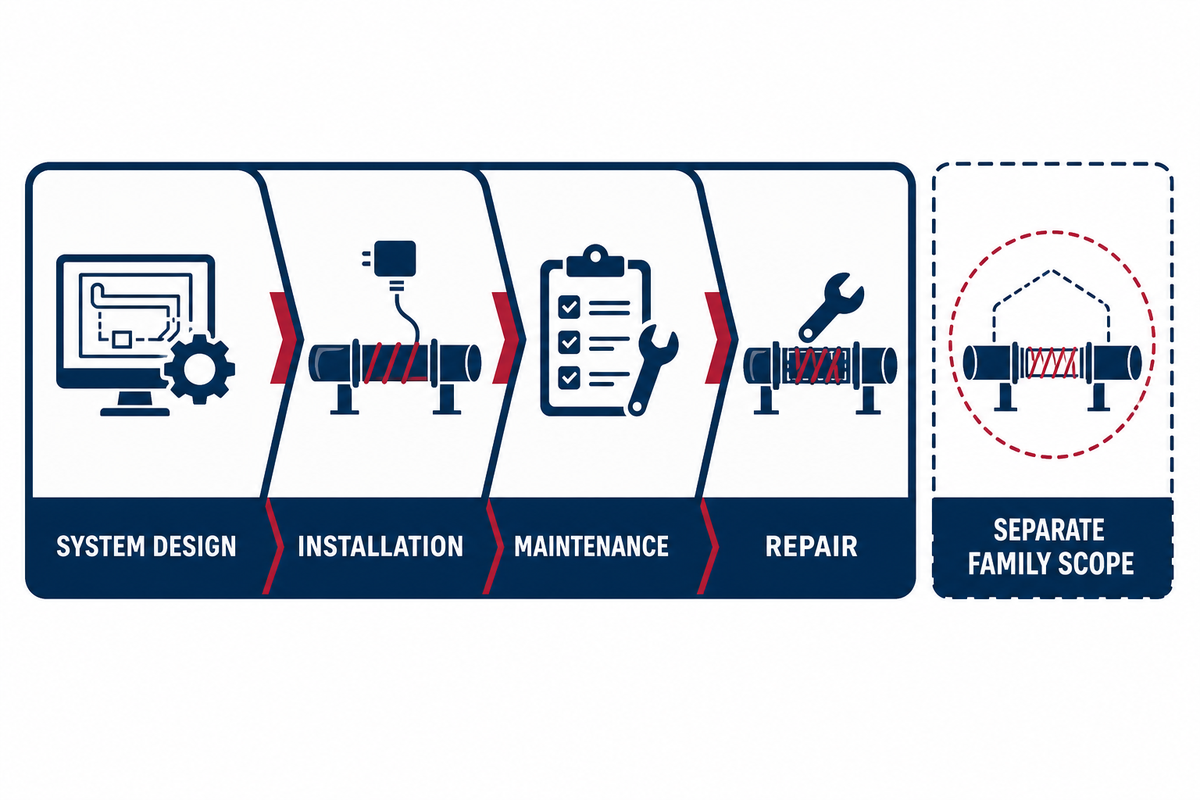
IEC/IEEE 62395-2:2024 keeps system design, installation, maintenance, and repair within one application guide. The official catalogue identifies the edition as a technical revision that replaces the 2013 version. Buyers should ask how every quoted component is documented across that lifecycle.
IEC’s official catalogue lists a publication date of June 27, 2024, an 88-page edition, and specific changes for sprinkler design considerations and emergency eyewash or safety-shower applications. Its public page supports scope and change tracking; it is not the purchased standard and does not prove product conformity.
Another correction follows from the broader standards landscape. IEEE 844.2 separately covers skin-effect trace heating for pipelines, vessels, equipment, and structures. That family can include ordinary and hazardous-area applications under its own scope. A resistance-cable-versus-blanket article is therefore a narrowed buying aid, not a map of every industrial pipe-heating technology.
Normalize RFQs Before Comparing Prices
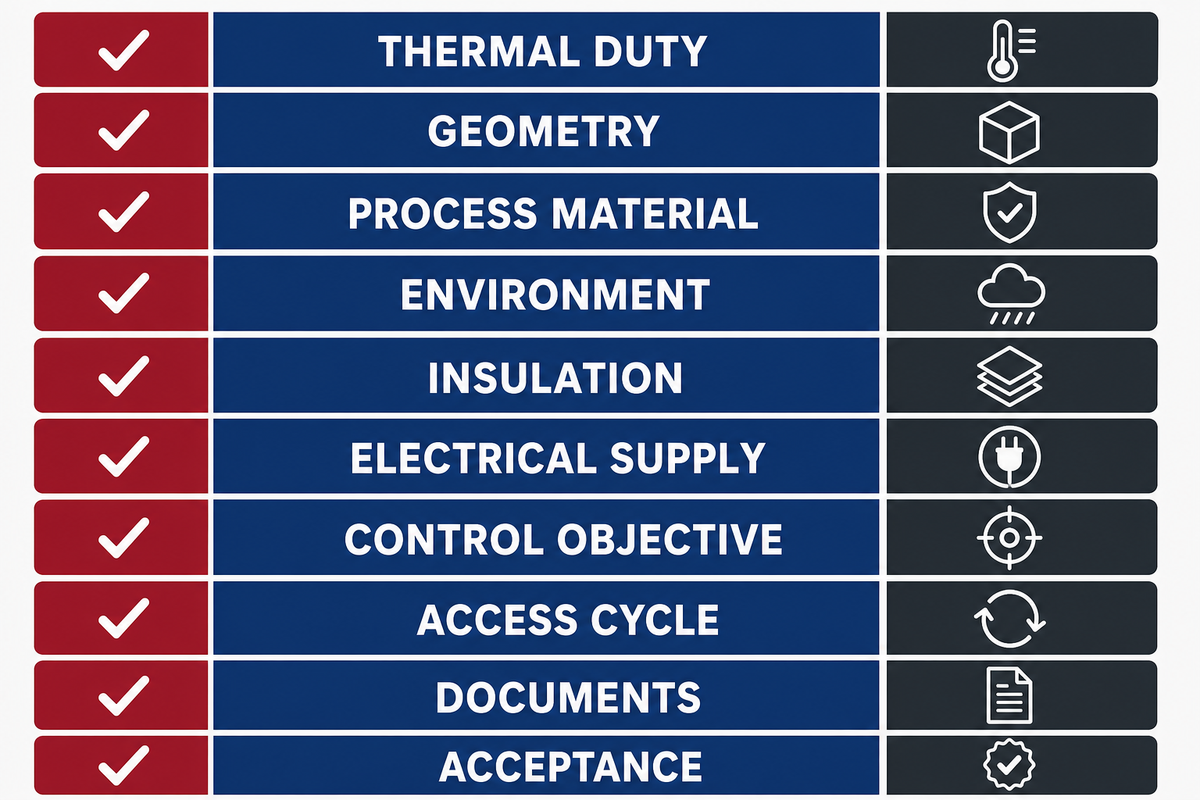
Comparable requests for quotation give every supplier the same thermal, geometry, insulation, environment, electrical, control, access, documentation, and acceptance inputs. A lower bid can reflect a smaller scope rather than a better system, so procurement should reject hidden assumptions before it compares the purchase price.
| RFQ field | What to supply | Why it matters | How to verify |
|---|---|---|---|
| Thermal duty | Freeze, maintain, or warm-up objective | Sets the energy problem | Approved duty brief |
| Geometry | Dimensions, fittings, supports, clearances | Controls routing and contact | Drawing or measured record |
| Process material | Current SDS and operating state | Bounds chemical and temperature review | SDS Sections 7, 9, and 10 |
| Environment | Ambient, wind, washdown, moisture, location class | Changes losses and approval | Site classification record |
| Insulation | Material, thickness, jacket, reinstatement | Changes the heat path | Specification and inspection |
| Electrical supply | Voltage, circuits, protection, grounding | Determines feasible system design | Electrical single-line and load record |
| Control objective | Heater, wall, or fluid feedback | Defines sensor and zones | Control narrative |
| Access cycle | Expected removal and service events | Changes lifecycle labor and replacement | Maintenance plan |
| Documents | Calculations, drawings, certificates, manuals | Defines what can be audited | Document register |
| Acceptance | Electrical, insulation, fit, function, and handoff tests | Defines completion | Signed test record |
Use the pipe-heating design record check before comparing two proposals. FlexBlanket can then review the project-specific drawing and duty without turning this article into a promise about certification, lead time, wattage, or process performance.
Need a project-specific pipe heating review?
Send the thermal duty, geometry, insulation, environment, electrical supply, control objective, and access requirements to FlexBlanket for an application review. Include drawings, calculations, and approval requirements so cable, blanket, and hybrid proposals can be compared against the same buyer-defined evidence boundary.
FAQs: Heat Trace vs Heating Blanket
Q: Is a heating blanket always more efficient than heat trace cable?
No. Efficiency depends on the complete heat path, surface contact, insulation, ambient exposure, control duty, and whether the method fits a linear run or irregular zone.
No. Efficiency depends on pipe and component geometry, contact, insulation, ambient conditions, wind, moisture, control strategy, and the temperature objective. A fitted blanket may improve contact over a defined irregular zone, while cable can distribute heat along a long repetitive run. Compare both methods against the same heat-loss calculation and control boundary rather than product wattage alone.
Q: Can an active heating blanket replace pipe insulation?
Usually not. An active blanket adds heat, while insulation limits environmental heat loss; many systems need both functions, with the outer jacket and moisture protection defined by the application.
Usually not. An active blanket supplies heat, while insulation limits heat loss to the environment; many systems need both functions. The required insulation construction depends on surface temperature, ambient exposure, moisture, maintenance access, and the heater instructions. Treat the heater, insulation, outer jacket, sensor, and control zone as one system instead of using a blanket as an automatic substitute.
Q: Is self-regulating heat trace self-controlling?
No. Local output adjustment does not choose circuit length, electrical protection, sensor position, insulation, area approval, monitoring, or the safe temperature limit for the process.
Self-regulating cable changes local heat output as temperature changes, but that does not make the installation self-designing or self-approving. Circuit length, power connection, protection, sensor strategy, insulation, environmental exposure, area classification, and maximum temperature limits still require review. Some systems also need thermostatic control, monitoring, alarms, or over-temperature protection based on the process and applicable instructions.
Q: How should maintenance cost be compared?
Use the same access frequency, labor rate, downtime rate, inspection scope, insulation-reinstatement work, replacement boundary, and evaluation period for both quotations, with each responsibility assigned in writing.
Maintenance cost depends on whether access and replacement boundaries match the asset. Record who removes, stores, inspects, reconnects, tests, and reinstates each zone, then price those tasks over the same time window. A low purchase price can hide owner labor, downtime, insulation work, or a larger replacement boundary.
Q: Can heat trace and heating blankets appear in one RFQ?
Yes. A single RFQ can request cable, blanket, or hybrid proposals when every bidder receives the same zone, control, insulation, access, document, and acceptance boundaries.
Yes. Procurement can compare more than one configuration in a single request, but each proposal must map its heater, electrical, control, insulation, maintenance, and evidence scope to the same zone list. The RFQ should expose every assumption and exclusion rather than treating a mixed proposal as an automatic recommendation.
Q: What information should an RFQ include?
Comparable RFQs define thermal duty, geometry, process material, environment, insulation, electrical supply, controls, access, responsibilities, documents, assumptions, exclusions, and acceptance evidence on the same basis.
Provide the thermal duty, pipe and component geometry, process material, start and target temperatures, minimum ambient, wind or washdown exposure, area classification, insulation construction, electrical supply, sensor and control objective, zone boundaries, access frequency, drawings, installation responsibility, inspection plan, and acceptance evidence. Ask both suppliers to state every assumption, exclusion, field termination, controller, sensor, spare, document, test, and reinstatement task. Require each proposal to identify who measures the pipe, calculates heat loss, supplies insulation, terminates power, configures alarms, commissions the zones, records test results, and restores the system after maintenance. Quotations missing these inputs may look cheaper only because part of the installed system or lifecycle work is absent.
How This Comparison Was Built
The comparison normalizes installed scope, lifecycle cost, responsibilities, exclusions, and RFQ evidence for ordinary-location resistance cable trace and active fitted surface blankets. It does not replace the site’s method-selection tool or installation guide. The project brief supplied FlexBlanket’s product-family and industry context; no private plant measurements, price history, performance results, customer endorsements, or unrecorded technical-review claims were used.
Related Articles and Tools
- Installation, commissioning, troubleshooting, and seasonal maintenance — procedural ownership for fitted pipe heating blankets.
- Compare other surface-heater construction families — wider product-family inputs outside this RFQ cost comparison.
References & Sources
- MEASUR Insulated Pipe Reduction Calculator Oak Ridge National Laboratory
- Process Heating Systems U.S. Department of Energy
- Heat Trace Sensor and Insulation Event Record U.S. Nuclear Regulatory Commission
- Safety Data Sheets, Appendix D to 29 CFR 1910.1200 Occupational Safety and Health Administration
- 29 CFR 1910.307 Hazardous Locations Occupational Safety and Health Administration
- Mechanical Insulation Design Guide: Installation National Insulation Association
- IEC/IEEE 62395-2:2024 International Electrotechnical Commission and Institute of Electrical and Electronics Engineers
- IEEE 844.2 Skin-Effect Trace Heating Application Guide Institute of Electrical and Electronics Engineers
- Certified Trace Heating for Fire Sprinkler Pipes UL Solutions