Get in touch with FlexBlanket Company

Propane Tank Heater Blankets: A Project-Specific Application Review
A propane tank heater blanket is an electric heating jacket, not a portable space heater and not a universal permission to warm a cylinder. FlexBlanket screens the vessel, duty, electrical location, control method, and required documents before a configuration moves toward quotation.
No online result on this page is a site-use approval. The cylinder supplier, facility safety authority, applicable rules, and authority having jurisdiction remain controlling.
R-1200
T-LIMIT
4
published size anchors
Metric listings still require actual diameter and height.
1
preset family listing
A published setting is not a universal cylinder allowance.
6
file input pack
Documents, duty, power, location, photos, and commercial needs.
4
possible outcomes
Clarify, complete files, route elsewhere, or stop.
Start with evidence, not a wattage guess
01Vessel Identification
- Identify the exact vessel and its condition.
02Ambient & Demand
- State minimum ambient temperature and actual vapor demand.
03Power & Classification
- Document voltage, frequency, and area classification.
04Physical Access
- Keep valves, relief devices, labels, and inspection points accessible.
05Compliance Stop
- Stop when the vessel supplier or local rules do not permit the proposed route.
THERMAL-CFG
Propane Heater Requests Start With A Four-State Evidence Docket
A common assumption is that a product sold as a propane tank warmer is automatically suitable for any propane cylinder. A product name is not a substitute for a vessel-specific review, and the conclusion does not follow from a tank blanket shape or thermostat label.
Public safety guidance sets a stricter starting point. PERC tells propane users not to apply an external heat source to storage cylinders or tanks in extreme cold. The request can therefore move forward only through a documented, application-specific review that addresses this warning with the cylinder supplier, responsible safety parties, applicable requirements, and suitable product evidence.
Fuel remains in the cylinder while outlet pressure or equipment performance falls in many buyer reports. That symptom is not always proof that a heating blanket is the right correction: vessel fill, wetted surface, ambient conditions, demand, regulator behavior, and system sizing can all change the result.
Engineering clarification
Core documents exist, but configuration questions remain.
Missing files
Identity, supplier instructions, or location evidence is incomplete.
Alternative route
Capacity, supply architecture, or a listed vaporizer needs review first.
Do not proceed
Damage, leakage, prohibited heating, or unresolved approval blocks the request.
Why the evidence docket comes first
The reason for this sequence is mismatch risk: a 50 kg capacity label confirms nominal capacity, not permission to heat or the geometry needed for fit. FlexBlanket uses the submitted vessel and installation record to decide whether technical configuration clarification can begin.
We treat vessel acceptability and heater configuration as separate decisions. A cylinder can be valid for service yet unsupported for external heating, and a technically configurable heater can still be unacceptable at the proposed location.
A buyer wants one outside-temperature trigger because it sounds simple. We instead ask for the full duty: the coldest credible condition, continuous and peak consumption, vessel fill state, target outcome, and the control point that the responsible engineer will accept.
Evidence that identifies the vessel
- Manufacturer data sheet and readable nameplate photographs
- Material, service, rated capacity, dimensions, and current inspection status
- Written instructions covering external heat and allowable surface temperature
- Evidence that the vessel is free of leakage, severe corrosion, fire damage, or other rejection conditions
Evidence that identifies the installation
- Lowest ambient condition, wind or exposure, fill range, and connected demand
- Available voltage, frequency, circuit protection, and connector requirements
- Documented ordinary or classified electrical location3
- Required listings, evaluations, inspection records, and approval owners
Published Propane Blanket Configurations Support Dimensional Review
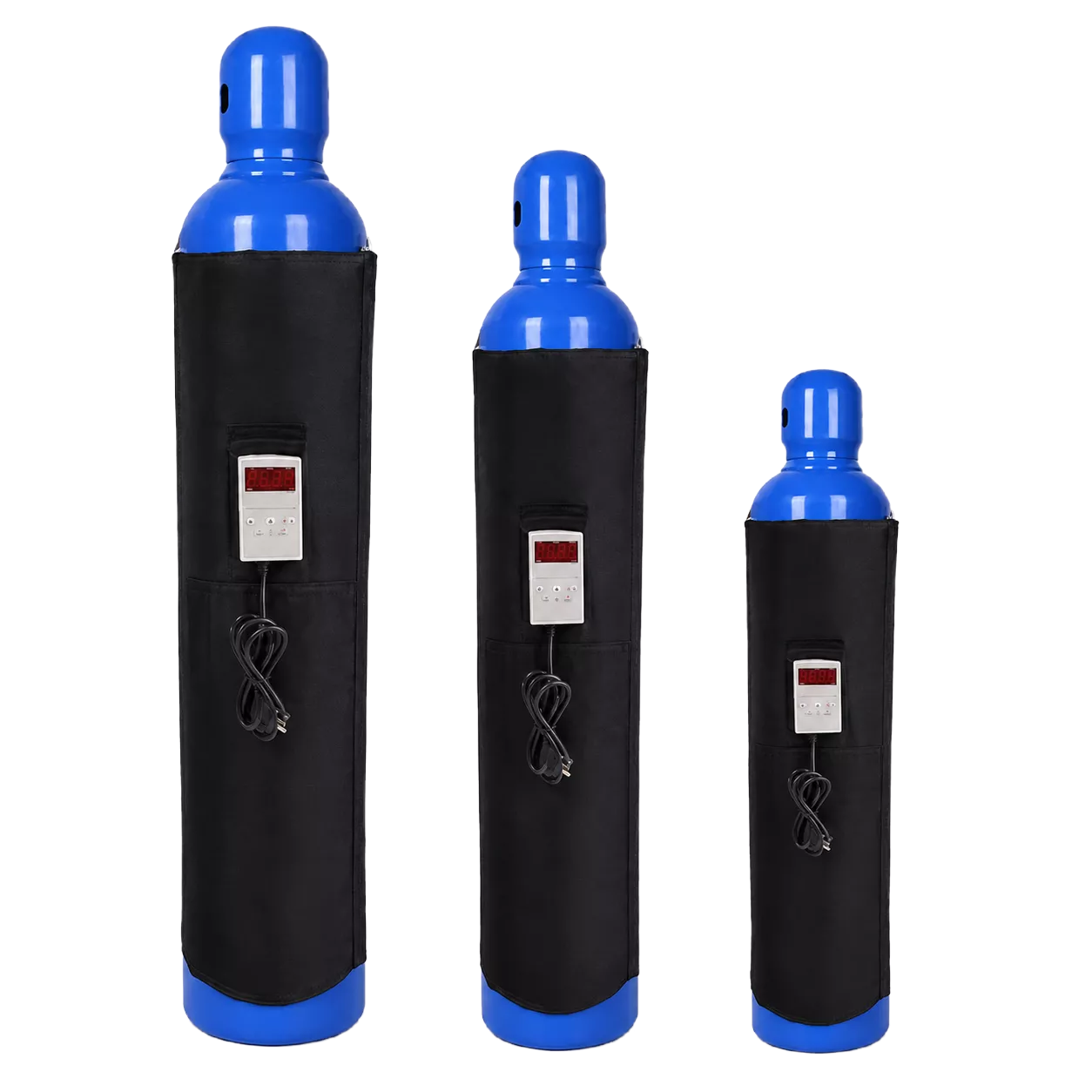
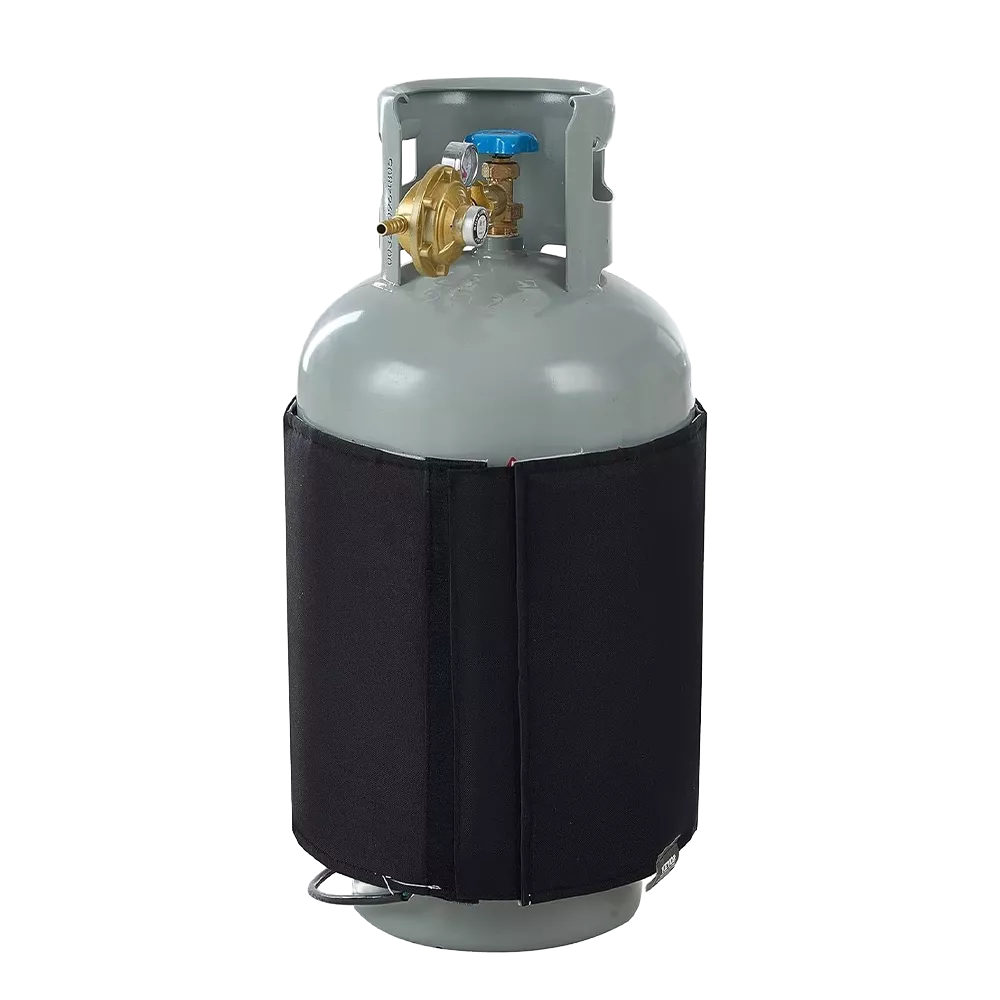
FlexBlanket currently publishes propane selections for 5 kg, 10 kg, 15 kg, and 50 kg propane cylinders. A government recall example distinguishes model-specific dimensions and markings, showing why nominal capacity alone cannot identify a vessel. These published sizes are commercial starting points; they do not establish valve layout, relief-device clearance, surface condition, or permission to heat.
Published control reference
The current propane heater family lists a preset 32°C ± 5°C (90°F ± 9°F). That is a product-family configuration, not a claim that every cylinder, fill condition, propane system, or authority permits that surface-temperature route.
Nominal pounds or kilograms do not identify dimensions well enough for a purchase order. A U.S. 20 lb cylinder, a 100 lb cylinder, and metric-labeled vessels enter a dimension-led propane tank heating blanket review; none is silently mapped to an in-stock blanket because the number looks similar.
Selection route
What the number means here
Required buyer evidence
Commercial status
5 kg published anchor
Website-listed propane family size
Actual diameter, body height, valve and relief layout
Project review required
10 kg published anchor
Website-listed propane family size
Data sheet, nameplate, actual dimensions, quantity
Project review required
15 kg published anchor
Website-listed propane family size
Photographs, supplier heating instructions, target duty
Project review required
50 kg published anchor
Website-listed propane family size
Fill range, connected demand, installation clearances
Project review required
20 lb U.S. request
Search and inquiry label only
Exact vessel make, model, diameter, height, and markings
Custom dimensional review; no stock assumption
30/40/100 lb U.S. request
Multiple non-equivalent vessel categories
Separate data for each vessel and installation
Custom dimensional review; no automatic conversion
32°C ± 5°C (90°F ± 9°F)
Published preset family configuration
Allowed vessel temperature and responsible approval
Not a universal operating instruction
We offer custom dimensions and shapes when a listed size is not the correct geometry. The review still keeps the blanket below shoulder transitions where required, maintains access to the valve and relief device, and checks that fasteners do not cover labels or inspection points.
Active heating blanket
A heater adds controlled electrical heat through a designed assembly. Its power, sensing, insulation, and electrical suitability must be reviewed together.
Insulation blanket
A passive propane tank insulation blanket can reduce heat loss but does not create heat, so it is not interchangeable with active heating. Requests to insulate a vessel still require attention to moisture, access, labels, and supplier instructions.
Band or partial coverage
A low-cost band may look convenient, but localized heat, movement, exposed surface, and sensor placement can change the risk. Price alone cannot establish an acceptable heat path.
Related Category
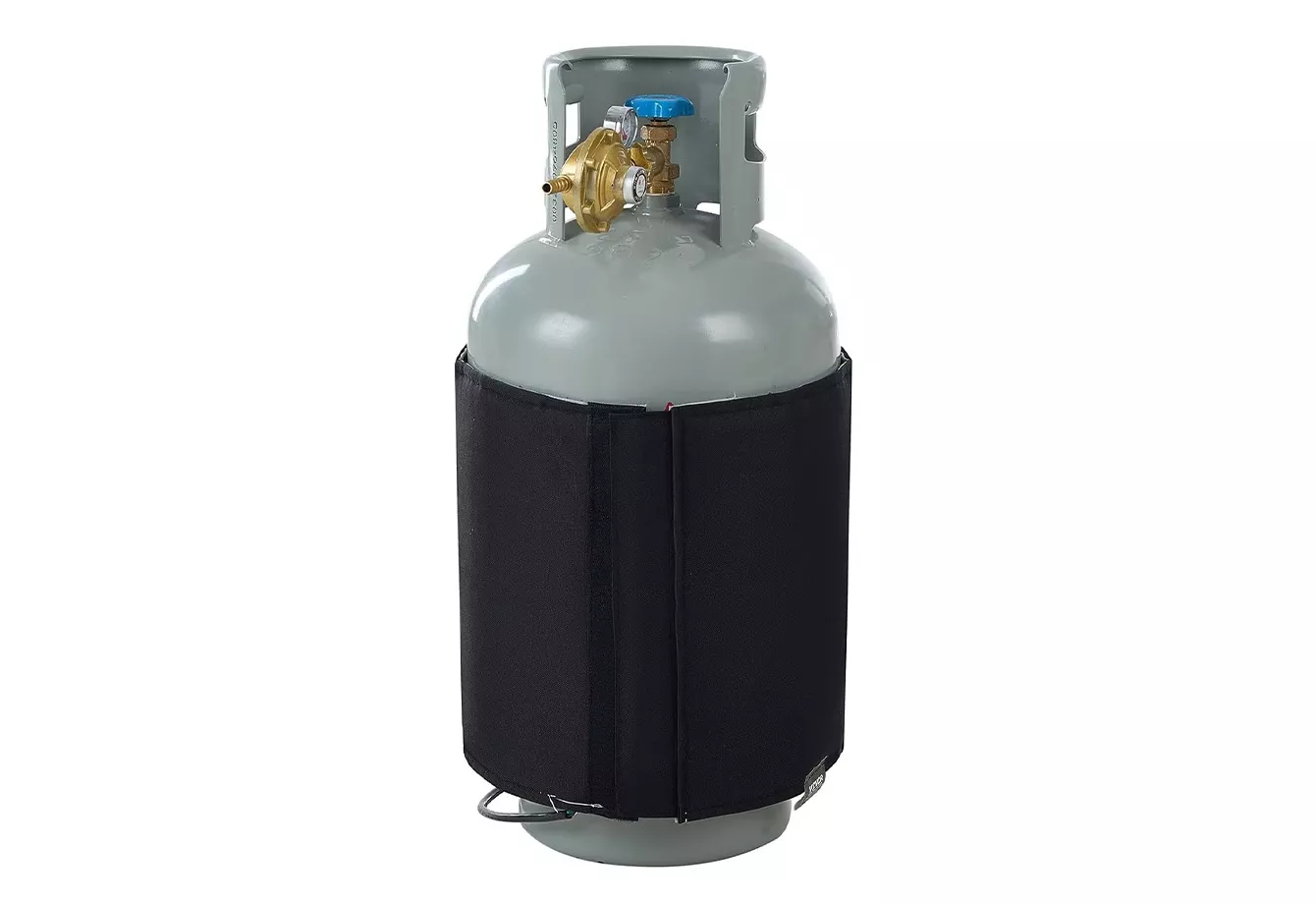
Gas Cylinder Heating Jackets
Gas Cylinder Heating Jackets Cover Other Industrial Services
This page owns the project-specific propane blanket request. Non-propane cylinder work belongs in a separate gas cylinder heater review because gas properties, vessel construction, process objectives, temperature limits, and facility controls can differ materially.
An industrial buyer who transfers a 50 kg propane assumption to a 100 lb cylinder or another gas service creates mismatch risk. A government cylinder recall example distinguishes model-specific dimensions and markings, showing why a capacity label cannot fully identify a vessel.4 For other industrial gas services, compare general non-propane cylinder requirements on the sibling page, while this application review returns to the exact gas, vessel, process duty, dimensions, and installation.
The first question is whether an external heating route can be documented for the exact vessel and installation. Vapor demand and cold-weather behavior matter, but they do not cancel public safety guidance or local approval duties.
- Vessel permission
- Vapor demand
- Area classification
The review begins with gas identity, phase, pressure system, cylinder material, supplier temperature limit, process need, and location. A solution accepted for one service is not transferred to another by changing only the label.
- Gas identity
- Process duty
- Cylinder construction
We can review generic gas-cylinder product-family features such as fiberglass insulation, heating wire, digital temperature control, and quick-release fastening only against the submitted duty. Those published features do not create a blanket approval for propane or for a classified location.
A broader heating solution page helps buyers compare custom platforms; a gas-cylinder page handles general cylinder selection; this page handles propane-specific evidence and quotation readiness. Keeping those jobs separate prevents a buyer from treating cross-application capability as propane authorization.
Temperature, Control, Power, and Sensors Form One Configuration
A facility wants a wattage answer before sending the vessel and weather data. We do not provide a generic wattage table because heat transfer depends on geometry, exposed area, temperature difference, conduction, convection, and radiation. A project wattage review also needs wind exposure, insulation, target condition, duty cycle, and evidence that the sensor represents the controlled surface.
Mass labels do not size the circuit
A 5 kg request and a 50 kg request can each create mismatch risk when vessel geometry, application duty, or power is assumed. Those two capacity labels are procurement anchors, not thermal calculations.
- Lowest credible ambient temperature and exposure
- Starting condition and desired operating result
- Continuous and peak propane demand
- Fill-level range and operating duration
- Voltage, frequency, phase, and available circuit
- Connector, cable, grounding, and protection expectations
- Ordinary or classified location documentation
- Required listing or evaluation evidence
- Control setpoint and allowed surface-temperature limit
- Sensor type, location, attachment, and fault response
- Manual, thermostat, or other controller expectations
- Independent overtemperature response required by the project
- Diameter, straight body height, shoulders, feet, and guards
- Valve, relief device, label, and inspection access
- Indoor or outdoor exposure and moisture conditions
- Removal, cleaning, inspection, and replacement access
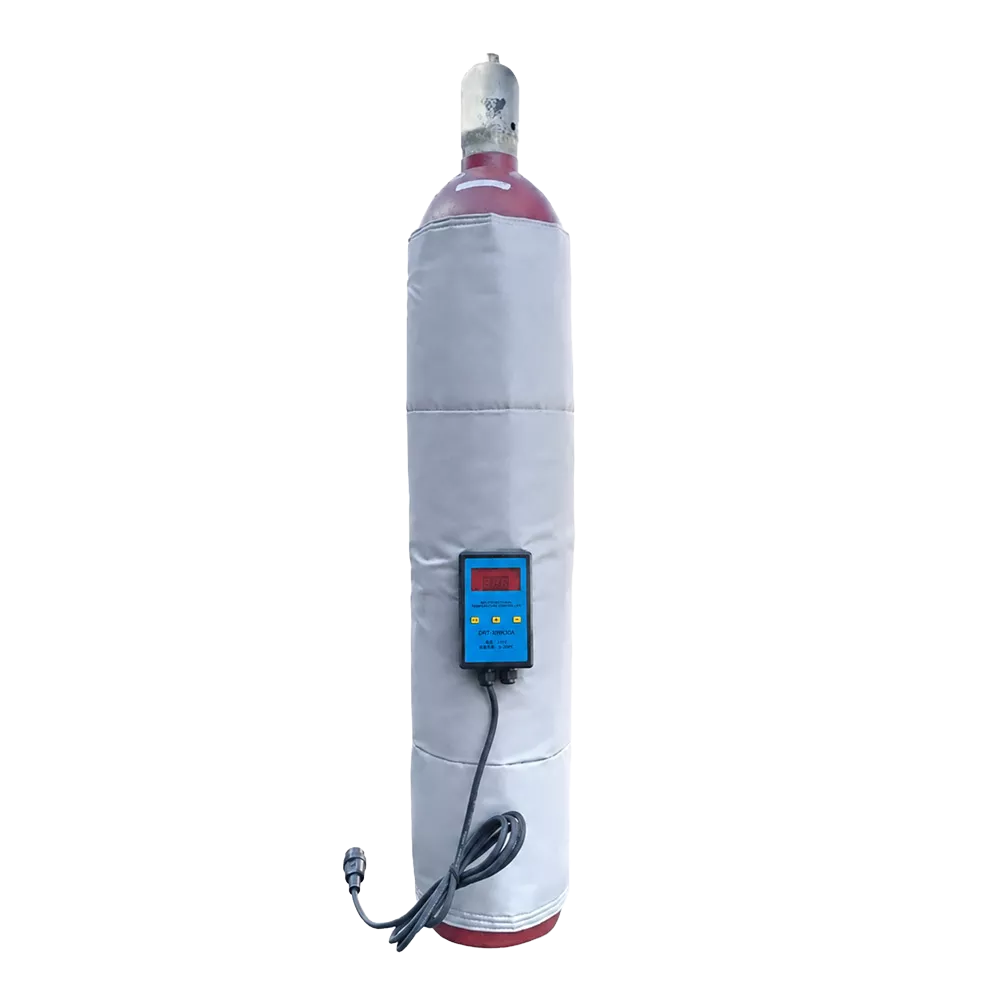
Configuration commitments
We provide custom temperature control and custom sensors and monitoring options for reviewed projects. We review blanket size, review insulation, and review the temperature control system as connected decisions because each trade-off affects the others.
Even heat distribution is a design outcome to verify, not a result to promise without a project test. Heater zoning, blanket contact, seams, closures, insulation, sensor position, and uncovered metal can change the surface-temperature pattern.
Input
Buyer supplies traceable vessel, installation, duty, and approval data.
Technical configuration review
FlexBlanket checks whether a configuration can be defined without overriding vessel or location limits.
Output
The result is a clarification list, a bounded configuration proposal, an alternative route, or a stop decision.
“Optimal temperature” is therefore not a universal number for propane. The acceptable target is the project-specific outcome that remains within vessel instructions, system needs, equipment evidence, and the authority responsible for the installation.
PROPANE VESSEL
THERMAL DYNAMICS
SUPPLY CAPACITY
Cold-Weather Propane Routes Come Before External Heating
Propane vapor withdrawal cools the liquid. RegO explains that outside-air temperature and the vessel surface wetted by liquid affect vaporization capacity, which is why a cylinder can struggle under demand in freezing conditions even when liquid remains.
Cold-weather performance is a supply-system question before it is a blanket-selection question.
Confirm the symptom
Separate supply pressure, regulator behavior, icing, equipment lockout, and vapor-capacity limits instead of assuming the heater is the cause or cure.
Check demand and fill
Document connected input, peaks, run duration, vessel quantity, actual fill range, ambient temperature, and exposure.
Review supply capacity
Ask the propane supplier whether a larger vessel, revised refill plan, or approved manifold arrangement is the appropriate route.
Review vaporization equipment
Where the application requires it, evaluate a purpose-designed and properly approved vaporizer as a system project.
Review external heating evidence
Proceed only when written vessel guidance and temperature limits support further engineering. The installation also needs documented classified-location evidence and responsible approvals.
Hold the stop line
Do not improvise with torches, space heaters, unreviewed bands, or generalized advice when the evidence gate remains open.
Trade Case Analysis
A trade case reported cold-weather lockouts that were addressed by reviewing demand, fill level, tank geometry, and temperature derating; the selected route was a larger buried tank instead of a blanket.
That example does not prescribe the same answer for every site, but it shows why heating is only one branch in a system decision.
Commercial timing after the technical route is defined
Most orders ship within 2–6 weeks after configuration and quotation approval. The promised production window begins after those approvals, so winter projects benefit from submitting the complete review pack before the cold-weather failure becomes urgent.
Unnumbered Commercial Discussion
ROI stays deliberately unnumbered. The useful commercial discussion is the cost of an unplanned shutdown, repeated emergency deliveries, engineering time, schedule risk, and the cost of an approved supply alternative—not a fabricated savings percentage.
Classified Locations and Vessel Condition Set Hard Stop Lines
OSHA requires equipment and wiring in a hazardous classified location to be intrinsically safe, approved for that location, or demonstrated safe for the location. The classification must be documented; an ordinary-area product does not become suitable because its surface temperature appears low.
The same boundary applies to propane tank heater blankets, propane tank warmers, and products marketed as a propane tank electric blanket. Search wording is not a substitute for the exact electrical and vessel evidence.

STOP
Hard Lines
Do not advance the request
- The cylinder leaks, is fire-damaged, badly corroded, physically damaged, or outside its inspection requirements.
- The cylinder or system supplier prohibits external heating or provides no usable guidance.
- The proposed blanket would obscure a valve, relief device, label, connection, or inspection point.
- The location classification is unknown or required product evidence is unavailable.
- The request relies on a portable heater, flame, improvised heat trace, or unreviewed heating band.
Inputs that support further review
- Traceable vessel identity, current condition evidence, and readable markings.
- Written supplier guidance and permitted surface-temperature boundary.
- Documented electrical location, power supply, and protection requirements.
- Defined thermal duty, connected propane demand, and exposure.
- Named facility reviewer, approval route, and required product documents.
No certification transfer
This page does not claim UL, CSA, ATEX, IECEx, or another classified-location approval for a FlexBlanket propane product. A project team must compare the exact offered configuration and its documents with the exact installation classification before purchase or use.
No blanket repairs a rejected vessel. Heating also cannot substitute for a functioning regulator, correct container capacity, a compliant piping system, or qualified propane service.
HAZLOC EVIDENCE
THERMAL COMPLIANCE
The Six-File Review Pack Makes a Propane Request Actionable
A short message such as “Need a heater for a 100 lb bottle” leaves the central engineering and approval questions unanswered. Missing documents create quotation delay, rework risk, and repeated clarification; the following six groups turn a search inquiry into a reviewable project brief.
1. Vessel identity file
Data sheet & parameters
Data sheet, manufacturer and model, readable nameplate images, material, capacity marking, diameter, straight body height, overall height, and current inspection status.
2. Vessel heating instructions
Manufacturer guidance
Manufacturer or supplier guidance covering external heat, allowed surface temperature, prohibited coverage zones, and any required listing or approval.
3. Duty and weather file
Operating environment
Lowest credible ambient temperature, wind or exposure, current symptom, fill range, connected continuous and peak demand, operating hours, and desired result.
4. Electrical and location file
Power & classification
Voltage, frequency, phase, available circuit, plug or termination needs, ordinary or classified location documentation, and required protective devices.
5. Installation photo file
Visual clearances
All sides of the vessel, valve and regulator arrangement, relief device, labels, guards, nearby equipment, mounting surface, weather exposure, and available clearance.
6. Commercial and approval file
Project logistics
Quantity, needed-on-site date, destination, quotation contact, required product documents, facility reviewer, and authority having jurisdiction when applicable.
We return specific missing-data questions instead of disguising unknowns as assumptions. When the evidence supports the next step, we can review blanket size, review wattage, review insulation, and review the temperature control system against the same project record.
What a complete pack does not do
It does not guarantee a quote, approval, performance, or site acceptance. It reduces avoidable quotation revisions and gives the responsible parties a common evidence set for the decision.
For custom work
FlexBlanket offers custom dimensions and shapes, custom voltage and wattage, custom temperature control, and custom sensors and monitoring. Every option remains subject to the propane evidence gate; “custom” describes configuration flexibility, not unlimited application permission.
Ordering, Manufacturing, and Delivery Follow Configuration Approval
Manufacturing begins after the application route, configuration, and quotation are agreed. Discovering that a 50 kg label or 32°C preset was misapplied after approval creates mismatch, rework, and delay risk, so procurement timing cannot force an undocumented choice.
Screen
Check the six-file pack, identify stop conditions, and decide whether engineering clarification is justified.
Clarify
Close gaps in vessel identity, thermal duty, dimensions, electrical location, control, and required documentation.
Configure
Define coverage, fastening, insulation, heater circuit, sensor, controller, cable, and project-specific document scope.
Quote
Record the agreed configuration, quantity, destination, commercial scope, exclusions, and approval responsibilities.
Produce
Release the approved configuration to manufacturing and complete the inspection scope stated in the project record.
Deliver
Provide the agreed goods and project documents; site installation and acceptance remain with qualified responsible parties.
Most orders ship within 2–6 weeks after configuration and quotation approval. This is the current published production commitment; freight time, customs, site installation, local inspection, and authority approval are separate schedule items.
Planning implication
The more complete the initial pack, the sooner the project can reach a stable configuration. Missing vessel instructions, ambiguous dimensions, or an unknown area classification can reopen the quote and move the start of the production window.
How We Work: Three Offline Tools Prepare a Better Review Request
These tools organize buyer inputs on the local page and do not send data to FlexBlanket. They do not calculate a safe wattage, diagnose a propane system, or issue an approval.
TOOL // 01
Application Evidence Gate
Check the minimum vessel, condition, duty, electrical, and approval inputs and receive a bounded readiness status.
Open checklist
TOOL // 02
Cold-Weather Route Comparison
Compare the questions behind refill planning, added capacity, vaporization equipment, and project-specific external heating.
Open comparison
TOOL // 03
Six-File Pack Builder
Mark the evidence you have, identify gaps, and print a preparation summary for your internal project team.
Open pack builder
FAQ: Configuration and Approval Questions
Does a published blanket size prove approval for my propane cylinder?
No. A size label starts a dimensional review; the exact vessel, condition, supplier instructions, allowed temperature, installation, and required approvals still control the decision.
Can one blanket fit both metric and U.S. propane cylinder sizes?
Not by label alone. Submit actual diameter, straight body height, shoulder and base geometry, valve and relief-device layout, and photographs for every vessel category.
Which documents must be reviewed before wattage is selected?
Send the vessel data and heating instructions, thermal duty, fill and demand range, dimensions, power details, area classification, installation photographs, and required product evidence. A wattage number without those inputs is not a defensible selection.
Can an ordinary-area blanket be used in a classified location?
Not without installation-specific evidence. The configuration must be intrinsically safe, approved for the documented classification, or otherwise demonstrated safe for that exact location. The project file should also identify the classification, equipment markings, wiring method, temperature class, installation boundary, responsible evaluator, and evidence connecting each item to the proposed location; an ordinary-area label cannot supply that chain.
What happens when the cylinder supplier does not authorize external heating?
The external-heating route stops. Review supply capacity, fill planning, additional approved vessels, an appropriate vaporization system, or another solution with the propane supplier and responsible engineer.
What files and photos should I send for a project-specific review?
Use the Six-File Propane Review Pack: vessel identity, supplier heating instructions, duty and weather, electrical and location data, installation photographs, and commercial and approval requirements.
What published propane configurations are available for initial review?
FlexBlanket lists 5 kg, 10 kg, 15 kg, and 50 kg propane cylinders as current product-family size anchors, subject to dimensional and application review. U.S. pound-rated requests follow the custom dimension route and are not assumed to be equivalent stock items.
What temperature setting appears on the current product family?
FlexBlanket lists a preset 32°C ± 5°C (90°F ± 9°F) for the current propane heater family. The listed setting does not override the vessel supplier’s temperature limit, site rules, classified-location requirements, or project approval.
Do propane tank blankets work?
They can only be assessed against the exact vessel, duty, controls, and approval route; the product category alone does not establish a safe or effective result.
What can I use to keep my propane tank warm?
Start with the propane supplier and the system demand review. Capacity, refill planning, an approved vaporizer, or a documented project-specific heating route may be considered by qualified responsible parties.
Is a propane tank warmer necessary or nice to have?
Neither label decides the project. Treat it as a system question: identify the operating failure, document demand and conditions, compare approved alternatives, and use external heating only when the required evidence supports review.