Get in touch with FlexBlanket Company

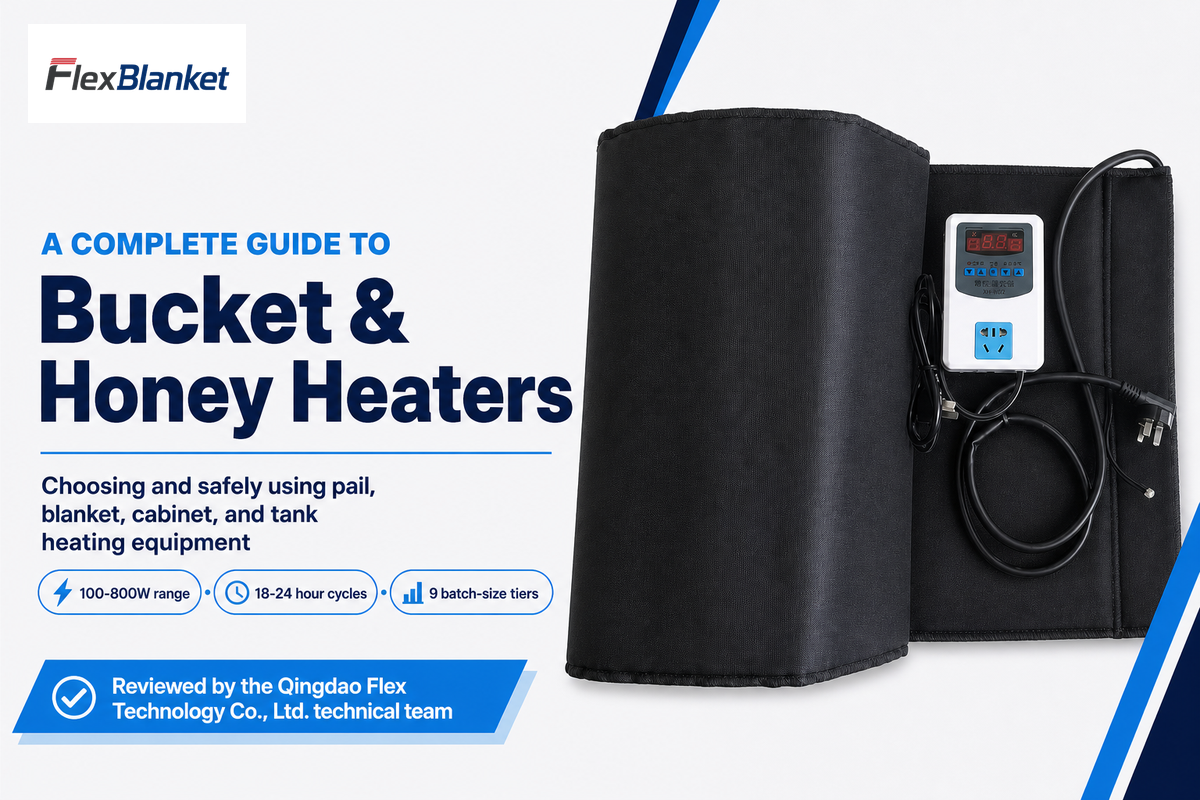
Bucket & Honey Heaters are the equipment class this buyer’s technical guide covers: temperature science, equipment classes, and a safety checklist before you buy.
Quick Specs
| Common wattage range | 100–800W, scaling with container size (5-gal pail up to 55-gal drum) |
| Practiced operating range | 100–110°F for honey liquefaction; up to 145°F on adjustable models (not recommended for extended honey exposure) |
| Typical liquefaction time | 18–24 hours for a fully granulated 5-gallon bucket at 100–110°F |
| Safety listing to verify | NRTL-recognized mark (UL, ETL, or CSA) — confirm at the model level, not from listing copy alone |
| Demand timing | Seasonal, peaks October–January/February in the US (2.9–3.5× the June–July trough) |
Buying a bucket and honey heater is one of those decisions that looks simple, pick a wattage, pick a temperature dial, done, until the honey scorches on one side of the bucket while the center is still a solid brick. This guide walks through the actual physics of heating honey across 9 batch-size tiers, why your thermostat reading and your honey’s real temperature aren’t the same thing, which of 4 equipment classes actually fits your volume, and what to verify across 5 checklist points before you buy. It hands off to a specific equipment page only after you’ve worked through the decision, not before.
A bucket or honey heater liquefies crystallized honey by holding it at roughly 100–110°F for 18–24 hours, low enough to avoid measurable enzyme loss and flavor change in most honey. Controller readings describe the heater surface, not the honey at the center of the bucket, which is why uneven heating, not underpowered equipment, is the most common complaint. Getting this right is a batch-size and verification question first, and a wattage number second.
Key Takeaways
- Low and slow (100–110°F over many hours) is the evidence-backed approach, not higher heat for a shorter cycle.
- A thermostat probe reads the heater element, not the honey at the center of the container, this is a general engineering principle, confirmed independently in vessel-heating research, flexible-heater design research, a 70-year-old patent, and a university extension build.
- Only one of the widely sold competitor product lines in this category discloses NRTL-equivalent safety certification on its listing, and per OSHA’s own guidance, silence on a listing page still isn’t proof either way.
- Equipment class should follow batch volume and frequency, not just price.
- Demand for this equipment is seasonal (fall/winter peak, running 2.9–3.5× the summer trough) — source it before extraction season, not during a cold snap. Commercially available units span 100W to 800W and 41°F to 302°F depending on model, so match wattage and range to your container.
What “Bucket and Honey Heaters” Covers, and What It Doesn’t
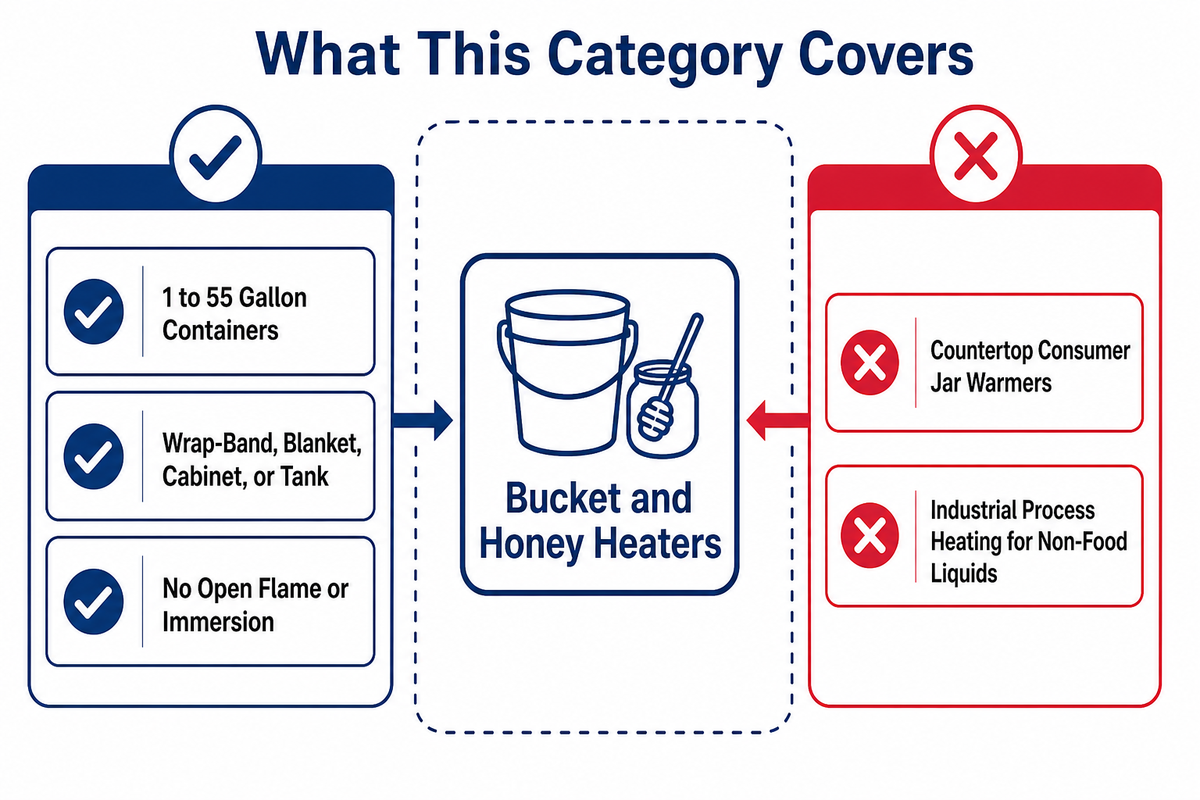
Bucket and honey heaters are electric wrap-band or cabinet-style heating equipment built to liquefy crystallized honey in containers from roughly 1 gallon up to 55-gallon drums, without direct flame or open immersion. If you’re processing honey by the pail or the drum for extraction, bottling, or resale, this is the equipment category. It doesn’t cover countertop consumer jar warmers meant for a single 12-ounce jar on a kitchen counter, and it doesn’t cover industrial process-heating systems built for non-food liquids.
Shoppers search for this equipment under several names — bucket warmer, band heater, blanket honey heater, or simply a 5 gallon bucket heater — but it’s the same category: heating equipment designed for 5-gallon pails up through 55-gallon drums, built to liquefy honey (sometimes spelled “liquify” on manufacturer listings).
Two audiences land on this term for different reasons. Beekeeping operations and honey packers are evaluating equipment for a real batch-processing decision. Home cooks with one jar of set honey are usually looking for a five-minute fix, and are better served by a warm-water bath than by any of the equipment discussed here. If that’s you, skip to the FAQ for the short answer, and consider the rest of this guide the batch-scale version of the same problem.
The Temperature Science: What Actually Happens to Honey When You Heat It
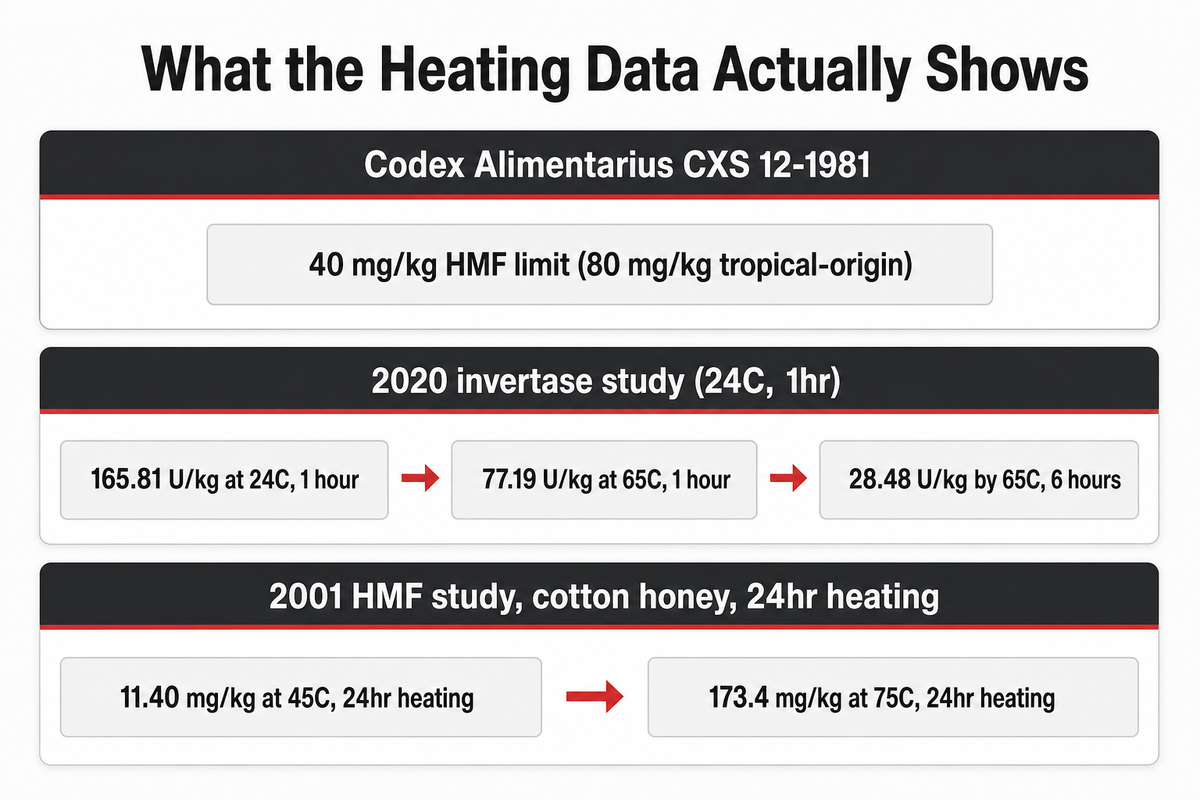
Heating honey at batch scale trades speed for quality, and the trade is not governed by one universal temperature cliff; it depends on the honey’s own composition and history as much as the heat itself. Hydroxymethylfurfural (HMF) is the standard marker regulators use: under Codex Alimentarius CXS 12-1981, honey after processing may not exceed 40 mg/kg HMF (80 mg/kg for honey of declared tropical origin), and the same standard separately requires that honey not be heated or processed to the point that its essential composition changes or its quality is impaired.
Peer-reviewed data on honey enzymes tells a similar but more nuanced story. One 2020 study measured invertase activity in blossom honey falling from 165.81 U/kg at 24°C (about 75°F) after one hour to 77.19 U/kg at 65°C (149°F) after one hour, and down to 28.48 U/kg by six hours at 65°C, a statistically significant decline (p≤0.01, R²=-0.949) as both temperature and time increased, from a peak activity range of 147.96–178.27 U/kg measured at the mildest 24°C/1-hour condition. But a separate peer-reviewed review reports the opposite result under different conditions: honey heated at 55–75°C for 5–25 minutes showed no measurable enzyme loss in some samples, with storage time and the honey’s own history mattering more than the brief heating event itself. Separately, a 2001 study heating cotton honey for 24 hours found HMF rising from 11.40 mg/kg at 45°C to 173.4 mg/kg at 75°C, a more than 15× increase, with the steepest jump occurring between 65°C (52.70 mg/kg) and 75°C. Composition, moisture, acidity, floral source, and how long the honey had already been stored all shift the outcome, which is exactly why a single “safe temperature” number should be treated as a practiced range, not a scientific constant.
💡 Pro Tip
The practiced range that shows up consistently, in a peer-reviewed enzyme study, in a 1953 patent, and in a university extension build, is 100–110°F held for many hours, not a fast blast of high heat. Slower and cooler is the evidence-backed choice, not just the cautious one.
Sensor Placement Changes What Your Thermostat Is Actually Reading
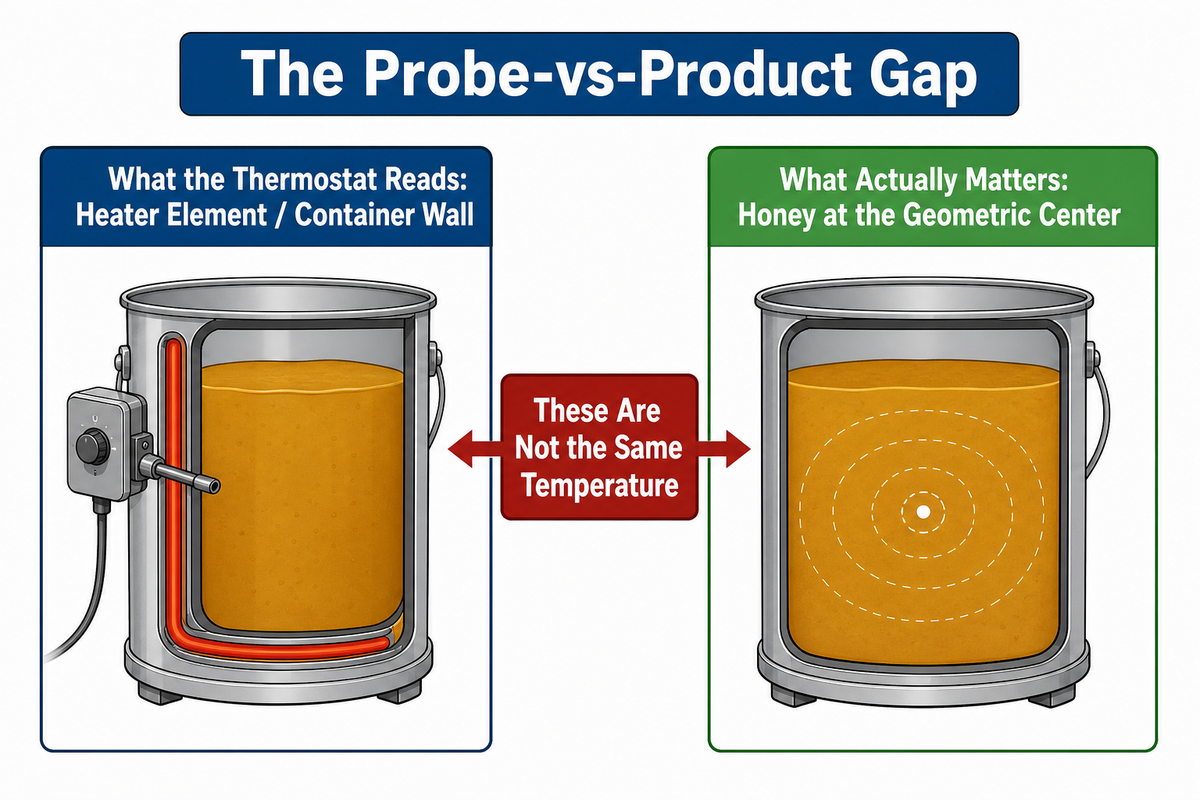
A heater’s thermostat controls the heater, not the honey, and the gap between those two numbers is the single most under-explained mechanism in this entire product category. Call it The Probe-vs-Product Gap: a temperature sensor reads the specific point it’s touching, and that point is very often the heating element or the container wall, not the honey sitting at the geometric center of a five-gallon bucket. This isn’t a defect in any particular product, it’s a general property of how heated systems and their sensors work, and it shows up independently across very different kinds of evidence.
Research on transient surface-temperature distribution used a 256-point sensor grid at 30 mm spacing on a heated vessel and found spatially different readings driven by wall conduction and convection, a local surface reading is location-dependent, not automatically the temperature of the bulk contents. Separately, peer-reviewed work on flexible-heater design found that temperature uniformity depends on heat-source spacing and the thermal conductivity of the heater’s own construction, meaning coverage area by itself doesn’t guarantee even heating. Neither study tested a commercial honey bucket heater directly, the connection to honey heating is an applied engineering inference, not a lab result specific to this product. But two independent lines of engineering research point toward one shared underlying mechanism, and two other, completely different kinds of sources back up why it matters in practice: a 1953 US patent for a honey-heating machine was already engineered to hold tank liquid at a deliberate 110–120°F target, and a University of Delaware extension design for a DIY four-bucket honey heater states its explicit build goal as producing “no hot spots, no lumps” seven decades apart, an engineer and an extension writer independently solved for the same failure mode.
“No hot spots, no lumps.”
How Hot Do Bucket Heaters Get?
Commercially available bucket and pail heaters typically span 41–158°F on digital-control models and up to 86–302°F on higher-wattage drum-band models. That range describes what the heater’s own controller can be set to, not a guarantee that the honey itself stays at a stable, uniform temperature.
A listing quotes a maximum temperature well above the 100–110°F practiced range mainly so the same unit can also melt wax efficiently; treat that number as the heater’s ceiling for other materials, not evidence about how evenly it will maintain heat in a honey bucket. As a practical filter, if a listing’s quoted maximum runs 50°F or more above the 100–110°F practiced range, read that figure as the wax-melting ceiling, not as evidence about honey performance. Based on the specification ranges published across several manufacturer listings reviewed for this guide, consistent, monitored heating, not raw wattage, is what actually determines how well a batch turns out.
Which Equipment Class Fits Your Batch Size: Pail Heaters, Warming Blankets, Cabinets and Tanks
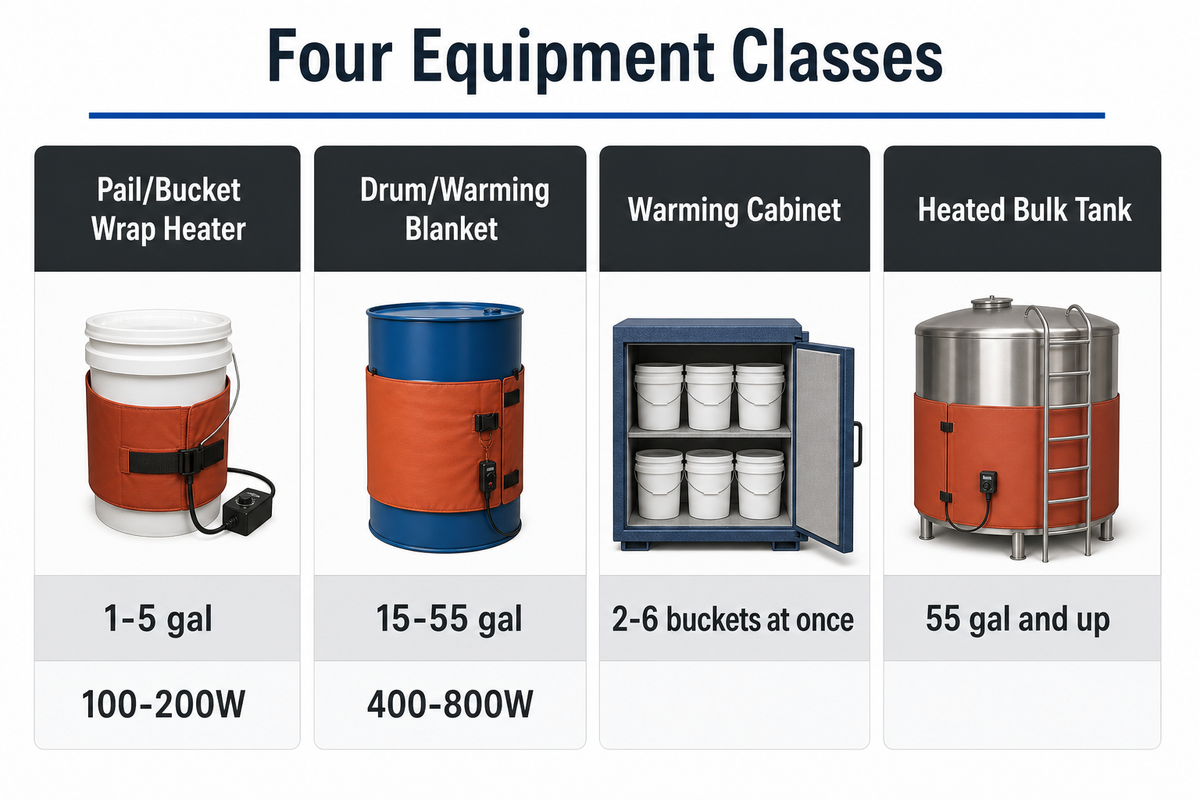
Four equipment classes cover most of this category, and they aren’t interchangeable once your batch size moves past a bucket or two: a wrap-band pail heater, a larger warming blanket, an insulated warming cabinet, and a heated bulk tank built for continuous-flow use.
Wrap-band pail heaters strap directly around a single 1–5 gallon container, whether the pail itself is plastic or metal (aluminum and steel are both common), and heat by direct contact, so matching the band’s length to the container’s diameter matters more than the material it’s made of. Warming blankets scale that same idea up to a 15–55 gallon drum. Warming cabinets are well-insulated enclosed spaces with a low-wattage heat source that hold multiple containers at once, cutting heat loss so an unheated room doesn’t slow the cycle down. Heated bulk tanks, with or without a water jacket, are built for continuous-flow processing rather than batch-at-a-time liquefaction.
Band Heater, Bee Blanket, Bottling Tank: What Different Suppliers Call This Equipment
Beekeeping suppliers use different names for the same equipment class, and it helps to recognize them before comparing prices. A band heater or bucket warmer usually means the pail-scale wrap-band design; a blanket honey heater, or the trademarked Bee Blanket line from Powerblanket, covers both pail and drum scale under one brand name; and once you move past a single bucket, you’ll see references to a bottling tank heater, which is really the bulk tank class described above with an immersion or jacket element built in. None of these are meaningfully different physics; they’re marketing names layered onto the same four equipment classes, and 5 gal pail-scale units are the highest-volume segment across the beekeeping suppliers reviewed for this guide.
| Attribute | Pail/Bucket Wrap Heater | Drum/Warming Blanket | Warming Cabinet | Heated Bulk Tank |
|---|---|---|---|---|
| Typical capacity | 1–5 gal | 15–55 gal | 2–6 buckets at once | 55 gal and up |
| Common wattage | 100–200W | 400–800W | Low-wattage bulb or resistive element, size-dependent | Site-specific, immersion or jacket element |
| Heat delivery | Direct-contact wrap band | Direct-contact wrap band, larger surface | Ambient enclosed air, indirect | Immersion element or water-jacket, indirect |
| Typical liquefaction time | 18–24 hr | 24–48 hr | 24 hr for a full load, per one documented extension test | Continuous/batch, site-dependent |
| Best for | Sideliners, single-bucket sales runs | Semi-commercial drum handling | Batch prep before bottling day | Continuous bottling-line feed |
| Food-contact surfaces beyond the container | None (heats the container exterior only) | None (heats the container exterior only) | None (ambient air only) | Yes — tank interior, valves, transfer lines |
| DIY-viable | Rarely (purpose-built band is the norm) | Rarely | Commonly (documented extension plans exist) | No — commercial fabrication |
| Primary failure mode to verify | Localized hot spot at the wrap seam | Uneven heating across drum height | Slow, uneven warm-up if overloaded | Dead zones away from the element |
| Verification method | Check multiple points after a full cycle, not just the dial | Same, plus top-vs-bottom check | Rotate/check all positions in the cabinet | Confirm mixing or recirculation, not just setpoint |
| Dispensing method | Pour or gate-valve decant once liquefied | Pour or gate-valve decant | Pour after removing from cabinet | Gate valve or pump, no manual pour |
| Limitations / Not suitable for | >5 gal batches, continuous processing | <15 gal batches (oversized for the job) | Single urgent bucket (slower than a direct wrap) | Occasional small-batch sideline use |
Commercial and sideline beekeeping operations commonly budget for barrel heaters and bottling tank immersion heaters as a distinct equipment line item, separate from extractors and settling tanks, once volume moves past 55-gallon barrel scale.
What Temperature Should a Honey Warming Cabinet Be?
Warming cabinets built for honey, sized for 2–6 buckets at once, are commonly run in roughly the same 90–125°F band used for pail and drum heaters, since the goal, gentle, gradual liquefaction without measurable quality loss, doesn’t change with the equipment type.
Convenience is the cabinet’s advantage: processing multiple buckets on the same schedule, not a different, faster temperature strategy. Treat any cabinet advertised well above that range for honey specifically as a case to verify before use, not a shortcut to trust by default.
For readers whose batch has already outgrown pail-scale heating, drum heating blankets built for 55-gallon scale cover the next step up in this same equipment family.
Decrystallization at Batch Scale: The B2B Version of a Kitchen Problem
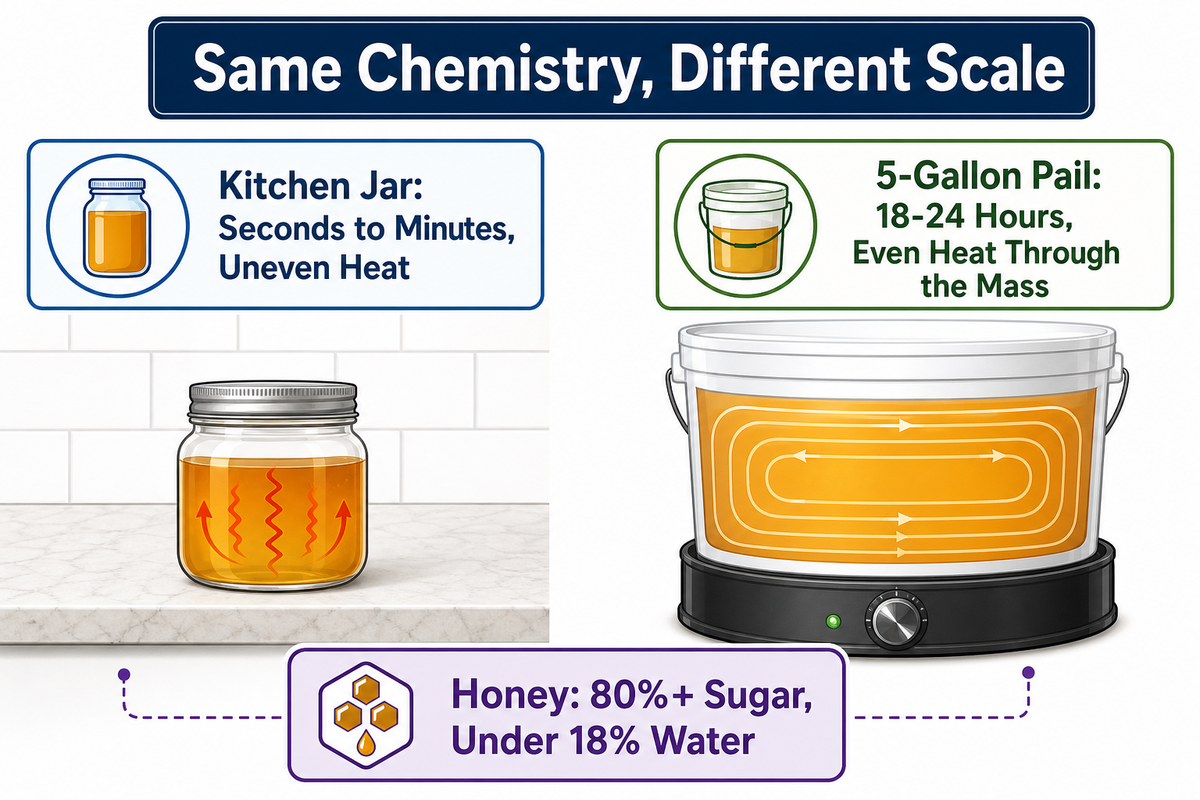
Decrystallizing a 5-gallon pail isn’t the same problem as microwaving a jar on a kitchen counter, even though both come down to the same underlying chemistry: honey typically runs 80%+ sugar and under 18% water by weight, and it crystallizes because glucose has limited solubility in that water fraction — heat just redissolves those crystals. Scale and control make the difference. A jar in a microwave heats unevenly over seconds to minutes, with no way to check what’s happening at the center; a 5-gallon pail on a dedicated heater takes 18–24 hours precisely because slow, even heat transfer through that much mass is what avoids the localized overheating a fast method can’t detect.
This guide deliberately doesn’t chase the fast-fix framing that dominates home-cook search results, because that framing answers the wrong question for a batch-processing buyer. At this scale, the real question isn’t “how do I decrystallize honey quickly” — it’s “what equipment reliably gets my batch size to a liquid, food-safe, unscorched state on a schedule I can plan around.” That reframing is also why the equipment discussed throughout this guide is built around hours-long, low-temperature cycles rather than a five-minute microwave-style fix.
The Batch-Size Ladder: A Decision Framework
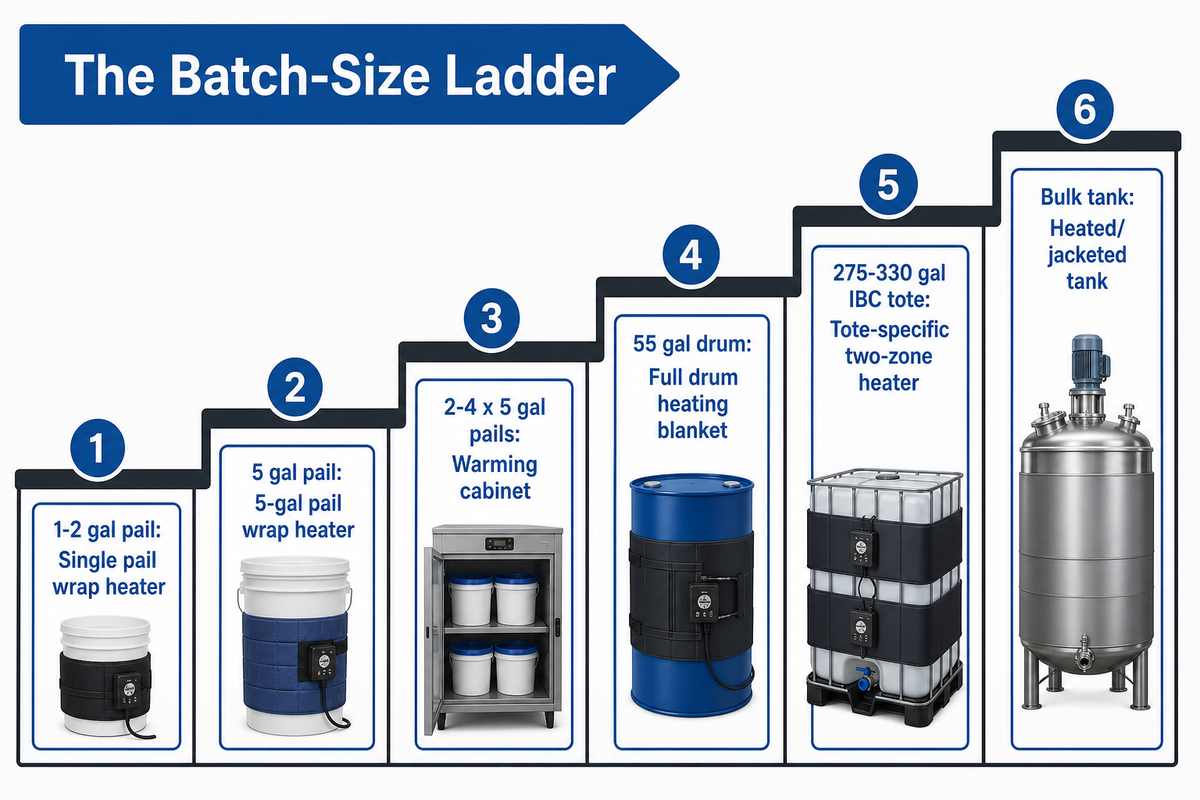
Match equipment to your actual batch volume and frequency before you compare brands or prices, the Batch-Size Ladder below is the fastest way to narrow the field to the equipment class that fits, with a verification point for each tier so you know what to check before you buy, not just after.
| Batch volume | Recommended class | What to verify first |
|---|---|---|
| 1 × 1–2 gal pail | Single pail wrap heater | Wattage matches container size (undersized bands run longer, unevenly) |
| 1 × 5 gal pail | 5-gal pail wrap heater | Digital vs. fixed thermostat — digital gives you the verification data |
| 2–4 × 5 gal pails | Warming cabinet | Cabinet holds even ambient temperature across all positions, not just near the element |
| 1 × 15–30 gal keg-scale drum | Small drum/keg heating blanket | Blanket coverage height matches drum height (partial coverage = a real cold zone) |
| 1 × 55 gal drum | Full drum heating blanket | Top-vs-bottom temperature check after a full cycle, not just the dial reading |
| 2+ × 55 gal drums, routine | Multiple drum blankets or a small warming room | Room/space thermostat consistency across the full footprint |
| 275–330 gal IBC tote | Tote-specific two-zone heater | This is a distinct equipment tier — see the full container heater range rather than adapting drum-scale gear |
| Bulk tank, batch-fed | Heated/jacketed bulk tank | Food-contact surface material and cleanability (see the safety checklist below) |
| Bulk tank, continuous-flow | Heated/jacketed tank with recirculation | Mixing/recirculation confirmed, not just an average setpoint reading |
Once you know which row you’re on, you’ve a specific equipment class and a specific thing to verify, that’s the point at which it makes sense to move from research to a quote. FlexBlanket’s pail and honey warmer heating line covers the pail-through-drum tiers on this ladder if you’re ready to compare models against the verification points above.
Safety and Verification Checklist Before You Buy
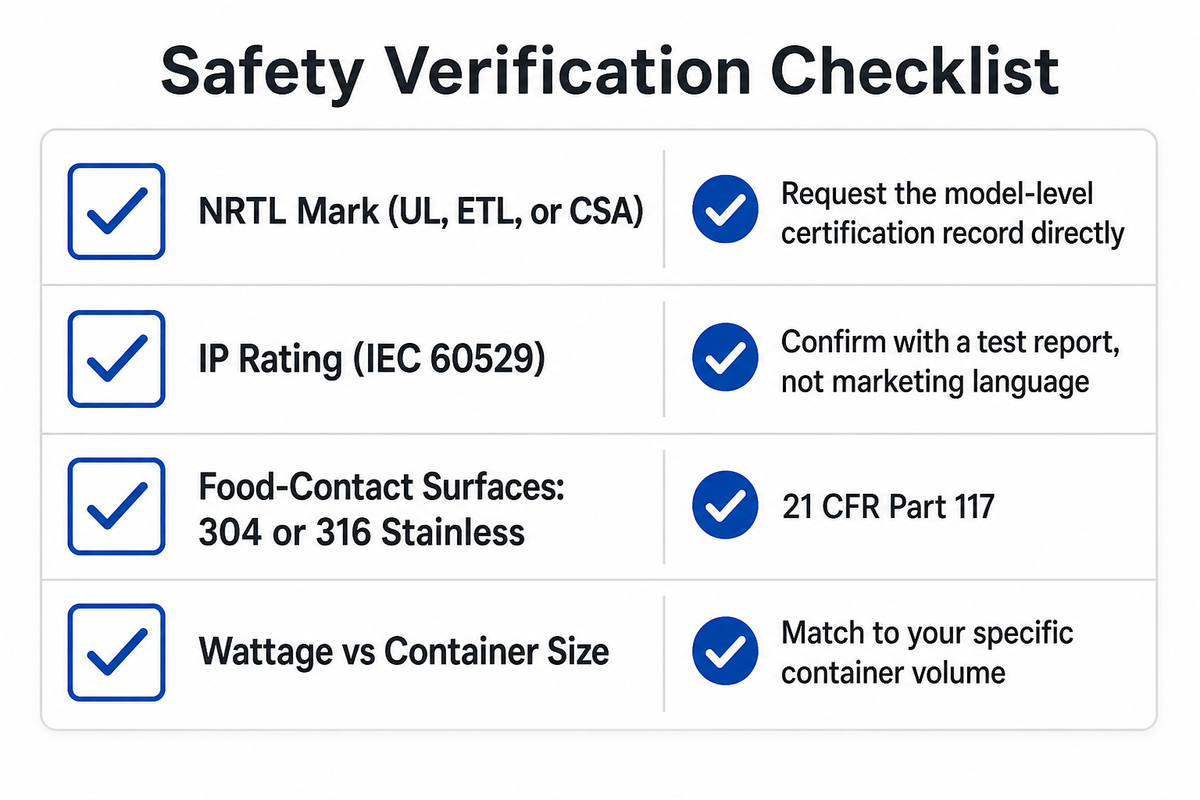
Beyond temperature performance, a bucket or honey heater is still a 100–800W plug-in electric appliance, and verifying its safety credentials is a separate question from checking its wattage. In the United States, OSHA requires nationally recognized testing laboratory (NRTL) approval, a mark like UL, ETL, or CSA, for many classes of workplace electrical equipment; a conformity mark from a different region’s scheme, CE included, is not treated as a substitute. Of the widely sold competitor product lines reviewed for this guide, most do not prominently disclose NRTL-equivalent certification on their product listing pages; one notable exception is the line marketed under the trademarked name “Bee Blanket” (sold by Powerblanket), which prominently states ETL certification to UL and CSA standards. That is not, by itself, proof those products lack certification — OSHA’s own guidance notes that an absent database entry needs direct confirmation with the NRTL, not an assumption either way from a webpage. In practice, that means a verification action, not a purchase-blocking claim: request the specific model-level NRTL certification record directly from the manufacturer before you buy, rather than trying to resolve it from listing copy.
An IP rating is a related but separate credential worth understanding. Under IEC 60529 (consolidated edition 1989+A1:1999+A2:2013), an IP code classifies the degree of protection an enclosure provides against dust and water ingress, it does not, by itself, certify that a specific product was independently tested. A manufacturer-quoted IP rating is a first-party claim unless a test report backs it up, so treat “waterproof” marketing language with the same verification standard as a temperature claim. For bulk-tank equipment specifically, food-contact surfaces are commonly specified in 304 or 316-grade stainless steel with an internal finish smoother than 32 microinches Ra (per 3-A Sanitary Standards practice) to resist microbial buildup and support full drainage.
RFQ checklist — copy these into your quote request:
| Parameter | Recommended range | Why it matters | How to verify |
|---|---|---|---|
| Operating temperature | 100–110°F for honey (not the heater’s max rating) | Matches the evidence-backed low-and-slow range | Ask for the thermostat’s actual controllable range, not just the marketing max |
| Wattage vs. container size | 100–200W for 5-gal, 400–800W for 55-gal | Undersized wattage extends cycle time and risks uneven heat | Confirm against your specific container volume, not a generic “fits most” claim |
| Safety listing | NRTL mark (UL/ETL/CSA), model-specific | Workplace electrical-equipment requirement in the US | Request the certification record directly — do not infer from listing silence |
| Sensor/verification points | ≥2 check points per cycle (not just the dial) | Addresses the Probe-vs-Product Gap directly | Confirm you can check the container in more than one spot after a cycle |
| Food-contact surfaces (tank/valve tier only) | Meets 21 CFR Part 117 food-contact requirements; 3-A Sanitary Standards where applicable | A separate compliance question from electrical listing once equipment includes tanks, valves or transfer lines | Ask for material spec (e.g. 304/316 stainless) and surface-finish documentation |
Seasonal Planning: Why Demand Peaks Before Winter
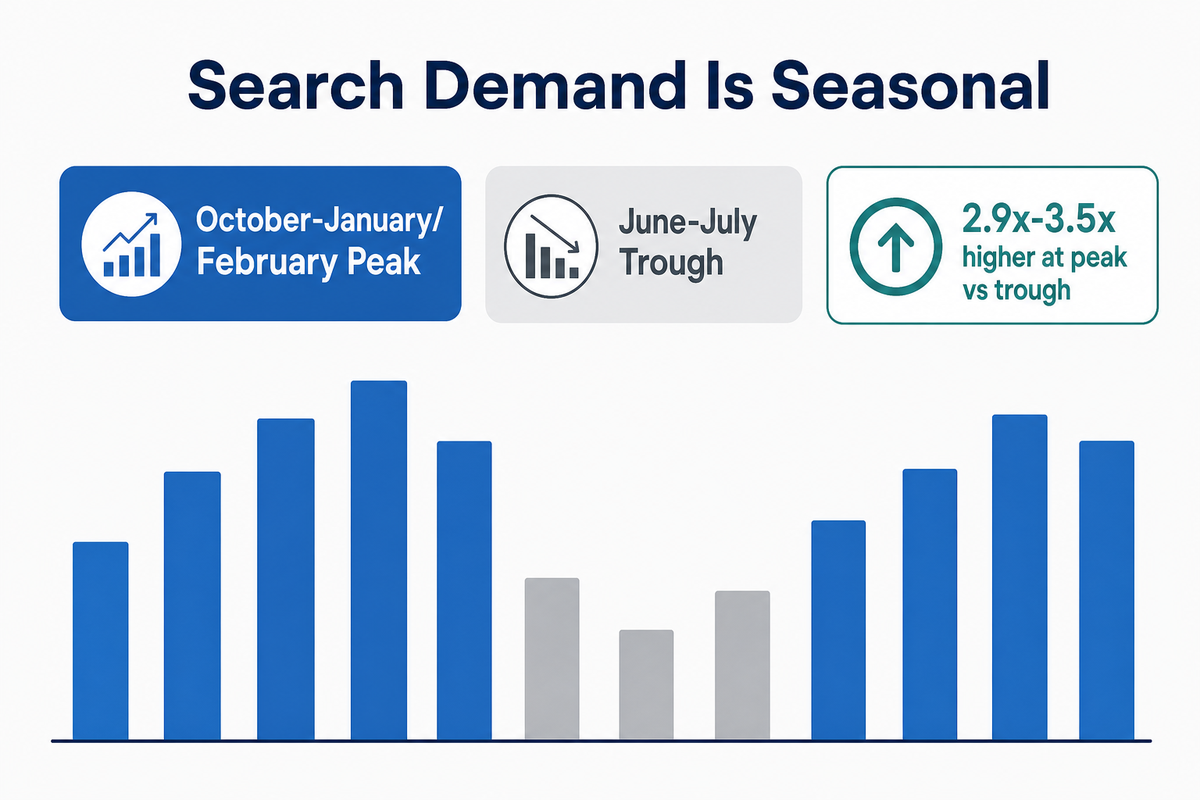
Once that RFQ checklist is in hand, timing the purchase matters as much as the equipment itself: source your bucket or honey heater before extraction season starts, not after the first batch has already crystallized on you. This run’s own search-demand data shows a clear October-through-January/February peak, running 2.9–3.5× the June, July trough across four core search terms. That timing lines up with beekeeping-calendar resources like Dadant’s own seasonal guide and when most US beekeeping operations actually harvest: the common window is late July through mid-September, with roughly 80% capped frames used as the typical readiness signal before pulling honey from the hive. Once harvest is done, processing, liquefying, and bottling typically follow within 4–8 weeks, which is exactly the lag between the late-summer harvest window and the October search-demand peak observed in this run’s data.
That said, this is the most common US pattern, not a single national calendar. Harvest timing varies meaningfully by region and climate, even within one state, extension guidance documents significantly different timing between northern and southern growing zones, and some regions see multiple harvests or winter/spring nectar flows on a different schedule entirely. Plan against your own region’s extraction calendar, and treat the fall equipment-buying window as a planning prompt, not a rule that applies identically everywhere.
Common Mistakes: What DIY Forum Threads Get Right (and Wrong)
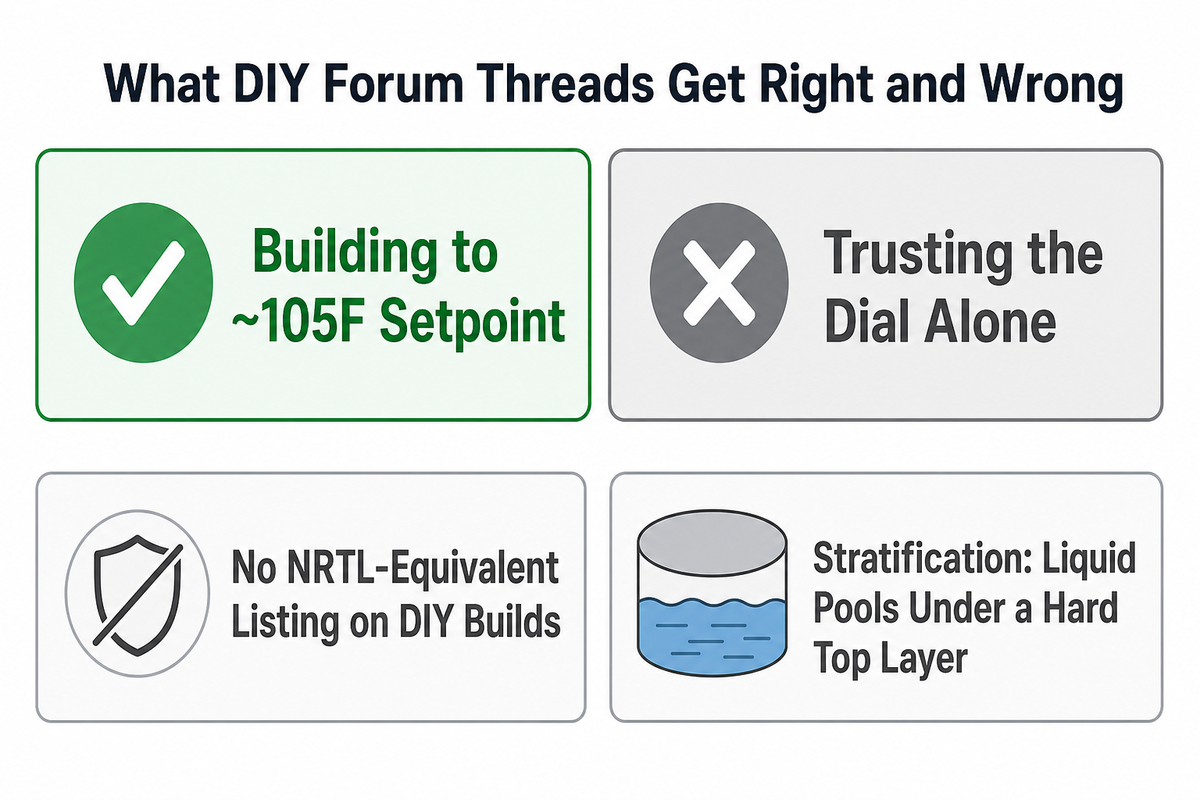
Beyond planning around your own region’s calendar, beekeeping forum threads on homemade honey warmers are a genuinely useful, if inconsistent, source of field experience, and reading enough of them surfaces the same handful of mistakes repeatedly.
- ✔Community practice commonly builds working DIY heaters from plywood boxes lined with two inches of rigid-foam insulation, 60-watt incandescent bulbs, and a generic baseboard-heater thermostat, and consistently reports setting them to roughly 105°F (within the 100–110°F band), which lines up with the peer-reviewed and extension evidence in this guide. This is independent convergence on the right temperature range.
- ✔Reported stratification, liquid honey pooling in the bottom third of a bucket under a hard, unmelted layer on top, especially when the bucket sits on a cold floor below roughly 50°F, is a real, commonly observed symptom of the Probe-vs-Product Gap in practice, not a one-off complaint.
- ✔What the DIY-forum approach gets wrong is safety-credential parity: a bulb-and-thermostat rig built from generic hardware-store parts has no NRTL-equivalent listing as an assembled heating appliance, unlike a purpose-built, certified bucket heater. It can be built and used safely with reasonable care, but it is not the same safety category as a listed product, and that distinction is worth being honest about rather than treating “it’s worked for years” as equivalent to certification.
- ✔Judging an 18–24 hour cycle finished by the thermostat dial alone, rather than physically checking 2 or more points in the container, is the most common avoidable mistake — exactly the gap the Probe-vs-Product Gap describes.
About This Analysis
This guide draws on 14 cited sources spanning Codex Alimentarius honey-composition standards, peer-reviewed enzyme-activity and heat-transfer research dating back to 2001, a 1953 US patent, a University of Delaware apiculture extension design, US OSHA and IEC safety-credential guidance, and this run’s own DataForSEO search-demand data, cross-checked against beekeeping-community forum practice rather than written from a single source. Where the available evidence was genuinely mixed (as with honey’s response to heat, which depends on the honey’s own composition and storage history, not one universal temperature threshold), this guide says so rather than picking the cleaner-sounding number. Reviewed by the Qingdao Flex Technology Co., Ltd. technical team.
Frequently Asked Questions
Q: How long will a 5-gallon bucket of honey last?
Raw honey stored sealed in a food-grade bucket has an effectively indefinite shelf life due to its low moisture and high sugar content, which resist microbial growth.
What changes over time isn’t safety, it’s texture: honey will crystallize as it cools and ages, and warmer storage or repeated temperature swings above roughly 50°F can speed that up, while cold storage near 40°F slows it. Crystallization is not spoilage, a crystallized 5-gallon (about 60 lb) bucket sealed against moisture is still fully usable honey years later, and this guide covers exactly how to bring it back to liquid form over an 18–24 hour cycle without damaging it, rather than treating the crystallized state as a problem that needs an urgent fix.
Q: What is the best way to heat honey?
The best-supported approach is low and slow: roughly 100–110°F held for many hours, using indirect wrap-band, cabinet, or water-bath style equipment rather than direct high heat.
This range shows up consistently across a peer-reviewed enzyme study, a 70-year-old patent, and a university extension design, three independent sources converging on the same practiced range. Faster methods that use higher heat trade speed for a real risk of localized overheating, flavor change, and enzyme loss, especially at the point closest to the heat source.
Q: Why isn’t it good to heat honey?
Heating honey too hot or too fast risks raising hydroxymethylfurfural (HMF) above the 40 mg/kg level allowed under Codex Alimentarius honey standards and can measurably reduce natural enzyme activity, changing flavor and composition.
The risk is temperature- and time-dependent, and it varies by the honey’s own composition and storage history, not a single fixed cliff at one exact degree. One peer-reviewed study measured invertase activity dropping more than 80% after six hours at 65°C (149°F), while a separate review found some honey samples heated briefly at similar temperatures showed no measurable loss at all. That’s exactly why equipment built for gradual, controlled, low-temperature heating over 18–24 hours exists as its own product category, instead of everyone just using a stovetop for a five-minute fix.
Q: Does honey lose its benefits when heated?
Excessive heat can reduce measurable enzyme activity, sometimes by more than 50% under sustained heat above roughly 55–65°C, though the effect depends heavily on temperature, duration, and the specific honey.
Peer-reviewed research shows enzyme activity like invertase declining by more than 50% under sustained heat above roughly 55–65°C (131–149°F), while a separate study found some samples heated briefly at similar temperatures showed no measurable loss at all. Heat conservatively if enzyme content matters to you, and don’t treat any single number as a universal guarantee either way — that’s the honest summary.
Q: Is it safe to warm up honey?
Yes, warming honey at the practiced 100–110°F range over 18–24 hours is standard, safe practice for liquefying crystallized honey, provided you monitor the temp at more than one point in the container rather than trusting the dial alone.
The bigger safety question isn’t the honey, it’s the heater. Verify its NRTL/UL/ETL/CSA listing at the model level before use.
Q: What is a good pail heater for honey?
A good pail heater for honey matches wattage (100–200W for a 5-gallon pail) to your container size, offers a controllable thermostat in the 100–110°F practiced range, and carries a verifiable NRTL-equivalent safety listing at the model level.
Beyond those three points, the decision comes down to your actual batch size and frequency, see the Batch-Size Ladder earlier in this guide for a tier-by-tier recommendation rather than a single “best” product, since the right choice changes meaningfully between a single 5-gallon pail and routine 55-gallon drum processing.
References & Sources
- Codex Alimentarius CXS 12-1981, Standard for Honey Food and Agriculture Organization of the United Nations / Codex Alimentarius Commission
- Investigation of Variations of Invertase and Glucose Oxidase Degrees against Heating and Timing Options in Raw Honeys Sahin, Kolayli & Beykaya, Journal of Chemistry (2020)
- Peer-reviewed review on honey heat treatment and enzyme response PubMed Central
- Transient surface-temperature distribution study (256-point sensor grid) PubMed Central
- Flexible-heater temperature-uniformity design study PubMed Central
- Honey Heater build plans Mid-Atlantic Apiculture Research and Extension Consortium, University of Delaware
- Karabournioti & Zervalaki, “The Effect of Heating on Honey HMF and Invertase,” Apiacta 4 (2001) journal of Apimondia, International Federation of Beekeepers’ Associations
- Nationally Recognized Testing Laboratory (NRTL) Program FAQ U.S. Occupational Safety and Health Administration
- Safety and Health Information Bulletin on NRTL-approved equipment U.S. Occupational Safety and Health Administration
- United States Standards for Grades of Extracted Honey U.S. Department of Agriculture, Agricultural Marketing Service
- 21 CFR Part 117, Current Good Manufacturing Practice, Hazard Analysis, and Risk-Based Preventive Controls for Human Food U.S. Food and Drug Administration
- IEC 60529, Degrees of protection provided by enclosures (IP Code) International Electrotechnical Commission
- US Patent 2,629,885, Combined Honeycomb Filler and Honey Heating Machine United States Patent and Trademark Office
- Regional beekeeping and harvest-timing guidance University of Florida IFAS Extension
Related Articles
- Container heaters for drums, totes and pails the full equipment range this guide’s Batch-Size Ladder points into
- Drum heating blankets for 55-gallon scale the next equipment tier once a batch outgrows pail-scale heating
- IBC tote heating blankets for 275–330 gallon bulk container heating