Get in touch with FlexBlanket Company

Silicone & Flexible Heaters
Silicone & Flexible Heaters for Industrial Process Heating
FlexBlanket builds silicone rubber flexible heaters to the dimensions of your vessel, pipe, valve or drum, from a first article through to OEM and ODM production. Send the geometry, target temperature, operating conditions and local voltage, and a heating solution drawing comes back before you order.
The drawing is prepared at no charge, and the design is confirmed with you before any tooling is cut.
- Free heating solution drawing before you order
- 7–15 days production after order confirmation
- −60 °C to 250 °C at ±5 °C uniformity
- 12, 24 or 48 VDC and 120 or 230 VAC builds
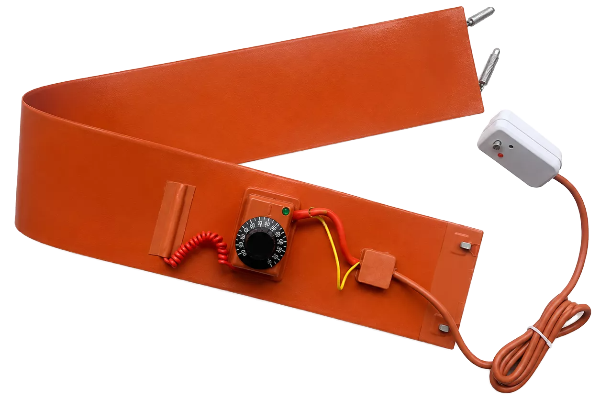
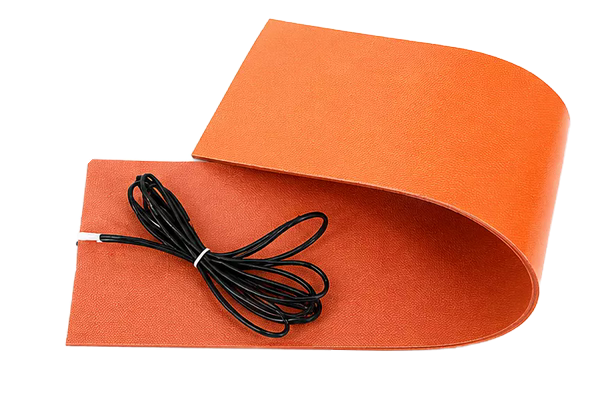
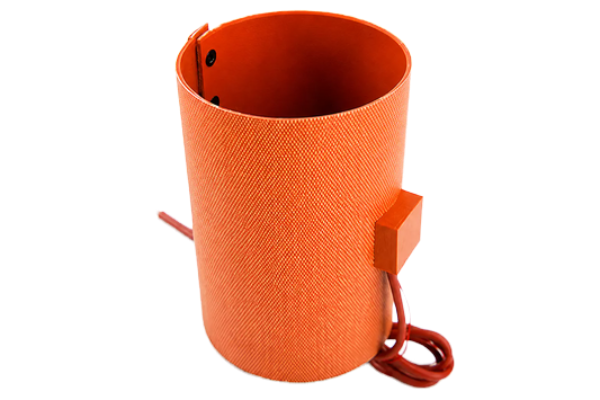
A flexible heater is a resistive heating element sealed inside a bendable insulating sheet, so it can be wrapped around or bonded onto the surface being warmed. The figures below apply to our fiberglass-reinforced silicone rubber heaters; the drum band family runs its own range and is listed separately in the product cards.
Technical Specifications
Operating range
−60 °C to 250 °C
Power density
1.0–3.0 W/cm²
Heater thickness
0.8–3.0 mm
Supply voltage
12-48 VDC; 120/230 VAC
Temp uniformity
±5 °C
Ingress protection
IP65
Heater Constructions, Forms and Control Options
Two constructions cover the field: resistance wire wound into a pattern, or metal foil etched into a circuit. Both are vulcanised between fiberglass-reinforced silicone rubber sheets. What changes is how many watts fit into a given area and how the flexible heating element behaves when bent.
Wire-wound construction
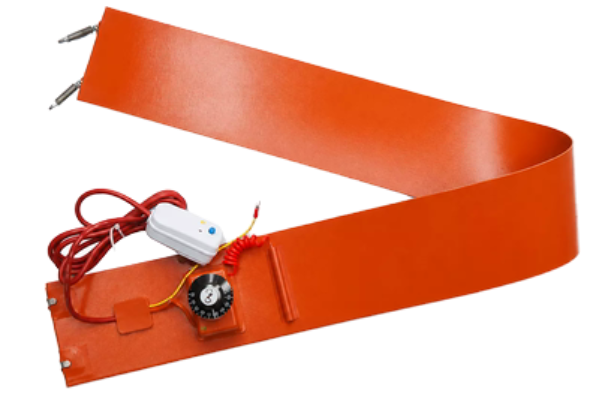
Wire wound to a set pattern takes repeated wrapping and unwrapping without complaint, and it lets us build large single sheets. Choose it for drum bands, tank walls and any silicone blanket heater that comes off and goes back on in service.
Etched foil construction
Foil etched into a circuit and laminated into the sheet packs more watts into a smaller area, and it makes several independently controlled zones on one heater practical. Choose etched foil heaters for compact plates, instrument bodies and any part where the heat pattern has to follow a specific geometry.
Sizing the Wattage Before You Specify a Heater
The common assumption is that a higher watt density makes a better heater. It is not always true: the figure is capped by the temperature the heated surface may reach and by how tightly the heater is controlled, so pushing it up shortens warm-up while raising the risk of scorching product against the wall. Work backwards instead — fix the target temperature and warm-up time, calculate the heat the mass and standing losses demand, then divide by the area you can cover.
Insulation over the heater drives the surface hotter for a given watt density, which is why an insulated jacket and a bare bonded pad cannot share one power figure.
The attachment layer carries a ceiling of its own: pressure-sensitive adhesive gives out well before the silicone rubber does, while vulcanised bonding carries the full range.
An empty or part-filled vessel takes away the heat sink the heater was sized against, and surface temperature climbs until the control loop or a limit device stops it.
1.0–3.0 W/cm²
We build to 1.0–3.0 W/cm² (6.5–19.4 W/in²), which covers warm-up and temperature-maintenance duty on filled drums, vessels and pipework.
Heater Formats We Build
- Flat and wrap-around blankets for tanks, plates and vessel walls
- Insulated heaters with a bonded outer insulation layer for outdoor and low-ambient duty
- Valve jackets shaped to the body and bonnet
- Filter jackets for housings that have to stay above a pour point
- Pipe blankets, jackets and wraps for line sections, elbows and flanges
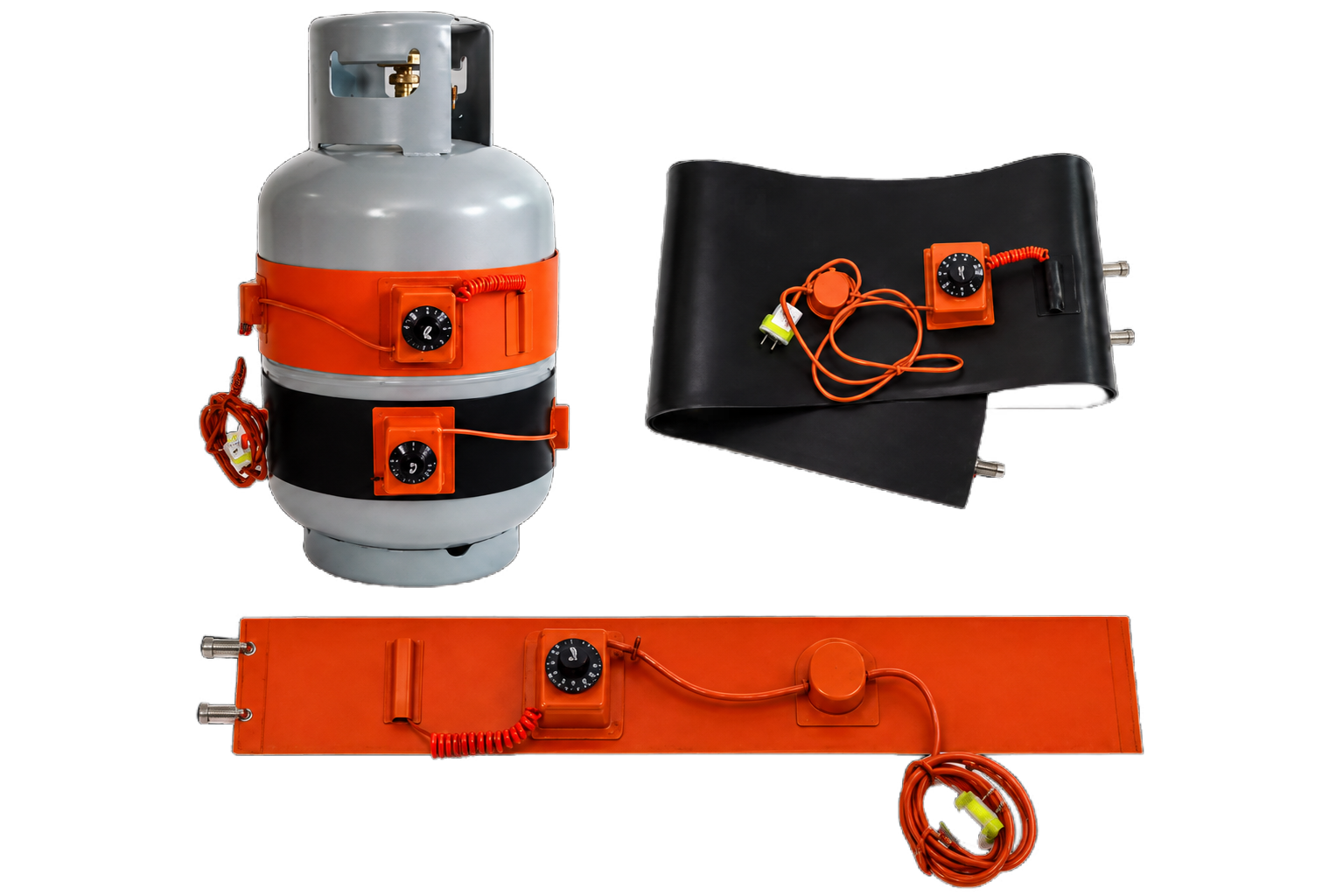
- Cylinder blankets for gas and process cylinders
Temperature Control Options
- Mechanical thermostat — a fixed or adjustable setpoint reading the heater surface, for single-zone maintenance duty.
- RTD sensor with controller — a platinum sensor at the point you name, for loops that must hold a process value rather than a surface value. Requirements for industrial platinum resistance thermometers are set by IEC 60751; state the sensor type and tolerance class your controller expects with the enquiry.
- Thermocouple — for higher setpoints and long sensor runs back to an existing panel.
- PID controller — for duties that need controlled ramp rates or tight holding around setpoint.
Processes on Our Floor
- Laser cutting and die cutting for sheet and jacket profiles
- Wire winding for wire-wound heating elements
- Flat vulcanizing presses for bonding the silicone rubber laminate
- Industrial high-temperature ovens for post-cure
Silicone Rubber, Polyimide and Polyester Heater Materials
We manufacture silicone rubber heaters. Polyimide (Kapton) and polyester film heaters sit in the table below so you can rule them in or out before you spend time on a drawing. The three are not interchangeable: silicone rubber carries thickness and wraps a drum wall, while a polyimide heater is the choice when the clearance available is a fraction of a millimetre.
Material Comparison: What Sets the Temperature Ceiling
| Property | Silicone rubber (what we build) | Polyimide film (Kapton) | Polyester film |
|---|---|---|---|
| Construction and thickness | Wire-wound or etched foil vulcanised between fiberglass-reinforced silicone rubber sheets, 0.8–3.0 mm (0.031–0.118 in) | Etched foil between thin polyimide films, a fraction of a millimetre thick | Etched foil laminated between polyester films |
| Operating range | −60 °C to 250 °C (−76 °F to 482 °F) on our builds | The film withstands far more heat than the adhesive holding the laminate; only adhesive-free builds reach the film’s own ceiling | The lowest of the three, which places it in warming duty rather than process heating |
| What actually sets the ceiling | The attachment method: vulcanised bonding carries the full range; adhesive backing lowers it | The bond line, not the film | The film and the bond line together |
| Conformability | Wraps drums, pipes, valves and tanks; tolerates repeated removal and refitting | Follows tight radii and small plates where thickness counts | Follows tight radii; temperature is the limit |
| Usually fitted to | Drums, IBC totes, process vessels, pipework, valves, filter housings and cylinders | Instruments, optics, medical devices and small heated plates | Enclosures, batteries and other low-temperature warming duties |
| Rule it out when | Vacuum service, or anywhere outgassing is critical | Duty temperature exceeds what the bond line holds | The duty is hotter than warming |
Container and Heat-Load Routing Matrix
Start from the object you have to heat, not from a heater catalogue: each row carries the format, power basis and control we would put on that duty, and power on custom builds is fixed at drawing review. On caged totes, 49 CFR §178.700 classifies a metal cage as structural equipment and heating or heat-insulating devices as service equipment on intermediate bulk containers built for hazardous materials transport. The regulation defines those terms and sets no sizing method, so the working consequence is ours: a tote heater is sized to the panels the cage leaves open rather than to the full wall.
| Heated object | Material | Capacity or size | Format | Power basis | Control | Where it is built |
|---|---|---|---|---|---|---|
| Drum | Steel or HDPE | 200 L (55 gallon) | FLB-SDH-250 band, up to three bands | 2000 W per band | Thermostat, 30–150 °C | Silicone drum heaters |
| Drum | Steel or HDPE | 105 L (27.7 gallon) | FLB-SDH-150 band | 1000 W per band | Thermostat, 30–150 °C | Silicone drum heaters |
| Drum or pail | Steel or HDPE | 25–60 L (6.6–15.9 gallon) | FLB-SDH-125 band, or a custom blanket below 25 L | 1000 W per band, or 1.0–3.0 W/cm² custom | Thermostat, 30–150 °C | Drum heating blankets |
| IBC tote | HDPE in a steel cage | Pallet-footprint tank | Wrap-around blanket, built to the cage dimensions | 1.0–3.0 W/cm² | RTD with controller | IBC tote heaters |
| Process tank or vessel wall | Steel or stainless steel | From your drawing | Flat blanket panels | 1.0–3.0 W/cm² | RTD or PID | Custom build |
| Pipe run, elbow or flange | Steel or stainless steel | Diameter and length from your drawing | Pipe blanket, jacket or wrap | 1.0–3.0 W/cm² | Thermostat or RTD | Pipe heating blankets |
| Valve body | Steel or stainless steel | From the valve drawing | Removable valve jacket | 1.0–3.0 W/cm² | Thermostat | Custom build |
| Filter housing | Steel or stainless steel | From the housing drawing | Removable filter jacket | 1.0–3.0 W/cm² | Thermostat or RTD | Custom build |
| Gas or process cylinder | Steel | Cylinder diameter and height | Cylinder blanket | 1.0–3.0 W/cm² | Thermostat | Gas cylinder heating jackets |
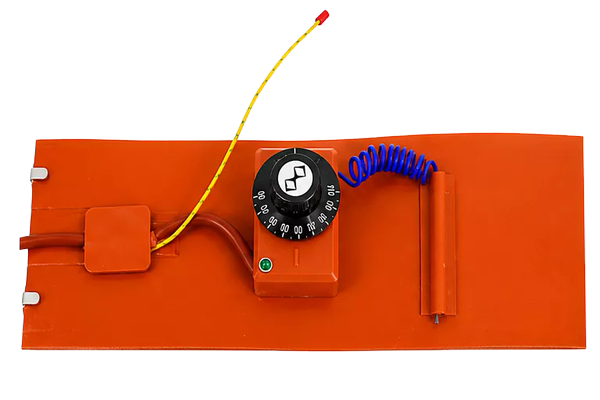
Silicone Rubber Heaters
- Build Fiberglass-reinforced silicone rubber, 0.8–3.0 mm, wire-wound or etched foil
- Key ratings 1.0–3.0 W/cm², −60 °C to 250 °C, ±5 °C uniformity, insulation resistance ≥300 MΩ, dielectric withstand ≥2500 V, IP65
- Fitted to Tanks, vessel walls, plates, pipework, valves, filter housings and cylinders
- Control Thermostat, RTD, thermocouple or PID
- Lead time 7–15 days after order confirmation; 1–2 weeks for a first-article sample
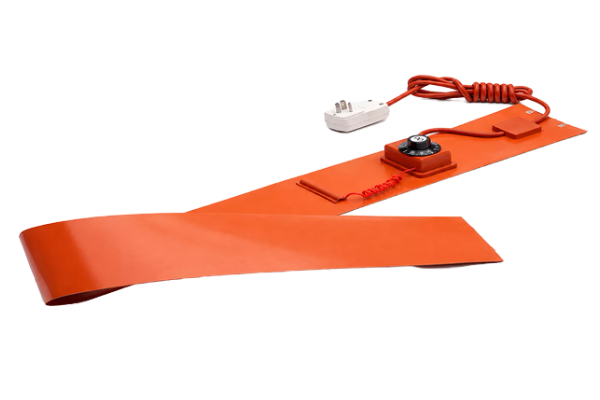
Silicone Drum Heaters
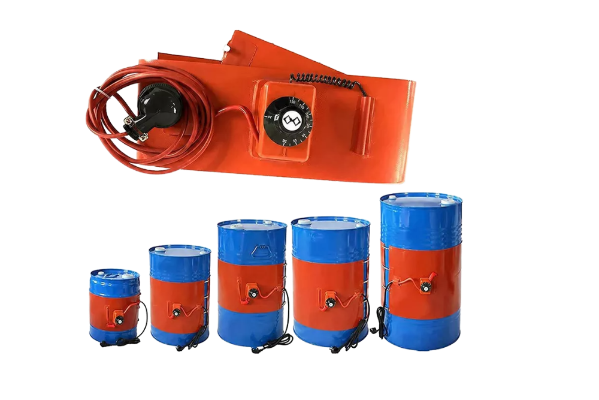
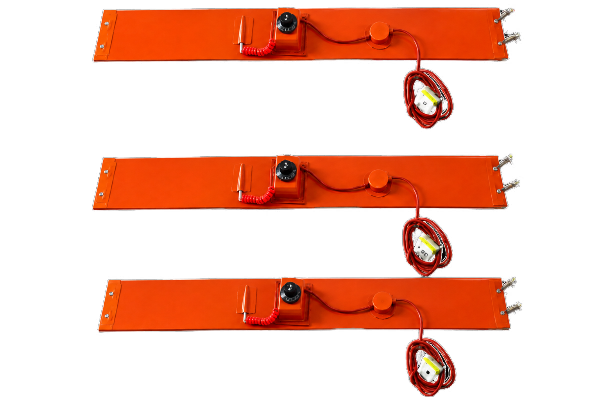
- Models FLB-SDH-250, FLB-SDH-150, FLB-SDH-125
- Band size / power 1740 × 250 mm at 2000 W; 1740 × 150 mm at 1000 W; 1740 × 125 mm at 1000 W (68.5 × 9.8 / 5.9 / 4.9 in)
- Fitted to 25–200 L (6.6–55 gallon) steel and HDPE drums, up to three bands on a single 200 L drum
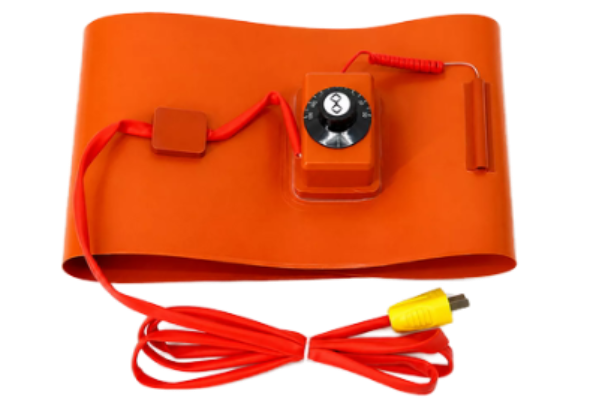
- Control Adjustable analogue thermostat, 30 °C to 150 °C (86 °F to 302 °F), IP65 controller enclosure, 10 A (EU/UK) or 15 A (US) plug
- Lead time 7–15 days after order confirmation
Another Format or Another Material
Send the grade, geometry and duty with your enquiry, and the quotation confirms whether we build it and what the heater would look like.
Attachment, Insulation and Sensor Integration
A heater rated to 250 °C does not always run to 250 °C. What holds it on, and what sits over it, set the lower of the two ceilings, and each row below names what that trade-off costs you. Each option is settled before the heater is built, at the stage named in the last column.
Vulcanised bonding
What it involves
Bonded to the surface with uncured silicone and cured in place
What it limits
Nothing below the heater’s own range, but the fit is permanent
Settled at: Drawing review
Pressure-sensitive adhesive backing
What it involves
An adhesive film applied at the factory, peeled and stuck on site
What it limits
The adhesive sets the temperature and watt density ceiling, and it has a shelf life before use
Settled at: Quotation
Mechanical straps and tension springs
What it involves
A wrap-around band held closed by springs or buckled straps, fitted without tools
What it limits
Needs a surface the band can grip, and the heater must be removable
Settled at: Drawing review
Bonded insulation layer
What it involves
An insulating outer layer built onto the back of the heater
What it limits
Raises surface temperature for the same power, so the wattage is re-sized when insulation is added
Settled at: Drawing review
RTD or thermocouple integration
What it involves
Sensor placed under the heater or inside the jacket, wired out to your controller
What it limits
Sensor position decides what the control loop actually measures
Settled at: Drawing review
Lead wire and plug
What it involves
Lead exit side, cable length, and a 10 A (EU/UK) or 15 A (US) plug on drum bands
What it limits
Destination voltage and socket standard
Settled at: Order confirmation
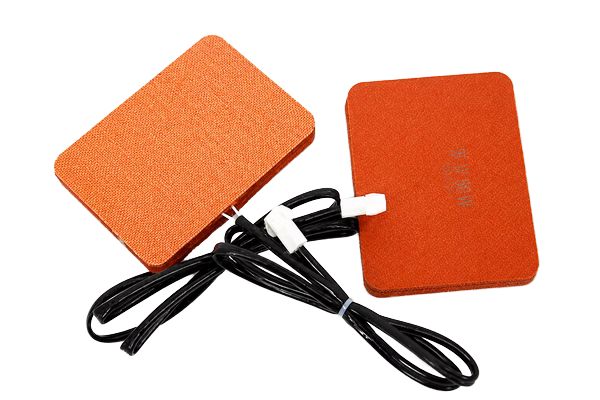
Silicone Heater Specifications and Standard Lead Times
Every figure below is what we build to, and each row names the family it belongs to. Take these rows straight into your enquiry and mark the ones your duty changes.
SPEC MATRIX
Quotation Inputs, Pricing Drivers and Delivery Terms
There is no price list for custom heaters. Price follows the heated area, the power and voltage, the construction, the control package and the quantity, and your figure comes back in a written quotation.
What Moves Your Price
| Driver | Effect on cost | How to reduce it |
|---|---|---|
| Heated area | Silicone sheet, wire length and cure time all scale with area | Heat only the section that must stay warm, and mark which surfaces are allowed to run cold |
| Control package | A PID loop with an RTD costs more than an adjustable thermostat | Use a thermostat where a maintained band is enough, and keep PID for ramp-rate duties |
| Construction | Etched foil in a small high-density area costs more than wire-wound over a large one | Ask for wire-wound unless the zone layout or thickness requires foil |
| Quantity | Pattern setup and tooling are spread across the run | Ask for one, ten and fifty in one quotation so the break points are visible before you commit |
Lead Times by Order Stage
| Order stage | Lead time | What it covers |
|---|---|---|
| First article or sample | 1–2 weeks | One heater built to the approved drawing for fit and function checks |
| Production order | 7–15 days after order confirmation | Full quantity, tested and packed |
| Expedited order | Confirmed at drawing review | Expedited slots are available; we confirm feasibility against the current schedule before you order |
What We Need to Quote
- Tank, drum, pipe or vessel dimensions
- Target temperature, and the warm-up time if the duty is not simple maintenance
- Operating conditions: ambient minimum, indoor or outdoor, what the heater sits against
- Local supply voltage and the socket standard at the destination
Payment and Delivery Terms
- Payment by T/T, with a 30% deposit and the 70% balance settled before shipment
- EXW and FOB quoted as standard, with CIF or delivered terms quoted on request
- Minimum order quantity is set per design at quotation, and small trial quantities are considered on custom builds
- Samples are available before a bulk order, with sample cost and freight confirmed in the quotation
- The 7–15 days run from order confirmation, which follows drawing approval in the sequence below, and exclude transit
Electrical Testing and Quality Documentation
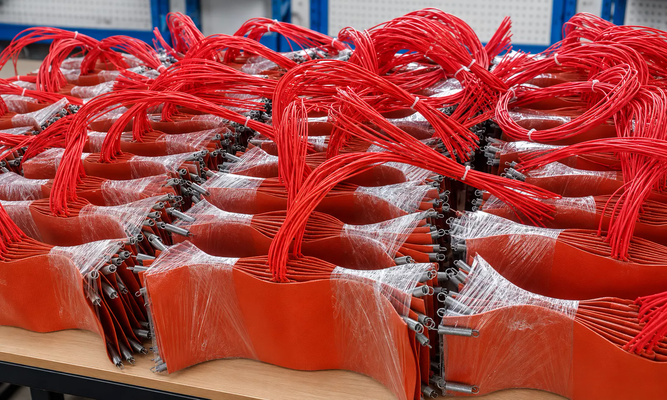
Every heater is electrically tested before it leaves the floor, and the paperwork that travels with it is fixed rather than negotiated per order. Heaters fail in service through a breakdown path in the laminate far more often than through a broken element, because wrapping, clamping and thermal cycling stress the insulation exactly where a visual check cannot reach. That is why all six tests below run on every unit rather than on a sample.
Six Tests on Every Heater
-
DC resistance
Confirms the element was wound or etched to the pattern the drawing calls for.
-
Multi-channel temperature
Checks the surface at several points, not one, because the ±5 °C figure is measured against all of them.
-
Withstand voltage
Holds the heater at ≥2500 V without breakdown.
-
Power-on
Runs the heater to confirm it draws the rated power at the specified supply.
-
Leakage current
Verifies current is not finding a path it should not take.
-
Insulation resistance
Confirms ≥300 MΩ between the element and the outer surface.
What Travels With the Order
- A proforma invoice, sales contract, commercial invoice, packing list and certificate of origin
- Production progress, quality inspection and container loading photos or videos
- A 24-month warranty with free replacement parts for manufacturing defects
- In-process inspection and pre-shipment acceptance are welcome, either by your own staff or by a third-party inspector you appoint. If a heater performs outside the approved drawing, it is rebuilt against the same acceptance criteria used at test.
How to Check a Heater Supplier’s Compliance Claims
The common assumption is that a thicker stack of certificates means a safer heater. It is not always so, and four rules decide what any one of those documents is actually worth.
- A CE mark says nothing about United States workplace requirements. It is a manufacturer’s declaration for the European market, so wherever an OSHA standard calls for approval by a Nationally Recognized Testing Laboratory, a CE mark does not satisfy that requirement.
- In the European Union, low voltage equipment between 50 and 1000 V AC or 75 and 1500 V DC is self-declared by the manufacturer. A voluntary certificate from a certification body is not a recognised means to prove compliance, and such a certificate is not permitted to carry a CE mark.
- United States workplace rules recognise a separate route for equipment built to one customer’s specification: it can be judged safe by its manufacturer on the basis of test data, provided the employer keeps that data and can produce it for inspection. Ask any supplier which test data they will hand over for that file.
- If a supplier mentions UL, ask which mark it is. A Recognized Component is certified for building into a larger certified end product and carries conditions of acceptability that using it outside them can void, and UL Solutions describes those conditions in The UL Component Recognition Classification, which points to its UL Product iQ database for looking them up.
The European Commission states that voluntary or additional certificates “are not a recognised means to prove compliance” and that “they have no value in the case of checks by market surveillance authorities or customs”. It adds that “it is not acceptable for certificates to bear a CE marking”.
European Commission, Low Voltage Directive (LVD)
From Vessel Dimensions To Installed Heater In Six Steps
Design Notes That Lower Your Cost
| Design Feature | What To Specify | Why It Saves Money |
|---|---|---|
| Heated zone boundary | Mark what must stay warm and what may run cold | Silicone sheet and element length scale directly with heated area |
| Sensor position | Name the single point the controller has to hold | A loop measuring the wrong surface is the most common reason a heater is rebuilt after commissioning |
| Lead exit and length | Give the exit side and the cable run to the panel | Avoids field splices and a second cable order at installation |
| Voltage and plug | State the supply voltage and socket standard at the destination | An element wound for the wrong voltage cannot be re-rated; it has to be rebuilt |
Quotation Input Checklist
Work through the checklist before you write the enquiry, and the quotation comes back on the first exchange instead of the third.
Industries and deployment conditions
The heater changes with what sits inside the container and how cold the surroundings get, not with the industry name on the purchase order. These are the duties we build for most often.
Where a flexible heater is not the right tool
Four duties come to us regularly where a silicone heater is the wrong answer, and it is cheaper to say so before a drawing is produced.
Vacuum chambers and low-outgassing environments
Why it works against you
Silicone rubber outgasses, and the adhesive layers in a laminated heater are the first thing to give.
What to do instead
Specify an adhesive-free polyimide construction, or move the heat source outside the chamber wall.
Long pipe runs measured in tens of metres
Why it works against you
Cost, circuit count and control zones multiply with length; a custom blanket per section is the most expensive way to buy metres.
What to do instead
Use self-regulating heating cable along the run and keep flexible jackets for valves, flanges and instruments.
A live steam network already reaches the equipment
Why it works against you
Adding an electrical circuit, panel space and control loop can cost more than tapping heat you already generate.
What to do instead
Steam trace the line, and use electric heaters only where steam cannot reach or cannot be modulated finely enough.
Containers that run empty or part-filled
Why it works against you
The heat sink the heater was sized against disappears, and surface temperature climbs until something stops it.
What to do instead
Interlock the heater with level or temperature sensing, or size a lower watt density that a dry surface can tolerate.
Silicone & Flexible Heaters Engineering Tools
-
heater specification sheet
Define your precise thermal and dimensional requirements for custom silicone heater engineering.
-
quotation input checklist
Streamline your project estimation by verifying all critical electrical and environmental parameters.
-
watt density and warm up estimator
Calculate optimal thermal output and required heat-up times for your specific industrial application.
What is the difference between a silicone rubber heater and a polyimide (Kapton) heater?
Thickness and temperature separate them. A silicone rubber heater is 0.8–3.0 mm thick, wraps drums and vessels, and runs −60 °C to 250 °C on our builds; a polyimide heater is a fraction of a millimetre thick and suits small plates and instruments where the clearance available is measured in tenths of a millimetre. In a polyimide build the bond line, not the film, limits temperature, because the film takes far more heat than the adhesive holding the laminate together — which is why the two are not interchangeable rather than simply different in size.
What are the main types of flexible heaters?
Two, separated by how the heating element is made: resistance wire wound into a pattern, or metal foil etched into a circuit. Wire-wound takes repeated wrapping and covers large areas; etched foil puts more watts into a small area and makes multi-zone layouts practical.
How are etched foil flexible heaters manufactured?
A thin metal foil is etched into a circuit, laminated between insulating sheets and cured under heat and pressure. In our silicone builds the laminate is fiberglass-reinforced silicone rubber, vulcanised on flat presses and post-cured in a high-temperature oven.
How do I size the wattage for a flexible heater?
Fix the target temperature and the warm-up time first, then calculate the heat the mass and the standing losses demand, and only then divide by the area you can cover. Our band is 1.0–3.0 W/cm² (6.5–19.4 W/in²); insulation over the heater and adhesive attachment both pull the usable figure down, so state them with the enquiry.
How do silicone heaters work?
Current through a resistance element dissipates power as heat, and the silicone rubber laminate spreads that heat evenly into the surface it is pressed against. Because the sheet is flexible it stays in contact with a curved wall along its whole length, which is why a wrapped heater outperforms a rigid element clamped to the same drum.
Can a silicone drum heater be used on a plastic (HDPE) drum?
Yes. Our drum bands suit both steel and HDPE drums, with the 30 °C to 150 °C thermostat set to what the drum wall and contents will take. Say which material you have, because the setpoint is not the same for both.
Can more than one heating band be used on one 200 L drum?
Yes, up to three bands on a single 200 L (55 gallon) drum. Stacking bands is how you shorten warm-up on a full drum instead of raising the setpoint, which is what damages heat-sensitive contents.
Can a drum heater be run on an empty drum?
No. With no contents to absorb the heat, the band’s surface temperature runs well past the setpoint the drum wall was sized for. Switch the heater off below the level at which the band still contacts liquid, or interlock it with level sensing.
Which drum sizes and voltages are supported?
Drums from 25 to 200 L (6.6 to 55 gallon) in steel or HDPE, on 120 VAC or 230 VAC, with a 10 A (EU/UK) or 15 A (US) plug fitted to match the destination. The three band models are FLB-SDH-250 at 2000 W, FLB-SDH-150 at 1000 W and FLB-SDH-125 at 1000 W.
What information do you need to quote a custom heater?
Four things: the tank or vessel dimensions, the target temperature, the operating conditions, and your local voltage. Two more make the drawing faster — a photo of the object, and whether the heater will be insulated or bonded — because both change the watt density the duty can carry before any wattage is fixed. With those we produce a heating solution drawing at no charge before you order, and the quotation is written against that drawing.
What is the lead time for a custom silicone heater?
Production runs 7–15 days after order confirmation, and a first-article sample takes 1–2 weeks. Expedited slots exist; we confirm feasibility against the current schedule at drawing review rather than promising a date in advance.
Which documents ship with the heaters?
A proforma invoice, sales contract, commercial invoice, packing list and certificate of origin travel with the order. Photos or video of production progress, quality inspection and container loading are sent during the build, and the heaters carry a 24-month warranty with free replacement parts for manufacturing defects.