
Get in touch with FlexBlanket Company

Updated August 2026
Quick decision inputs
Heating objective · contents and mass · starting and target temperature · drum material and measured dimensions · ambient exposure · available electrical supply · control sensor location · release test and stop conditions
Silicone Drum Heaters are flexible resistance heating bands that maintain or raise temperature through contact with a container wall. Selecting one by nominal drum size, maximum temperature, or wattage alone misses the installed system: contents, drum wall, contact, insulation, sensor, controller, electrical supply, and operating environment all affect the result.
Silicone Drum Heaters should be selected from the heating duty backward. Define the material limit, heat-up objective, real drum geometry, heat-loss conditions, feedback temperature, safety boundary, and acceptance test before choosing a band or controller.
TL;DR
- The controller display may represent the heater or drum wall, not the bulk contents.
- No universal wattage or heat-up time survives changes in mass, material, ambient loss, insulation, or contact.
- An ingress rating doesn’t replace hazardous-location approval or a current Safety Data Sheet review.
- Useful requests for quotation compare evidence and test methods, not catalogue maxima.
What Silicone Drum Heaters Can and Cannot Control
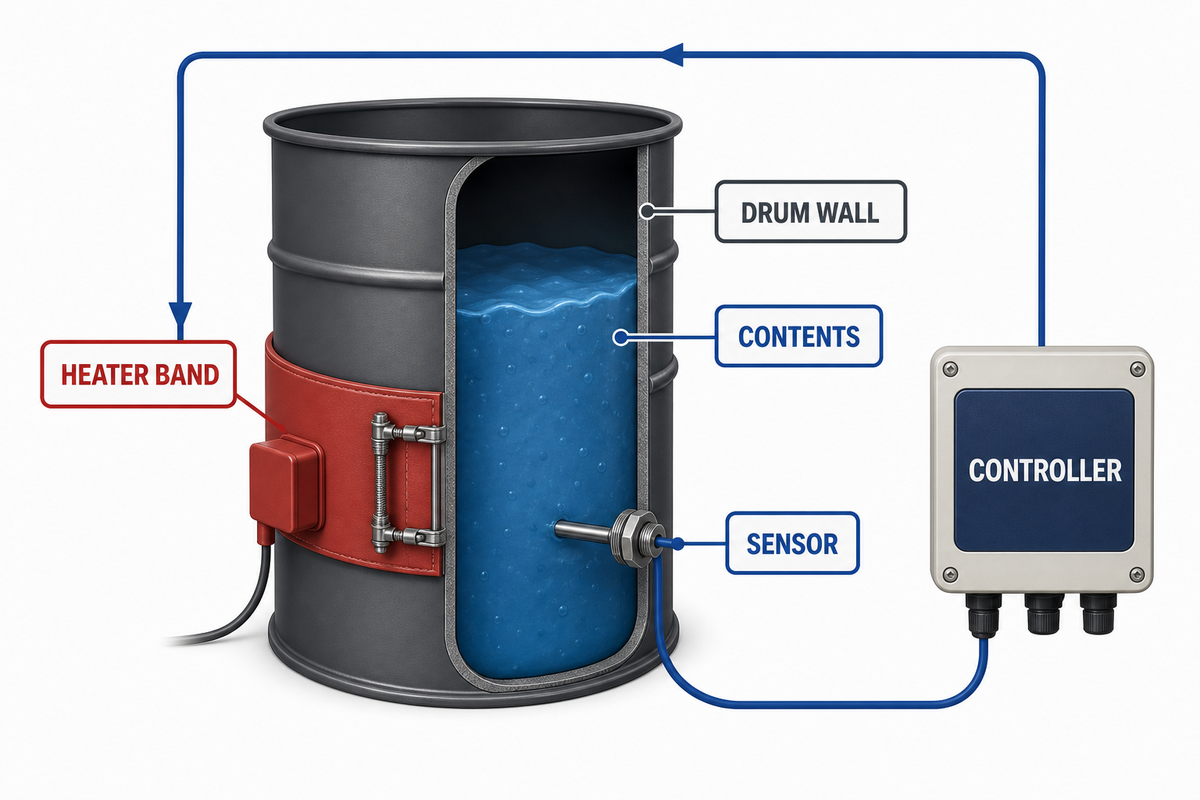
Silicone drum heaters convert electrical energy into heat at the drum surface. A thermostat or temperature controller responds to a sensor at one defined location. That arrangement can regulate a measured point, but it can’t by itself prove bulk-material temperature, uniformity, heat-up time, or suitability for the contents.
The useful unit of analysis is the installed thermal system. Silicone rubber carries the heating element and helps a heating band conform to the curved surface. Contact moves heat into the wall; the wall conducts it toward the contents; natural circulation or mixing redistributes it; insulation reduces loss; and feedback decides when power changes. A weak link anywhere in that chain can dominate performance.
| Part | Question it answers | What it does not prove |
|---|---|---|
| Heater | How electrical power becomes surface heat | Contents temperature |
| Contact | Where heat can cross the interface | Uniform pressure around the drum |
| Drum wall | Container-side temperature and conduction path | Material compatibility |
| Contents | Thermal mass, viscosity, phase, and hazards | A universal setpoint |
| Insulation | How exposed losses are limited | Safe washdown or weather exposure |
| Control | Which measured point governs power | Independent release acceptance |
Common mistake: treating an adjustable thermostat as a material-temperature guarantee. The display is meaningful only after the sensor location and controlled variable are named.
Construction language also needs boundaries. A silicone heating assembly may use fiberglass reinforcement inside a laminate, but those words don’t establish chemical resistance, ingress protection, or a permitted drum temperature. Request the exact construction record for the proposed unit.
Start With the Material and Heating Objective
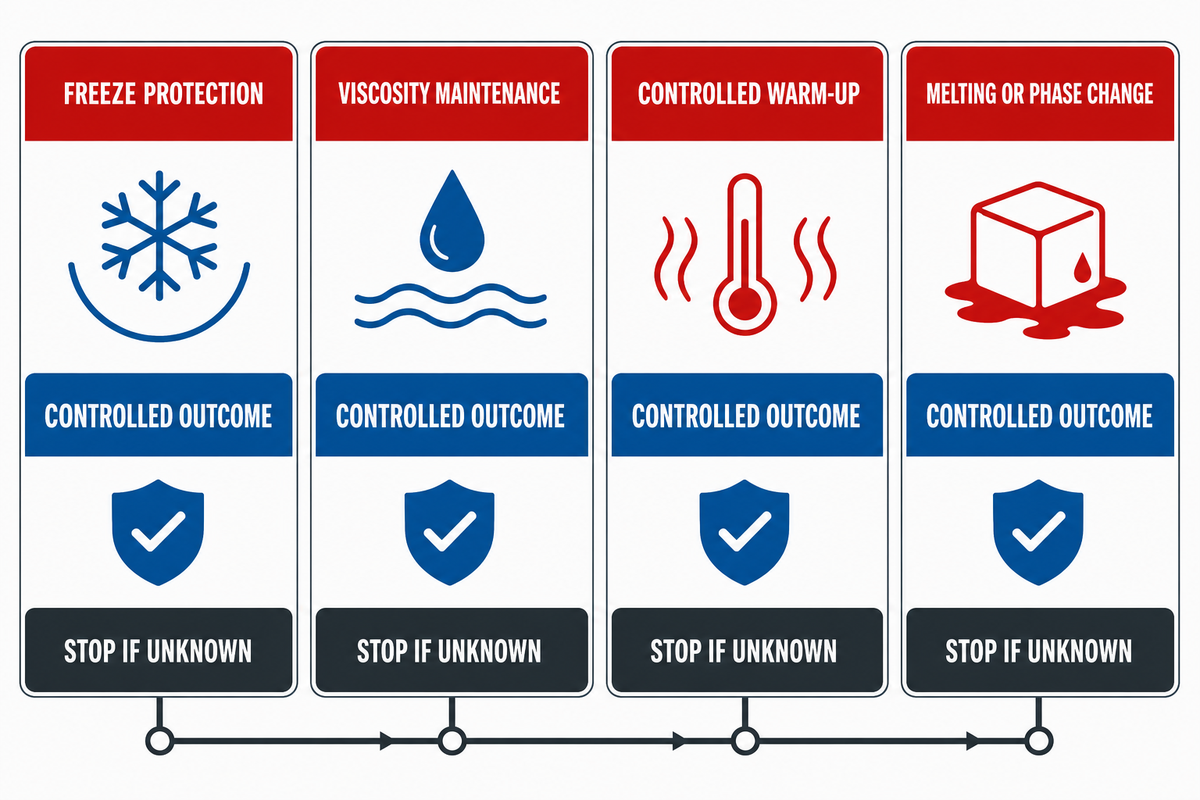
The first selection decision is the job, not the heater model. Freeze protection, viscosity maintenance, controlled warm-up, and melting describe different endpoints and failure modes. Write one duty sentence that names the material state, permitted temperature boundary, starting condition, target condition, and required time before requesting a configuration.
| Objective | Controlled outcome | Dominant question | Stop if unknown |
|---|---|---|---|
| Freeze protection | Stay above the validated low-temperature boundary | Worst ambient exposure and outage response | Material freeze behavior |
| Viscosity maintenance | Reach a handling or pumping condition | Which material temperature matters | Viscosity-temperature data |
| Controlled warm-up | Move between two validated states | Allowed rate, uniformity, and dwell | Temperature-sensitive limit |
| Melting or phase change | Supply latent as well as sensible heat | Phase data and local-overheat risk | Phase-change behavior |
Current Safety Data Sheet information is part of that brief, not documentation collected after purchase. Under OSHA Appendix D, Section 7 addresses handling and storage, Section 9 includes properties such as flash point, auto-ignition, decomposition temperature, and viscosity where applicable, and Section 10 covers stability, reactivity, hazardous reactions, and conditions to avoid. Those sections inform questions; they don’t give the heater permission to operate.
For viscosity control, define the handling result and the material temperature that proves it. Material can appear pumpable at the warm wall while the core remains viscous, so the release test should represent the part of the contents that actually enters the process.
Imagine two identical metallic drums stored next to each other. One contains a stable oil that merely requires lower viscosity for flow. The other contains a temperature-sensitive adhesive with a narrow process window. The same band can cause drastically different process risks because the release test, allowed wall temperature, and response to lack of circulation differ. “Keep warm” isn’t an acceptable duty statement for either.
Build the 8-Input Heat-Up Brief
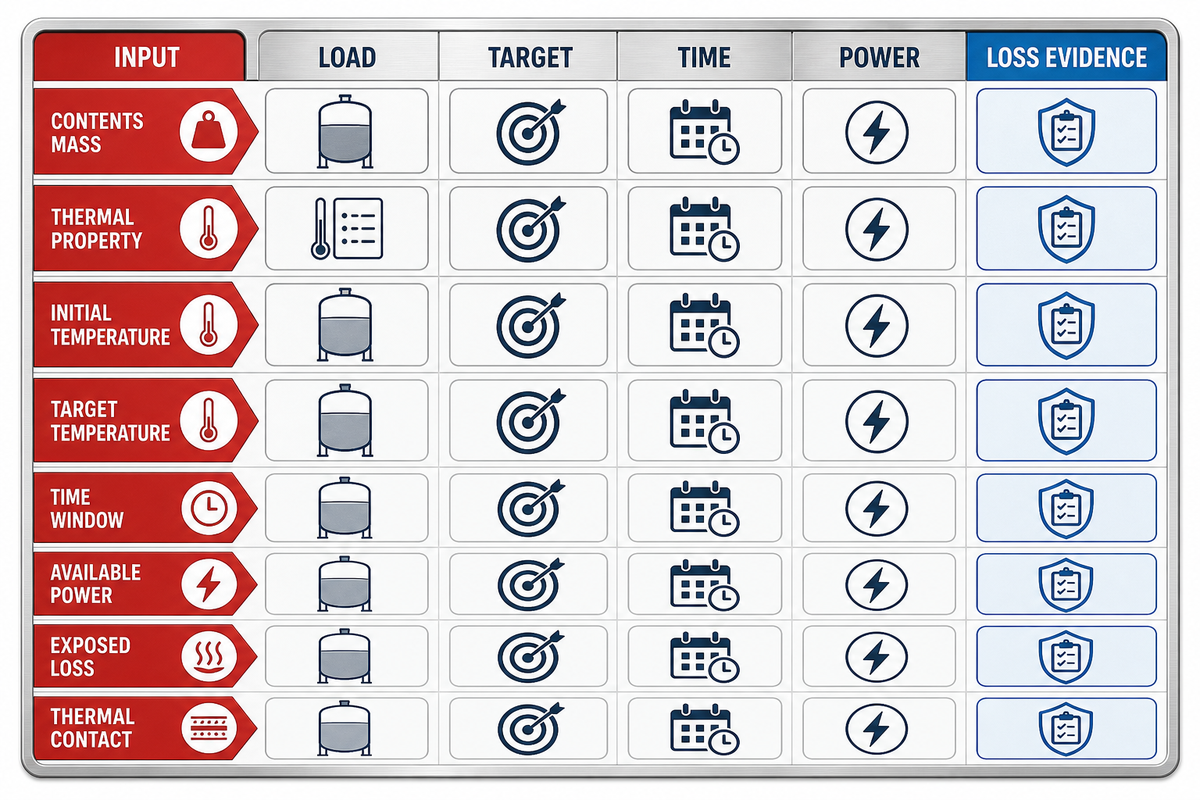
The 8-Input Heat-Up Brief is the minimum calculation handoff for a condition-bound estimate. It records the load, thermal property, starting and target states, time allowance, available power, exposed loss, and contact or insulation condition. Missing fields must be labeled unknown rather than replaced with a catalogue assumption.
8-Input Heat-Up Brief: A bounded worksheet separating known process inputs from assumptions prior to the supplier’s power or time estimates.
- State contents mass — record the actual batch mass in kg, not only nominal drum volume in L.
- Name the thermal property — use material-specific heat capacity in kJ/kg·K or mark the proxy and its source.
- Measure the start — record initial material and drum-wall temperature in °C.
- Define the target — name the release temperature in °C and which measurement proves it.
- Set the time window — state the allowed heat-up time in h and whether the duty is one-time or repeated.
- Confirm available power — record the proposed heater input in kW and the verified supply in V.
- Describe exposed loss — capture minimum ambient temperature in °C, wind, floor contact, lid exposure, and insulation.
- Describe thermal contact — note band width in mm, surface condition, air gaps, closures, and any obstacles.
For ideal sensible heating, the energy-balance starting equation is energy = mass × specific heat × temperature rise. Actual time is longer when energy leaves through the exposed drum or when contact and circulation restrict useful transfer. Melting, evaporation, or reaction requires additional terms. Therefore, a quick heat-up time from another material isn’t transferable.
Illustrative calculation, not a heater guarantee
Assume a nonreactive load of 100 kg, an assumed heat capacity of 4.0 kJ/kg·K, and a rise from 20 °C to 40 °C. Ideal energy is 100 kg × 4.0 kJ/kg·K × 20 K = 8,000 kJ. With an idealized 1.0 kW delivered entirely to the load, the lower-bound time is 8,000 kJ ÷ 1.0 kJ/s = 8,000 s, or about 2.22 h. Real time must add measured losses and transfer limits.
How long does it take for a tank heater to heat up?
Tank-heater heat-up time can’t be read from wattage alone. Estimate the ideal energy from mass, specific heat, and temperature rise; divide by the useful power reaching the load; then add heat loss, contact, circulation, phase-change, and control constraints. Validate the result during a controlled first cycle.
Useful supplier answers should expose assumptions. If an answer quietly substitutes a water-like property for a viscous or semi-solid material within a drum, assumes room ambient, or counts rated power as delivered load power, the output is a screening estimate rather than an acceptance commitment.
Choose the Heat-Transfer Method Before the Silicone Band

Method choice follows the dominant heat path, access needs, and material constraints. A narrow band heater concentrates surface input, a full coverage drum jacket spreads contact, and an immersion unit heats from within the contents. None is universally better, and the wrong family can’t be repaired by selecting a higher catalogue temperature.
| Method type | Heat path | Useful when | Maintenance access | Limitations / Not suitable for |
|---|---|---|---|---|
| Narrow silicone band | Localized wall contact | Bounded maintenance duty with a validated contact zone | High | Uniform bulk heating without circulation evidence |
| Wide silicone band | Broader wall contact | More contact is useful and geometry permits full seating | High | Drums with ribs, dents, or obstacles under the band |
| Multiple bands | Several wall zones | Manufacturer allows coordinated zoning and load | Medium | Unverified spacing, overlap, sensor, or circuit capacity |
| Full-coverage drum heating blanket | Distributed wall contact plus insulation | Loss reduction and broader coverage drive the duty | Medium | Frequent washdown or access unless the exact design permits it |
| Base heater | Bottom-wall input | Stable support and bottom-up circulation are validated | Low while loaded | Unstable drums or poor bottom contact |
| Immersion heater | Directly inside material | Wetted compatibility and insertion access are approved | Low to medium | Contamination-sensitive or incompatible contents |
| Warming cabinet | Heated enclosure and air | Batch staging and enclosure controls fit the process | High after unloading | Point-of-use portability or unapproved atmospheres |
| Heated room | Whole-space ambient control | Many containers share a stable storage objective | High | Fast individual heat-up or mixed incompatibilities |
| IBC tote heating system | Container-scale distributed contact | The process container is an IBC rather than a drum | Container dependent | Forcing a drum-sized band onto tote geometry |
If a silicone band remains the right heat path, compare verified silicone drum heater configurations on the commercial solution page before building the request for quotation.
Terminology check: search results often group silicone rubber drum heaters with a pail heater, bucket heater, full coverage drum heaters, tubular heaters, and an oil drum heater. Those product families don’t share one heat path. “Drum heater band,” “band with temperature controller,” and “gallon drum heater” are also listing phrases, not proof of fit or process suitability.
Search systems also mix “barrel heater,” “drum warmer,” “plastic drum heater,” “silicone heaters,” “silicone heating pad,” and “silicone heating blankets.” Those phrases describe different container scales, contact areas, or product families, so each result still needs the duty and fit checks in this guide.
Supplier language such as “drum immersion heaters are ideal” needs a condition after it. Ideal for which contents, access method, cleanliness requirement, heat flux, and maintenance procedure? Product-family selection is an engineering boundary, not a ranking exercise.
Match Drum Size, Material, and Contact Area
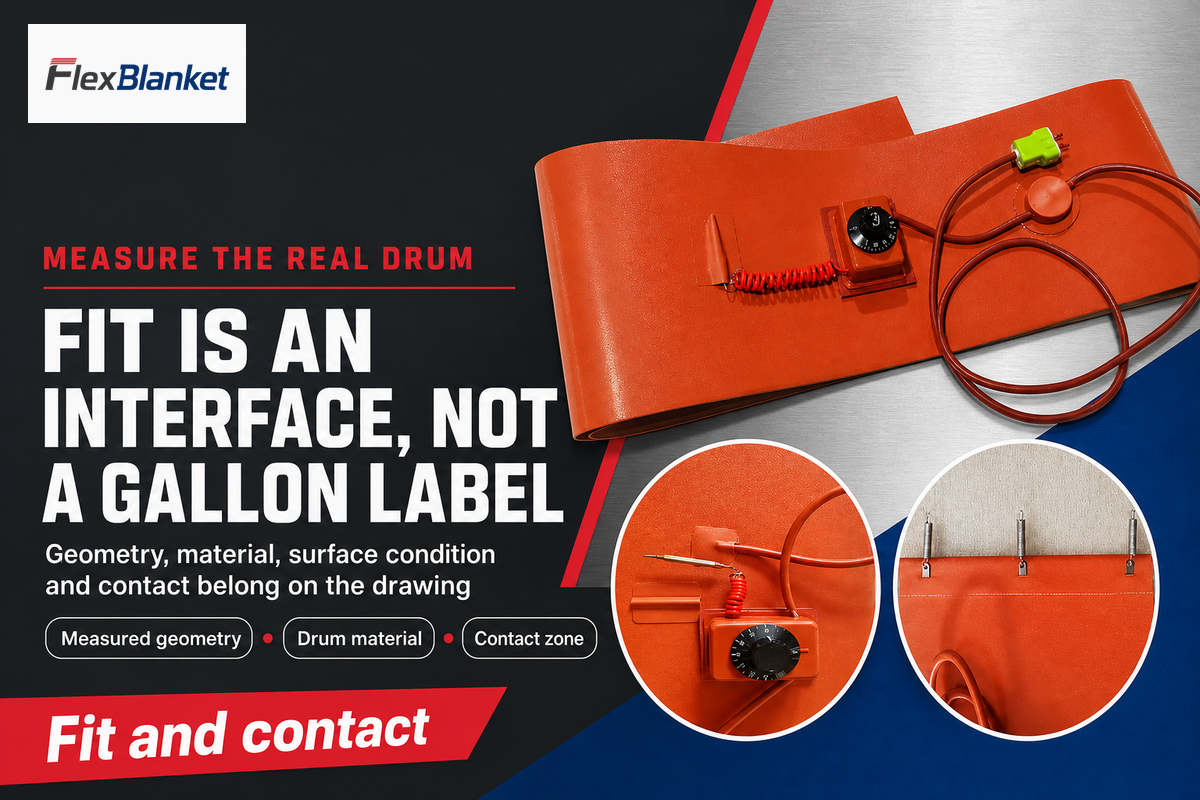
Fit is a measured interface, not a nominal gallon label. Record circumference or diameter, usable straight-wall height, drum material, surface condition, ribs, seams, closures, and obstacles. A heater that can wrap around a drum may still bridge air gaps, load an edge, or contact a damaged wall.
Nominal labels such as 55 gallon drum, 55-gallon overpack, and 200 L container don’t establish the same geometry. Measure the actual unit. For metal drums, check coating, dents, corrosion, and permitted wall temperature. For plastic buckets or polymer drums, obtain the drum manufacturer’s continuous-service and contents limits; the heater’s high temperature range doesn’t override them.
Catalogues may use the phrase “variety of standard sizes,” but “silicone rubber drum and pail” still needs a dimensional drawing. Standard availability is useful only after the measured contact zone and closure travel match the container.
Nominal coverage also differs from effective thermal contact. NASA’s thermal-interface guidance, used here only for the physical mechanism, treats conductance as dependent on effective area and interface conditions rather than apparent area alone. Drum selection must therefore ask about tension, surface finish, seams, air gaps, and contact pressure without transferring aerospace values.
Scale matters too. A pail and bucket heating solution is the simpler starting point for a 5 gallon container, while custom silicone rubber heaters suit shapes that don’t match available drum bands. Choose a family to minimize the temptation to squeeze a stock size into a poor contact.
Can I use the 55-gallon heater on a plastic drum?
Sometimes, but permission begins with the exact plastic drum and contents, not the heater’s maximum range. Verify wall construction, mechanical condition, the drum manufacturer service limit, chemical compatibility, contact pattern and an approved control scheme. Then confirm both wall and material temperature during the initial cycle.
The controller ceiling isn’t permission to run polymer at that value. Stop if the container softens, distorts, loses contact, shows stress, or lacks a documented service boundary. For a sensitive material, add an independent contents measurement and release criterion rather than relying on digital temperature control at the band.
Use the Control Point Separation Map
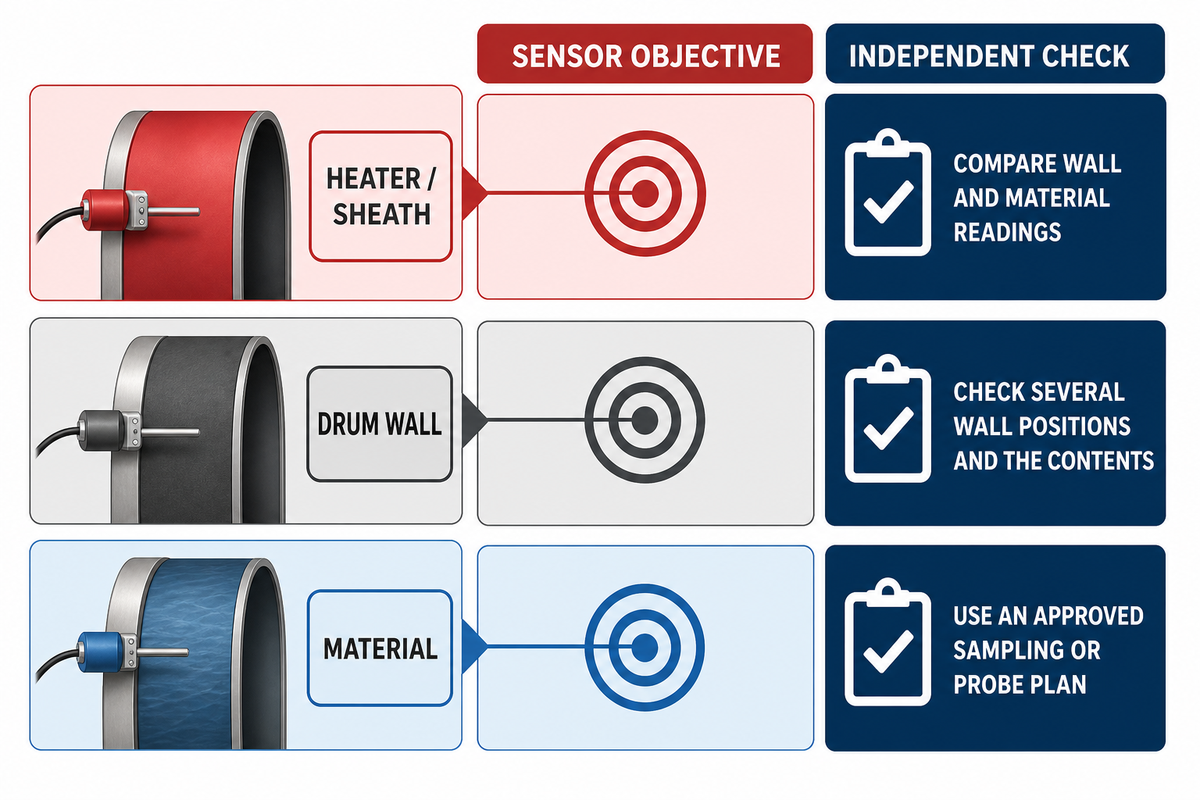
The Control Point Separation Grid sorts heater or sheath temperature, drum-wall temperature, and material temperature. Each reading answers a different question and may need a different sensor location. Control is defensible only when the primary feedback, protective limit and independent release measure are explicitly designated.
Control Point Separation Grid: a three-layer record that prevents one convenient sensor reading from standing in for the whole thermal system.
| Temperature | Typical sensor objective | Risk if confused | Independent check |
|---|---|---|---|
| Heater / sheath | Protect the heating element or interface | A protected heater is assumed to mean ready contents | Compare wall and material readings |
| Drum wall | Bound the container surface or contact zone | Local wall temperature is treated as bulk temperature | Check several wall positions and the contents |
| Material | Prove the process or transfer condition | One point misses stratification or a cold core | Use an approved sampling or probe plan |
This map is a verification framework synthesized from several heater and control contexts. It isn’t an industry-standard sensor-placement rule, and none of the cited apparatus dimensions or setpoints transfers to a storage drum. Product instructions and the site’s process-safety review decide the actual placement.
“The temperature of the internals in the heater are of possible concern.”
Rhinehart’s article compares controller hierarchy in a fired-heater example, not a drum band. The portable point is limited: process temperature and heater protection may require different control goals. It doesn’t outline FlexBlanket wiring, setpoints or sensor positions.
A common diagnostic pattern is “the thermostat says ready, but the pump still struggles.” The display may be responding to a warm wall directly under the band while the viscous core remains cooler. Adding a second band could increase local wall stress without fixing mixing or feedback. First compare heater, wall, and material readings against the release definition.
Trace the Hidden Thermal Bottleneck
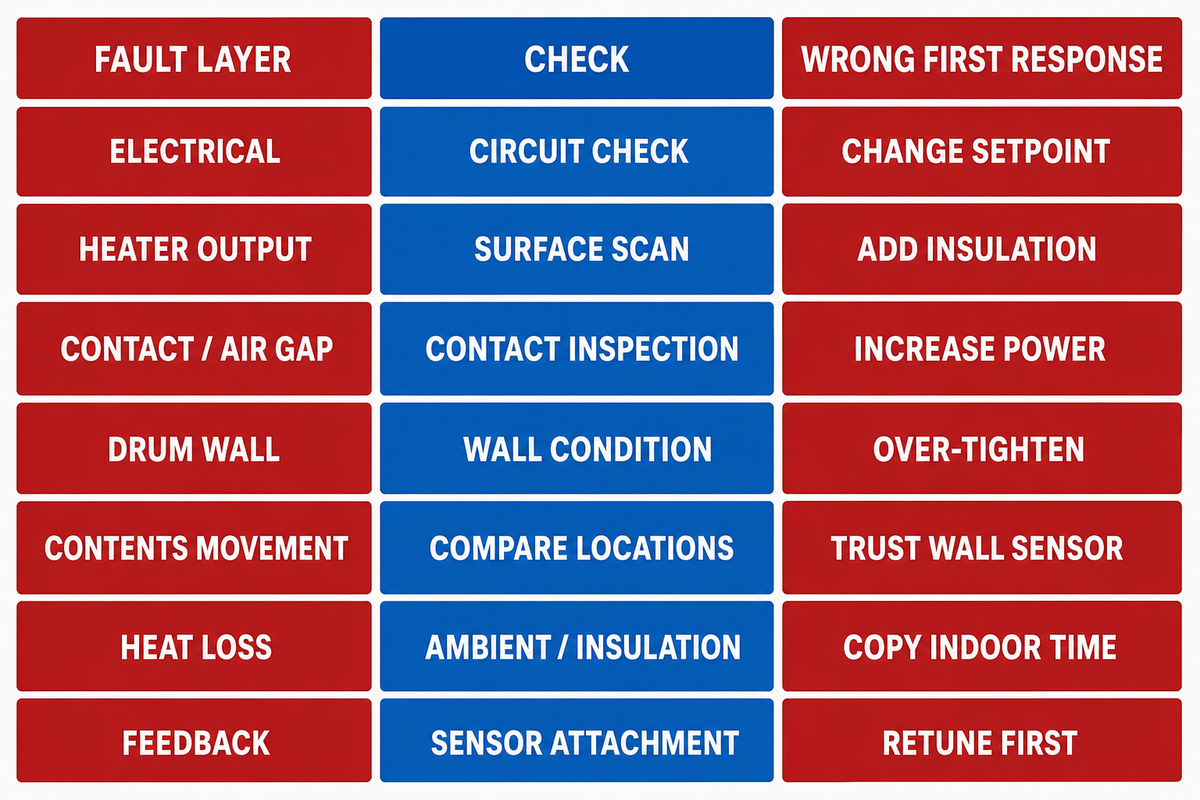
The Drum Heat-Path Fault Chain follows useful heat from electrical input through heater distribution, contact, drum wall, contents movement, exposed loss, and feedback. The slowest or least controlled layer governs the practical result. More power helps only when that layer can accept and distribute additional heat safely.
Drum Heat-Path Fault Chain: a failure chain that finds where usable heat transfer is being limited before power is increased.
| Layer | Observed symptom | Discriminating check | Wrong first response |
|---|---|---|---|
| Electrical input | No or intermittent rise | Qualified electrical verification against nameplate and instructions | Changing the process setpoint |
| Heater distribution | Uneven surface pattern | Approved surface-temperature survey | Adding insulation over an unresolved fault |
| Contact / air gap | Band hot, wall response weak | De-energized fit and surface inspection | Increasing wattage |
| Drum wall | Local hot zone near obstacle | Material, coating, dent, seam, and wall-temperature review | Tightening past the product instruction |
| Contents circulation | Wall hot, material core cold | Compare approved material locations over time | Trusting the wall sensor |
| Exposed loss | Works indoors, stalls outdoors | Record ambient temperature, wind, floor, lid, and insulation condition | Copying the indoor heat-up time |
| Feedback | Overshoot or short cycling | Confirm sensor attachment and the controlled variable | Retuning before checking placement |
Although an insulated drum can reduce exposed loss, wet, displaced, or badly fitted insulation can affect both the operating behavior and the inspection accessibility. “Easy to clean” does not in itself reflect a property of the system unless the specific band, lead, controller, connectors, and cleaning procedures used are addressed within the scope of the claim.
Use the Safety Screen Before Energizing
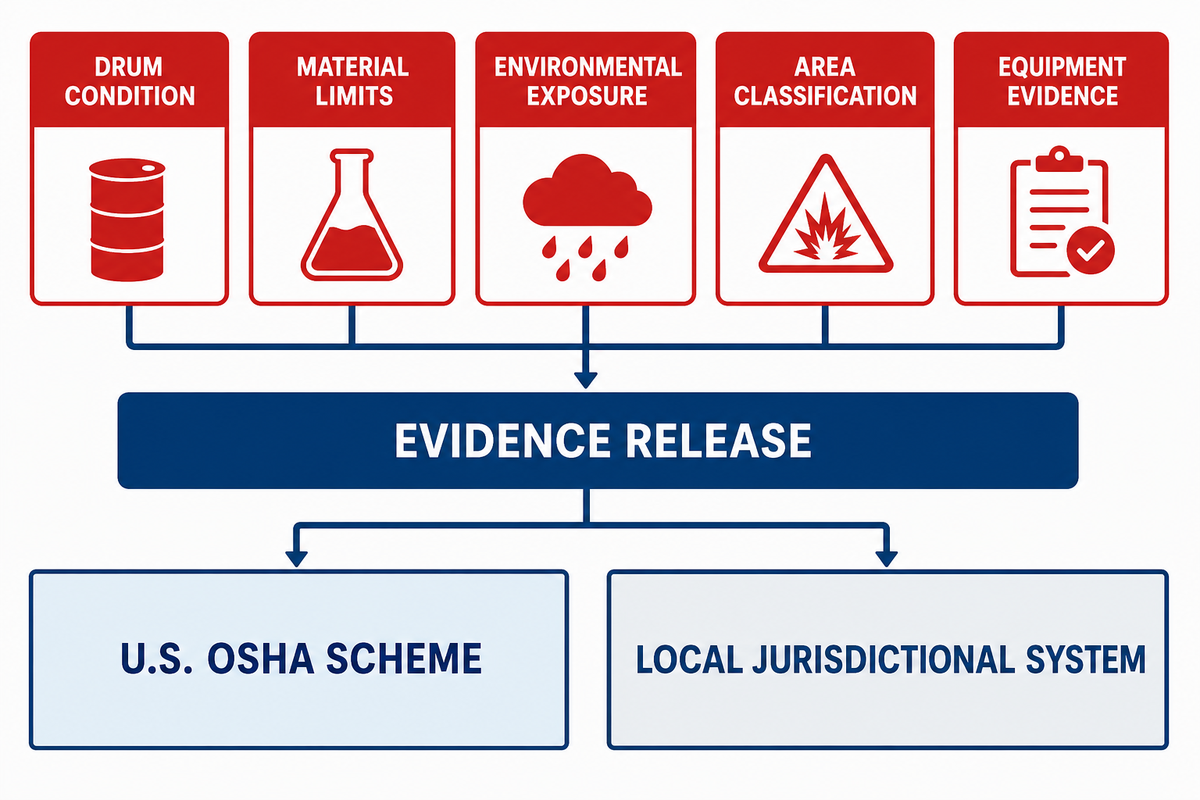
The Pre-Energization Evidence Hold blocks energization when drum condition, material limits, environmental exposure, area classification, or matching equipment evidence is unresolved. It’s a pre-start decision aid, not a certification. Each row needs site-specific documentation from the responsible process, electrical, and safety personnel.
Pre-Energization Evidence Hold: five unresolved conditions that keep a drum-heating installation de-energized until evidence closes the gap.
Do
- Inspect the empty or loaded drum condition before fitting.
- Review current SDS and container service limits.
- Match the complete system to water and cleaning exposure.
- Document ordinary or classified location status.
- Use product instructions and site electrical procedures.
Don’t
- Energize over a dent, leak, residue, or unknown surface.
- Treat silicone as universally resistant to chemicals.
- Read IP65 as immersion or explosion protection.
- Infer approval from a generic standard reference.
- Assume one thermostat makes unattended duty safe.
| Source | What it answers | What it does not answer |
|---|---|---|
| OSHA 1910.1200 Appendix D | Required SDS information structure | A safe setpoint for a specific batch |
| OSHA 1910.307 | Classified-location documentation and equipment boundaries | Classification of the reader’s site |
| IEC 60529 / IP code | Solids and water ingress classification | Chemical resistance or hazardous-location approval |
| ASTM C1055-20 | Framework for heated-surface contact-burn assessment | One universal safe-touch temperature |
| IEEE/IEC 62395-1:2024 | Trace and surface-heater safety and test scope | Explosive-atmosphere approval or FlexBlanket conformity |
Ordinary location and classified location are separate branches. A generic drum heater used in an ordinary dry area still needs electrical, temperature, container, and material review. For U.S. installations, match the documented class, group, and temperature conditions under the applicable OSHA scheme; elsewhere, use the jurisdiction’s classified-area and equipment-marking system. An IP rating can’t bridge that gap.
Can I use the heater on an empty drum?
Don’t energize an empty drum unless the exact heater instructions, drum construction, control arrangement, and site procedure explicitly permit that state. Removing the contents changes the heat sink and can drive wall or heater temperature away from the validated loaded condition.
The same stop applies when a drum is drained during operation, moved under an energized band, or loses contact. Define the shutdown and restart response before use. ASTM C1055 also makes clear that acceptable surface temperature depends on contact time and system context; it does not supply one touch-safe number for every installation.
Commission and Diagnose the First Heat Cycle
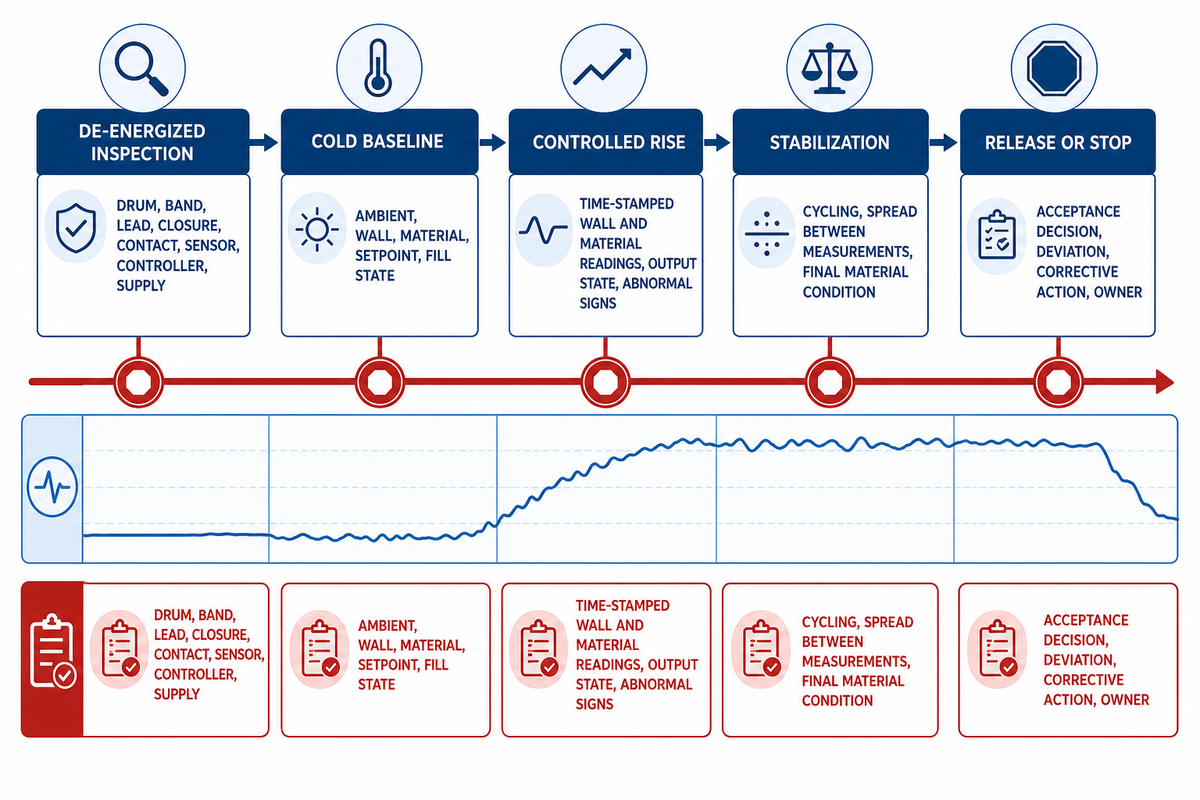
The first heat cycle converts assumptions into site evidence. Record the de-energized condition, cold baseline, controlled rise, stabilization behavior, heater or wall readings, material readings, controller output, and release or stop decision. Routine use begins only after the observed system matches its defined duty and safety limits.
Illustrative log format only:
At 0 min, note ambient -5 °C, wall 15 °C, and material 15 °C. A hypothetical record might next show 30 min at wall 22 °C and material 18 °C, 60 min at wall 28 °C and material 22 °C, then 120 min at wall 36 °C and material 30 °C. These values demonstrate separation of readings; they aren’t a safe trajectory or acceptance criterion.
| Stage | Record | Release question |
|---|---|---|
| De-energized inspection | Drum, band, lead, closure, contact, sensor, controller, supply | Does the physical installation match instructions? |
| Cold baseline | Ambient, wall, material, setpoint, fill state | Are the starting assumptions true? |
| Controlled rise | Time-stamped wall and material readings, output state, abnormal signs | Is useful heat reaching the load without exceeding limits? |
| Stabilization | Cycling, spread between measurements, final material condition | Does the chosen feedback hold the process objective? |
| Release or stop | Acceptance decision, deviation, corrective action, owner | Can the evidence support routine or unattended duty? |
Suppose a band warms rapidly, the wall beside the sensor rises, and the material probe barely changes. That pattern points toward contact geometry, sensor bias, contents circulation, or exposed loss before it points toward insufficient nameplate power. If the controller overshoots, verify sensor attachment and measurement purpose before changing tuning. If the lead, silicone laminate, closure, or surface shows damage, de-energize and follow the manufacturer and site isolation procedure.
For power consumption, record actual energized behavior through a qualified measurement method instead of multiplying rated power by elapsed clock time and assuming continuous output. Cycling, voltage, control mode, ambient load, and interruptions can change the result. Listings may compress 120 V to “120v,” but either notation is still not evidence that the proposed heater, connector, overcurrent protection, or branch circuit is correct for the site. A 50 Hz or 60 Hz supply label also needs exact equipment and site verification.
As an arithmetic check, 1.5 kW at 120 V corresponds to 12.5 A, while the same 1.5 kW at 240 V corresponds to 6.25 A. At full output for 30 min, the energy is 0.75 kWh; for 60 min, it is 1.5 kWh. At a hypothetical 50% duty cycle over 8 h, the arithmetic total is 6 kWh; over 24 h, it is 18 kWh. Qualified electrical review must still size the branch circuit and protection.
Score the RFQ Without Repeating the Product Catalogue
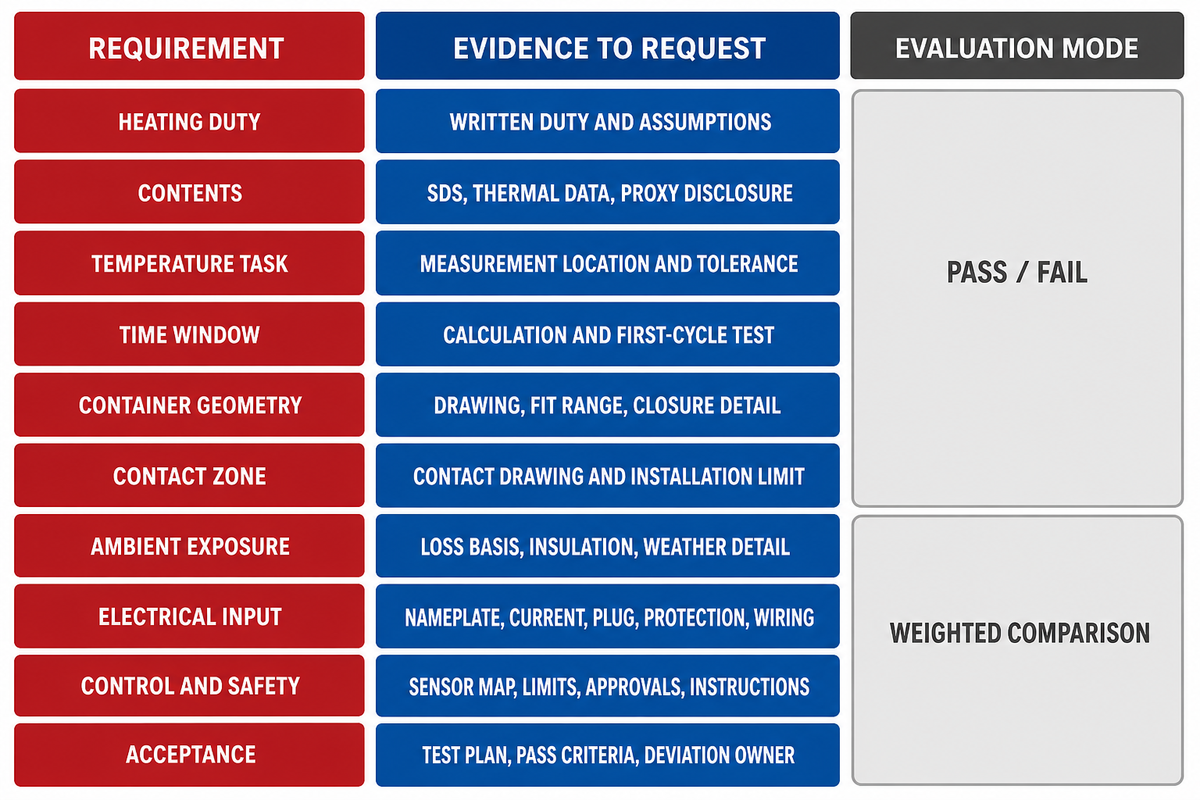
The Duty-Bound Evidence Grid tests whether each proposal is tied to the buyer’s duty, geometry, material, control objective, environment, and acceptance method. Use pass/fail when minimum technical acceptability is the real decision. Use weighted comparison only when better-than-minimum performance creates a defined tradeoff and factor importance is stated.
Duty-Bound Evidence Grid: a procurement table that compares the strength of duty-bound evidence rather than maximum catalogue numbers.
| Requirement | Example input syntax | Evidence to request | Pass/fail question | Limitations / Not suitable for |
|---|---|---|---|---|
| Heating duty | Maintain, warm, or melt | Written duty and assumptions | Does the proposal answer the stated job? | Generic “keep warm” answer |
| Contents | Hypothetical 180 kg batch | SDS, thermal data, proxy disclosure | Are material limits explicit? | Unknown chemistry or phase |
| Temperature task | Hypothetical 15 °C to 40 °C | Measurement location and tolerance | Is the controlled variable named? | Only a thermostat range |
| Time window | Hypothetical 8 h | Calculation and first-cycle test | Are losses and phase terms visible? | Unbounded heat-up promise |
| Container geometry | Hypothetical 1,200 mm circumference | Drawing, fit range, closure detail | Does the heater seat on the real drum? | Nominal gallon size only |
| Contact zone | Hypothetical 100 mm usable band width | Contact drawing and installation limit | Are ribs and seams excluded? | Bridged or damaged surface |
| Ambient exposure | Hypothetical minimum -5 °C | Loss basis, insulation, weather detail | Is worst credible exposure included? | Indoor assumption for outdoor duty |
| Electrical input | Hypothetical 120 V, 1.5 kW | Nameplate, current, plug, protection, wiring | Does the whole circuit match? | Voltage label without site review |
| Control and safety | Wall control plus material release | Sensor map, limits, approvals, instructions | Are failure responses defined? | One sensor assumed to prove all states |
| Acceptance | Recorded first heat cycle | Test plan, pass criteria, deviation owner | Can both parties verify success? | Marketing claim without test method |
Formal procurement systems illustrate why both modes exist. The United States Federal Acquisition Regulation describes a lowest-price-technically-acceptable method in which non-price factors are judged acceptable or unacceptable rather than ranked. Its broader evaluation rules also require stated factors and relative importance. Private industrial buyers aren’t governed by those provisions; the useful analogy is to choose a mode deliberately.
Models, exact ratings, price, lead time, factory evidence, and quotation ownership remain on the commercial solution page. This guide owns the selection method, commissioning logic, and evidence questions.
Frequently Asked Questions
How do silicone drum heaters work?
Answer
A silicone drum heater uses an internal resistance element to produce surface heat. Laminate and reinforcement construction vary by unit and should be confirmed from the exact construction record. Close contact helps heat cross the wall, while a thermostat or controller changes power from a sensor reading. That reading doesn’t automatically equal contents temperature, so the installed system still needs defined feedback, insulation, and first-cycle verification.
Can silicone drum heaters be used on plastic drums?
Answer
Sometimes. Confirm the exact polymer drum, wall construction, manufacturer’s continuous-service limit, contents, mechanical condition, heater permission, and control method. Maintain the specified contact and validate both wall and material temperature during the first cycle. A heater’s maximum controller range doesn’t authorize the plastic drum to operate at that temperature, and any softening, distortion, or loss of contact is a stop condition.
Is an IP65 drum heater waterproof?
Answer
No. IP65 addresses dust and water-jet ingress under defined test conditions. It doesn’t establish immersion, flooding, high-pressure washdown, chemical resistance, or hazardous-location approval, and it doesn’t prove every component in the installed system has the same rating. Match exact evidence to the real cleaning, weather, connector, cable-entry, and controller exposure before energizing.
Can two heater bands be used on one 55-gallon drum?
Answer
Only when the heater manufacturer and site procedure allow that arrangement. Check spacing, overlap restrictions, individual or coordinated control, sensor placement, drum material, total electrical load, and the effect on the contents. Validate wall and material temperatures instead of assuming two bands divide heat evenly.
Should a drum heater be left on overnight?
Answer
There is no universal yes. Approval depends on material limits, drum condition, heater instructions, controller architecture, independent over-temperature protection, site electrical rules, area classification, and credible failure response. If the installation has not been validated for unattended operation, treat the answer as no. Before approval, document what happens if the sensor loses contact, controller output remains energized, insulation becomes wet, the drum is emptied or moved, power returns after an outage, or circulation stops. Define alarm, shutdown, inspection, and restart ownership for each case. The first-cycle record should compare heater or wall readings with material temperature at the proposed duty. Responsible site electrical and process-safety personnel, not the thermostat setpoint, decide whether unattended service is acceptable.
What information should be sent for a drum-heater quote?
Answer
Send the heating objective, contents and mass, starting and target temperatures, allowed time, drum material and measured dimensions, minimum ambient condition, insulation and exposure, available electrical supply, controlled variable, sensor location, cleaning or weather exposure, area classification, and acceptance test. Add the current SDS, container drawing, supply details, and named approval requirements. This binds the quote to duty rather than nominal gallon size or a catalogue maximum.
Key takeaway
Choose a silicone drum heater from a verified duty and acceptance test backward; a catalogue maximum cannot replace material, contact, control, safety, and commissioning evidence.
Turn your duty brief into a reviewable heating proposal

Compare commercial configurations on the solution page, then share the material, drum, environment, control objective, and acceptance criteria with FlexBlanket.
Review Silicone Drum Heater ConfigurationsAsk FlexBlanket About Your Duty
Editorial and evidence note
This guide separates general engineering and procurement methods from FlexBlanket-specific product claims. Standards and third-party research are attributed to their owners. No named-customer relationship, product certification, universal safe temperature, guaranteed heat-up time, or hazardous-location approval is asserted without exact supporting evidence.
References & Sources
- Process Heat Basics, United States Department of Energy
- Energy Balances, Colorado State University
- Safety Data Sheets, Appendix D to 1910.1200, Occupational Safety and Health Administration
- Flexible-heater thermal distribution study, peer-reviewed research archived by the National Library of Medicine
- Feedback-location study for a flexible heater, peer-reviewed research archived by the National Library of Medicine
- Surface and internal temperature measurement protocol, peer-reviewed research archived by the National Library of Medicine
- Ensuring the Right Controller Is in Charge, Control Global
- 29 CFR 1910.307, Hazardous Locations, Occupational Safety and Health Administration
- ASTM C1055-20, ASTM International
- IEEE/IEC 62395-1:2024, IEEE Standards Association
- IEC explanation of ingress protection codes, International Electrotechnical Commission
- FAR 15.101-2, Lowest Price Technically Acceptable, United States Acquisition.gov