Get in touch with FlexBlanket Company

Updated August 2026
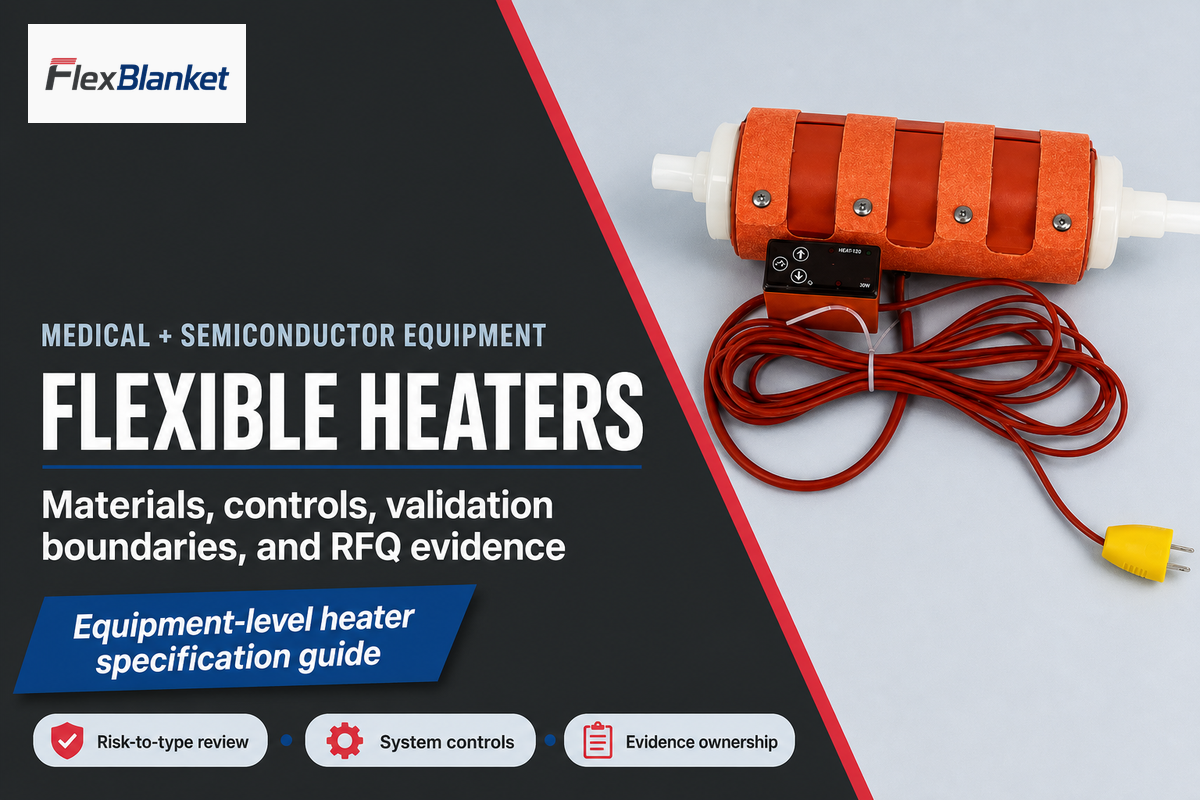
Flexible Heaters for Medical & Semiconductor Equipment are component-level thermal systems specified for controlled heat in finished-device medical products, diagnostic equipment, semiconductor tools or related assemblies. The real sourcing question is whether the heater material, circuit pattern, sensor path, controls, exposed surfaces, cable routing and evidence records fit the host equipment’s duty.
Direct answer: Flexible heaters are thin, bendable electric heating elements used to add controlled heat to surfaces, assemblies, fluid paths or components. Medical and semiconductor buyers should choose them through a risk-to-type review, then request system-level RFQ evidence before prototype release.
Quick Specs
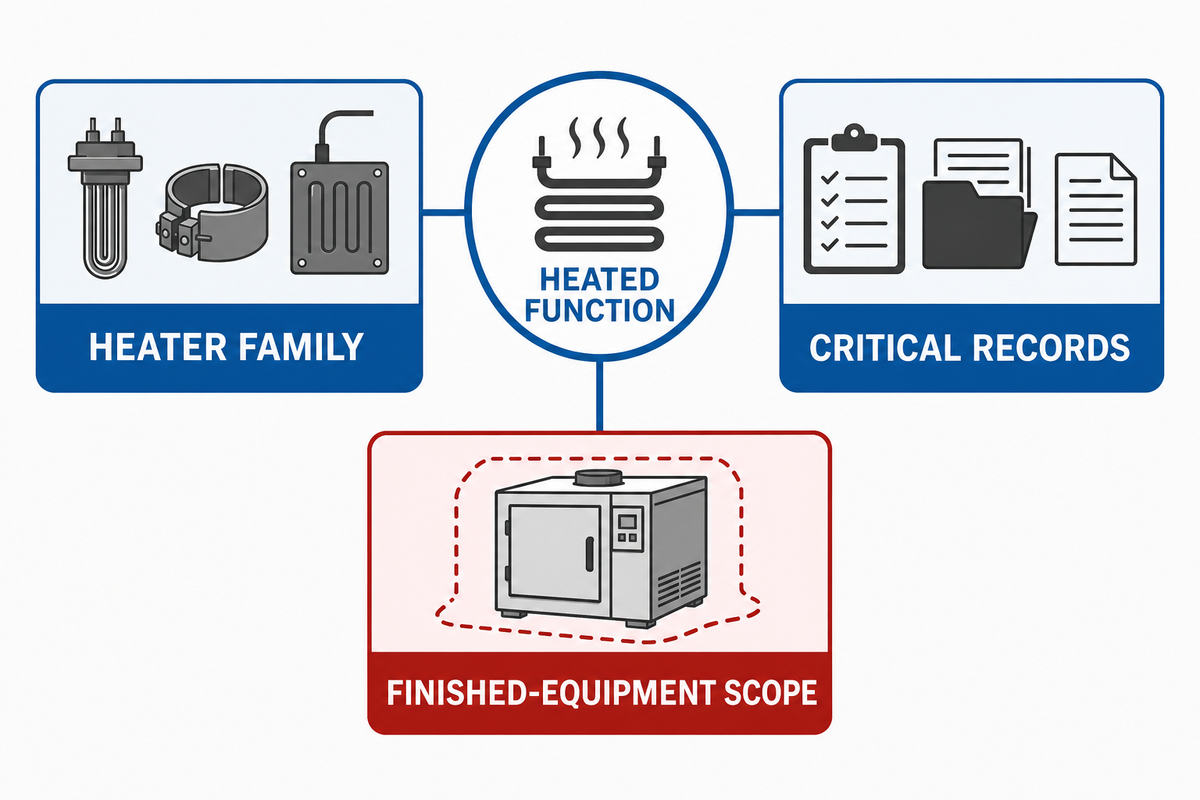
- Best first question: What function is being heated: patient-contact surface, diagnostic fluid path, valve body, gas line, chamber hardware or enclosure?
- Primary heater families: silicone rubber, polyimide or Kapton-family film, etched foil, wire wound, printed circuits and removable heater jackets.
- Critical records: voltage, watt density, thermal load, sensor type, control limits, dielectric test, insulation resistance, exposure conditions and validation owner.
- Scope warning: FDA, IEC and SEMI references help frame evidence. They do not make a standalone heater a cleared medical device or qualified semiconductor tool.
Key takeaways
- Material choice follows the application risk. Polyimide wins in tight, low-mass builds only when bend, adhesive and dielectric limits fit.
- Silicone rubber heaters remain strong for contact, durability and wet or rough surfaces, but watt density and surface coupling still need review.
- Semiconductor buyers should not treat heater-surface uniformity as wafer or process-temperature proof.
- Medical buyers should keep biocompatibility, reprocessing and electromagnetic compatibility at the finished-equipment level.
- Move quote requests beyond six starter fields into a 10-domain heater-system evidence pack.
Engineering note: Flexible heaters offer uniform heat distribution only when contact pressure, sensor location and insulation match the load; in medical and semiconductor devices, heaters are used to stabilize surfaces rather than prove process uniformity by themselves. The FlexBlanket project-site heater specification sheet cited here should be treated as page-specific supplier evidence: its silicone-heater rows provide dimensions, power-density range, operating-temperature range, supply-voltage choices, ingress-protection wording and dielectric-withstand wording for drawing review, not a guarantee that any finished medical or semiconductor system is compliant. NASA-style outgassing screens use 125°C for 24 hours with a 25°C collector, so the RFQ should name the test condition rather than ask for “low outgassing” in general.
Where flexible heaters fit inside medical and semiconductor equipment
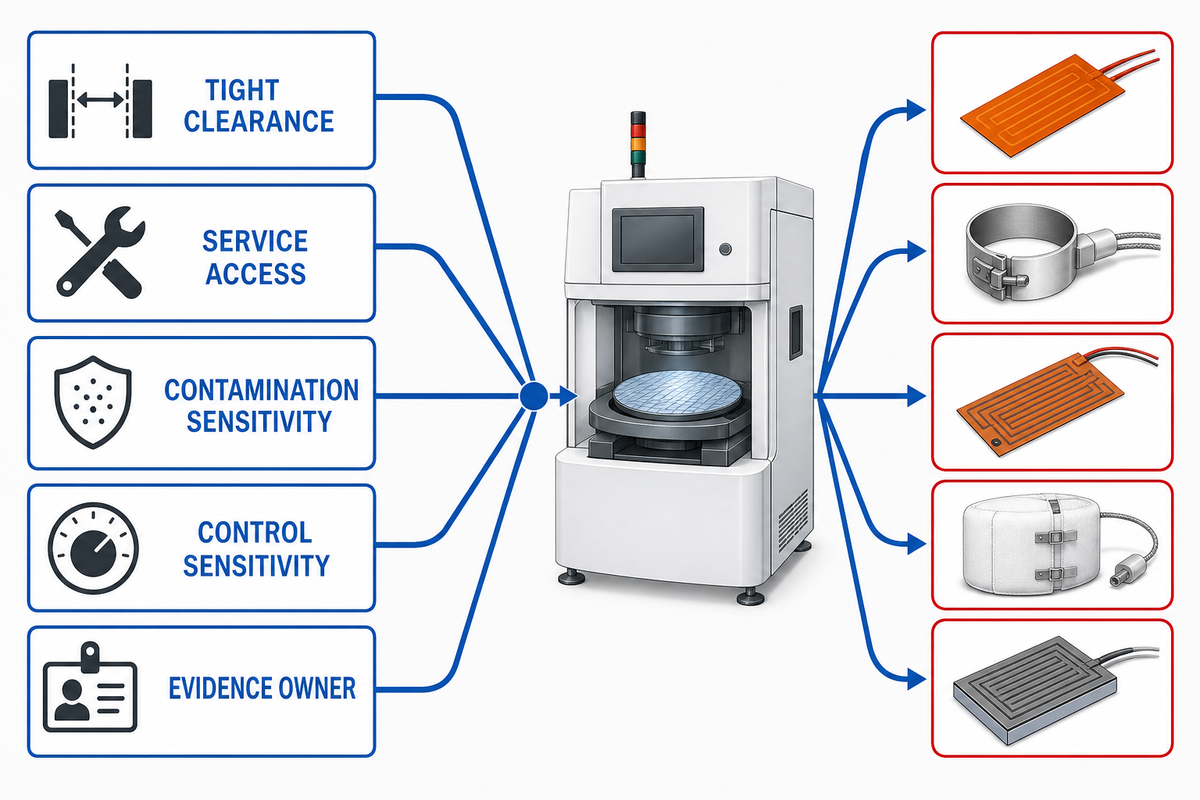
Flexible heaters fit medical and semiconductor equipment when a flat, curved or irregular surface needs controlled heat close to the target. Across this wide range of applications, heaters are designed as equipment inputs rather than standalone compliance artifacts. The heater is one part of the thermal design. It should be specified with the host assembly, power supply, controller, sensor, mounting surface and validation file in view.
In medical equipment, a diagnostic module may need stable heat around a reagent path. Semiconductor gas boxes may need temperature control around a valve or line. Both cases use a flexible heating element, yet the approval path, contamination risk and evidence owner are different. The supplier can document heater construction and test records; the equipment maker still validates the finished medical or semiconductor system.
FlexBlanket’s public product pages describe custom flexible heaters, silicone rubber heaters and related heating solutions for industrial equipment. Use those pages as a specification starting point, then add the missing application record: heated object, drawing, temperature target, voltage, control method, exposure and acceptance criteria.
Dual-Industry Risk-to-Type Selector
The Dual-Industry Risk-to-Type Selector maps the risk first, then the heater type. That order keeps buyers from asking for a material family before the duty is known.
| Risk type pattern | Medical clue | Semiconductor clue | Likely heater path | Evidence to request | Not suitable for |
|---|---|---|---|---|---|
| Tight clearance | PCR or diagnostic cartridge zone | Sensor module or compact enclosure | Polyimide etched foil | Drawing, bend route, dielectric check | Rough surfaces or repeated abrasion |
| Wet or rough contact | Washdown-adjacent device housing | Utility cabinet or non-process cover | Silicone rubber heater | Ingress rating, adhesion, strain relief | Minimum-thickness assemblies |
| Uniform local heat | Reagent or sensor zone | Line, valve or plate heater | Etched foil pattern | Pattern drawing, thermal map, sensor plan | Unknown heat-sink geometry |
| Service access | Replaceable warmer cover | Valve or gas-line maintenance | Removable jacket | Closure, leads, connector, fit-up record | Permanent bonded surfaces |
| High contamination sensitivity | Sterile or reusable device boundary | Vacuum or process-adjacent surface | Material-reviewed custom build | Material, cleaning, outgassing and batch data | Catalog substitution without validation |
| Control sensitivity | Patient or diagnostic temperature limit | Process stability target | Heater plus sensor/control stack | RTD or thermocouple path, alarm, cutoff | Open-loop power only |
| Current or voltage limit | Battery or low-voltage module | Tool cabinet power constraint | Resistance-matched custom circuit | Voltage, resistance, wattage, fuse limit | Power chosen after heater layout |
| Lead exit conflict | Compact cartridge or tray | Tight valve manifold | Custom lead and strain-relief design | 3D clearance, connector, bend radius | Flat drawing with no cable route |
| Finished-equipment validation | Medical electrical equipment | Semiconductor process tool | Supplier evidence plus integrator test plan | Owner, standard, test method, acceptance | Component approval language |
Evidence capsule: FDA’s biocompatibility page says device review is for the final finished medical device, while NIST reports RTP wafer-temperature effects up to 25 deg C from measurement geometry. Those 2 facts explain why the selector starts with system risk, not heater material.
Kapton and polyimide heaters for tight spaces and fast thermal response
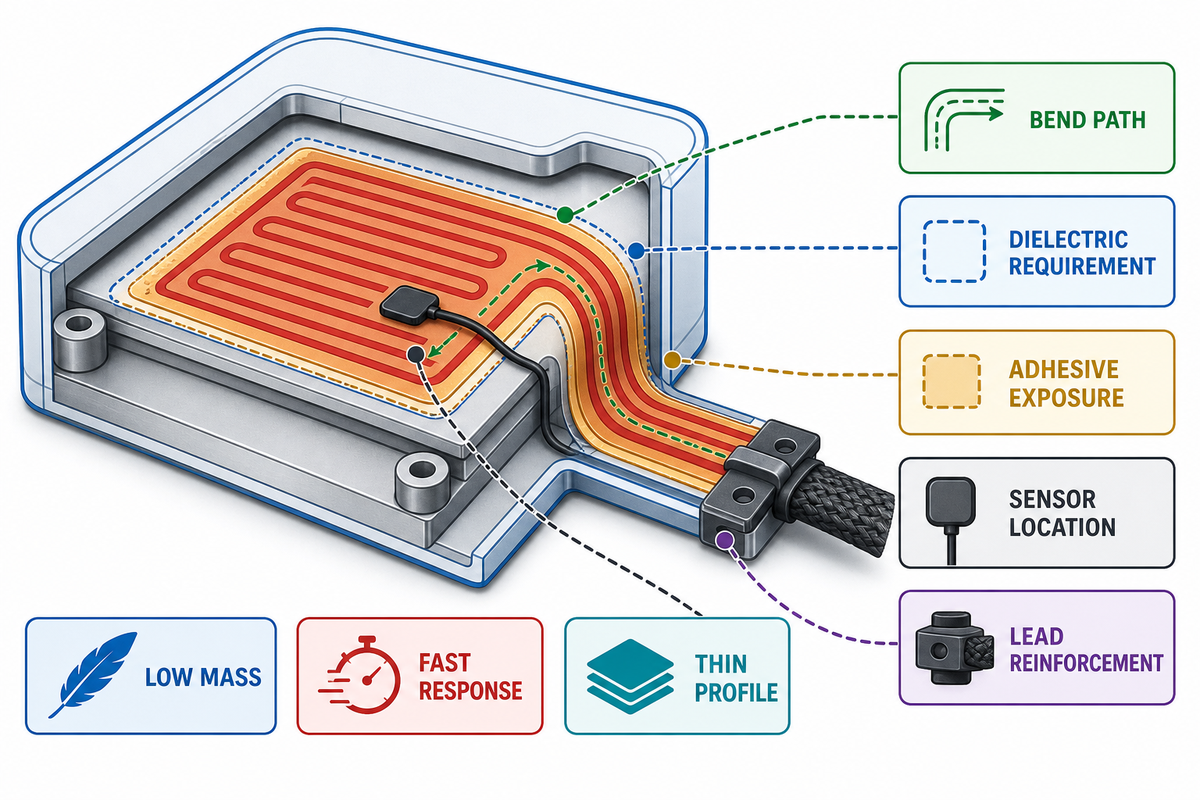
Because the selector above starts with system risk, polyimide and Kapton-family heaters fit tight equipment spaces only when low mass, fast response and a thin profile matter more than abrasion resistance. The practical choice is not polyimide or silicone in isolation; it is which material keeps efficient heat transfer inside the real envelope. They work best when the buyer already knows the bend path, adhesive exposure, dielectric requirement, sensor location and the real surface that will accept heat.
In medical diagnostics, that can mean a compact reagent path or a disposable-adjacent module where the heated zone is small. In semiconductor equipment, it can mean a sensor enclosure or local surface where profile and circuit repeatability matter. Polyimide isn’t a shortcut around validation. Adhesive chemistry, lead exit, pressure points and cleaning exposure can still decide whether the design survives production.
Use the term Kapton carefully. Many buyers use it as a shorthand for polyimide film heaters, but the material stack, conductor pattern and adhesive layer still need supplier confirmation. Ask for a drawing that shows heated area, cutouts, bend zones, lead reinforcement and a stated dielectric test.
Procurement objection: Buyers who only ask for “thin and fast” can receive a heater that fits the opening but fail at the cable exit. A 0.5 mm clearance advantage loses value if the lead has to bend inside the enclosure.
Silicone rubber heaters where durability and surface contact matter
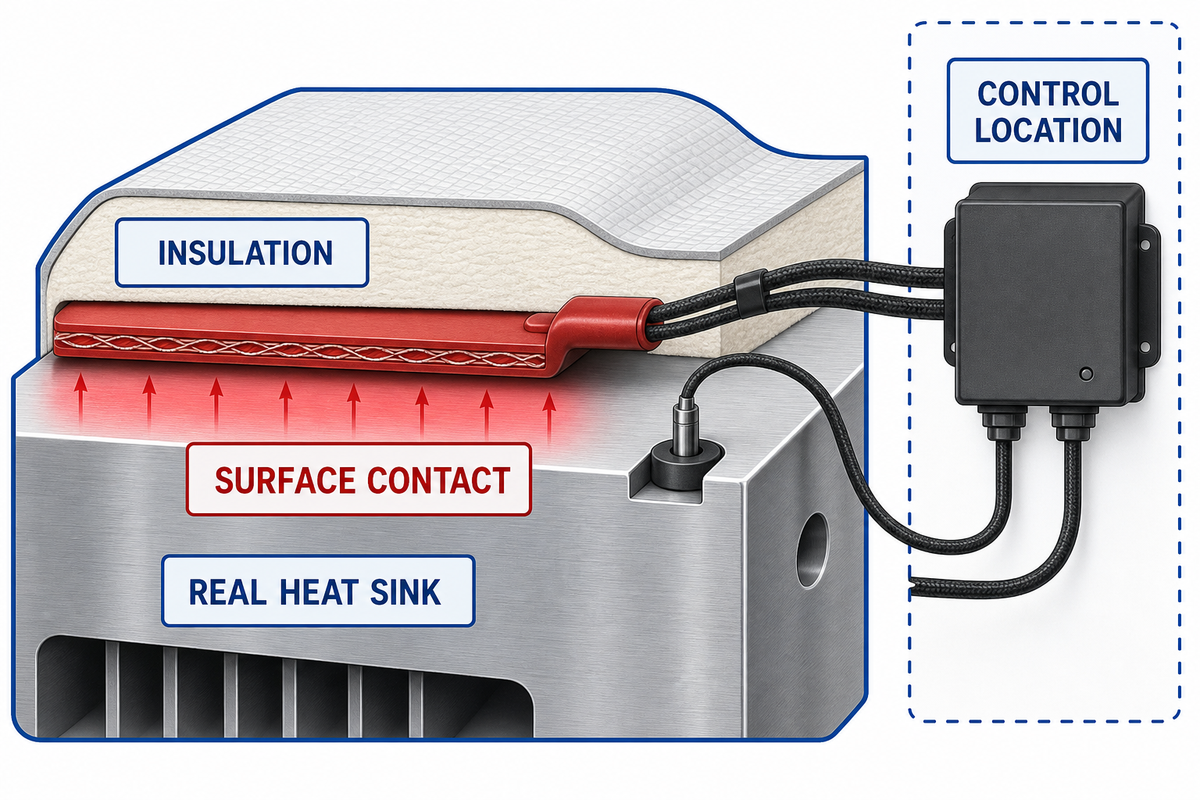
Silicone rubber heaters are usually the stronger choice when the heated object is larger, rougher, wetter or more likely to see handling during installation. Their value comes from conformal contact, mechanical tolerance and a material stack that can support rugged flexible heater designs in industrial equipment.
The project-site FlexBlanket heater specification sheet cited here lists custom silicone heater construction with fiberglass-reinforced silicone rubber, wire-wound or etched-foil options, a stated -60 C to 250 C operating range, 0.8-3.0 mm thickness, 1.0-3.0 W/cm2 power density, at least 300 MOhm insulation resistance, at least 2500 V dielectric withstand, and flexible heater voltage options: 12, 24 and 48 VDC plus 120/230 VAC where appropriate. Treat the 0.8 mm to 3.0 mm thickness row, 1.0 W/cm2 lower-density row, 3.0 W/cm2 upper-density row, 300 MOhm insulation row, 2500 V dielectric row and IP65 ingress wording as manufacturer-stated component records for drawing review inside the current build-envelope, not independent proof of finished medical or semiconductor equipment compliance.
Surface contact matters as much as catalog temperature. Running a silicone heater in open air can let the conductor become much hotter than the application surface. TurboFlex’s technical note on surface temperature versus conductor temperature makes the practical point: specify the real heat sink, insulation and control location before you choose watt density.
“The Agency does not clear or approve individual materials that are used in the fabrication of medical devices.”
Evidence capsule: Birk’s watt-density example notes perimeter watt density may rise by 5 to 15 percent to offset edge losses. That kind of local patterning explains why “silicone versus polyimide” isn’t enough; the heater design must match the heat-loss map.
Flexible heating elements: etched foil, wire wound and printed circuits
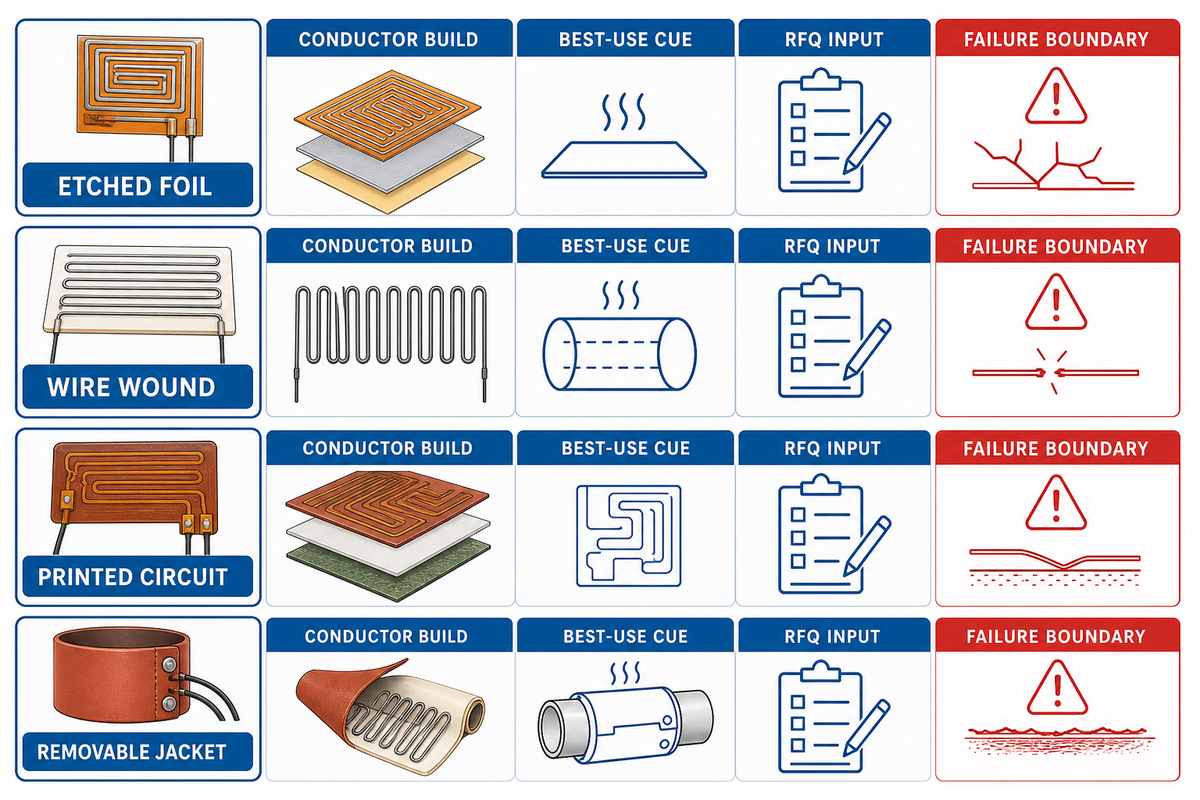
Flexible heating elements should be compared by conductor layout, not only by insulation material. Etched foil, wire wound and printed circuits can all deliver heat, but they differ in pattern detail, lead routing, repeatability, local watt density and how easily the heater follows the target surface.
Etched foil suits repeatable patterns and tight heat zones. Wire wound designs can serve larger or rugged silicone rubber heaters. Printed circuits may fit thin specialty builds, but the ink, substrate and termination method need review. Medical trade sources describe silicone wire-wound, silicone etched-foil and polyimide etched-foil heater constructions in device applications, which is a useful type cluster for buyers.
Catalog language can blur the type decision. Custom flexible heaters, polyimide flexible heaters, wire wound flexible heaters, foil flexible heaters, etched foil heaters, wire wound heaters, polyester heaters, electric heaters and flexible circuit heaters may all appear in one sourcing search. In this guide, those flexible heater options are engineering labels; the custom design still depends on the flexible substrate, conductor path, lead exit and validation owner.
Ask for the conductor pattern early. One heater can match voltage and wattage but still put heat in the wrong place if holes, clips, ribs or sensor pockets were missing from the drawing. That mismatch is a common reason sample heaters move into a redesign loop.
| Element build | Best use | RFQ input | Failure boundary |
|---|---|---|---|
| Etched foil | Patterned heat and thin zones | 2D drawing plus hot/cold zones | Poor fit if the loss map is unknown |
| Wire wound | Rugged silicone heater builds | Bend radius and termination details | Limited fine pattern detail |
| Printed circuit | Special thin or sensor-adjacent builds | Ink, substrate and termination data | Material stack may control life |
| Removable jacket | Valves, lines and service points | Closure, insulation and cable route | Loose fit reduces heat transfer |
Medical device heaters: specify the function, not just the blanket
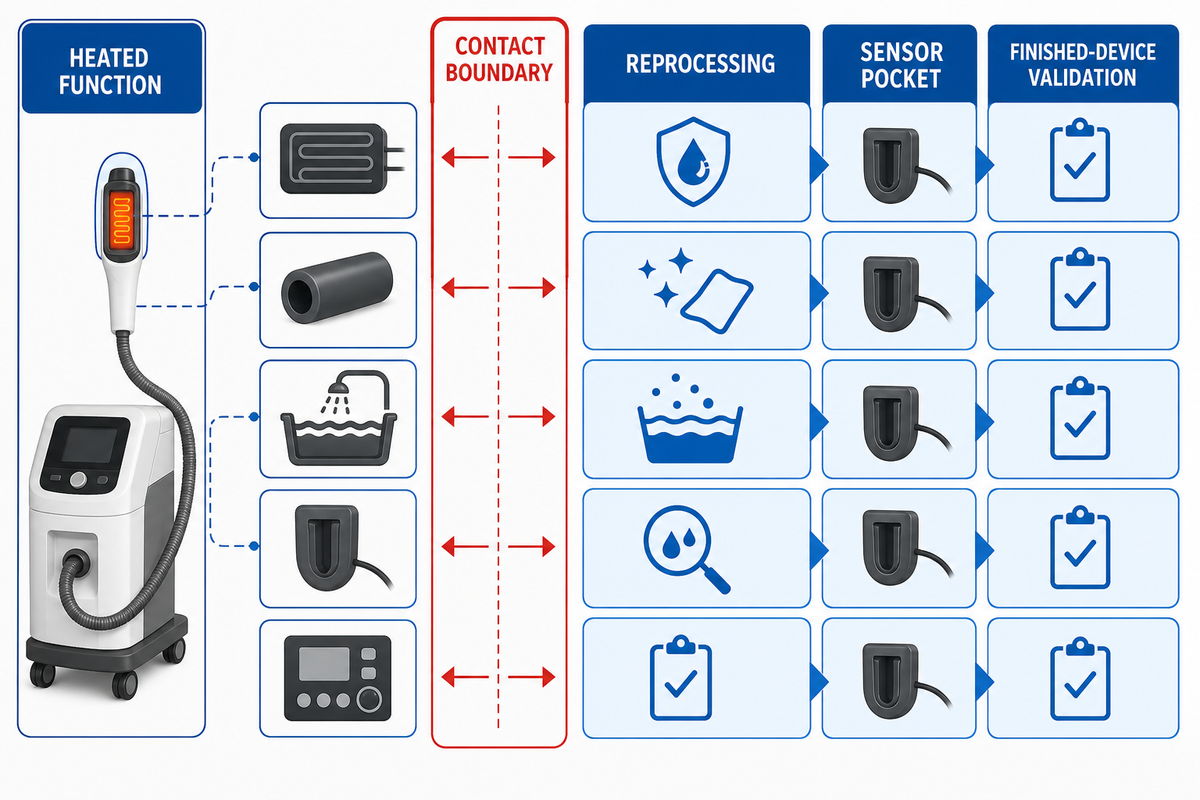
Medical device heaters should be specified by the heated function and the finished equipment boundary. Heaters for a diagnostic fluid path, bed-prewarming surface, dialysis accessory, warming tray or patient-adjacent pad can require different control limits, cleaning exposure records and validation owners.
Medical applications may include laboratory equipment, medical diagnostic instruments, diagnostic equipment and fixtures used near medical procedures, but the needs of the medical industry do not turn a component heater into a cleared device. In the medical field, high-quality flexible heaters still need the same boundary review as any other sourced component. A silicone rubber or polyimide selection should identify whether polyimide materials, silicone heaters or polyester flexible constructions touch the patient, the fluid path or only an internal support surface.
IEC 60601-2-35 is often relevant to heating devices using blankets, pads or mattresses in medical use, but the public IEC page also lists exclusions such as physiotherapy heaters, infant radiant warmers, infant incubators, infant transport incubators and cooling devices. That scope matters. An internal flexible heater inside a medical product does not automatically fall under that particular standard.
FDA’s biocompatibility material explains the same principle from another angle: the device is assessed in final finished form, including sterilization when applicable. Reusable medical devices add a second boundary. FDA’s reprocessing guidance says manufacturers must validate reprocessing instructions so cleaning, disinfection or sterilization consistently returns the device to an adequately reprocessed state.
Scenario: In a diagnostics project, the team asks for a thin heater around a reagent channel and sends only target temperature plus voltage. The sample reaches setpoint on the bench, but the sensor sits 18 mm away from the hottest point and the cleaning wipe path runs across the lead exit. The better RFQ would add patient/contact boundary, wipe chemistry, sensor pocket, cable strain relief and the party responsible for finished-device validation.
Evidence capsule: IEC 60601-2-35 is a 2020 particular standard with defined inclusions and exclusions, while FDA reprocessing guidance focuses on finished reusable devices and labeled instructions. Those 2 sources turn “medical heater” into a function and validation question.
Semiconductor heaters: uniformity, outgassing and service access
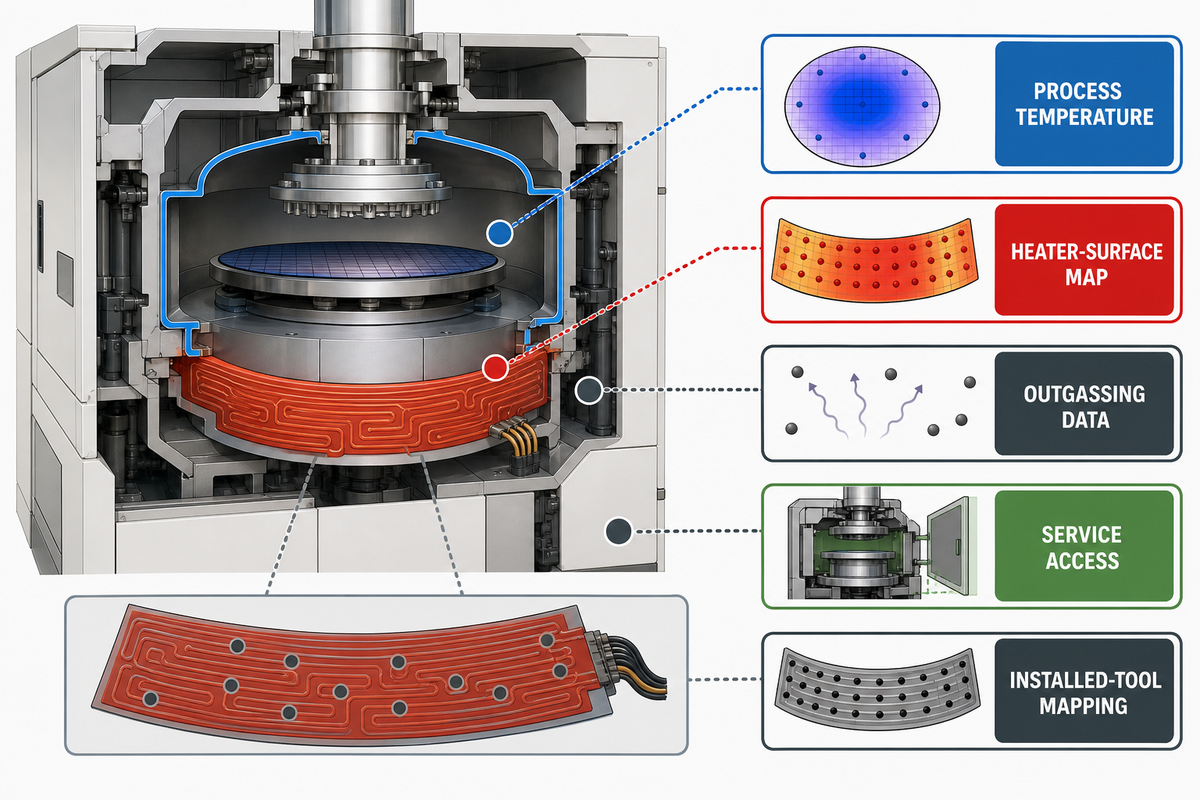
Semiconductor heaters require a wider evidence file because the heater can affect process stability, contamination risk, maintenance time and measurement confidence. The buyer should separate heater-surface uniformity, installed-tool temperature mapping, exposed material review, outgassing data and service access before choosing the final heater form.
NIST’s rapid thermal processing work is a useful warning. The publication reports wafer temperature depressions up to 25 deg C related to lightpipe proximity and measurement geometry. That doesn’t define every semiconductor heater test, but it proves the broader engineering point: a surface temperature number isn’t the same as wafer or process temperature evidence.
Outgassing deserves the same caution. NASA’s outgassing database user guide uses defined conditions, including 125 deg C for 24 hours, and warns about manufacturing variation, formulation changes and batch testing for critical applications. Use those data as a screen. Particle generation, cleanliness and decontamination remain separate customer or process qualifications.
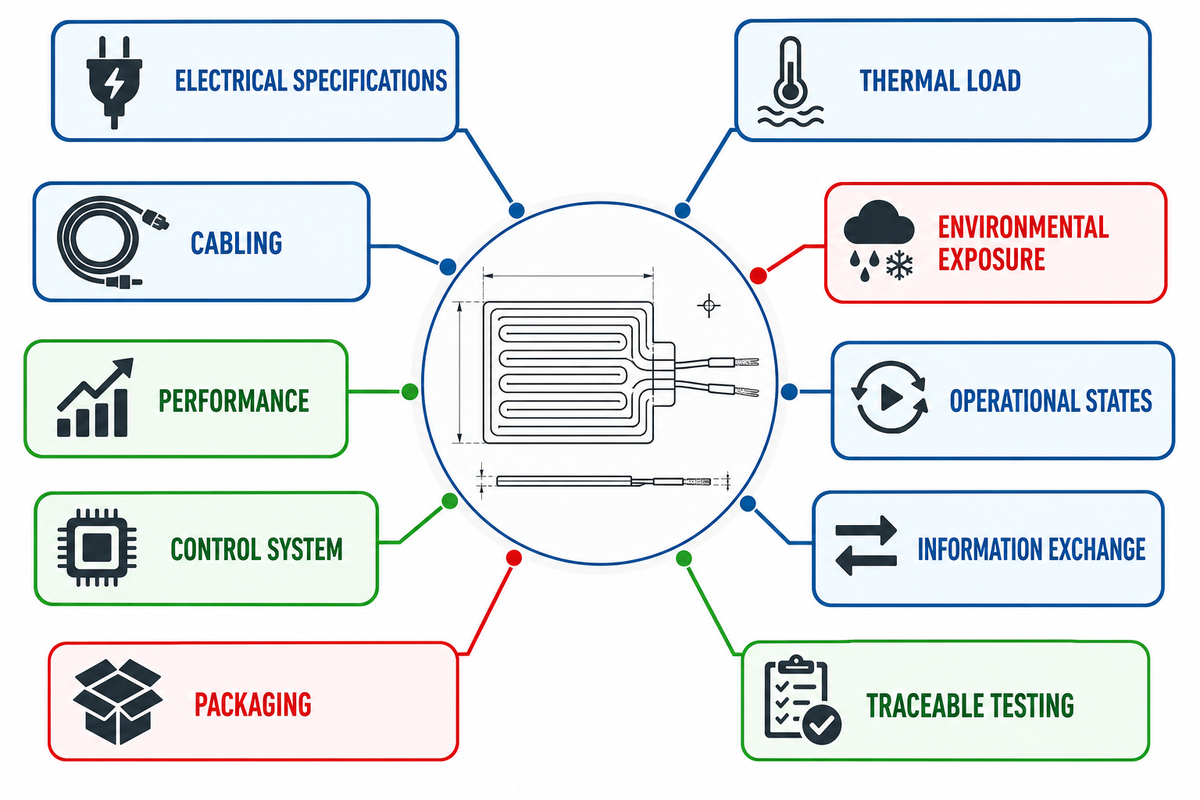
SEMI F109 gives buyers a stronger RFQ frame than a material checklist. The public abstract says the guide covers heater-system requirements for semiconductor and related industries, including electrical specifications, thermal load, cabling, environmental considerations, performance, operations, controls, information exchange, packaging and testing.
Scenario: When a tool owner asks for a removable heater jacket for a valve body after a bonded film design made service slow, the drawing often shows the valve size but not the cable exit, clamp stack, purge-area exposure, cleaning method or installed temperature mapping plan. The quote can still be issued, yet the useful specification isn’t complete until service clearance and process metrology are agreed.
Temperature control system choices that change heater qualification
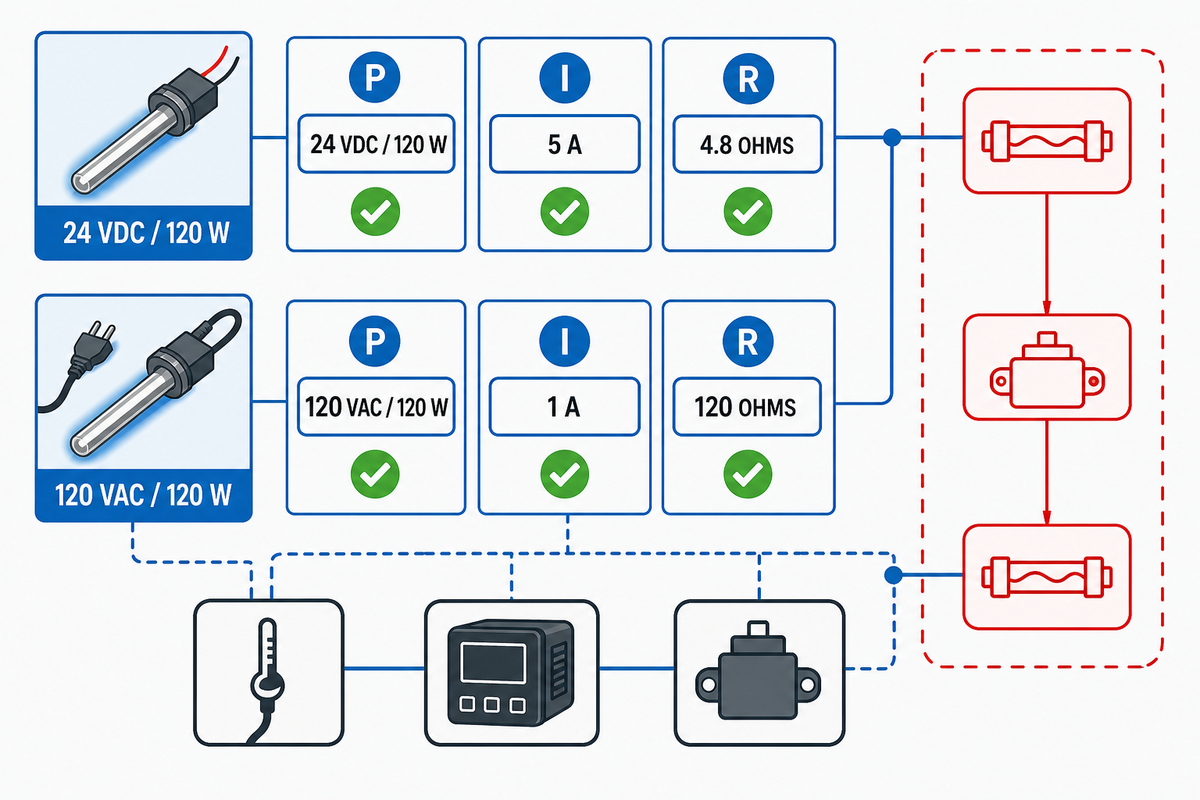
Temperature control changes heater qualification because the same flexible heater can behave differently with a new sensor location, controller mode, alarm limit, wiring path or power-switching method. Buyers should specify the control stack before they approve drawings, not after the heater is already built.
For medical electrical equipment or systems, IEC 60601-1-2 brings electromagnetic disturbances into the risk conversation. The public IEC abstract covers medical electrical equipment and systems in the presence of electromagnetic disturbances and emissions from those systems. Heater power, controller electronics, sensor leads and cable routing should therefore be considered in the finished system’s electromagnetic-compatibility and risk-management plan.
Electrical limits also belong in the first RFQ. A 12 VDC heater drawing, a 24 VDC cabinet and a 120 VAC field supply point lead to different resistance, current, relay and protection choices. FlexBlanket’s specification sheet includes fields for local supply voltage, target temperature, controller or thermostat, sensor and lead details; those fields should not be left to purchasing after engineering freezes the layout.
For an electrical sanity check, a 24 VDC, 120 W heater draws 5 A and implies 4.8 ohms, while a 120 VAC, 120 W heater draws 1 A and implies 120 ohms. A 240 W variant doubles that review burden to 10 A at 24 VDC or 2 A at 120 VAC. A 12 VDC, 60 W heater also draws 5 A, while a 48 VDC, 96 W heater draws 2 A. Put voltage, wattage, current, resistance and fuse limit in one review line so procurement does not compare 2 heaters that load the control cabinet in different ways.
Evidence capsule: Practical heater-control forum threads often turn into current, switching and sensor-placement discussions. A 10 A, 12 V control problem is not a compliance source, but it shows why current and sensing choices must be solved before a custom flexible heater is released.
Reliability and compliance risks buyers should screen before sourcing
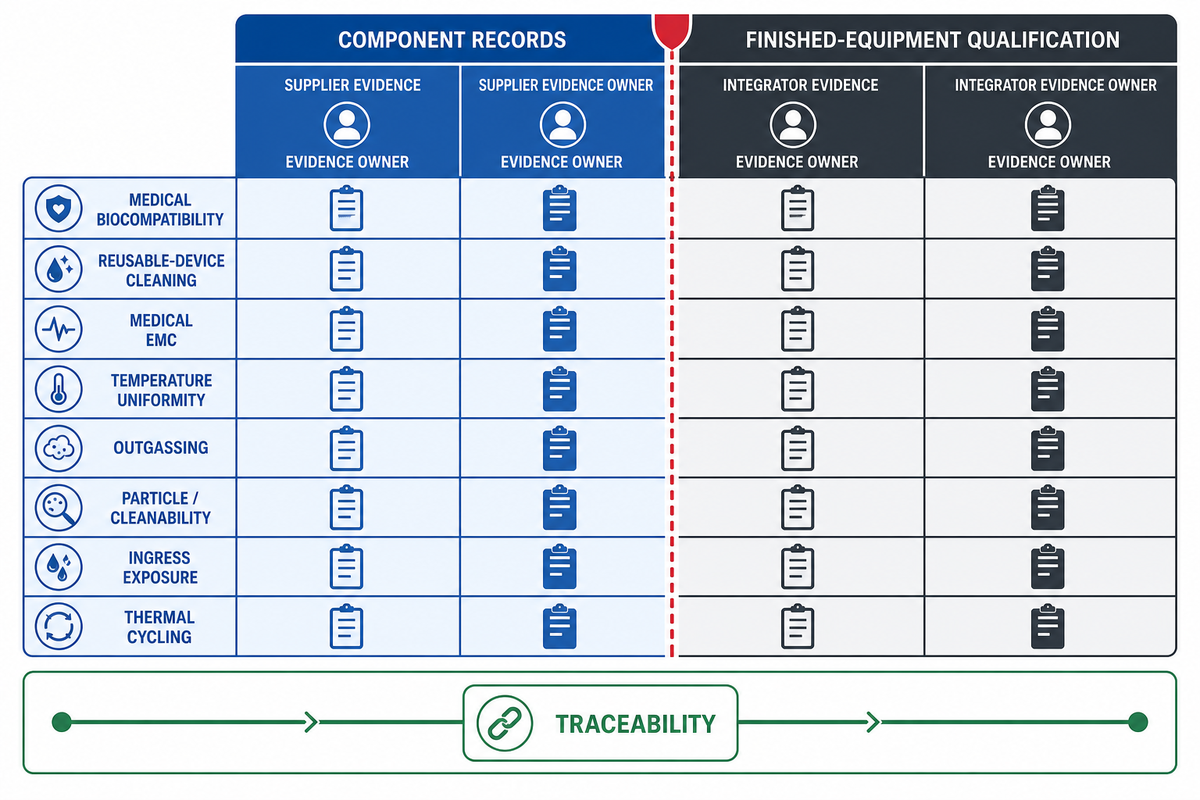
Reliability screening should cover the heater component, the installed equipment and the evidence owner. Insulation resistance, dielectric withstand, ingress exposure, cleaning or reprocessing, electromagnetic disturbance, outgassing, particles, thermal cycling and traceable records all change the sourcing decision.
Component records still matter. FlexBlanket’s first-party quality claims include ISO 9001, CE, RoHS, a 2500 V withstand voltage test, insulation resistance at or above 300 MOhm, and an IEC 60529 IP40-IP67 range for the cited heater records. Those figures belong in a component evidence request. They shouldn’t be rewritten as finished medical or semiconductor equipment compliance.
SEMI S2 adds another useful boundary. The current SEMI store page describes S2 as performance-based environmental, health and safety guidance for semiconductor manufacturing equipment, while warning that SEMI safety guidelines don’t address all safety issues. In sourcing language, that means a heater RFQ can ask for EHS-related records, but the tool owner still owns the full equipment safety decision.
Validation Boundary Matrix
| Risk | Supplier evidence | Integrator evidence | Owner | Hidden bottleneck |
|---|---|---|---|---|
| Medical biocompatibility | Material stack and processing notes | Final finished device assessment | Regulatory/QA | Contact category changes after design freeze |
| Reusable-device cleaning | Surface, lead and seal details | Validated cleaning or sterilization instructions | QA/clinical engineering | Internal geometry traps residue |
| Medical EMC | Lead, sensor and controller information | ME equipment/system test plan | Electrical engineering | Cable route changes after heater approval |
| Semiconductor temperature uniformity | Heater pattern and surface map | Installed process mapping and calibration | Process engineering | Sensor setup shifts measured temperature |
| Outgassing | Material and batch data where available | Representative exposure review | Process/quality | Historic material data no longer matches batch |
| Particle or cleanability risk | Surface finish and edge/lead construction | Customer cleanliness or decontamination qualification | Process owner | Treating low outgassing as low particles |
| Ingress exposure | Seal, lead exit and IP record | Installed cleaning or splash condition | Maintenance/QA | Connector is weaker than blanket body |
| Thermal cycling | Material and adhesive recommendation | Cycle count and load profile | Reliability engineering | Warm-up target hides steady-state stress |
| Traceability | Drawing, revision and test record | Device or tool file linkage | Procurement/QA | Prototype data not tied to production revision |
Custom flexible heaters: the RFQ evidence pack that reduces redesign loops
Custom flexible heaters need more than a drawing and target wattage. Strong RFQs start with six intake fields, then expand into a heater-system evidence pack that engineering, procurement and QA can review before sample approval.
The six starter inputs are still useful: geometry, voltage, wattage, heated surface, control method and operating environment. They open the conversation. SEMI F109 shows why they aren’t enough for a semiconductor or precision equipment project. Its public abstract describes a heater-system requirements framework with 10 domains for custom resistive electrical heater systems in semiconductor and related industries.
10-Domain Heater-System RFQ Evidence Pack
| RFQ domain | Buyer input | Supplier evidence to request | Acceptance question |
|---|---|---|---|
| Electrical specifications | Voltage, wattage, resistance, current limit; note 12 V, 24 V, 48 V, 120 V or 230 V if relevant | Circuit drawing and test record | Does it fit the power supply and protection plan? |
| Thermal load | Start, target, warm-up time, heat sink | Watt-density and thermal review | Does the design heat the real mass, not air? |
| Cabling | Lead exit, length, bend, connector | Lead reinforcement detail | Can the cable survive assembly and service? |
| Environmental exposure | Moisture, wipe, chemical, vacuum, abrasion | Material and seal recommendation | Does exposure exceed the component evidence? |
| Performance | Uniformity, ramp, steady tolerance such as +/-5°C when specified | Thermal map or sample test | Is the measurement point the process point? |
| Operational states | Startup, idle, fault, shutdown | Control and alarm assumptions | What happens when heat transfer is poor? |
| Control-system specifications | Sensor, controller, cutoff, alarm | Sensor placement and wiring plan | Can controls be tested in the final system? |
| Information exchange | Drawing revision, owner, test method | Revision-controlled quotation package | Can QA trace sample data to production? |
| Packaging | Handling, clean bag, coil limit, storage | Packing and handling note | Will shipping damage bend zones or leads? |
| Testing | Pass/fail values and sample count | Dielectric, resistance and thermal records | Which result blocks sample release? |
FlexBlanket’s heater specification sheet, quotation input checklist and application input record can serve as the public starting point for this pack. For a custom medical or semiconductor project, add the validation owner, standard scope and acceptance criteria before purchase approval.
Send the heater-system RFQ pack
What 2026 buyers should change in flexible heater sourcing
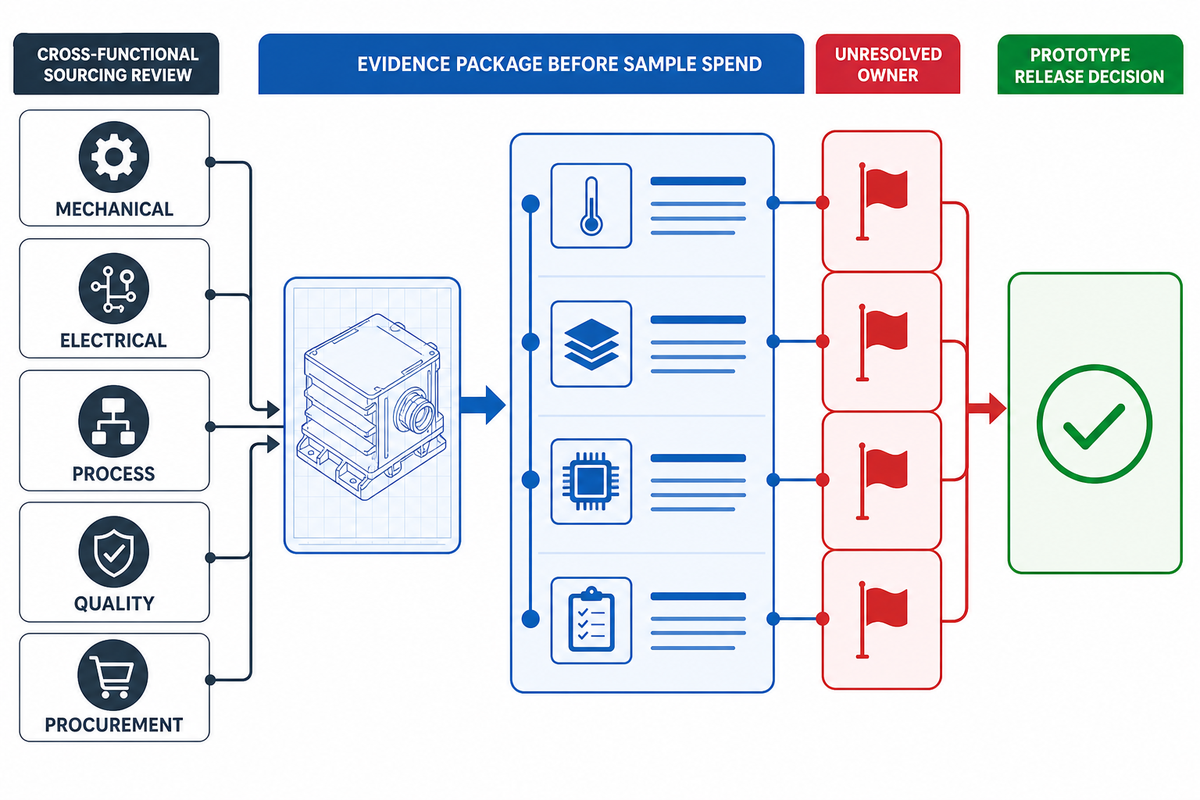
After the RFQ pack makes evidence ownership explicit, 2026 sourcing should move thermal, electrical, material and validation evidence earlier in the buying process. Market demand for flexible heaters and precision thermal management is useful context, but the stronger change is procedural: custom heater projects now need cleaner requirements before prototype spending.
Market.us reports a 7.1 percent CAGR signal for the flexible heater market. Use that number only as background. The practical action is not “buy a heater sooner.” It is to involve mechanical, electrical, process, quality and procurement owners before they release the sample drawing.
For medical equipment, ask which finished-device standard, contact boundary, reprocessing method and electromagnetic-disturbance plan apply. For semiconductor equipment, ask how the installed tool will prove process temperature, material exposure, outgassing limits, cleanliness and service access. Buyers who answer those questions before RFQ reduce quote ambiguity and make supplier comparison fairer.
Flexible heaters are used in industrial applications where rigid blocks cannot make reliable contact, and flexible heaters are engineered around shape, voltage, sensor placement and acceptance records. The advantages of flexible heaters over traditional heating are fit, local heat placement and fast response; heaters are ideal only when those advantages of flexible construction are tied to the finished equipment’s risk file. When choosing polyimide or silicone, the advantages of flexible construction should be judged against exposure, lead exit and sensor placement. The medical field benefits from flexible heaters only when cleaning, contact and control limits are defined early. Flexible heaters are also relevant to semiconductor processing, but only after contamination, access and process-temperature evidence are separated from the component drawing.
FAQ
What is a flexible heater?
Answer
In this context, a flexible heater is a thin or conformable electric heating element that transfers controlled heat into a surface, assembly, fluid path or component. Common types of flexible heaters include silicone rubber heaters, polyimide heaters, etched foil heaters, wound heaters and printed circuits. The right choice depends on the heated surface, temperature target and validation duty.
Are flexible heaters safe to use?
Answer
Flexible heaters can be safe in an equipment design when voltage, watt density, insulation, surface temperature, sensor placement, controller behavior, grounding, cleaning exposure and over-temperature protection match the application. Safety is a system result, so the equipment maker must validate the finished medical or semiconductor system, document the control limits and confirm that the heater does not create a new patient, process or service hazard. The supplier should provide component records; the buyer should connect those records to the finished assembly’s risk file.
Can flexible heater elements be customized?
Answer
Custom flexible heaters can be specified by shape, hole pattern, voltage, wattage, lead exit, sensor, adhesive, material stack, connector, temperature range and environmental exposure. Stronger RFQs also name the validation owner, standard scope, test method and pass/fail values, then attach the drawing revision and the acceptance criteria that will decide whether the prototype can move into equipment testing. For regulated or contamination-sensitive equipment, add contact boundary, reprocessing method, outgassing condition and cable-service clearance before release.
What are the main types of flexible heaters?
Answer
The main types include silicone rubber heaters, polyimide or Kapton-family heaters, polyester heaters, etched foil heaters, wire wound heaters and printed circuit heaters. “Type” can mean dielectric material, conductor pattern or physical form, so buyers should separate material, circuit build and mounting method before comparing quotes. This prevents a thin-film request from hiding the lead exit, sensor pocket or service-access issue that actually controls the design.
What makes flexible heaters different from conventional heaters?
Answer
Flexible heaters are low-profile, conformable and easy to pattern around holes, curves, leads and local heat zones. Conventional rigid heaters can be better for bulk heat, but flexible heating solutions often fit equipment surfaces where space and geometry control the design. They also let engineers place heat closer to the target surface, which can reduce warm-up lag when the sensor and thermal load are specified correctly. That advantage disappears if the drawing omits cutouts, lead reinforcement, contact pressure or the control limit that protects the hottest conductor path. In medical equipment, the same advantage can simplify a warmer, diagnostic module or tray if the cleaning path is known. In semiconductor equipment, it can help a valve, line or chamber-adjacent surface, but only when material exposure, outgassing screen, particle risk and service access are handled as separate evidence questions.
Transparent sourcing note
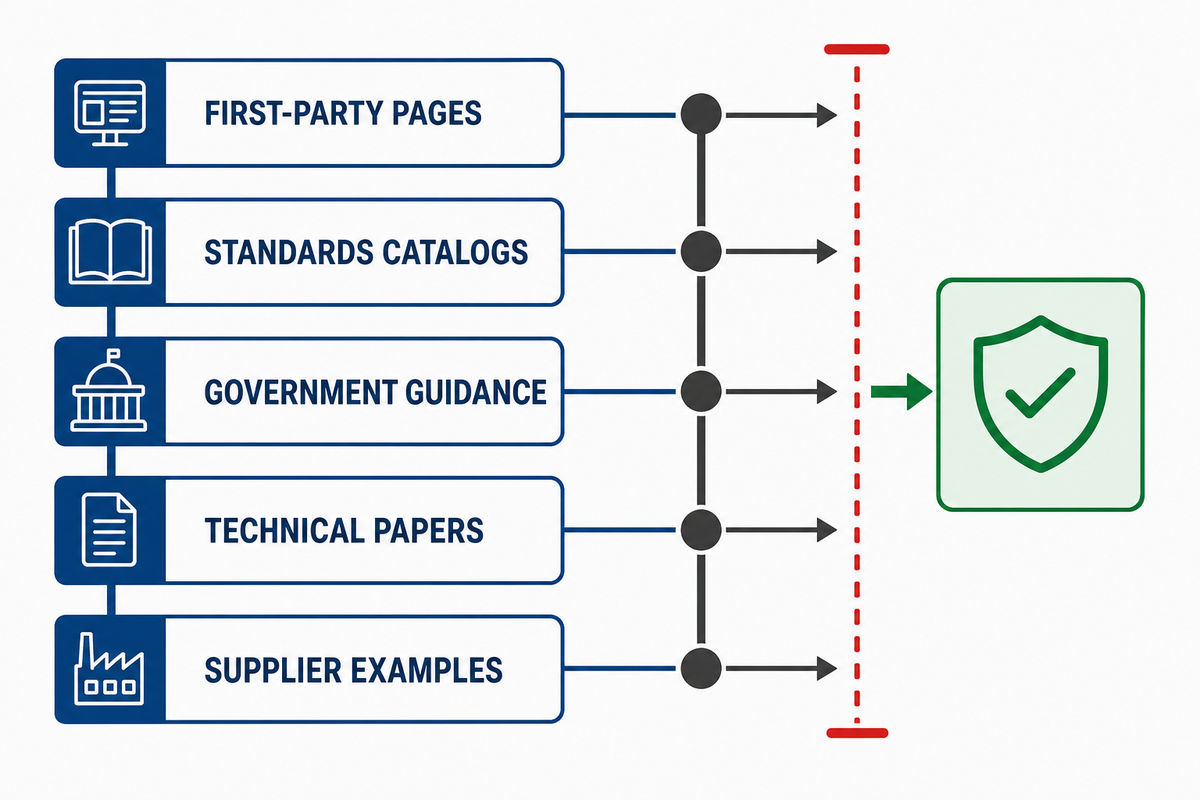
This guide uses public first-party FlexBlanket pages, standards catalog pages, government guidance, technical papers, trade sources and supplier examples. It’s a buyer specification guide, not legal, regulatory or process-qualification advice. Final medical-device approval, semiconductor tool qualification and site-specific compliance decisions belong to the equipment maker and its qualified reviewers.
References & Sources
- FDA: Basics of Biocompatibility
- FDA: Factors Affecting Quality of Reprocessing
- IEC 60601-2-35:2020 public page
- IEC 60601-1-2:2014+A1:2020 public page
- SEMI F109 heater-system requirements public page
- SEMI S2 EHS guideline public page
- NASA Goddard Outgassing Database User Guide
- NIST: Effects of Lightpipe Proximity on Si Wafer Temperature
- Birk Manufacturing: watt density in medical devices
- MedDeviceOnline: flexible heaters for medical devices
- Semiconductor Digest: flexible heaters in semiconductor fabrication
- FlexBlanket heater specification sheet
- FlexBlanket quotation input checklist
- FlexBlanket application input record