Get in touch with FlexBlanket Company

Industrial electric heating · 1000 L and 1250 L totes
IBC Tote Heaters for 275 and 330 Gallon Containers
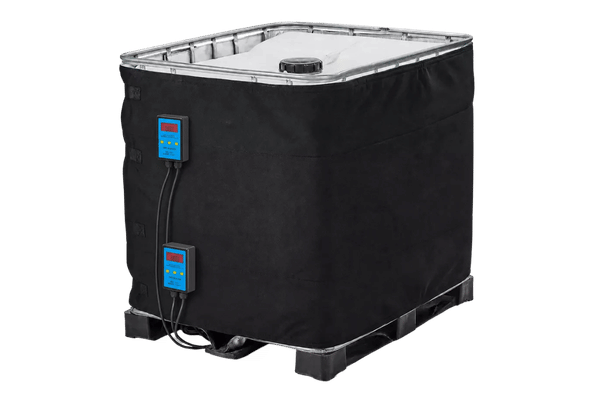
FlexBlanket IBC Tote Heaters wrap the container wall to support freeze protection, viscosity control, temperature maintenance, or a reviewed heat-up duty without placing a heating element inside the liquid contents. We manufacture full-wrap systems for standard tote sizes and build custom dimensions, voltages, and wattages when the duty falls outside the listed models.
Configuration checkpoint
- Start with the duty, not the catalog wattage
- Published 275/330-gallon model classes in 1000 L and 1250 L formats; actual dimensions still define fit
- 120 VAC or 230 VAC electrical options
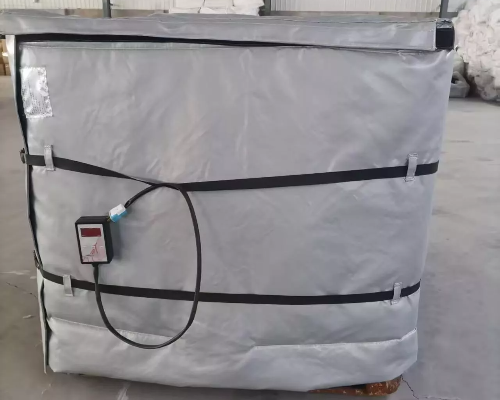
- Digital thermostat, live display, timer, and over-temperature protection
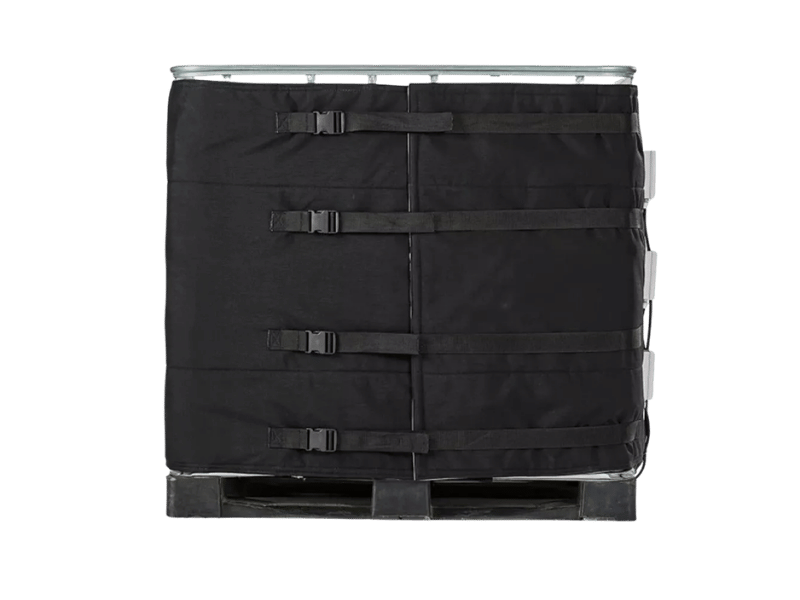
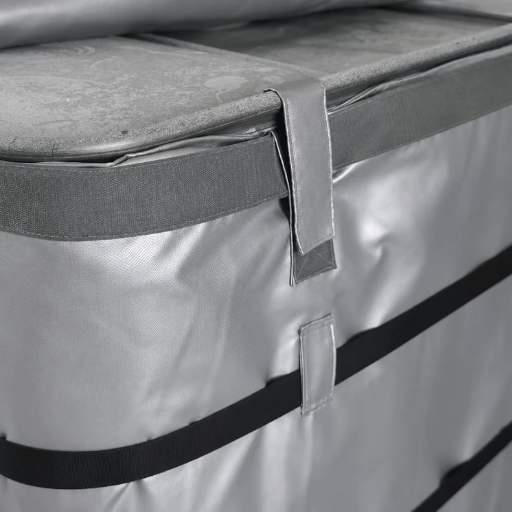
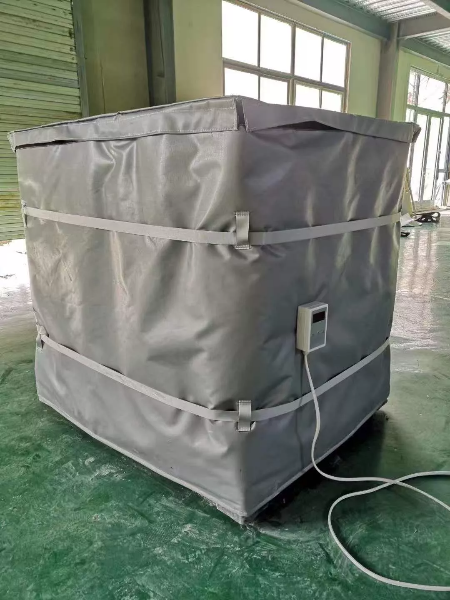
- Full-wrap body with adjustable quick-release buckles
- The listed heater range is not an allowable temperature for every tote or product. Container, sensor, site, and electrical limits set the final setpoint.
SYSTEM PROCESS
Container Heating Built Around the Process Duty
A tote heating blanket works from the outside while keeping the product path closed and avoiding an immersed device in the container. That approach suits applications where access, hygiene, or contamination controls rule out an immersion heater.
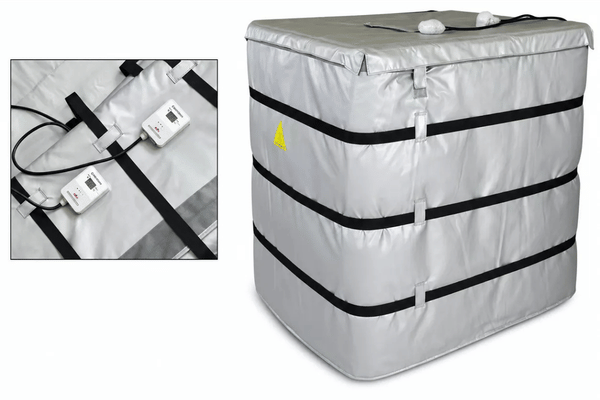
The heat-balance check
Sensible heat follows product mass × specific heat × temperature rise, adjusted for system loss and available time. Oklahoma State University’s process-heating guidance uses the same factors, which is why fill volume and product data are included in the quote brief.
- Increased thermal mass or larger temperature increase results in greater required energy.
- Lower ambient temperature and exposed surfaces increase heat loss.
- Viscosity, convection, mixing, and sensor position affect heat distribution.
Six questions that stop a bad match
- 01 Will the blanket fit the actual tote and cage?
- 02 Is the duty temperature maintenance, freeze protection, viscosity reduction, or heat-up?
- 03 Where will temperature be sensed and accepted?
- 04 Does available wattage cover the load and losses?
- 05 Are voltage, plug, circuit, ingress, and location compatible?
- 06 Do the contents, fill, container, storage, and transport constraints permit heating?
Freeze protection
Our configuration review begins with the lowest ambient condition, exposure duration, product freeze point, and available power. That target prevents the contents from crossing the established limit without assuming a standard winter outcome.
Viscosity reduction
This review considers the target handling temperature, product response, and whether circulation or mixing is used. Surface temperature can change before the center of a full IBC tank, particularly with viscous material.
Temperature maintenance
Sizing begins with steady heat loss when the tote is already near its working temperature. An insulated cover can reduce loss through the top surface when the application allows.
Controlled heat-up
A heat-up analysis begins with product mass, specific heat, initial and target temperature, allotted time, ambient condition, and losses. A 3000 W nameplate cannot answer that question.
SYSTEM SPECIFICATIONS
Full-Wrap Construction for Repeatable Installation
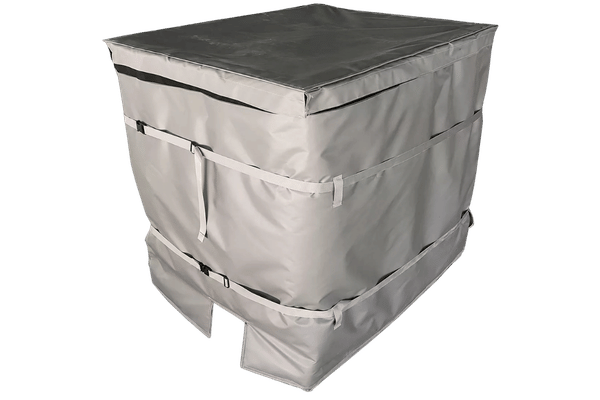
Standard construction uses a Teflon- or silicone-coated polyester outer layer, high-density polyester insulation, and silicone-insulated electric heating elements. We build the tote heater blanket to enclose the container wall and fasten with adjustable quick-release buckles.
What each layer does
Outer fabric
provides the flexible heater handling surface and protects the internal assembly in the stated environment.
Thermal insulation
slows outward heat loss so more input is directed toward the tote wall.
Heating circuit
spreads electric heating across the designed contact area rather than concentrating all power at one small insertion point.
Buckles
enable the user to draw the blanket into contact around the IBC cage and container profile.
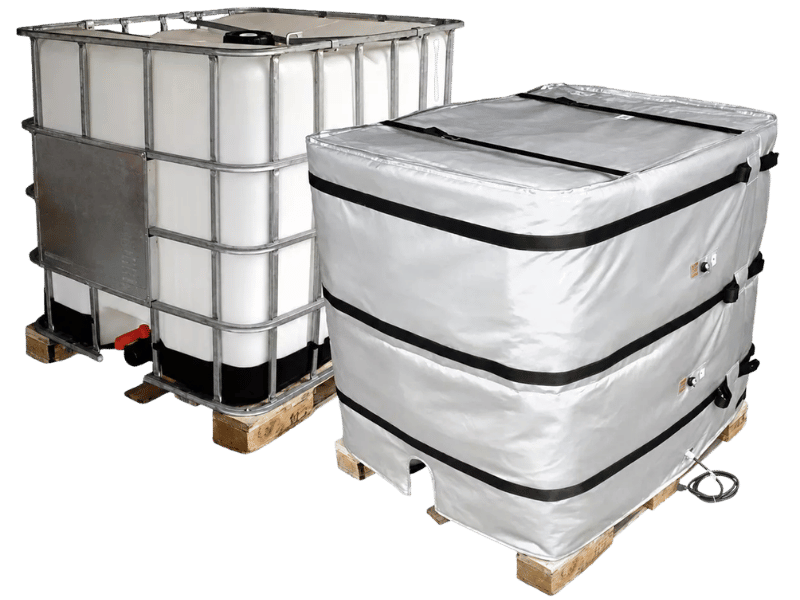
Contact matters
Loose fabric, cage interference, creases, or an incorrectly installed sensor may produce a different temperature pattern from the approved setup. Examine the wrap, straps, cable route, and controller position whenever the blanket is relocated to another tote.
SYSTEM CAPABILITIES
Two-Zone Digital Control and Application Options
The standard control package uses two independent zones with a digital thermostat, live temperature display, timer, and over-temperature protection. Separate zones let an operator manage the upper and lower blanket areas without pretending that one surface reading equals the bulk liquid temperature.
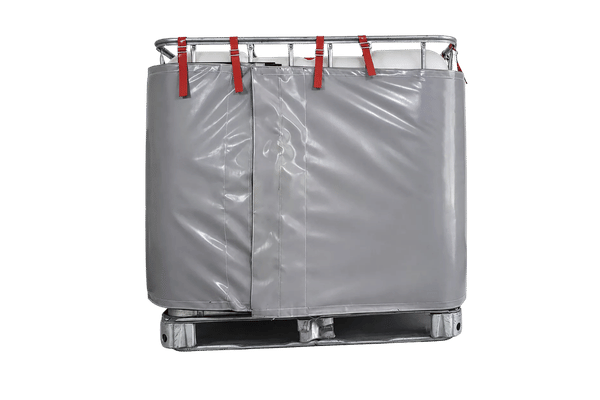
01 Control evidence before setpoint approval
A control mismatch can fail the duty because sensor location and bulk response are not the same. A thermostat does not always describe bulk product temperature; FlexBlanket provides two zones and a digital controller, while the buyer defines the 1000 L or 1250 L product-side acceptance method.
02 Sensor-point review
Each controller sensor needs a documented position and meaning. Bulk acceptance needs a product-side measurement plan when gradients matter.
03 Top-loss control
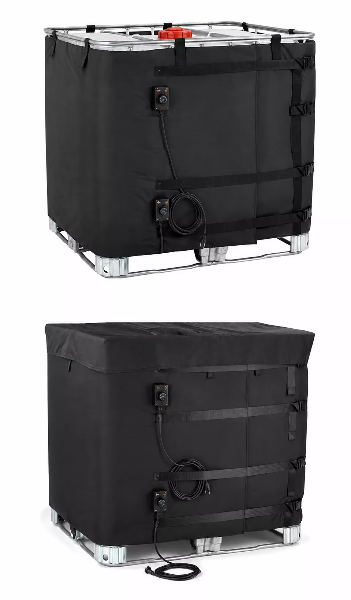
An insulated top cover is available when lid access, venting, filling, and site rules allow it. Its purpose is to address an exposed surface, not change the product’s allowable temperature.
04 Exposure protection
A waterproof cover is available as an option, but the heater itself remains listed as IP42. Installed exposure is reviewed without turning an accessory into a washdown claim.
05 Bottom input
A bottom heater can add contact beneath the tote when the base geometry and material allow it. Combined duty needs its own power, temperature, and sensor review.
SPECIFICATIONS
The Two-Zone Configuration Table
Reference this table when selecting an initial model by tote size and envelope. It is a preliminary configuration map, not a thermal-duty guarantee.
Why table fit can still fail
A specification mismatch creates overheating or delay risk because the same 275 gallon tote can carry products with different thermal mass and loss. More wattage is not necessarily safer or faster; FlexBlanket engineers the quote around the duty after the 3000 W or 1500 W catalog path is identified.
| Model | Tote capacity | Blanket size | 230 VAC power | 120 VAC power | Control |
|---|---|---|---|---|---|
| FLB-IBC-275 | 1000 L format / 275 gal model class | 4400 × 1000 mm | 3000 W | 1500 W | Two zones |
| FLB-IBC-330 | 1250 L format / 330 gal model class | 4400 × 1350 mm | 3000 W | 1500 W | Two zones |
| FLB-IBC-275A | 1000 L format / 275 gal model class | 4400 × 1000 mm | 2000 W | 1500 W | Two zones |
| Standard voltage | 275 or 330 gallon path | Model-specific | 230 VAC | 120 VAC | Digital thermostat |
| Operating range | Heater rating only | Full-wrap body | –20°C to 130°C | Display + timer + protection | |
| Ingress | Application review required | Flexible insulated build | IP42 | Site review remains separate | |
| Power lead | Standard product family | 2 m / 6.5 ft cable | 16A EU/UK | 15A US | Plug matched to order |
The liter formats and gallon model classes above reproduce the supplied catalog categories; they are not quoted as exact unit conversions. Confirm the tote circumference, height, cage, valve, and access points before model approval.
PROCUREMENT & FULFILLMENT
Quote, Production and Delivery Terms
Pricing is driven by model, size, voltage, wattage, controller build, accessories, quantity, and schedule rather than a published price list. We quote the defined configuration after reviewing the tote and heating brief.
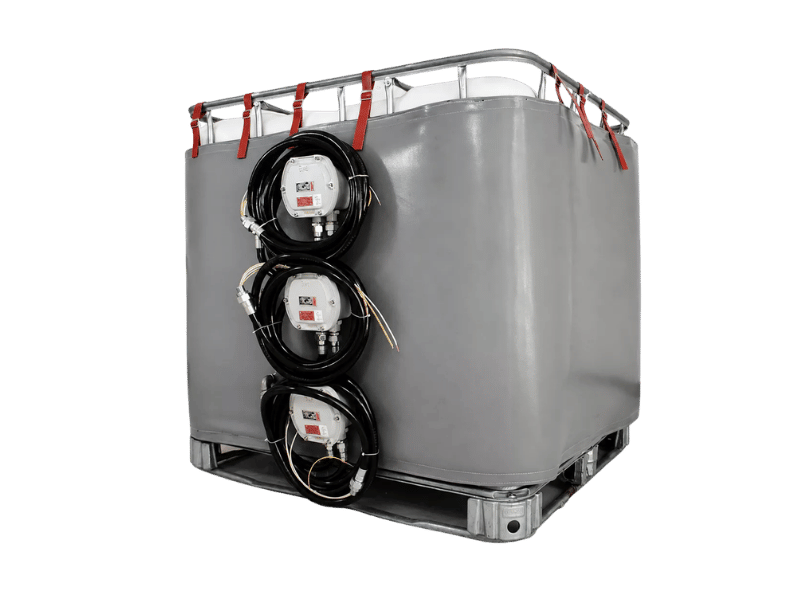
Commercial risk comes from an incomplete scope
Delay and price mismatch happen because a quote cannot price an unknown cable exit, controller, cover, plug, or delivery term. FlexBlanket ties the 7–15 days production schedule to the reviewed configuration and accepted order.
Order entry
Minimum order quantity is 1 piece. Samples are available; sample charges, customization charges, and freight are stated in the quotation.
Production
Standard production is scheduled in 7–15 days. Expedited scheduling is available; feasibility is confirmed during order review.
Payment
We accept T/T, PayPal, or Western Union; the payment schedule is confirmed in the quotation. No deposit percentage is published without an order-specific term sheet.
Shipping basis
We ship EXW or FOB; other delivery terms are quoted on request. Packing, freight, import, and destination obligations follow the accepted quotation.
What changes a quote
- Custom circumference, height, cutouts, strap positions, or cable exit.
- Voltage, wattage, plug, controller, zone, and sensor requirements.
- Insulated top cover, waterproof cover, and bottom heater options.
- Quantity, packing, delivery term, and production schedule.
SYSTEM COMPLIANCE
Application Boundaries That Belong in the Approval Record
We separate the product specification from process approval because heater range, tote limits, fluid limits, and site rules are not the same thing. This distinction helps protect buyers from confusing a catalog match with fit-for-duty evidence.
Temperature boundary
The –20°C to 130°C value describes the heater operating range. The controller setpoint must remain within the allowable temperatures for the tote, liner, valve, gasket, contents, and process.
Bulk-temperature boundary
A thermostat reacts at its sensor point. High viscosity, poor convection, partial fill, and absent mixing can leave hot and cold spots, so uniform heat distribution is not assumed.
Ingress boundary
IP42 is not evidence of washdown service or outdoor exposure beyond that rating. Cable connections, controller placement, and optional covers still need an installed-environment check.
Classified-location boundary
OSHA 29 CFR 1910.307 requires equipment in a hazardous classified location to be suitable for that specific location. We make no hazardous-area claim for this standard IBC heater family.
Chemical boundary
Provide the SDS when one applies, or the available product safety, handling, viscosity, compatibility, and temperature data. We do not claim universal compatibility between the blanket materials, tote, and every chemical.
Storage and transport boundary
For regulated materials, heating can affect ullage, vapor pressure, venting, internal pressure, and transport conditions. 49 CFR 173.35 includes IBC ullage and pressure requirements; heater selection does not replace a dangerous-goods review.
Stop and re-review when the duty changes
- The tote, liner, product, concentration, or fill level changes.
- The unit is moved from indoors to outdoors, into a wet area, or near flammable material.
- The target changes from holding temperature to active heat-up.
- The sensor position, controller, voltage, circuit, cover, or heating method changes.
Meaning of an approved target
The best blanket heater solution is the one that can safely maintain the approved target; the maximum watt label is not automatically optimal. “Optimal temperatures” are product-specific operating limits, not catalog constants.
ENGINEERING WORKFLOW
From Six-Input Heat Brief to Production Release
A useful question is brief, but it carries enough engineering detail to distinguish a standard IBC tank heater from a custom build. We review six input groups before the model, wattage, controller, and accessories move into the quotation.
The reason for six input groups
Missing product or site data creates a fit gap because the blanket, control, and electrical choices are connected. FlexBlanket uses six groups to bind the 275 or 330 gallon envelope to a specific engineering and commercial review.
01
Tote: capacity, maker or type, actual circumference and height, cage profile, valve, lid, and required access.
02
Contents: material designation, available safety data, density or fill mass, specific heat if known, viscosity, freeze point, and temperature limits.
03
Duty: hold, freeze prevention, viscosity reduction or heat-up; start temperature, target temperature and allowed time.
04
Environment: minimum ambient, indoor or outdoor exposure, moisture, wind, insulation, storage and transport conditions.
05
Electrical: supply voltage, phase, frequency, circuit limit, plug, cable route, location classification, and local requirements.
06
Control and acceptance: sensor point, independent measurement, alarm or timer requirements, mixing condition and the evidence used to accept the result.
Our review path
- We match the tote envelope to a standard or custom blanket.
- We check the thermal goal against the available power and loss conditions.
- We define zones, sensor points, controller functions, plug, cable and options.
- We record exclusions and application responsibilities in the quotation.
Your approval path
- Confirm product and tote temperature limits.
- Confirm electrical, ingress, and location suitability.
- Confirm installation, monitoring, storage, and transport rules.
- Approve the drawing, specification, commercial terms, and acceptance method.
VISUAL VERIFICATION
Product Evidence You Can Inspect Before Approval
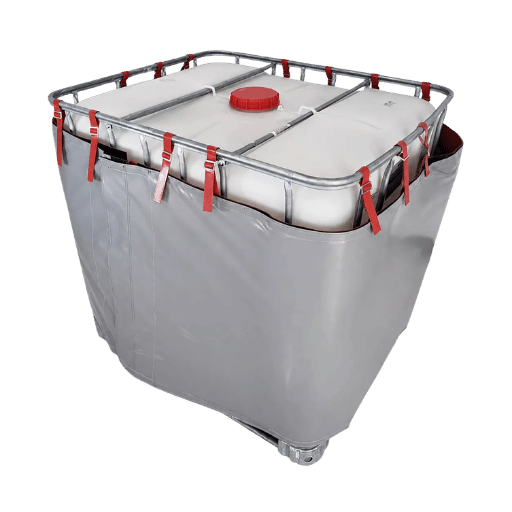
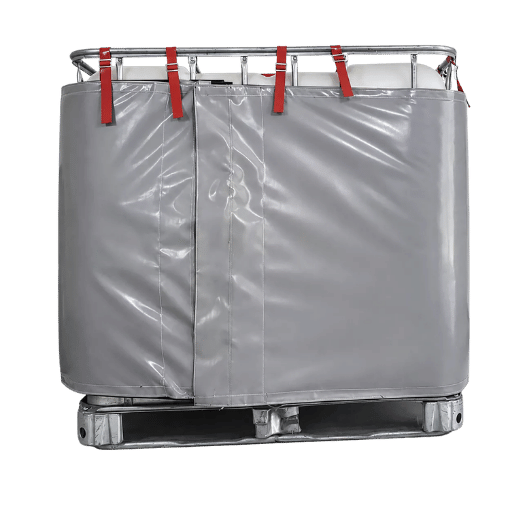
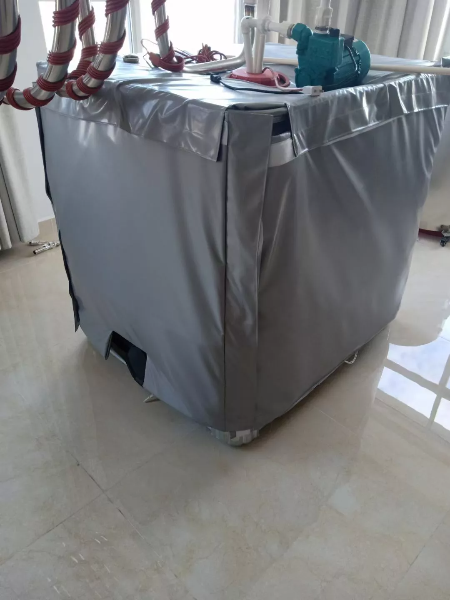
The gallery uses first-party product images from the supplied FlexBlanket materials. It shows the wrap, controller, cable, fastening, and fitted form; it is not offered as a named-customer case study or third-party certification record.
TECHNOLOGY SELECTION
The Wrap-vs-Contact Decision Grid
A flexible tote heating blanket is one approach, not the solution to every tank heating problem. Choose the approach based on access, contamination risk, required heat flux, contact area, mixing, tote construction, and maintenance plan.
Wraparound blanket
Best starting point: closed-product-path heating across the sidewall, removable installation, freeze protection, or reviewed temperature maintenance.
Trade-off: heat moves through the tote wall, and bulk response depends on product and convection.
Bottom heater
Best starting point: added contact from below where base geometry, support, and tote material permit it.
Trade-off: heat is concentrated at the base and needs its own temperature and compatibility check.
Immersion heater
Best starting point: direct heat transfer into a compatible fluid when insertion, contamination, cleaning, and access are acceptable.
Trade-off: local surface temperature and wetted-material compatibility can become the main constraints.
Why the method choice changes the risk
An IBC tote immersion heater puts a wetted element into the product, whereas a wrap blanket moves heat through the wall. FlexBlanket keeps that trade-off visible because 275 and 330 gallon duties can fail for different contact, cleaning, or sensor reasons.
| Decision factor | Wrap blanket | Bottom heater | Immersion heater |
|---|---|---|---|
| Product contact | No internal wetted element | No internal wetted element | Element contacts the product |
| Installation access | Sidewall and cage access | Base access and support review | Suitable port or lid access |
| Heat path | Through sidewall area | Through base area | Directly into liquid |
| Main review | Fit, contact, loss, sensor, environment | Base geometry, heat flux, sensor | Wetted material, local temperature, cleaning |
ENGINEERING TOOLS
IBC Tote Heater Selection Tools
IBC Heater Fit Checklist
Verify tote dimensions, cage profile, and duty constraints to ensure mechanical fit before ordering.
Run ChecklistSix-Input Heat Brief Builder
Define your thermal duty, environment, and electrical limits to receive an accurate custom quotation.
Start BuilderIBC Heating Method Selector
Compare wraparound blankets against bottom or immersion heating based on product contact and access rules.
Run SelectorSYSTEM CONFIGURATION
Send the Duty Before You Lock the Model
An accurate quote begins with defined operating inputs: tote dimensions, product data, temperatures, time, ambient conditions, electrical supply, sensor plan, and location restrictions. Provide those inputs and FlexBlanket will return a standard-model or custom-configuration path for your IBC Tote Heaters inquiry.
TECHNICAL REFERENCE
IBC Tote Heater Questions Before a Quote
Start with FLB-IBC-275 or FLB-IBC-275A, then confirm the 4400 × 1000 mm envelope and duty.
FLB-IBC-330 is listed for 1250 L / 330 gal at 4400 × 1350 mm. Approval also checks cage profile, strap position, valve and lid access, cable route, ambient conditions, product limits, and the sensor plan.
Wattage alone cannot supply an honest time. Send fill mass, specific heat if known, start and target temperature, allowed time, minimum ambient, exposed area, insulation, and mixing details; the review then separates energy needed by the product from heat lost to the surroundings.
Not by default. A surface sensor can move ahead of the center, especially in viscous or unmixed contents.
IP42 does not equal washdown or unrestricted outdoor service. A useful review covers rain direction, splash, condensation, wind, cable and plug exposure, controller placement, drainage, protection from standing water, and how the blanket will be stored between uses.
No approval is claimed. Apply OSHA 29 CFR 1910.307 and a qualified location review before selection.
Send an SDS when one applies. Otherwise provide the available safety, handling, viscosity, compatibility, decomposition, flash-point, temperature, and storage information; material-specific evidence is still needed even where a formal SDS is unavailable.
Favor the blanket for removable external heat and a closed product path. Consider immersion only with suitable port access and wetted-material approval.
Yes, we offer an insulated top cover, waterproof cover, and bottom heater. Adding either heat-retention or contact area changes access, power, sensor placement, venting, and heat distribution, so the option is recorded in the approved build rather than added without review.
Yes. Choose 120 VAC or 230 VAC, then confirm circuit protection, frequency, wattage, and the 16A EU/UK or 15A US plug.
Send tote dimensions and access points; contents and fill mass; duty, temperatures, and time; ambient and exposure conditions; voltage, circuit, plug, and classification; plus sensor, control, and acceptance needs. Those inputs define fit, zones, wattage, cable, controller, accessories, exclusions, and the quote.
Energy use is power draw × runtime. Payback also needs the local tariff, current method, losses, and a defined comparison period.