Get in touch with FlexBlanket Company

One US gallon of water weighs about 8.3 pounds at room temperature. The answer to how many lbs in a gallon changes with the liquid: milk is roughly 8.6 pounds per US gallon, honey about 12, and liquid propane about 4.23 at 60°F. A container adds extra weight.
By FlexBlanket · Updated October 2026
A gallon is a measure of volume; a pound is a measure of mass. Weight and volume conversions matter when you carry a water jug, order honey, examine a drum shipment, or compare two liquid quotations. Below, I’ve included tables showing the weight of a gallon (under stated conditions) followed by computations you can do with your own liquid’s density.
How many pounds are in a gallon of water and other liquids?
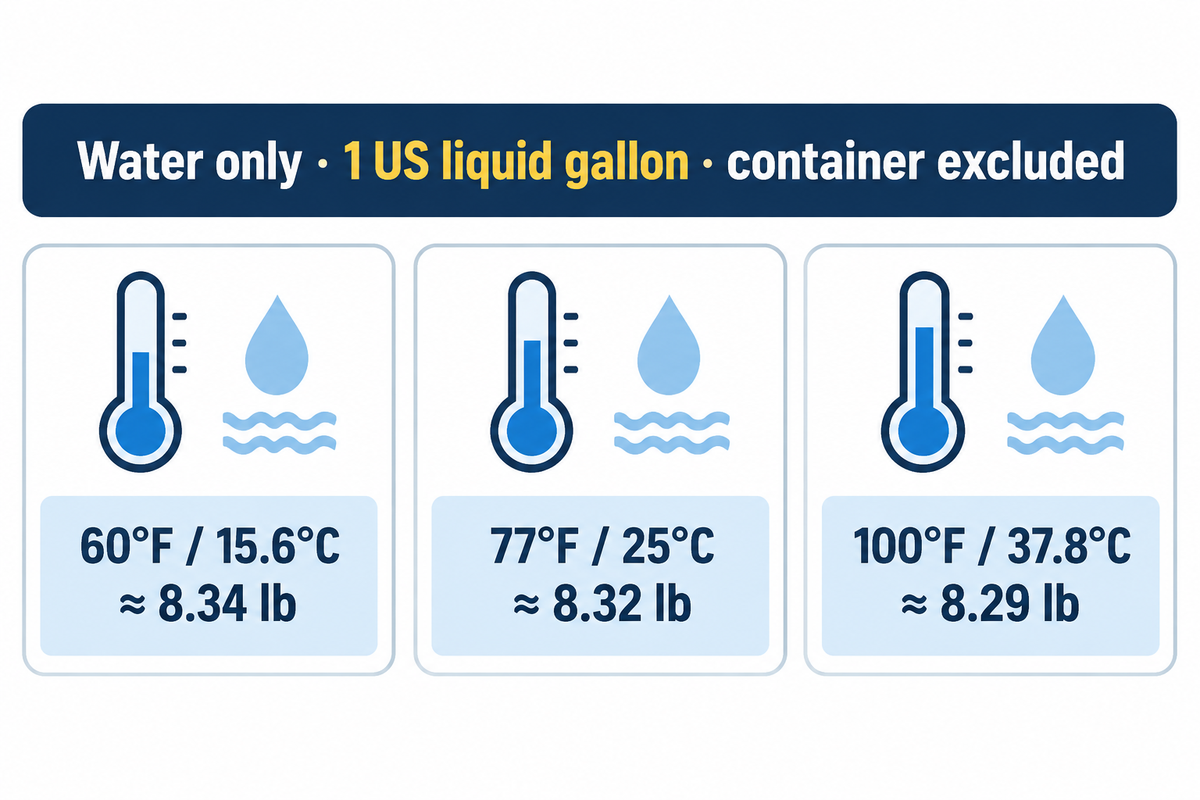
A US gallon of water weighs about 8.3 pounds when “gallon” means the US liquid gallon and the water is at room temperature. Densities of other liquids differ. Use the stated material and temperature in a conversion chart; a honey estimate can’t be used to assess milk, cream, or liquid propane.
| Liquid | Reference condition | Approximate weight | Basis |
|---|---|---|---|
| Water | 60°F / 15.6°C | 8.34 lb | Calculated from USGS density |
| Water | 70°F / 21°C | 8.33 lb | Calculated from USGS density |
| Water | 77°F / 25°C | 8.32 lb | University of Georgia estimate |
| Water | 100°F / 37.8°C | 8.29 lb | Calculated from USGS density |
| Producer milk | 20°C; textbook composition | 8.60 lb | Calculated from Guelph’s 1.030 kg/L |
| Packaged skim milk | 20°C; textbook composition | 8.62 lb | Calculated from Guelph’s 1.033 kg/L |
| Heavy cream | 20°C; textbook composition | 8.30 lb | Calculated from Guelph’s 0.994 kg/L |
| Honey | Temperature unspecified | About 12 lb | West Virginia University estimate |
| Liquid propane | 60°F reference basis | 4.23 lb | Calculated from government reference inputs below |
The USGS water-density table supplies the temperature-specific water inputs. University of Georgia Extension gives the separate 77°F estimate. Thus, “approximately 8.34 pounds” is a useful water reference, but it isn’t an exact answer at every temperature.
According to the University of Guelph dairy textbook, milk density varies with composition and temperature. Relative to one gallon of milk, one gallon of heavy cream weighs less. Fat content of milk changes the comparison, and thickness alone doesn’t tell you the density of the liquid.
Roughly 12 pounds per gallon is how West Virginia University Extension estimates honey’s weight. That’s a very rough estimate. To create a purchase order, the actual batch data is required. To process a honey bucket heater request, the size of the pail and the permitted temperature of the product are needed.
US gallon vs imperial gallon: which does your chart use?
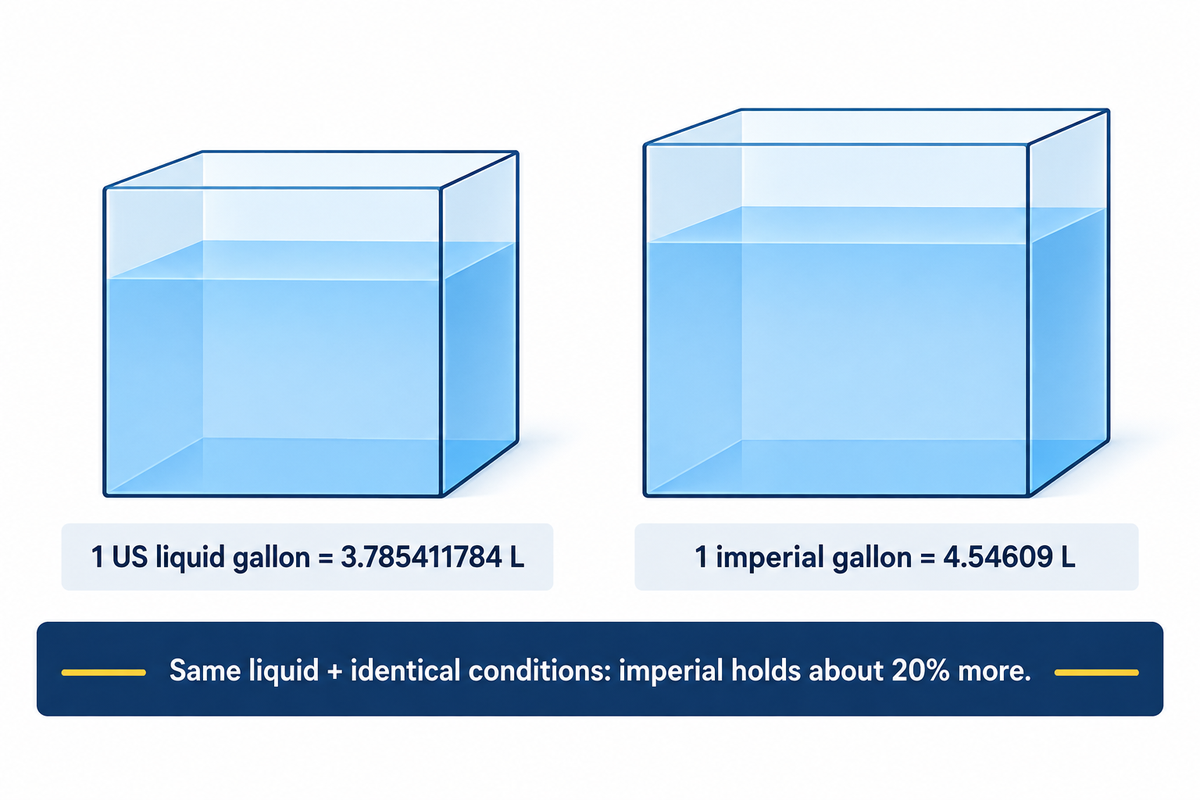
The liquid-weight chart uses the US liquid gallon which is a unit of volume. A US liquid gallon is 3.785411784 liters; an imperial gallon is 4.54609 liters. An imperial gallon therefore holds about 20% more of the same liquid, so its weight in pounds is also about 20% greater at identical conditions.
Use the National Institute of Standards and Technology’s Handbook 44 unit tables for the US conversion. NIST’s SP 811 conversion reference gives the imperial value. A UK gallon usually refers to the imperial unit. The liquid-weight chart uses US liquid gallons throughout.
In these weights and measures, the pound is the avoirdupois unit of mass: one pound is equal to 0.45359237 kilogram, and is equal to 16 ounces by mass (1 pound = 16 oz). Each ounce is a measure of mass here, not a fluid ounce. The metric system keeps mass and volume visibly separate as kilograms and liters; customary units require the same distinction.
For a hypothetical liquid with density exactly 1 kg/L, one imperial gallon contains 4.54609 kg, or about 10.02 lb. One US gallon contains about 8.3454 lb at that same assumed density. A US dry gallon is another volume unit; don’t select it for the liquid calculations on this page.
How do you convert gallons to pounds using density?
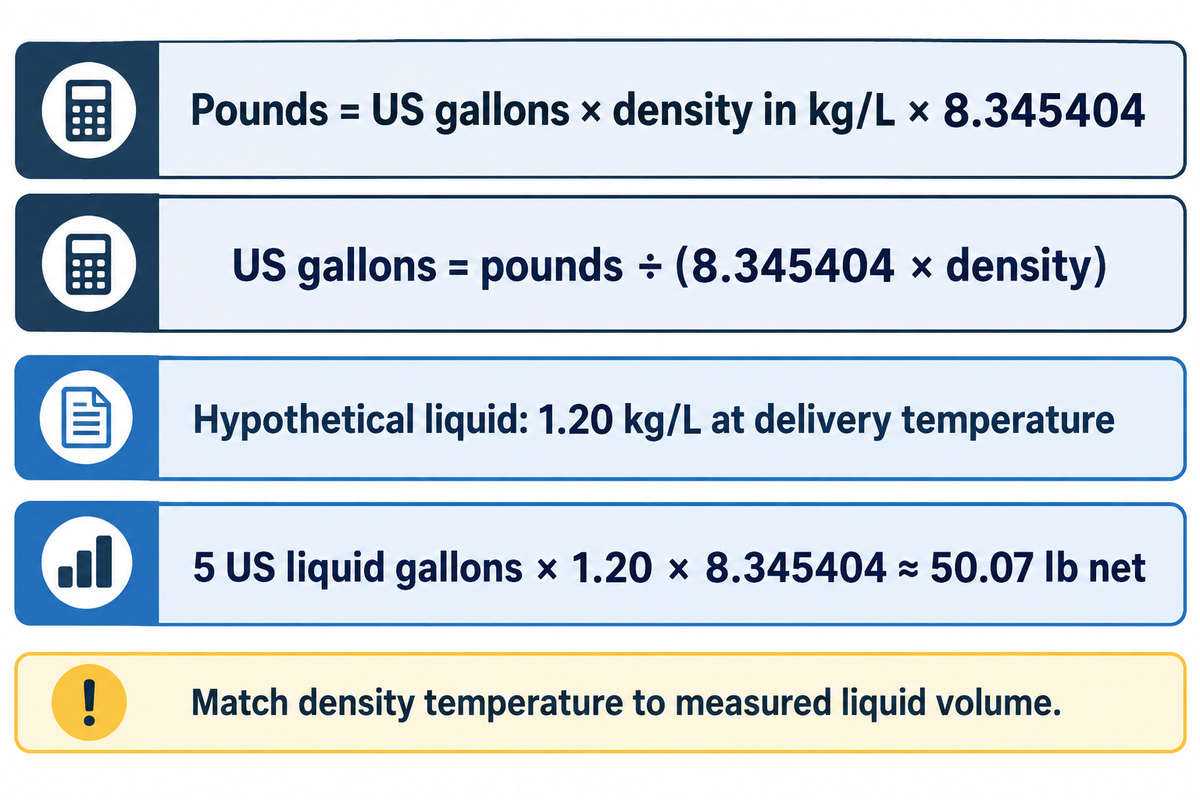
To convert gallons to pounds, multiply the volume in gallons by the liquid’s pounds per gallon. When density is given in kilograms per liter, first multiply US gallons by 3.785411784, then by that density, and divide by 0.45359237. Keep the density temperature consistent with the measured liquid volume.
Calculation formula: Pounds = US gallons × density in kg/L × 8.345404. The rounded factor comes from the NIST unit definitions. Numerically, 1 g/mL = 1 kg/L, so a density stated in grams per milliliter uses the same factor. For kg/m³, divide the density by 1,000 first.
Imagine ordering 5 gallons of a liquid whose supplier states 1.20 kg/L at the delivery temperature. The calculation would be 5 × 1.20 × 8.345404 = 50.07 lb of liquid approximately. A water setting in a gallons to pounds converter would give a lower result, because it would use the wrong density. Record the supplier’s density, its unit, and its reference conditions, along with the answer; then the next buyer can verify the result without guessing your assumptions.
How do you convert pounds to gallons?
To convert pounds to gallons, divide the net liquid mass by its pounds-per-gallon factor; for density in kg/L, the pounds to gallons conversion is US gallons = pounds ÷ (8.345404 × density). The parentheses matter: you divide by the entire product and not by 8.345404 followed by multiplication by density.
Using the same liquid example, 50.07 lb ÷ (8.345404 × 1.20) = about 5 US gallons. Round only after doing the calculation. If you use a pounds to gallons converter or a calculator to find the answer, check its material selection and unit of measurement. Entering gross package weight would count the container’s weight as liquid weight.
| Input type | What to do | What can go wrong |
|---|---|---|
| Density in kg/L | Use it directly in the US formula | Ignoring the stated temperature |
| Density in g/mL | Use the same numerical value as kg/L | Confusing grams with pounds |
| Density in kg/m³ | Divide by 1,000 to obtain kg/L | A thousandfold input error |
| Density in lb/US gal | Multiply directly by US gallons | Applying 8.3454 a second time |
| Specific gravity | Identify the reference fluid and temperature | Treating a ratio as a density with units |
| Relative gas density | Find a separate liquid-density entry | Using vapor data for stored liquid |
| Net liquid weight | Divide by the matching density factor | Choosing imperial rather than US gallons |
| Gross package weight | Subtract actual tare before converting | Counting packaging as product |
| Nominal container capacity | Obtain the actual fill volume or net mass | Assuming every container is full |
The University of Texas defines specific gravity as a dimensionless ratio with reference water at a stated temperature. A value marked 60°F/60°F carries a different reference basis from one using water at 4°C. Ask for mass density when a data sheet leaves that convention unclear.
Do
- Keep the material, phase, temperature and density unit together.
- Use the same gallon standard throughout the calculation.
Don’t
- Use viscosity as a density value.
- Apply a water preset to every liquid.
How much do 5 gallons of water weigh?
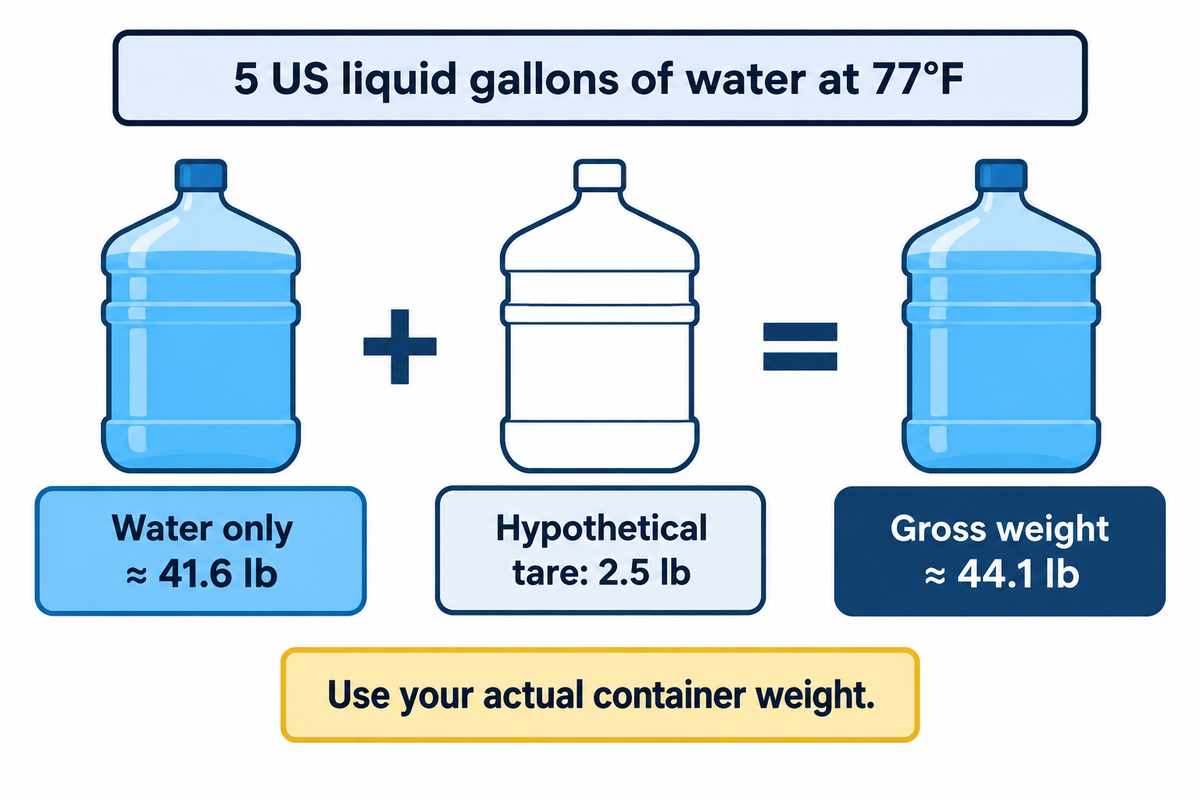
Five US gallons of water weigh about 41.6 pounds at 77°F, using University of Georgia Extension’s approximate 8.32-pound-per-gallon value. Again, this figure is for water alone. To determine the total weight, include the weight of the water jug and the cap, as well as any support or carrying equipment.
Suppose an empty water container weighs 2.5 lb and the volume of water added is 5 US gallons at those conditions. Water mass is 5 × 8.32 = 41.6 lb. Gross weight is then 41.6 + 2.5 = 44.1 lb. The 2.5 lb tare is an example, not a standard jug weight. Use a scale for your actual container when the total matters.
The density of water changes with temperature and the concentration of dissolved substances. The Penn State water science course states that as more dissolved salts are present, the density of water increases. The failure of “colder means denser” below water’s maximum-density temperature also occurs in pure water, without dissolved substances. For a brine solution, use its supplied density rather than the density of pure water.
How many gallons of propane are in a 100 lb tank?
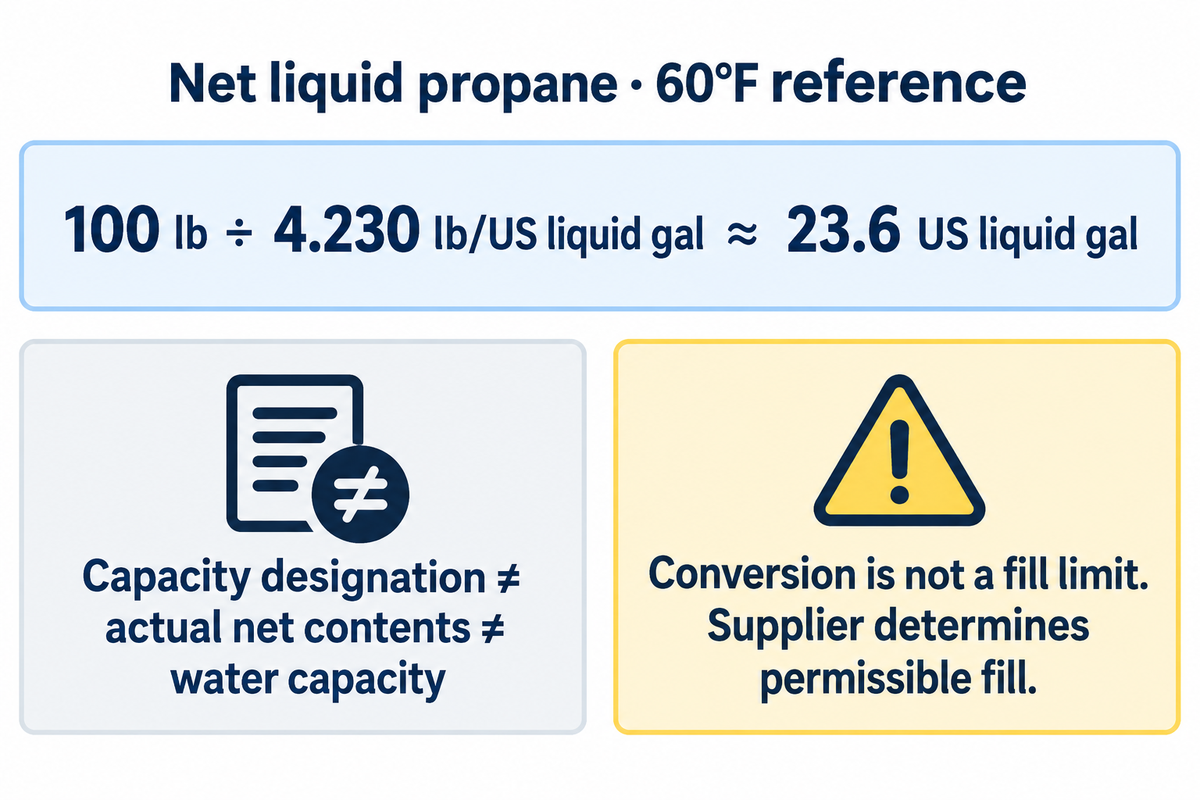
A net mass of 100 lb liquid propane is approximately 23.6 US gallons at a reference temperature of 60°F. This information describes the physical properties of propane. It doesn’t define how much propane is in a cylinder, or how much a supplier is allowed to put in a cylinder.
Here’s the reference calculation. Washington’s published propane table labels propane specific gravity as 0.5079 at 60°F/60°F. The federal cylinder regulation’s water reference gives 27.737 cubic inches per pound of water at 60°F. With a US gallon defined as 231 cubic inches, 0.5079 × 231 ÷ 27.737 gives about 4.230 lb per gallon. Then 100 ÷ 4.230 gives about 23.6 gallons.
Keep three quantities separate: the cylinder’s propane-capacity designation, its actual net propane contents and its water capacity. Water capacity describes the amount of water the container can hold; it isn’t the propane mass printed in a size description. Nor should the mass-to-volume calculation be multiplied by another blanket 80% factor. Have the propane supplier determine the permissible fill for the actual cylinder.
A real retail example makes the distinction useful. North Carolina’s consumer guidance explains that an exchanged nominal 20 lb grill cylinder can contain about 15 lb of propane. Read the net-weight statement rather than inferring contents from its name. That example concerns small exchange cylinders; it supplies no percentage to apply to a 100 lb cylinder.
Also check the phase. The CDC propane entry lists 1.55 under relative gas density. That field isn’t liquid density in kg/L and can’t replace the value provided above.
“In the event of extreme cold, NEVER try to keep propane storage cylinders or tanks warm by applying an external heat source.”
A weight conversion isn’t a heater-selection instruction. Any request for propane vessel heating applications requires a qualified, application-specific review. Don’t use this to pick a heat source.
Container weight: net contents, tare and gross weight
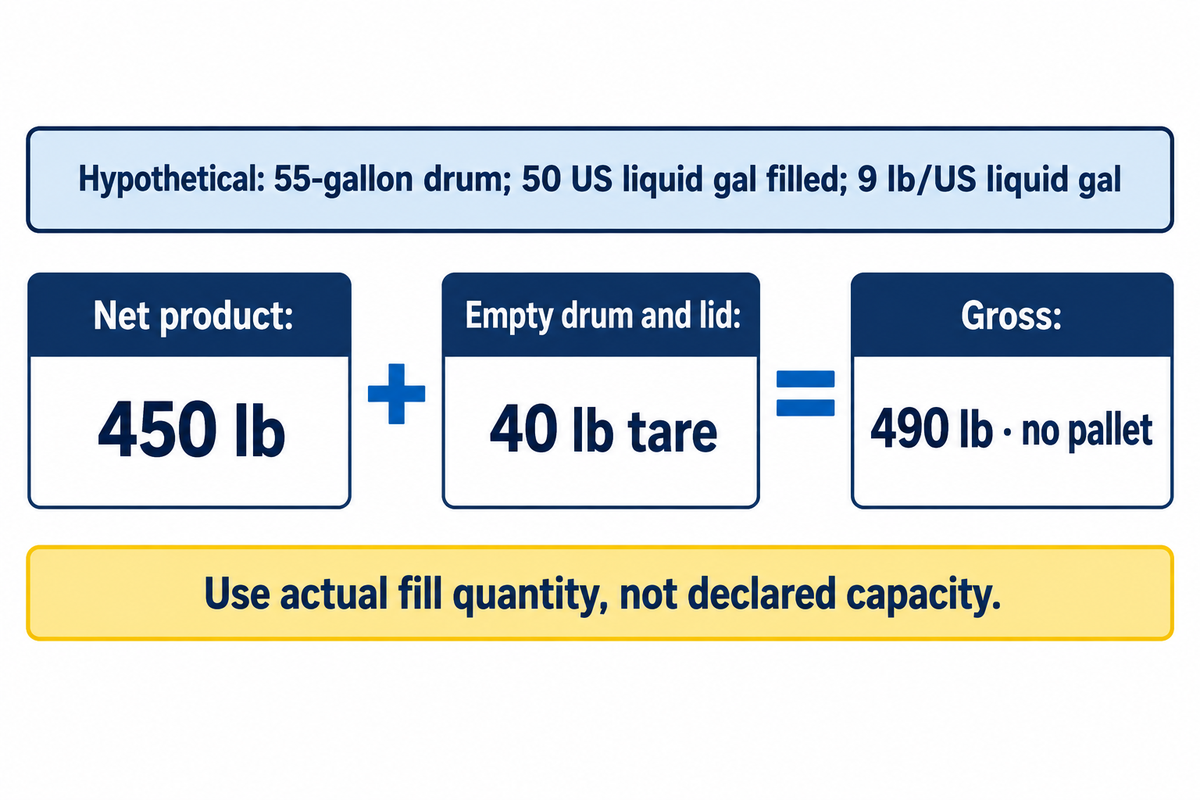
Net weight is the contents only, tare is the empty packaging included in the measurement, and gross weight is the sum of the two. In a shipment, determine if the tare provided includes the lid, pallet and other packaging. Only the net mass of the liquid needs to be converted to its volume.
Gross weight = net contents + tare. To find net contents, subtract tare from gross weight. Keep both measurements in the same units. A container’s declared capacity is neither measurement. For a partly filled container, use the actual fill quantity rather than the declared capacity.
How much does a 55 gallon drum weigh?
A 55 gallon drum containing 50 US gallons of liquid at 9 lb/US gal would weigh 490 lb if its empty drum and lid weigh 40 lb. This hypothetical gross weight includes 450 lb of product but no pallet. Actual weight depends on the contents, fill quantity and measured packaging mass.
The supplied examples must be replaced by the supplier’s actual liquid data and packaging weight. If the shipping document already provides 490 lb gross, dividing that whole number by 9 would already overstate the liquid volume. Subtracting 40 first returns 50 gallons. For a drum heating blanket enquiry, the actual drum dimensions must also be provided; a capacity class doesn’t determine blanket fit.
How do you compare prices per pound and per gallon?
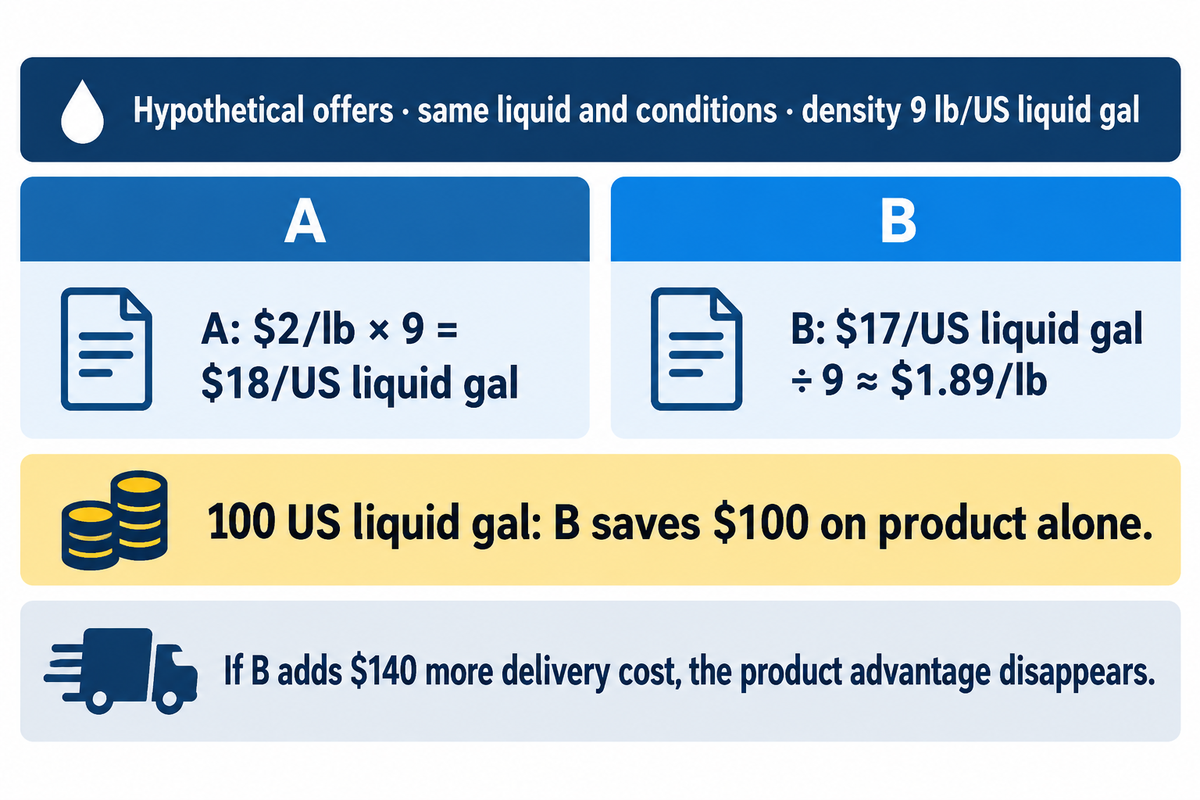
Compare a per-pound price with a per-gallon price by converting both to the same unit, using the quoted material’s density. Match the concentration and temperature basis and gallon standard, before comparing totals. Delivery, tax, packaging and other costs must be compared separately; an apparently lower unit price must not be mistaken for a lower total cost.
Quotation comparison is a practical application of weight and volume. Consider two hypothetical offers for the same liquid at the same concentration and delivery conditions. Its supplied density is 9 lb per US gallon. Supplier A asks $2 per pound; Supplier B asks $17 per US gallon. A’s equivalent gallon price is $2 × 9 = $18. B’s equivalent pound price is $17 ÷ 9 = approximately $1.89. On product alone, B is $1 per gallon lower.
For a hypothetical 100-gallon order, that’s $100 less before other charges. If B adds $140 more delivery cost, the apparent product-price advantage disappears. Keep the base numbers of the purchase comparison so changes in order size and/or freight can be easily evaluated.
Temperature-compensated volume requires special attention. LP Gas’s discussion of temperature correction explains that actual measured gallons and gallons normalized to a reference temperature can be different. Determine which basis is quoted and delivered. Don’t combine the two and treat them as if they’re describing the same volume under the same conditions.
Before ordering liquid: the Unit, Density, Tare Check
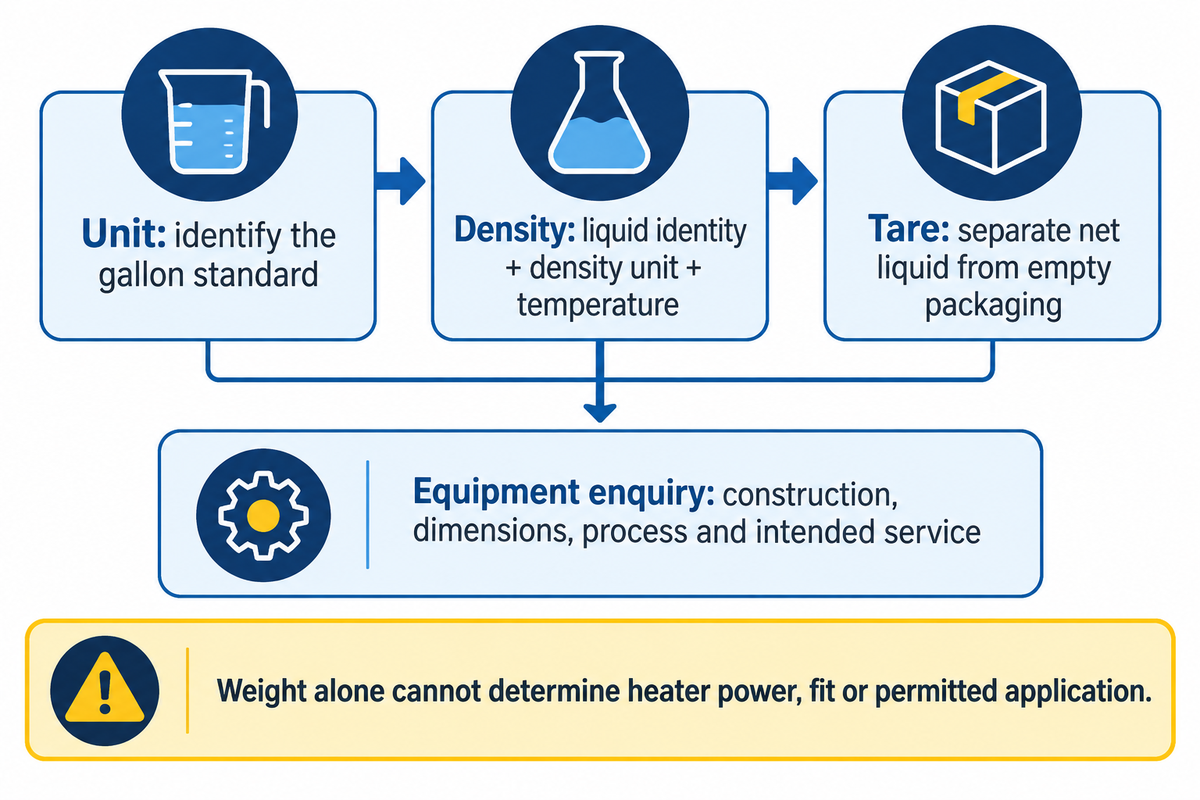
Before requesting a quotation, use the Unit, Density, Tare check. Identify the gallon standard, obtain the liquid’s density with reference conditions, and separate liquid weight from container weight. These give a good way to estimate liquid weight. Add the actual dimensions of the container for an equipment enquiry; weight alone can’t determine a heater’s power, fit or permitted application.
Send material identity, actual fill quantity and unit of density (as filled), temperature, container construction and dimensions, empty package weight, the process to be performed, and intended service. For IBC tote heaters send start and end temperatures, time available, ambient conditions and electric power supplied.
Key takeaway
Put the gallon standard, density conditions and actual tare beside the quantity. Those inputs make the weight calculation checkable and reveal what the equipment enquiry still needs.
Use the container heating range of FlexBlanket to identify the relevant vessel category and send the above application inputs for a configuration review.
Frequently asked questions
Does 8 pounds equal 1 gallon?
There’s no universal number of pounds to a gallon: eight pounds doesn’t equal one gallon for every material. One gallon of water weighs a little over eight pounds near room temperature when measured as a US liquid gallon. Honey and milk weigh more per gallon, while liquid propane weighs less. Identify the liquid and use its density if you need more than a rough everyday estimate.
How many pounds are in a 1 gallon bucket?
A bucket holding one US gallon of water at 77°F contains about 8.32 lb of water, plus the weight of the empty bucket and lid. Other contents and fill levels change that total. Calculate the liquid’s net weight from its density and measured volume, then add the packaging. A partly filled bucket contains less liquid. For a lifting, shipping or batching calculation, weigh the actual package instead of assuming that every nominal one-gallon container has the same tare.
Is 128 oz the same as 1 gallon?
128 US fluid ounces equal one US liquid gallon, but 128 ounces by mass don’t identify a fixed liquid volume. Fluid ounces measure volume; ordinary avoirdupois ounces measure mass. Check whether the label says “fl oz” before using a gallons conversion. For practical culinary measurement tips, start with the recipe label: use a scale for mass and a volume measure for fluid ounces. Cooking applications and product labels can use both kinds of units.
Is 5 pounds equal to 1 gallon?
No fixed conversion makes 5 pounds equal one gallon. Five pounds of room-temperature water is less than one US gallon; a different liquid needs its own density factor.
Can I use the same conversion for every liquid?
No. The density of the substance determines its pounds per gallon. Use a matching material, phase and temperature, and check the composition when a mixture or concentration changes.
References & Sources
- USGS: Water Density
- University of Georgia Extension: Weight of Water
- University of Guelph: Physical Properties of Milk
- West Virginia University Extension: Beekeeping Equipment
- NIST Handbook 44 (2026), Appendix C: General Tables of Units of Measurement
- NIST SP 811: Conversion Factors
- University of Texas: Specific Gravity
- Penn State: Water Density
- Washington Administrative Code 16-659-010: Liquefied Petroleum Gas
- 49 CFR 173.304a: Liquefied Compressed Gases in Specification Cylinders
- North Carolina Department of Agriculture: LP-Gas Consumer Questions
- CDC/NIOSH: Propane
- Propane Education & Research Council: Safety Guide for Propane Users
- LP Gas: Avoid Issues with Wheel Stops and Temperature Correction