Get in touch with FlexBlanket Company

Silicone Drum Heaters
Silicone Drum Heaters for 25–200 L Steel and Plastic Drums
Silicone drum heaters wrap around the outside of a steel or plastic drum and drive heat through the drum wall into the contents. We build them as flexible silicone rubber bands in three widths, each with a built-in adjustable thermostat and a sensor that reads the band surface. Send the measured outside diameter of your drum, the medium and your target temperature, and we return a free heating solution design drawing before you order.
- 30 °C to 150 °C (86 °F to 302 °F) adjustable
- 25–200 L (6.6–55 gallon) steel and HDPE drums
- 7–15 days after order confirmation
- 24-month warranty with free replacement parts
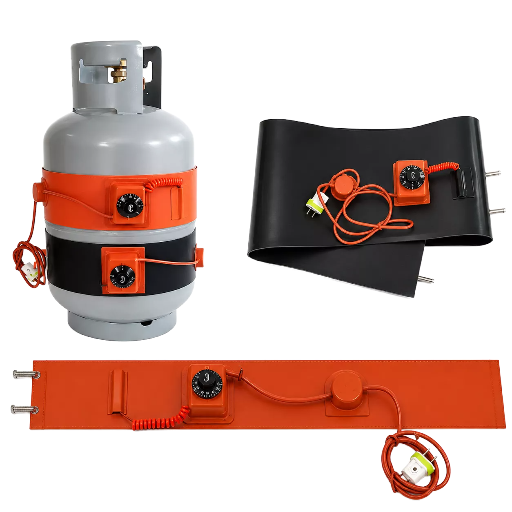
Technical Specifications Matrix
- Temperature range
- 30 °C to 150 °C (86 °F to 302 °F), set on an adjustable analogue thermostat
- Power per band
- 2,000 W on the 250 mm (9.8 in) band; 1,000 W on the 150 mm (5.9 in) and 125 mm (4.9 in) bands
- Drum capacities
- 25 L, 30 L, 50 L, 60 L, 105 L and 200 L (6.6 to 55 gallon), steel and HDPE
- Supply and plug
- 120 VAC or 230 VAC single phase, with a 10 A (EU/UK) or 15 A (US) plug fitted to your destination
- Ingress protection
- IP65 controller enclosure rated to IEC 60529 — dust-tight and protected against water jets
- Commercial terms
- 7–15 days after order confirmation, 24-month warranty with free replacement parts
Silicone Drum Heater Bands:
Models, Widths and Wattage
An electric drum heater band is a flat resistance element vulcanised between two sheets of silicone rubber, wrapped around the outside of a drum body and fastened with tension springs. Every model on this page runs on your local single-phase supply, with no steam piping and no hot-water circuit to plumb, and sits under the 600 V ceiling ANSI/UL 499 sets for electric heating appliances in unclassified rather than hazardous locations.
Width decides how much drum wall the band touches, and it is that contact area, not wattage on its own, that sets how fast the contents reach temperature.
Read the watt density column before the wattage column. The 125 mm and the 250 mm band both put 0.46 W/cm² into the drum wall, while the 150 mm band runs cooler per unit of area at 0.38 W/cm², which is why we reach for it on plastic drums and on materials that scorch.
Lower watt density buys a gentler drum wall, not a faster heat-up, because heat-up time follows total wattage.
| Model | Band size | Power | Heated area | Watt density | Current (230V) | Current (120V) |
|---|---|---|---|---|---|---|
| FLB-SDH-250 | 1740 × 250 mm (68.5 × 9.8 in) | 2,000 W | 4,350 cm² (674 in²) | 0.46 W/cm² (2.97 W/in²) | 8.7 A | 16.7 A |
| FLB-SDH-150 | 1740 × 150 mm (68.5 × 5.9 in) | 1,000 W | 2,610 cm² (405 in²) | 0.38 W/cm² (2.47 W/in²) | 4.3 A | 8.3 A |
| FLB-SDH-125 | 1740 × 125 mm (68.5 × 4.9 in) | 1,000 W | 2,175 cm² (337 in²) | 0.46 W/cm² (2.97 W/in²) | 4.3 A | 8.3 A |
2,000 W across 1740 × 250 mm. For 55 gallon drum heaters this is the default width, and the model to specify when heat-up time drives the decision on a 200 L drum.
At 230 V it draws 8.7 A. At 120 V it draws 16.7 A, which is more than a 15 A plug and circuit carry, so a 2000 W band is planned on a 230 V supply or a dedicated circuit; we confirm the supply and plug for your destination at quotation.
1,000 W across 1740 × 150 mm. It draws 4.3 A at 230 V and 8.3 A at 120 V, so it runs from an ordinary single-phase outlet in either market.
Lowest watt density of the three at 0.38 W/cm², which makes it the first choice on HDPE drums and on heat-sensitive contents.
1,000 W across 1740 × 125 mm. Same wattage as the 150 mm band over a smaller footprint, so it concentrates heat into a narrower ring of drum wall.
Two or three of these placed at different heights spread the same total load over more of the drum wall than one wide band does. That suits freeze protection and long steady holds.
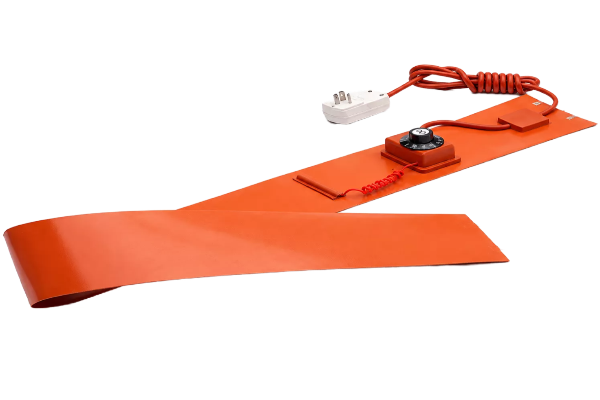
What These Bands Are Used For
01
Lubricants and base oils
reducing viscosity so a cold drum will pump.
02
Resins and adhesives
bringing epoxies and polyurethanes back to a workable state.
03
Waxes, fats and stearates
melting out and then holding above the melting point.
04
Water-based chemicals
freeze protection on drums stored outdoors.
05
Food-grade liquids in steel drums
glucose, syrups and edible oils that set on standing.
06
Sampling and dispensing
holding one drum at a stable temperature on a decanting bay.
Custom bands
Custom dimensions are available upon request. Every container below 200 L takes a band cut to its own circumference rather than a catalogue length.
We also build to OEM & ODM drawings, using the same element, jacket and control construction as the catalogue models and as our flat and curved silicone rubber heater panels.
Request QuotationSteel and Plastic Drums: The Media We Heat
Heat moves from the band through the drum wall, then into the contents by conduction near the wall and slow convection above it. What the medium does with that heat — thin out, melt, hold, or degrade — sets band width and set point, rather than the drum size on its own.
[ 01 ]
Oils and lubricants
Base oils and gear lubricants thicken as they cool, and getting them out of a cold 200 L (55 gallon) drum is the most common reason buyers ask for a band. Viscosity falls as the oil warms, so the number that matters is the pumping temperature your process needs.
Tight-head steel drums, which BASCO lists as the format for low-viscosity liquids such as solvents and oils, take a single 250 mm (9.8 in) band.
[ 02 ]
Resins and adhesives
Epoxy and polyurethane resins gain viscosity quickly below room temperature and usually arrive in open-head drums. BASCO lists open-head drums as the format for slow-moving materials such as adhesives and thick paint, and publishes an open-head steel drum at 24-1/2 in (622 mm) across against 23 in (584 mm) for a tight-head — approximate figures that move with the maker.
Even that 38 mm (1.5 in) gap between the two published figures changes the band length you need, which is why we size from a diameter you have measured rather than from a nominal capacity.
[ 03 ]
Waxes, fats and stearates
Paraffin, stearates and hard fats melt at a sharp point and then need holding above it, not driving far past it. Overshoot discolours the batch and wastes power, so this is a duty for a steady set point rather than the widest band on the shelf.
Send the melting point and the holding temperature separately; they are two different numbers on the thermostat, and a melt pumped into an unheated line plugs the line rather than the drum — keeping that run hot is a pipe process heating job, not a wider band.
[ 04 ]
Water-based chemicals and freeze protection
Freeze protection is the lightest duty on this page: the band holds the contents above the point where they freeze or crystallise, it does not raise them. Because the load is standing heat loss rather than heat-up, the 125 mm (4.9 in) band at 1,000 W is the starting point rather than the 250 mm band.
Send us the lowest ambient temperature at the site and whether the drum sits indoors or outdoors, and we size from those two numbers.
[ 05 ]
HDPE drums and their ceiling
Blow-moulded HDPE is the drum material BASCO lists for chemicals, food and cosmetics, and on a plastic drum the drum sets the temperature ceiling, not the heater. Polyethylene softens and creeps under sustained load well below the 150 °C (302 °F) the thermostat can reach, and a heated drum carrying its own contents can distort near the base.
On plastic drums we set the thermostat below the drum’s own limit, and we ask you to confirm that limit with your drum supplier before the order — the deflection temperature under load (ASTM D648) or the Vicat softening point (ASTM D1525), not the melting point.
[ 06 ]
Food-grade liquids in steel
Glucose, syrups and edible oils set on standing and are then decanted warm. They run on the same band construction as an industrial oil; the difference is in the set point and the hold time, not in the hardware.
The band heats the outside of the drum and never contacts the product, so the food-contact question stays with your drum liner, not with us.
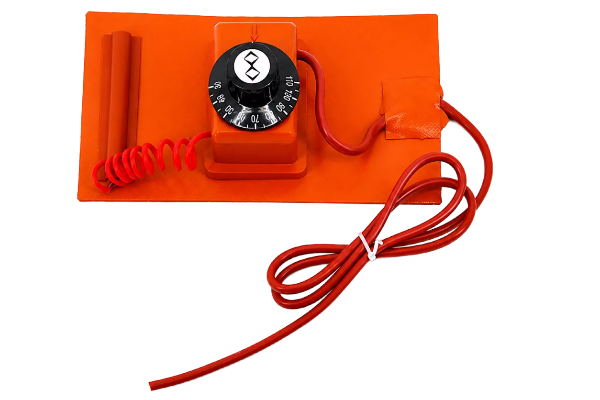
Drum Heating Duty Classes
Identify the duty class your application falls into before you pick a width, because the class and not the drum size decides the band count. We put the same three questions we ask on a quote into the Duty Class Selector.
| Duty class | What the band has to do | Starting point (200 L / 55 gal) | Load at 230 V | What we need from you |
|---|---|---|---|---|
| Freeze protection | Hold the contents above their freeze or crystallisation point; no temperature rise required | One 125 mm (4.9 in) band | 1,000 W / 4.3 A | Lowest site ambient temperature, indoor or outdoor placement |
| Viscosity reduction | Bring a cold, thick medium down to a pumpable viscosity and hold it there | One 250 mm (9.8 in) band | 2,000 W / 8.7 A | Pumping temperature and the medium’s pour point |
| Melt-out and hold | Take a solid or semi-solid through its melting point, then hold above it without overshoot | Two/Three 250 mm (9.8 in) bands | 4,000–6,000 W / 17.4–26.1 A | Melting point, holding temperature and batch cycle time |
Construction, Wrap-Around Fit
And Temperature Control
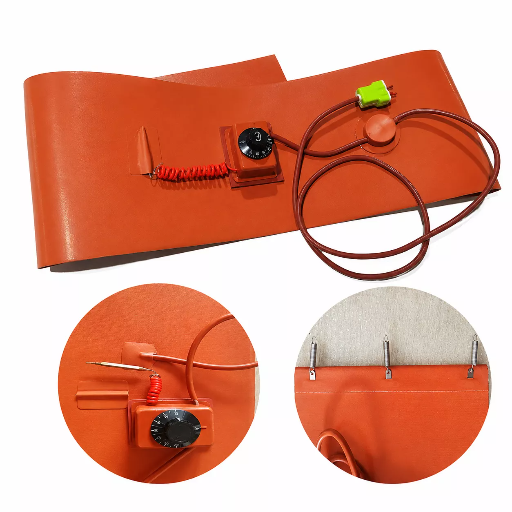
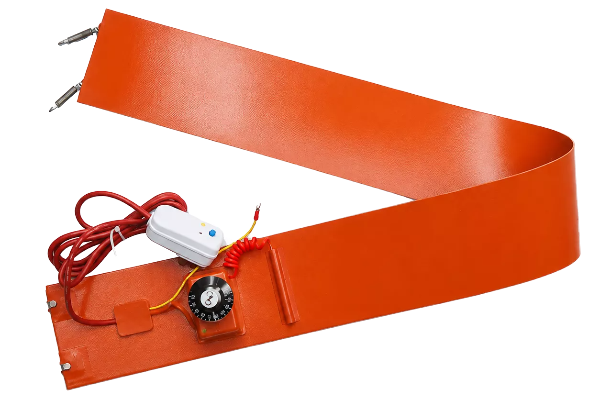
Six parts make up a drum band, and each one is worth a look when the shipment arrives. Each row below gives what a part is, why it is built that way, and what to check before the band goes on a drum.
No.
Part
What it is
Why it is built that way
What to check on arrival
01
Heating element
Resistance wire wound, or foil etched, into a flat pattern across the band area
A flat pattern spreads the load over the whole 2,175–4,350 cm² of band instead of concentrating it on a line
An even surface with no local bulge or ridge
02
Silicone jacket
The element vulcanised between two sheets of silicone rubber in a flat press
Pressing bonds jacket to element so there is no air gap to trap heat against the element
No delamination at the edges or around the lead exit
03
Closure springs
Two to four extension springs on metal hooks along one edge
The springs bridge the gap between band length and drum circumference, and hold tension as the drum warms and expands
Springs stretch by hand and return; hooks straight, not opened out
04
Thermostat
Adjustable analogue thermostat in an IP65 enclosure rated to IEC 60529
A dial has no membrane to perforate, which is what the IP65 rating has to hold in a wash-down bay
Dial turns through the full scale; enclosure gasket seated all round
05
Sensor
Sensor reading the band surface, between silicone and drum wall
Band-surface control is what protects the silicone from overheating; the medium always lags behind it
Sensor lead undamaged where it enters the enclosure
06
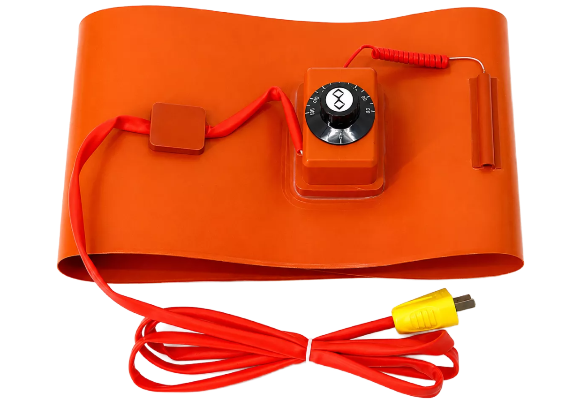
Lead and plug
Flexible lead terminated in a 10 A (EU/UK) or 15 A (US) plug
The plug is fitted to the destination so the band arrives ready to run without a rewire
Plug matches your outlet, and your circuit rating matches the band load
07
Width options
250 mm, 150 mm or 125 mm across, all 1740 mm (68.5 in) long in the catalogue
Width sets contact area; up to three heater bands go on a single 200 L drum when one is not enough
Width and length on the label match what you ordered
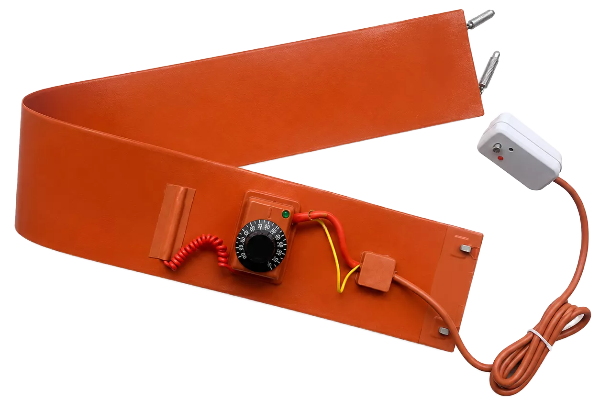
Drum Heater with Thermostat:
The Three Temperatures That Are Not the Same
A drum heater with a thermostat gives you three different temperatures, and buyers who treat them as one number get caught out. A neutral industrial-heater reference draws the same line between the heater’s own surface and the material inside.
The gap between the second and the third is why we ask for the target medium temperature and not for a dial setting. On a part-full drum the band surface can sit well above the contents while the contents are still cold, and on a plastic drum that gap is exactly where the drum gets damaged. The dial is an adjustable thermostat and not a precise setpoint controller, so a process that has to hold the medium inside a narrow window takes an external controller with its probe in the liquid.
- Maximum operating (sheath) temperature
- is the highest temperature that the heater’s sheath (or protective cover) may reach. This is not the maximum temperature a heated substance may reach.
- Dial set point
- — the number you turn the thermostat to.
- Band surface temperature
- — what the sensor reads and controls, sitting between the silicone and the drum wall.
- Medium temperature
- — what your process cares about, lagging behind the band surface by an interval that depends on fill level, drum material and how much of the wall the band covers.
Specifications, Drum Fit and Electrical Ratings
General Specifications Overview
| Parameter | Specification | Models |
|---|---|---|
| Band dimensions | 1740 × 250 mm, 1740 × 150 mm, 1740 × 125 mm (68.5 × 9.8 / 5.9 / 4.9 in) |
FLB-SDH-250 FLB-SDH-150 FLB-SDH-125 |
| Power per band | 2,000 W on the 250 mm band; 1,000 W on the 150 mm and 125 mm bands | |
| Supply voltage | 120 VAC or 230 VAC, single phase | |
| Current draw | 2,000 W band: 16.7 A at 120 V, 8.7 A at 230 V. 1,000 W band: 8.3 A at 120 V, 4.3 A at 230 V | |
| Temperature range | 30 °C to 150 °C (86 °F to 302 °F) | |
| Temperature control | Adjustable analogue thermostat, sensor reading the band surface | |
| Ingress protection | IP65 controller enclosure, rated to IEC 60529 | |
| Drum capacities | 25 L, 30 L, 50 L, 60 L, 105 L and 200 L (6.6, 7.9, 13.2, 15.9, 27.7 and 55 gallon) | |
| Drum materials | Steel and HDPE (plastic) drums | |
| Stacking | Up to three heater bands on a single 200 L (55 gallon) drum | |
| Plug fitted | 10 A (EU/UK) or 15 A (US), matched to the destination | |
| Installation | Tool-free wrap-around fit, closed by tension springs | |
| Warranty | 24-month warranty with free replacement parts for manufacturing defects |
The 150 °C ceiling belongs to the heater, not to your drum. On an HDPE drum the drum material sets the working limit, and we set the thermostat below it. Confirm that limit with your drum supplier before you order.
All three catalogue models are 1740 mm long. That length suits a 200 L (55 gallon) drum; for 25 L to 105 L containers the band is cut to the circumference you measure, and custom dimensions are available upon request.
Drum Fit by Capacity: 25 L (6.6 Gallon) Pails to 200 L (55 Gallon) Drums
A 200 L drum is not one diameter. BASCO, a drum distributor rather than a standards body, publishes the outside diameter of a tight-head steel drum as 23 in (584 mm) and an open-head steel drum as 24-1/2 in (622 mm), with plastic drums falling between them, and records these as approximate dimensions that vary between manufacturers and styles. Run those diameters through a circumference and the same 1740 mm band leaves a very different gap for the springs to close.
| Drum format | Published outside diameter | Circumference | Gap a 1740 mm band leaves |
|---|---|---|---|
| Steel, open-head | 24-1/2 in (622 mm) | 1,955 mm (77.0 in) | 215 mm (8.5 in) |
| Plastic (HDPE), tight-head | 23-1/4 in (591 mm) | 1,855 mm (73.0 in) | 115 mm (4.5 in) |
| Steel, tight-head | 23 in (584 mm) | 1,835 mm (72.3 in) | 95 mm (3.8 in) |
| Plastic (HDPE), open-head | 22-7/8 in (581 mm) | 1,825 mm (71.9 in) | 85 mm (3.4 in) |
The span runs from 85 mm to 215 mm — a factor of two and a half — on drums that all get called 55 gallon. That is the reason we ask for a measured outside diameter instead of a capacity, and the Drum Band Sizing Calculator runs the same arithmetic on the number you measure. Other drum makers publish figures a little either side of these, which is why the diameter you measure, and not the one anyone publishes, decides the band length.
| Container | Capacity | Band we start from | Band length |
|---|---|---|---|
| Pail | 25 L (6.6 gallon) | One 125 mm (4.9 in) band | Cut to measured circumference |
| Pail | 30 L (7.9 gallon) | One 125 mm (4.9 in) band | Cut to measured circumference |
| Drum | 50 L (13.2 gallon) | One 150 mm (5.9 in) band | Cut to measured circumference |
| Drum | 60 L (15.9 gallon) | One 150 mm (5.9 in) band | Cut to measured circumference |
| Drum | 105 L (27.7 gallon) | Two 150 mm (5.9 in) bands | Cut to measured circumference |
| Drum | 200 L (55 gallon) | One to three 250 mm (9.8 in) bands | 1740 mm (68.5 in) catalogue length |
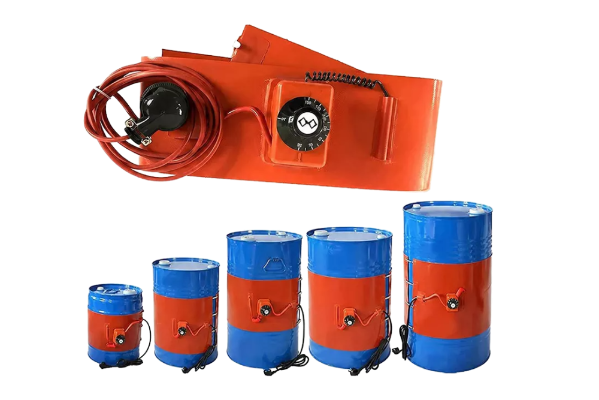
Pail heaters use the same element, jacket and thermostat as the drum bands; only the length changes. A pail at 25 L needs roughly a third of the band length a 200 L drum needs, so the wattage comes down with it.
The same construction across five container sizes. Band length changes with circumference; the element, jacket and thermostat do not.
Drum Band Stack Load Table
Stacking bands multiplies the load on your circuit, not just the heat on your drum. Check the current column against the outlet you plan to use before you order a second or third band.
| Drum | Band set | Heated width | Power | Current (230V) | Current (120V) | Supply note |
|---|---|---|---|---|---|---|
| 25 L pail | One 125 mm | 125 mm | 1,000 W | 4.3 A | 8.3 A | Runs from a standard single-phase outlet in either market |
| 30 L pail | One 125 mm | 125 mm | 1,000 W | 4.3 A | 8.3 A | Runs from a standard single-phase outlet in either market |
| 50 L drum | One 150 mm | 150 mm | 1,000 W | 4.3 A | 8.3 A | Runs from a standard single-phase outlet in either market |
| 60 L drum | One 150 mm | 150 mm | 1,000 W | 4.3 A | 8.3 A | Runs from a standard single-phase outlet in either market |
| 105 L drum | Two 150 mm | 300 mm | 2,000 W | 8.7 A | 16.7 A | A 2000 W band is planned on a 230 V supply or a dedicated circuit; we confirm the supply and plug for your destination at quotation |
| 200 L drum | One 250 mm | 250 mm | 2,000 W | 8.7 A | 16.7 A | A 2000 W band is planned on a 230 V supply or a dedicated circuit; we confirm the supply and plug for your destination at quotation |
| 200 L drum | Two 250 mm | 500 mm | 4,000 W | 17.4 A | 33.3 A | Two separate circuits, one per band |
| 200 L drum | Three 250 mm | 750 mm | 6,000 W | 26.1 A | 50.0 A | Three separate circuits; this is the maximum stack we build |
| 200 L drum | One 250 + two 125 | 500 mm | 4,000 W | 17.4 A | 33.3 A | Two circuits; spreads the same load over more of the drum wall |
Three 250 mm bands stack to 750 mm (29.5 in) of heated width on a drum that BASCO records as 33 to 34-3/4 in (838 to 883 mm) tall, so even a full stack leaves the rim and the base clear. Every figure in the current columns is the band load alone; add whatever else shares the circuit before you size the breaker.
Not sure which row you are on? Send the drum capacity, the material and a measured outside diameter, and we return a free heating solution design drawing with the band count and total load already worked out.
Pricing, Lead Time And What Ships With Your Order
Cost on a drum band tracks three things: how much silicone and element go into the band, what the control enclosure carries, and how many bands you order at once. We quote per band and per drum configuration rather than per project, so you can see exactly what a second or third band adds.
| Cost driver | What moves the price | What you can do about it |
|---|---|---|
| Band area | A 250 mm band carries twice the silicone and element area of a 125 mm band — 4,350 cm² against 2,175 cm² | Choose width from the duty class, not from the drum size |
| Band length | Catalogue 1740 mm bands run from existing tooling; a length cut to your measured circumference is a custom dimension | Send the measured outside diameter early so the length is priced into the first quote |
| Control and plug | The IP65 enclosure, thermostat and destination plug are a fixed cost per band, not per metre of band | Two narrow bands cost more in controls than one wide band of the same total power |
| Order quantity | Setup and vulcanising press time spread across the run | Ask for pricing at one, ten and fifty bands in the same quote so you can see where the break sits |
Lead Time And Documents
- Production: 7–15 days after order confirmation, for small batches and production orders alike.
- Documents with every shipment: a proforma invoice, sales contract, commercial invoice, packing list, and certificate of origin.
- Samples: available before a bulk order, with sample freight paid by the buyer.
- Spares: heating elements and critical components are kept for large overseas projects.
Counting starts when you confirm the design drawing and the plug type, not when the enquiry lands. Confirming both in one reply is the single biggest thing that shortens a delivery. A second band on the same drum costs you another circuit as well as another 2,000 W, so check the supply before you add one.
Request pricing at one, ten and fifty bands in the same enquiry and the quote comes back with the break points marked, together with the free design drawing.
Quality Control and Factory Testing
Every band is electrically tested before it leaves the line, and that test record is the part of this section you can actually check on arrival. Four production checkpoints sit behind it.
01
Incoming silicone sheet and element wire are checked against the order before the press is loaded.
02
Element pattern and lead position are checked after winding or etching, over the entire 1740 mm of a catalogue band, while the jacket is still open.
03
The vulcanising press cycle is recorded, then the band is examined for delamination at the edges and around the lead exit.
04
The full electrical test set runs on every finished band, followed by a pre-shipment acceptance check you are welcome to attend in person or watch on video.
Each band goes through DC resistance, multi-channel temperature, withstand voltage, power-on, leakage current and insulation resistance testing. Ask for the test record by band, not by batch — a batch certificate cannot tell you anything about the band in your hands.
Certificate Scope: What Is Covered and What Is Not
We run an ISO 9001 quality management system, and the EC Certificate of Conformity AMS190415927C is available with a quotation. Neither document answers the question buyers usually ask of it.
So read the certificates as proof that the process is recorded and audited, and read the electrical test records as proof about the band in your hands. The two answer separate questions.
- ISO 9001 covers the management system. Guidance published by ISO and the International Accreditation Forum states that certification to that standard does not certify products against a product standard and does not guarantee that every product conforms.
- That EC certificate covers substances, not performance. AMS190415927C addresses the RoHS Directive 2011/65/EU, which restricts ten substances in total — nine of them to 0.1 % by weight in any homogeneous material, and cadmium, which is the tenth, to 0.01 %.
- Band-level test records cover the band you are buying. Ask for them by band, and check that the model designation printed on any certificate matches the model on your order line.
What You Can Check Before the Order Ships
- Production progress, quality inspection and container loading photos or videos as the order runs.
- In-process inspection and pre-shipment acceptance at the factory, in person or by video.
- Remote video assistance for installation, commissioning and controller setup after delivery.
- A sample band on the exact construction you are ordering, in advance of the bulk run.
How We Size, Build And Ship Your Drum Heaters
What Changes the Design, and Why
| What we need | What it changes in the design | Example answer |
|---|---|---|
| Measured outside diameter | Sets band length and how far the springs have to stretch | 584 mm (23 in), tight-head steel |
| Drum material and head type | Sets the temperature ceiling and, on open-head drums, a larger diameter | HDPE, open-head, 581 mm (22-7/8 in) |
| Medium and how it behaves cold | Sets the duty class, and with it band width and count | Gear oil that will not pump cold |
| Target temperature at the medium | Sets the thermostat range needed and the band count | 60 °C (140 °F) at the pump inlet |
| Local supply voltage and outlet rating | Decides whether a 2,000 W band fits your circuit at all | 120 V, 15 A outlet |
| Placement and lowest ambient | Sets the standing heat-loss load and whether insulation is worth adding | Outdoor yard, −10 °C (14 °F) minimum |
Drum Heaters in Production and on the Drum
Every photograph on this page comes from our own production and shipping. Flex Blanket was founded in 2019 in Qingdao, China and builds silicone heaters in a 5,000+ m² production facility.
-
Die cutting and laser cutting the insulation and jacket blanks.
-
Wire winding for the heating element, ahead of the press.
-
Flat vulcanizing presses that bond element and jacket into one 1740 mm band.
-
Industrial high-temperature ovens, and OEM & ODM work to your drawing.
-
Customers are in chemical processing, oil and gas, construction, and food and beverage.
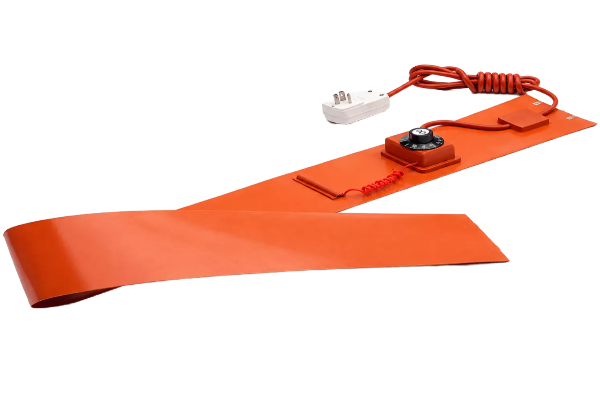
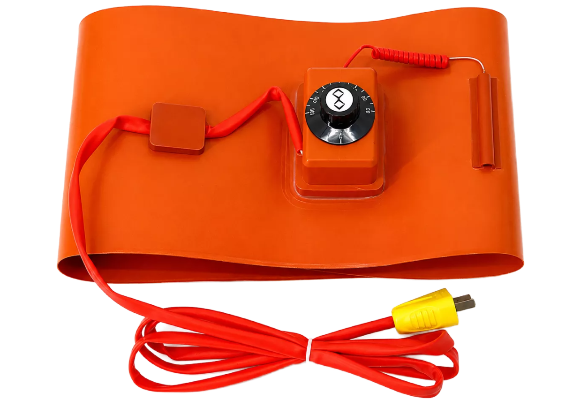
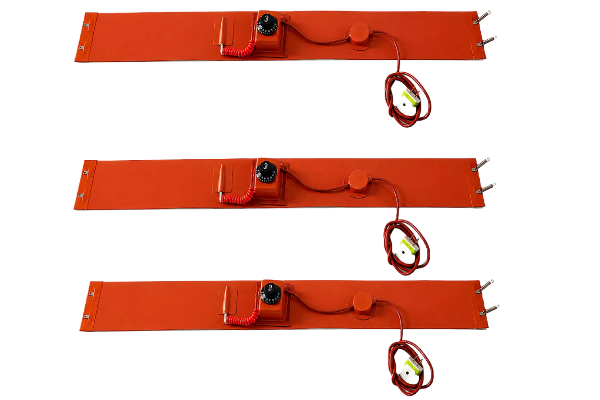
What the Photographs Show and What to Look For
A 1994 report by TiNi Alloy Company, stored by NASA, described three modes of failure in silicone foil heaters of this design. Those three failure modes are what our in-process inspection checks for, and they are the three areas to look at in any photograph a supplier sends you.
-
Local buckling of the etched foil
Read the element pattern for evenness across the full 1740 mm length; a raised line or a bulge is where the foil has lifted off the plane.
-
An inferior electrical connection at the lead
Read the lead exit for a clean sealed transition, with no exposed conductor and no distortion of the band edge around it.
-
Overheating of the silicone jacket
Read the jacket edges for delamination; the control range stops at 150 °C, so a set point above that sits outside the specification the jacket was built to.
when a silicone drum heater band is not the right call
A wrap-around band is the wrong choice in seven situations we see regularly. Each row gives the reason and where to look instead.
[ SPECIFICATION WARNING ]
Two products that are not interchangeable. On the left, three stacked heater bands on one 200 L drum — the product on this page. On the right, a full-coverage insulated jacket, which is the alternative named in row three above and is not supplied from this page.
Silicone Drum Heater Configuration Tools
-
Drum Band Sizing Calculator
Calculate the precise silicone band dimensions required for your specific industrial drum size to ensure optimal fitment.
-
Drum Heating Duty Selector
Determine the exact wattage and thermal specifications needed based on your material properties and heating environment.
-
Drum Heat Up Time Calculator
Estimate the operational time required to reach target temperatures based on ambient conditions and heater capacity.
Send Your Drum Size and Target Temperature for a Quote
Send the six answers and we return a free heating solution design drawing before you commit to anything. That drawing shows band width, band count, placement on the drum and total electrical load.
-
01
Design
Design drawing first — free, and it comes before the order, not after.
-
02
Lead Time
7–15 days after order confirmation, with the full document set listed above.
-
03
Warranty
24-month warranty with free replacement parts for manufacturing defects.
-
04
Support
Remote video assistance for installation, commissioning and controller setup.
Silicone Drum Heater Questions Buyers Ask
01
What size band do I need for a 55 gallon drum?
What size band do I need for a 55 gallon drum?
One 250 mm (9.8 in) band at 2,000 W is the starting point for a 200 L (55 gallon) drum. Measure the outside diameter first, because a tight-head steel drum at 23 in (584 mm) and an open-head at 24-1/2 in (622 mm) leave very different gaps for the springs to close. Send that measurement and the medium, and we confirm width and count on the design drawing.
02
Can I use a silicone drum heater on a plastic drum?
Can I use a silicone drum heater on a plastic drum?
Yes, on HDPE drums, with the thermostat set below the drum's own limit rather than the heater's. Polyethylene softens and creeps under sustained load well below the 150 °C (302 °F) the band can reach, so the drum sets the ceiling. Specifying a plastic drum heater is a watt-density question before it is a wattage question: the 150 mm band at 0.38 W/cm² is the starting point on HDPE rather than the 250 mm band at 0.46 W/cm², and once your supplier confirms the drum's limit we set the control range to match.
03
How many heater bands can I stack on one drum?
How many heater bands can I stack on one drum?
Up to three heater bands on a single 200 L drum. Three 250 mm bands cover 750 mm (29.5 in) of a drum that stands 838 to 883 mm (33 to 34-3/4 in) tall, and they draw 6,000 W in total. That needs three separate circuits, so check the supply before ordering the second and third band.
04
Will a 2,000 W band run on a standard US outlet?
Will a 2,000 W band run on a standard US outlet?
No. A 2,000 W band draws 16.7 A at 120 V, which is more than a 15 A plug and circuit carry. On a 230 V supply the same band draws 8.7 A and runs from an ordinary outlet, so for a 120 V site we either specify the 1,000 W band or plan the 2,000 W band on a dedicated circuit.
05
What temperature can I actually set?
What temperature can I actually set?
Every band carries an adjustable analogue thermostat covering 30 °C to 150 °C (86 °F to 302 °F). Its sensor reads the band surface, so the medium sits below the dial figure by an interval that depends on fill level and drum material. Give us the temperature you need at the medium and we work backwards to the set point.
06
How long does it take to heat a full 200 L drum?
How long does it take to heat a full 200 L drum?
That depends on the medium, the fill level and the starting temperature, so there is no single figure worth publishing. Heat-up time is mass × specific heat × temperature rise for the energy, divided by band wattage for the time, before heat losses. Our Heat-Up Time Calculator runs it, and we confirm the number on your design drawing.
07
Do you supply insulation to go over the band?
Do you supply insulation to go over the band?
No — band, control enclosure and lead only. Tell us if you plan to add an outer insulation wrap, because it cuts standing heat loss and changes the band count we recommend.
08
What certification do the bands carry?
What certification do the bands carry?
We run an ISO 9001 quality management system and hold an EC Certificate of Conformity, AMS190415927C, to the RoHS Directive 2011/65/EU — a substance restriction rather than an electrical performance test. Underwriters Laboratories publishes ANSI/UL 499 as one of the product safety standards covering electric heating appliances rated at or below 600 V in unclassified locations, so if your specification calls for a mark to that standard, ask for the certificates themselves and check the model designation on each one; a certificate that names a different model series is not a substitute for one that names the model on your order line.
09
What is the lead time, and what ships with the order?
What is the lead time, and what ships with the order?
Production runs 7–15 days after order confirmation, counted from the moment you approve the design drawing and the plug type. Every shipment carries a proforma invoice, sales contract, commercial invoice, packing list, and certificate of origin. Spare heating elements and critical components are held for large overseas projects.
10
Can I get a sample before a bulk order?
Can I get a sample before a bulk order?
Yes, with sample freight paid by the buyer. Order it on the exact construction you intend to buy — a catalogue band and a cut length are not interchangeable.
11
What do you need from me to quote?
What do you need from me to quote?
Six answers: measured outside diameter, drum material and head type, the medium, target temperature at the medium, local supply voltage and outlet rating, and where the drum stands. Those six determine band width, band count and total load. Send them together and the design drawing comes back with the quote.