Get in touch with FlexBlanket Company

Container Heaters: A Practical Selection Guide for Industrial Buyers

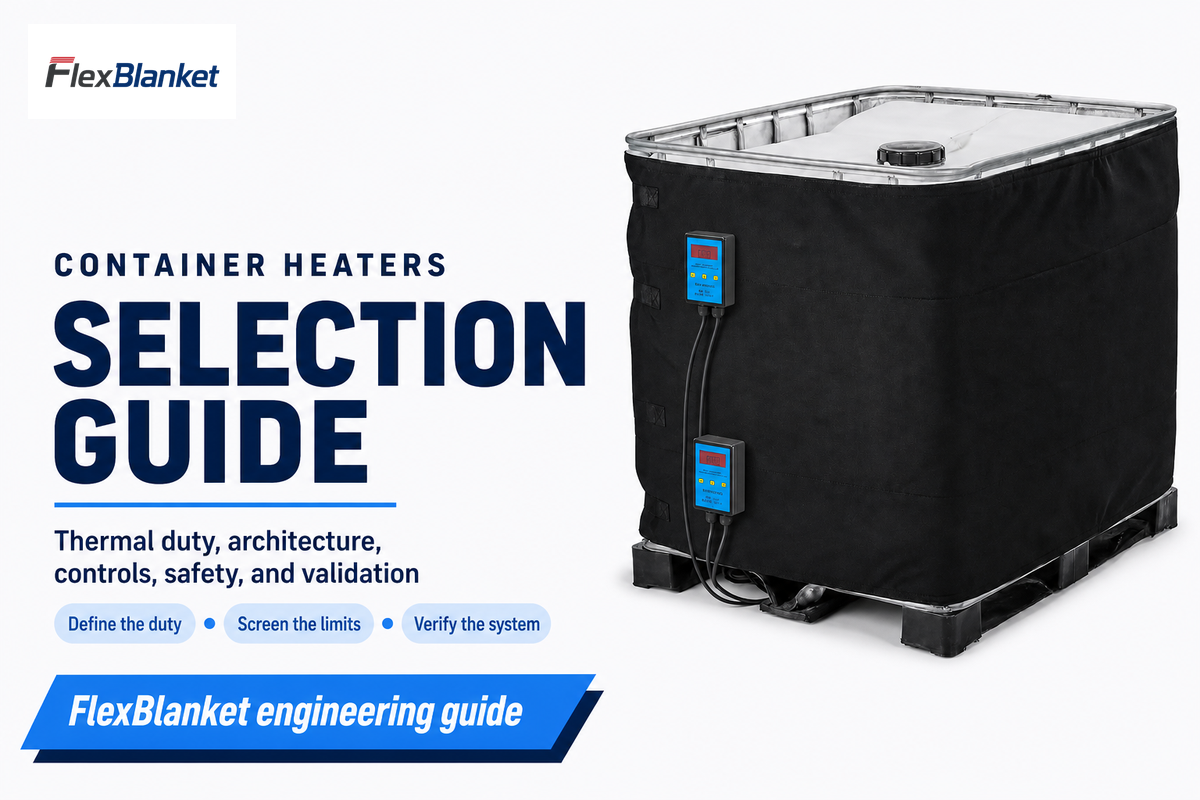
Container heaters are systems that prevent a material from freezing, sustain a process temperature, or enable a controlled warm-up. Alone the heater label doesn’t specify which task is active, how long it will take, or whether the installed system is appropriate. Justifiable choices begin with the thermal load, the heat path, the control boundary, and evidence from the actual application.
This distinction has value for drums, intermediate bulk containers (IBCs), pails, gas cylinders, portable tanks, and other process vessels. Full-wrap heating blankets, narrow band heaters, heated bases, and immersion heaters are all container-heating solutions, but they provide heat through different surfaces and pose different material, electrical, cleaning, and site concerns.
This guidance is intended for engineering, maintenance, operations, safety, and procurement teams developing a requirement before they evaluate sources. It isn’t a universal sizing tool, a hazardous-location decision, or a field installation procedure. Unknown properties remain unknown; no example test becomes a promise for another container.
What Is a Container Heater—and What Job Is It Actually Doing?
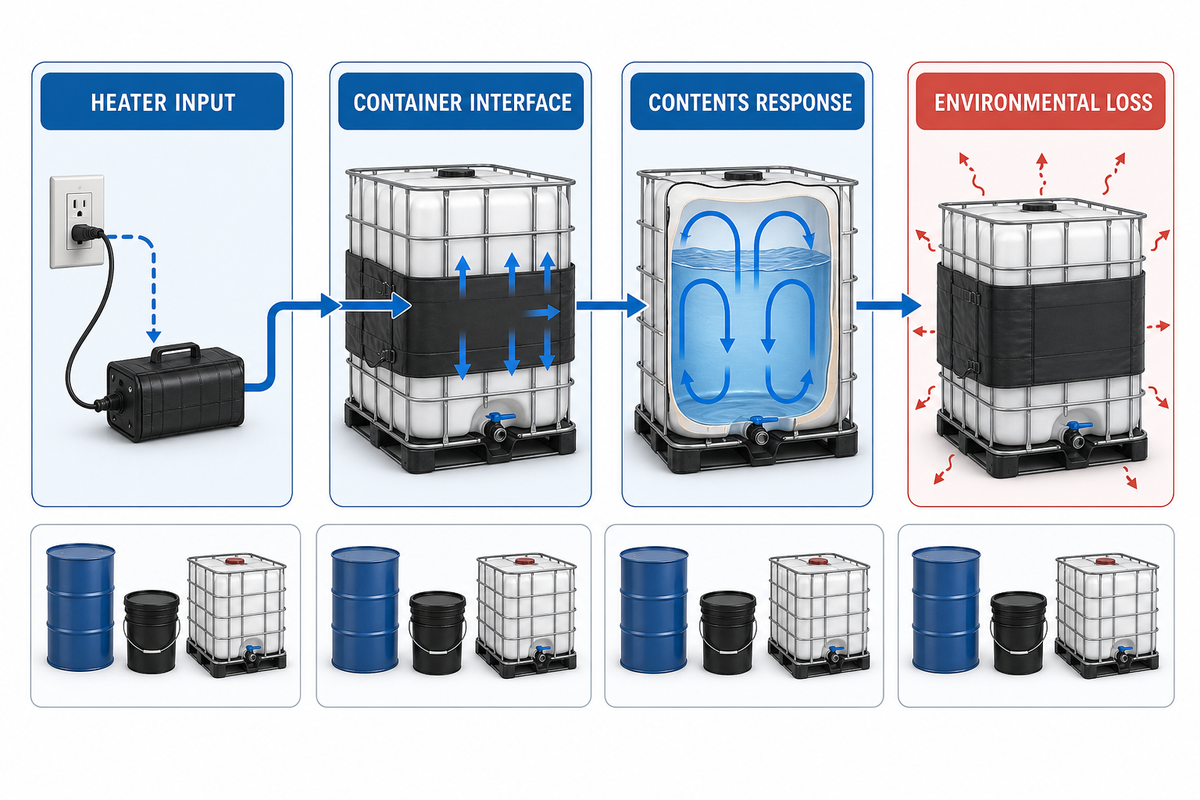
In this guide, a container heater is a system that applies or maintains heat around, below, or within a process container. Use the duty statement to name the job: prevent freezing, maintain a temperature band, reduce viscosity before transfer, recover from a cold start, or facilitate a controlled phase change. “Heat this container” isn’t yet a specification.
Start with the process goal because container shape doesn’t determine the load. For example, a 55-gallon steel drum of low-viscosity liquid, a plastic IBC containing a temperature-sensitive formulation, and a pail holding a waxy solid may have a common product-search term but require very different heat capacity, contact, loss, mixing, and wall-temperature limits.
A duty mismatch can create both process risk and a false comparison: the same 55-gallon label may hide a different fill state, wall limit, or required endpoint.
The U.S. Department of Energy considers process heating a system issue. Energy enters through a source and proceeds toward a material, while losses occur through equipment and environment. Its present process-heating page indicates that delivering energy directly into materials can reduce heat lost to the environment. That bounded principle is why electrical input alone can’t determine effective heat delivered to container contents; it isn’t an efficiency rating or a sizing rule. Refer to Finding Efficiencies in Process Heat.
Engineering note: Treat rated electrical input as a source-side value, not as measured heat delivered to the material. Record the heat path, losses, wall and contents readings, and the acceptance point for the actual installation; the Department of Energy system principle does not supply a container-specific efficiency or sizing factor.
| Duty | Operating question | Evidence needed | Common overreach |
|---|---|---|---|
| Freeze protection | What exposure must be survived, and for how long? | Lowest ambient, wind or enclosure condition, material limit, and response plan | Assuming a thermostat setting guarantees every part of the contents stays above freezing |
| Temperature hold | Which process band must be maintained during storage or transfer? | Target band, loss condition, sensor location, and acceptance period | Using heater nameplate watts as proof of holding performance |
| Cold-start recovery | What starting condition and deadline govern the warm-up? | Mass, properties, starting temperature, allowed wall temperature, losses, and test basis | Copying a heat-up time from a different fluid or container |
| Phase-change support | How does the material behave while melting or crystallizing? | Phase behavior, local-temperature sensitivity, mixing state, and responsible process review | Treating latent heat and local hot spots as ordinary sensible heating |
Initially, procurement should ask something other than “blanket or band?” The real question is whether the team can specify the task without naming a product. If it can’t, the appropriate status is investigate. That provides more value than a confident product comparison built on an unspecified duty.
Define the Thermal Duty Before You Compare Wattage
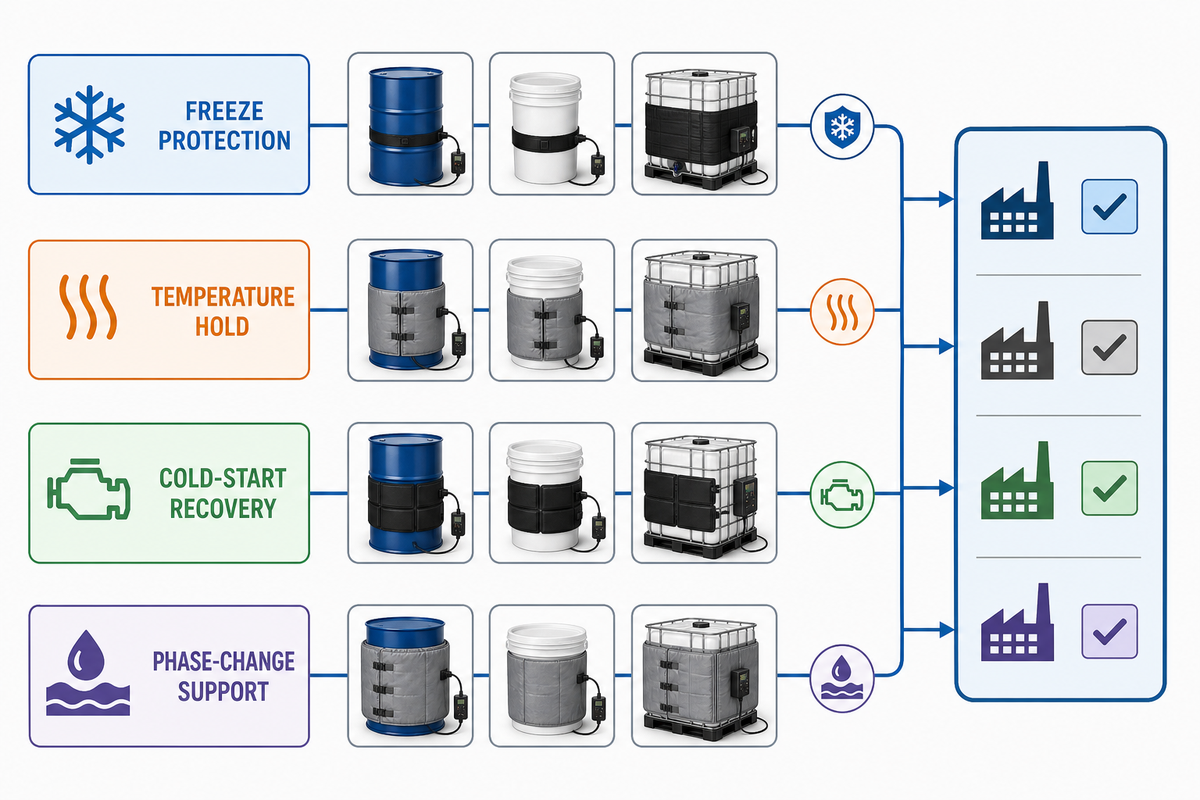
Thermal duty incorporates the required material condition, the time period, and the losses occurring during that timeframe. That product comparison now needs a duty-specific time-and-loss basis. Wattage is one component of that system, not the outcome. Two heaters with the same electrical rating may deliver different results when contact surface, insulation, ambient exposure, container wall, contents, fill condition, and control strategy vary.
For a simple “back-of-the-napkin” heating calculation, engineers usually start by comparing material mass, specific heat, and change in temperature required. That target energy is only one piece of the equation. Heat is lost through the air, floor, supports, piping, headspace, and via entry (for product access). When a container wall and material interface come into play, that interface (rather than the supply voltage) often becomes the limiting step to achieving the heating objective. Process definition is the key information to get right before choosing hardware.
Write the duty in four lines
- Initial Conditions: Contents temperature (Current), ambient condition, fill level, physical state (solid, liquid, gel), if the material is mixed or stationary.
- Desired State: A process-driven (not just controller-set-point-driven) temperature range at a designated measurement location.
- Time Requirements: Amount of time to hold at temperature, how quickly to get there, the cycling rhythm, and whether the container is monitored.
- Constraints: Wall and inner-liner limitations, risk of degradation or flashing, available electrical resources, area classifications, and appropriate testing methods.
Separate assumed constraints from required ones. “Contents must be pumpable out of the bottom valve by 07:00 AM” is a process constraint. “A standard wrap jacket will heat it to that level” is an unsubstantiated claim, unless matched to the thermal pathways and environment.
Published tests show why conditions matter. One supplier report for a 1,000-litre water-filled IBC recorded an average contents-temperature increase of around 1°C per hour under its stated jacket, insulation, ambient, and test arrangement. That is a helpful example of a documented test, but it is not a universal IBC heating rate. Water behavior, the tested configuration, and the measurement setup travel with the number. Review the conditional IBC water test.
If material data is absent or unknown losses cannot be estimated well, resist entering guesses in an online calculator. Such a result is unlikely to be better than having no result. Work with the product owner for physical property data and request that all implied (and explicit) losses, interface conditions and controls be listed by the supplier.
Match the Heater Architecture to the Container and Contents
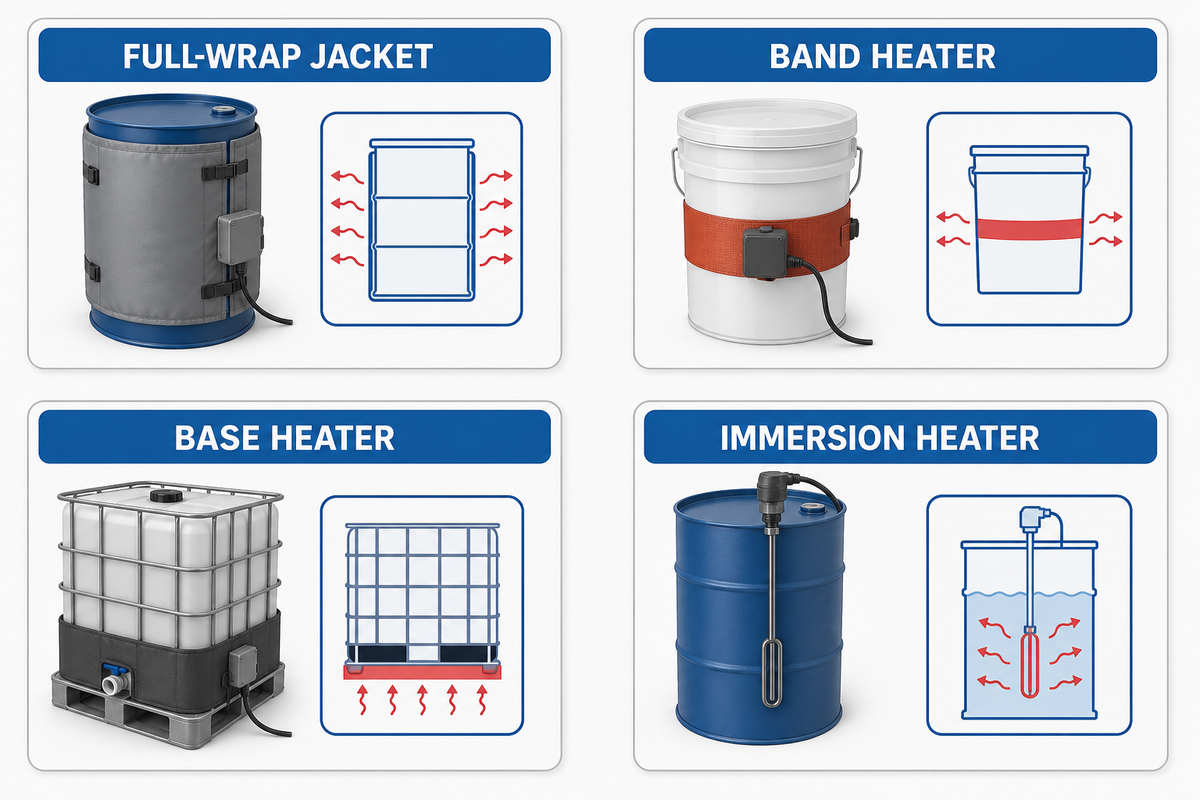
Heater topology shows where the heat is added and which interfaces require validation. Those supplier loss and interface assumptions now point to the heat-transfer surface that needs evidence. The U.S. Department of Energy’s Process Heating Sourcebook frames process heating as a system of energy requirements, losses, controls, and equipment rather than a nameplate alone. External wraps cover the wall; bands heat localized areas; base-mounted heaters heat through the bottom; and immersion heaters come into contact with the contents. Each may be best, depending on process constraints and interface configurations.
Comparing these 4 architecture families without the contact boundary creates a mismatch risk, because even a 55 gallon drum and a 1000 L IBC can require different heat paths despite sharing a product category.
| Architecture | Primary heat path | Questions to resolve | Evidence that should accompany an offer |
|---|---|---|---|
| Full-wrap blanket or jacket | Heater → outer wall → container wall → contents | Coverage, fit, gaps, top losses, wall limit, liner, sensor location, removal and cleaning | Drawing or size range, power, zoning, controller and high-limit arrangement, installation instructions |
| Band or belt heater | Concentrated circumferential zone → wall → local contents | Watt density, band placement, local wall temperature, movement of heat away from the band | Allowed container type, contact requirement, band position, temperature limits, control instructions |
| Base or bottom heater | Heated support surface → container floor → lower contents | Floor contact, load capacity, drainage, spill exposure, stratification, forklift or pallet interface | Load and size limits, surface-temperature control, ingress/environment rating, operating instructions |
| Immersion heater | Heating element → contents directly | Chemical compatibility, sheath loading, minimum coverage, cleaning, contamination, vapor, and access | Wetted-material specification, mounting arrangement, minimum immersion, control and independent protection |
Common product descriptions can offer guidance, but aren’t decision trees. Both a drum wrap and an IBC jacket could use electric resistance heating and insulation construction, but the contact area, overhead space, bottom geometry, exterior frame, pallet support, and removable liner all affect heat transfer differently. Cylinder heaters present even more mounting and fit complexities.
Construction terms need the same discipline. Drum heaters may use silicone, polyester, resistance wire, ceramic components, electric heating elements, or a positive-temperature-coefficient (PTC) design; an immersion heater may use a stainless steel sheath inside the container. Adjustable straps or quick-release buckles must be designed to fit the stated diameter, while a container base heater serves a different contact surface. These details describe construction. They do not prove that a heater will provide even heat, prevent an overheat condition, or suit a small container with temperature-sensitive materials.
Installation contact is particularly important for external resistance heaters. Folds, loose sections, overlapping heated areas, missing coverage, or contact over fittings can create local conditions that differ from the intended design. Current manufacturer instructions repeatedly make correct fit, contact, control, and sensor placement part of the operating boundary. Procurement should request those instructions before ordering, not after a heater arrives.
Architecture can also change the contamination boundary. An external heating blanket avoids direct wetted contact but must transfer through the container; radiant loss from the outer surface remains part of the duty. An immersion heater improves the direct heat path while creating material-compatibility, cleanability, insertion, minimum-coverage, and process-access questions. That is an engineering trade, not a ranking.
Collect the Inputs That Govern Heater Size and Heat-Up Time
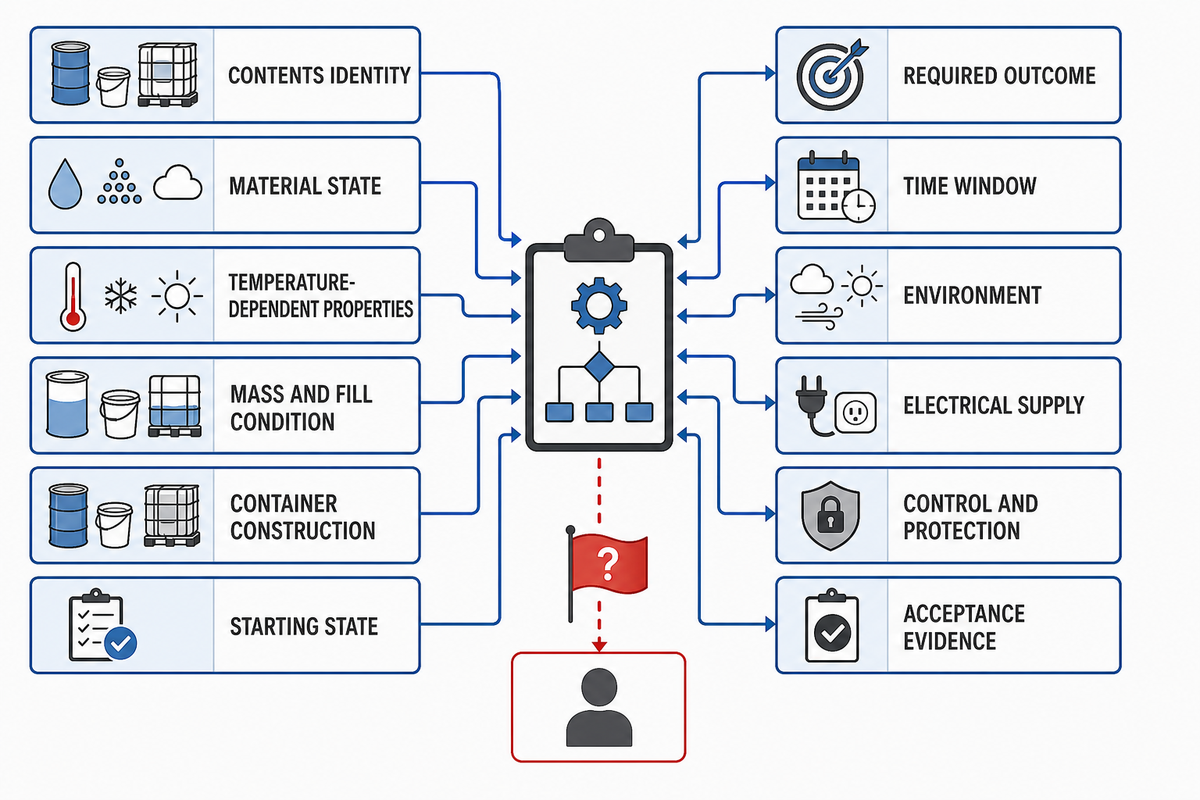
Defensible supplier briefs record the variables that can change the answer. At minimum, describe the contents, container, starting condition, target, time window, environment, available electrical supply, and control expectations. This system-level input discipline is consistent with the Department of Energy process-heating assessment framework, but it does not supply a container-specific calculation. If any critical value is unknown, mark it unknown and assign an owner rather than borrowing a number from another application.
This matters because an unknown sensor, loss, or control assumption creates a documented procurement risk; the 12-field record exposes that gap before a quote is treated as comparable evidence.
The Heat-Path Evidence Record: a 12-Field Decision Map
This record makes competing offers comparable. It is an evidence-recording aid, not a sizing formula, commissioning certificate, process-hazard analysis, or declaration of suitability.
- Contents identity: material name, grade or formulation, and controlling safety or technical data.
- Material state: liquid, suspension, paste, wax, solid, or phase-changing condition.
- Temperature-dependent properties: specific heat, viscosity, degradation range, crystallization or melting behavior where relevant.
- Mass and fill condition: actual contents mass, usable volume, headspace, and whether the level changes during operation.
- Container construction: material, wall, liner, dimensions, fittings, cage or pallet, insulation, and manufacturer limits.
- Starting state: measured contents temperature, wall temperature, ambient condition, date, time, and measurement method.
- Required outcome: hold, freeze protection, recovery, phase-change support, or transfer condition.
- Time window: deadline, hold period, operating cycle, and attended or unattended state.
- Environment: indoor, outdoor, wet, damp, washdown, wind, enclosure, floor contact, and nearby heat-sensitive materials.
- Electrical supply: voltage, phase, frequency, circuit capacity, plug or hardwire requirement, grounding, and cable route.
- Control and protection: process sensor, controller mode, independent high limit or documented equivalent, alarms, and shutdown ownership.
- Acceptance evidence: where and when temperatures will be measured, process success criteria, allowed deviation, test duration, and record owner.
Fluid movement belongs in the record too. Natural convection, forced mixing, recirculation, and stagnant layers can change how quickly heat moves away from a wall. If a supplier assumes mixing, the proposal should say so. If the container cannot be mixed, the test and sensor plan should reflect that fact.
Do not reduce this record to a questionnaire that produces an automatic model recommendation. Its value is the opposite: it exposes which assumptions still need engineering review. Each quote can then identify what the supplier calculated, what the buyer provided, and what the installed test must verify.
Use the Four-Temperature Envelope to Prevent False Setpoint Confidence
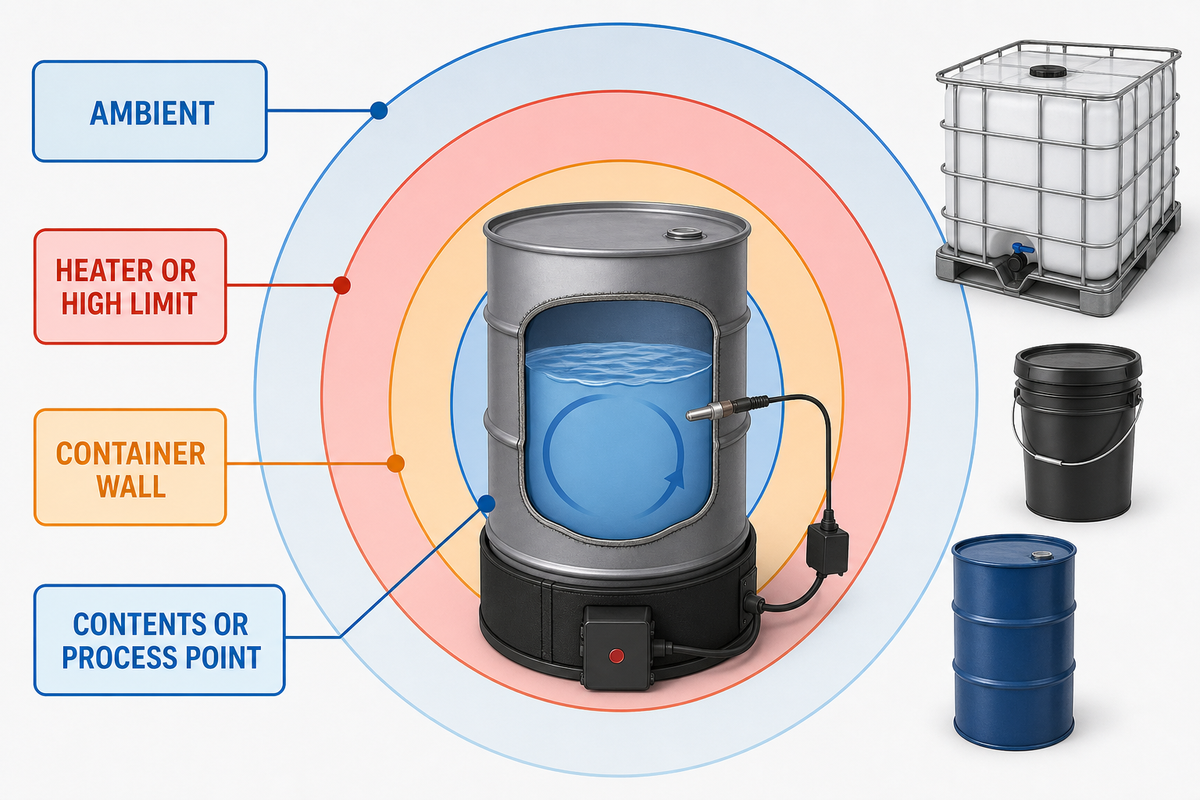
Controller setpoints are only one temperature in a container-heating system. The supplier record and installed test become useful only when each temperature means one thing. Better records separate ambient temperature, heater or high-limit temperature, container-wall temperature, and contents temperature. All four can matter concurrently, and none should be treated as a substitute for the others.
The Four-Temperature Envelope: a 4-Point Limit Map
| Temperature | What it represents | Failure hidden by a single display | Record with it |
|---|---|---|---|
| Ambient | The external loss and electrical-environment condition | Wind, cold floor, rain, washdown, or enclosure changes the installed duty | Location, range, wind/enclosure condition, and test time |
| Heater / high limit | The heating element, blanket, sheath, or protective limit condition | The heater or wall can run hot while bulk contents remain cold | Sensor type, location, controller, independent limit, trip and reset behavior |
| Container wall | A local boundary between heater and material | Plastic, liner, coating, seal, or contents can experience a local hot zone | Exact point, attachment method, contact condition, and allowable wall basis |
| Contents / process point | The material condition relevant to storage, transfer, or use | One reachable point may not represent the coldest, outlet, or bulk condition | Sampling or sensor position, mixing/flow state, timestamp, and acceptance rule |
This envelope also needs a measurement-method column. Contact sensors can disturb or misread a surface when attachment, contact resistance, geometry, pressure, or ambient heat exchange changes. That NIST paper studies contact-temperature error in a different laboratory apparatus and material context. It supports only the general error mechanism—not a container-specific error estimate, uncertainty budget, sensor prescription, or acceptance limit. Here, the operational rule is narrower: record how each reading was produced and have the responsible team assess uncertainty for the actual installation. See the NIST contact-temperature error discussion.
For an external heater, a sensor fitted beneath a blanket may effectively monitor for heater/wall limits even though it represents the process interior poorly. Contents probes are generally effective only if they are both compatible with the contents and the process, and properly positioned to reflect the conditions desired. Downstream outlet readings measure a different quantity altogether.
Used this way, the Four-Temperature Envelope organizes evidence rather than demonstrating safe commissioning. Responsibility for applicable limits, method choices, uncertainty assessment, and acceptable outcomes remains with the designated team.
For supplier and procurement review, the practical scenario is simple: every reported temperature must identify which of the 4 points was measured and how the sensor was attached.
Specify Sensors, Control Logic, High Limits and Electrical Supply
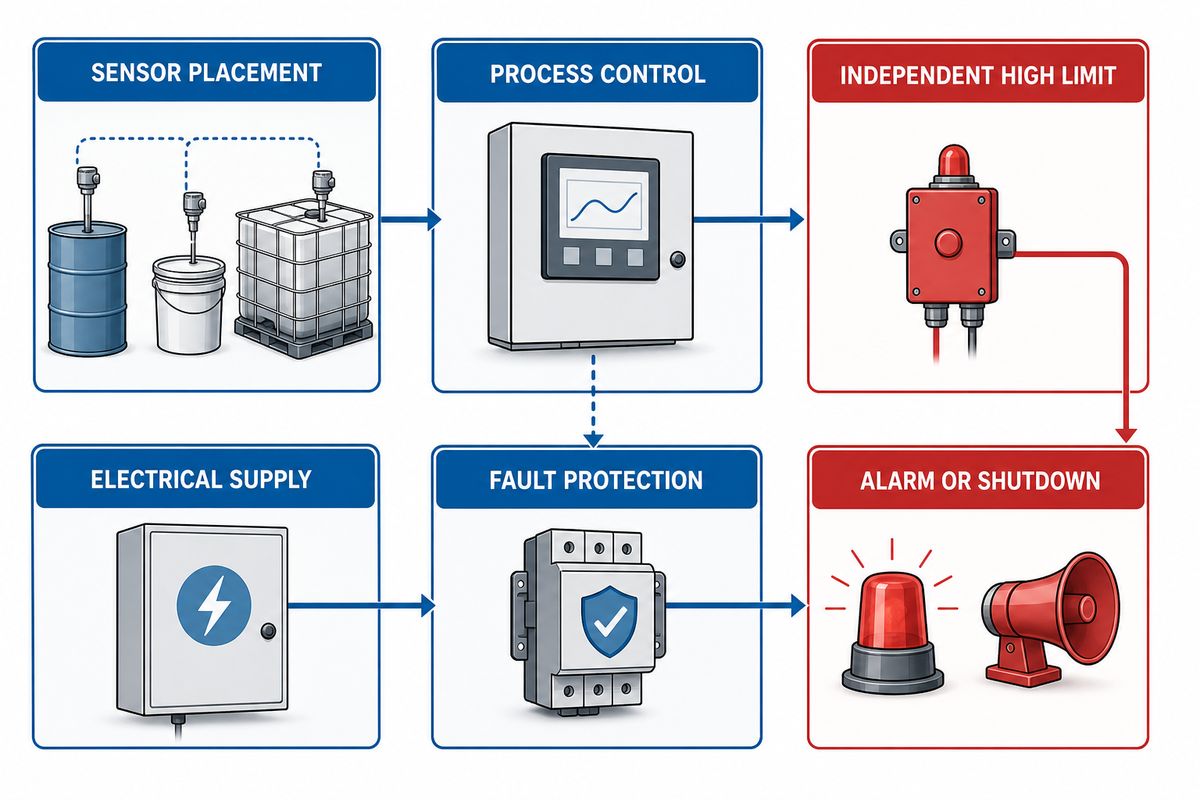
Control requirements should state what is measured, what is regulated, what independently stops excessive heating, and what happens after a fault. Those four temperature points only become actionable when control and protection roles are assigned. Thermostats, proportional-integral-derivative controllers, and independent high-limit devices serve different functions. Seeing a digital display does not prove that all protective functions exist.
Write the control sequence in plain language. Identify the normal process sensor, its location, the controller output, the high-limit sensor, the trip condition, whether the trip latches, who may reset it, and which alarm or shutdown state follows an open or failed sensor. Ask the supplier to identify any function that is combined in one device and the failure assumptions behind that design.
Proportional-integral-derivative control can reduce overshoot or stabilize a demanding process, but it is not always necessary for a simple, tolerant hold duty. Control choice depends on load response and acceptable variation. More sophisticated control does not cure poor sensor placement, weak contact, an undefined limit, or insufficient circuit capacity.
Terms such as efficient heating, effective heating, uniform heating, precise temperature, optimal temperature, and energy efficiency need a declared metric and boundary. “Optimal” may mean low heat loss, fast recovery, narrow variation, or lower energy use; those are not interchangeable. If thermal insulation is proposed, say what it is intended to insulate and how condensation will be managed. If heat comes from a temporary generator or another power source, verify voltage quality, grounding, protection, and capacity rather than treating portability as proof of operational safety.
Electrical documentation should include operating voltage, phase, frequency, current rating, configuration method (plug-in or hardwired), grounding, assumptions about fault current, wire length and rating, the method of connection/disconnection, and any site-required ground fault or leakage current detection. Poor matching between equipment and installation power conditions can prevent safe, reliable, or even functional, operation despite a theoretically sound process heating concept.
Regular wet, humid, outdoor, and washdown situations will each require their own review. An OSHA general-use wiring code requires that receptacles in wet or humid locations meet appropriate location and weatherproof-enclosure conditions; those are distinct from hazardous-location classification. See OSHA 29 CFR 1910.305.
Keep the standard scope beside the standard name
IEEE/IEC 62395-1-2024 covers defined electrical resistance trace-heating systems, including specified surface-heater forms and control methods. Its official scope also says it does not include applications in potentially explosive atmospheres. It can inform ordinary industrial surface-heating requirements, but it cannot be presented as a hazardous-location approval. See the official IEEE/IEC 62395-1-2024 scope.
Screen Container Material, Contents and Location Before Energizing
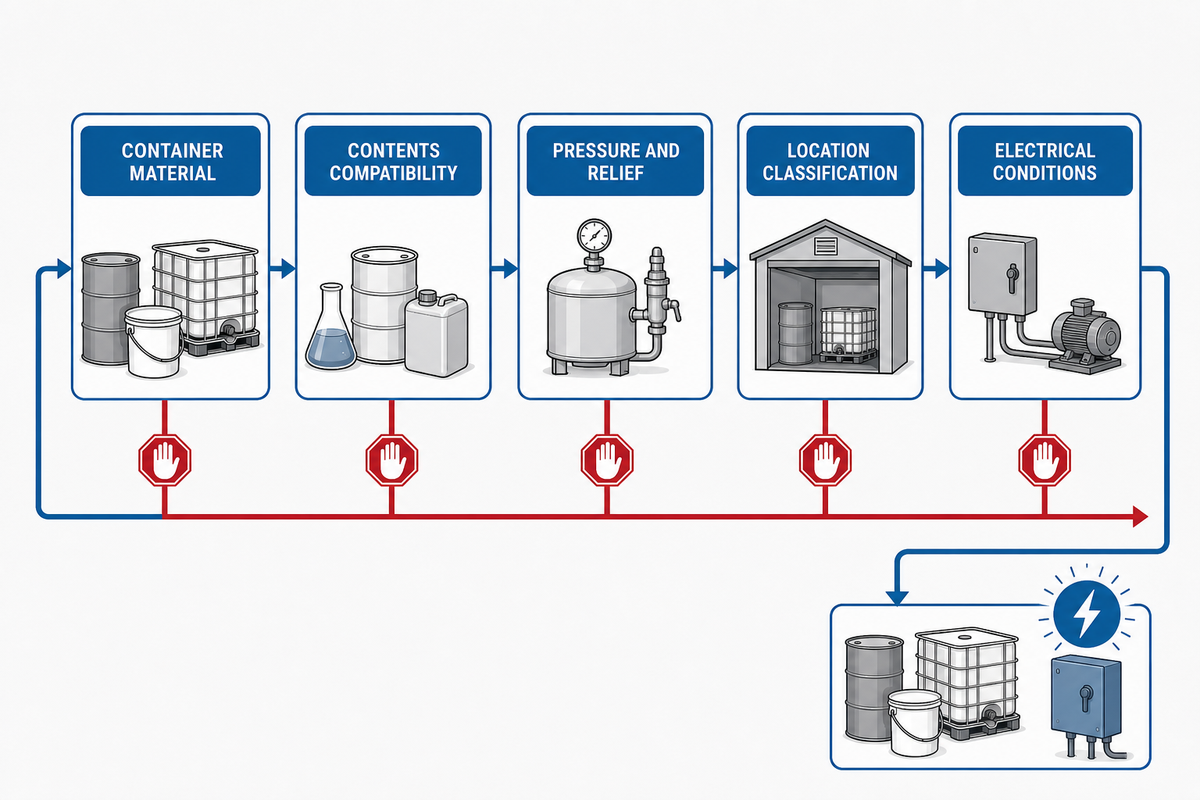
A heater that fits physically can still be inappropriate for the container, contents, closure, environment, or location. Before energizing, screen wall and liner limits, chemical compatibility, fill condition, venting, vapor generation, contamination, spill exposure, moisture, and the electrical classification of the area.
The stop-and-review screen matters because an unresolved compatibility, pressure, or classified-location risk cannot be cured by a heater that merely fits the container.
Closure state deserves its own stop point. Adding heat to a closed or inadequately relieved container can raise pressure through thermal expansion, vapor generation, or boiling. Berkeley Lab pressure-safety guidance says not to heat closed containers unless specifically authorized equipment includes an approved pressure-relief device. This laboratory guidance is used here only as a conservative stop-and-review screen. It is not a universal legal rule, a complete pressure-relief design method, or proof that one relief device makes an application safe. Responsibility for the applicable process-hazard review, engineering basis, equipment authorization, and local requirements remains with the designated team. See Berkeley Lab Pressure Safety.
| Status | Condition | Required action |
|---|---|---|
| Stop | Unknown contents, closed container without a reviewed relief path, damaged container, unclear liner limit, flammable vapor concern, or unclassified hazardous-area question | Do not energize; assign the relevant process, pressure, electrical, or safety review |
| Verify | Known material but incomplete temperature data, uncertain sensor access, wet/damp exposure, unknown plug/circuit, changing fill level, or supplier instructions not yet reviewed | Collect the missing document or measurement and revise the requirement |
| Proceed to controlled validation | Duty, container, contents, closure, location, supply, controls, limits, instructions, and acceptance plan are documented | Install under the responsible procedure and verify the actual system before routine use |
Where a hazardous location has varying conditions, a more detailed statement is necessary than “explosion-proof heater.” OSHA 29 CFR 1910.307 requires that equipment and installations in classified locations are justified by a location-specific safety case. Its options include intrinsically safe, approved, and demonstrated-safe paths, along with identified provisions for Division 2. Applicable class, group, material characteristics, temperature, installation, and documentation remain relevant. See OSHA hazardous-location requirements.
That U.S. specification should not be converted into a universal global approval claim. Different authorities use different systems and roles. Never include a component designation, enclosure rating, “weather resistant” description, or a broad compliance claim in the assembled heater-control-cable system without its precise scope.
Supplier statements may also include CE or ATEX information, but each certificate, declaration, product marking, notified-body role, and installation scope must be checked in the relevant jurisdiction. Indoor or outdoor use, ventilation, weatherproof connections, ingress protection, and winter months are separate considerations. Viscous adhesives or pharmaceutical liquids may require more tightly sealed contamination and material parameters than another fluid; the industry classification label alone does not establish compatibility. Determine what contents will be present, what specification controls them, and whether the installed system remains suitable indoors, in washdown, or outside.
Validate the Installed System Instead of Trusting the Nameplate Alone
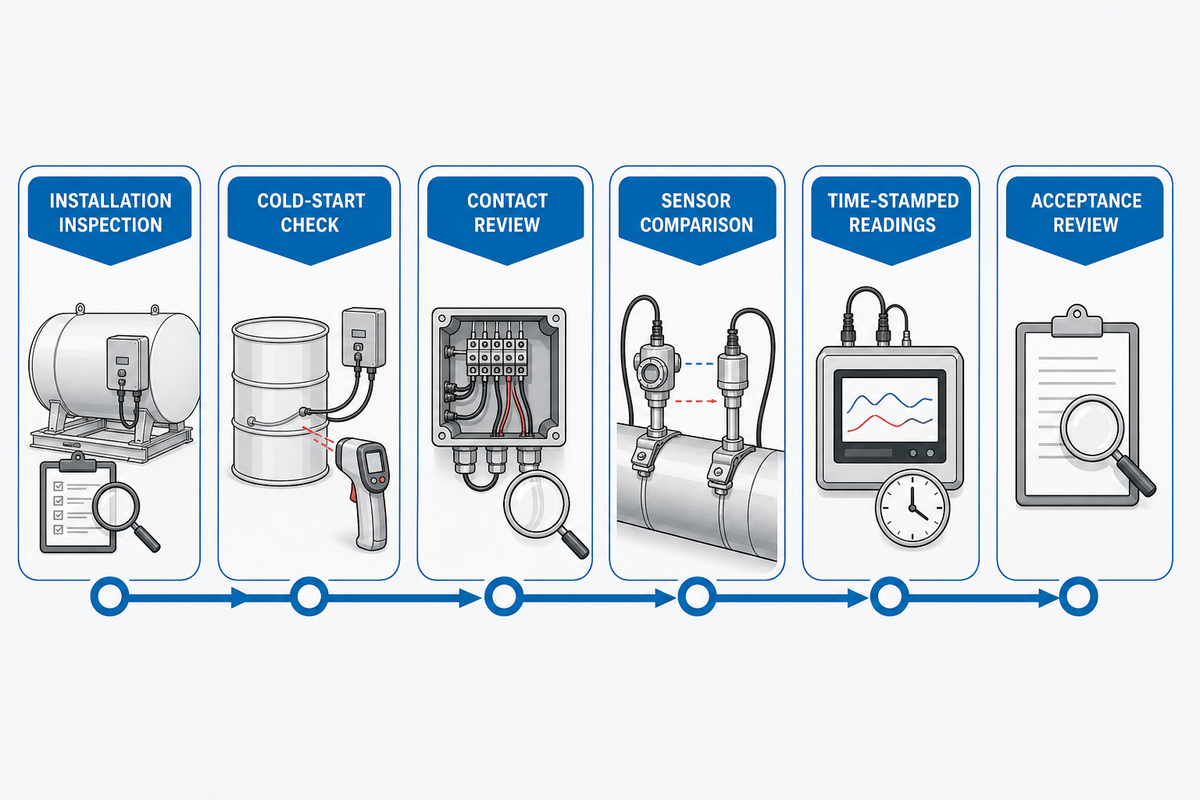
Installed-system validation asks whether the real container, contents, heater, controls, sensor methods, environment, and operating procedure meet the documented acceptance criteria. A nameplate confirms rated product information; it does not confirm contact, heat loss, contents response, sensor representativeness, pressure boundary, or site suitability.
Before the first controlled run, record the installed model and serial data, container identity, contents and fill state, closure/vent arrangement, heater placement, insulation, controller settings, high-limit setting, sensor locations, electrical circuit, ambient condition, and responsible observers. Photographing the setup can make later changes visible, provided site policy permits it.
During the run, record time-stamped ambient, heater or high-limit, wall, and contents/process-point readings. Note mixing, transfer, access, weather, alarms, cycling, or interruptions. The NIST contact-temperature study supports documenting attachment and contact conditions as a measurement concern, while providing no container-specific uncertainty or acceptance limit. Compare the result with the process-owned acceptance rule, not with an attractive test from another application.
Test protective functions separately where the responsible procedure allows. Acceptance records should state what happens on high limit, sensor failure, power interruption, controller restart, and loss of required contact or flow. Successful warm-ups do not prove a protective trip works; a functioning trip does not prove the process temperature is representative.
Repeat validation after a material, concentration, fill level, container, liner, heater, controller, sensor, insulation, location, supply, or operating-window change. This repetition is not paperwork for its own sake. It prevents a result from one configuration becoming an unsupported promise for the next.
What the evidence record can and cannot establish
The evidence record preserves assumptions, measurements, scope, acceptance criteria and ownership. It can’t replace engineering design, a process-hazard analysis, applicable code review, product certification, pressure-system review or the manufacturer’s installation instructions. Filling out a form isn’t evidence that the judgment on which it’s based was correct.
Build Supplier-Comparable Requirements Before Requesting a Quote
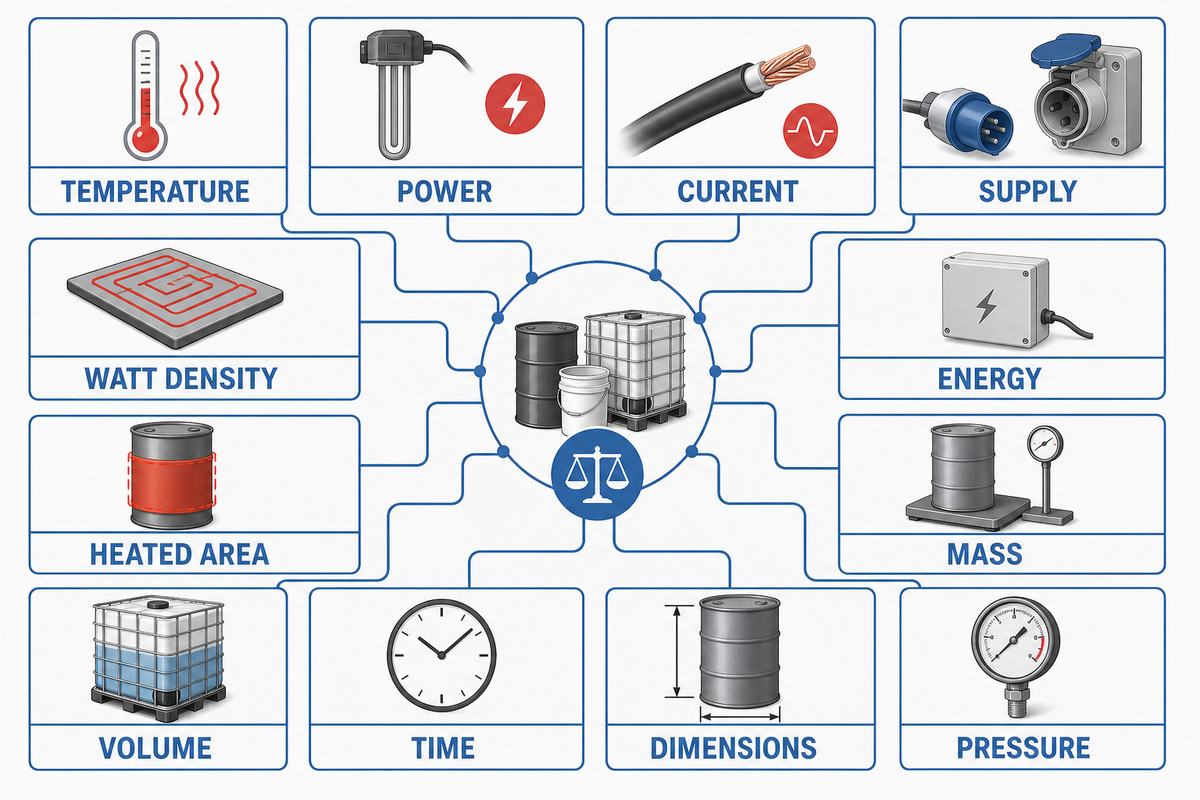
A useful request for quotation gives every supplier the same duty, input record, constraints, and evidence request. This changes the comparison from headline wattage and price to scope, assumptions, controls, documentation, and installed verification. It also makes exclusions visible before purchase.
Because quote comparisons carry mismatch risk, every numerical offer should retain its original unit, scope, and test basis before procurement normalizes the figures.
Normalize the unit basis before comparing offers. Keep every supplier’s original value, then add the agreed comparison unit without rounding away a limit. Numerical entries below are notation and conversion checks, not recommended design values.
| Data category | Comparison units | Record alongside the value |
|---|---|---|
| Temperature | 0°C = 32°F; a 10°C interval = an 18°F interval | Whether it is ambient, heater, wall, or contents temperature |
| Power | Notation check: 500 W, 1 kW, or 2 kW | Total, per zone, and any stated tolerance |
| Current | Notation check: 10 A, 15 A, or 20 A | Rated and maximum current at the stated voltage |
| Supply | Notation check: 120 V at 60 Hz; 230 V at 50 Hz | Plug, circuit, grounding, and protection assumptions |
| Watt density | Notation check: 0.5 W/cm² or 1 W/in² | Heated area, element construction, and surface basis |
| Energy | 1 kWh = 1,000 Wh; 2 kWh = 2,000 Wh | Whether the figure is calculated, metered, or measured over a stated interval |
| Heated area | 1 ft² ≈ 0.0929 m²; 10 ft² ≈ 0.929 m² | Contact area, unheated gaps, overlaps, and the geometry used for calculation |
| Mass | 1 kg ≈ 2.205 lb; 1,000 kg ≈ 2,205 lb | Contents mass, not nominal container capacity |
| Volume | 1 US gal ≈ 3.785 L | Actual fill, headspace, and usable capacity |
| Time | 60 sec = 1 min; 60 min = 1 hr; 24 hr = 1 day | Starting condition, endpoint, and test interval |
| Dimensions | 1 in = 25.4 mm; 1 ft = 304.8 mm; retain stated dimensions such as 10 mm or 100 mm without silent rounding | Container, heated area, fittings, and tolerances |
| Pressure | 1 bar = 100 kPa; 1 psi ≈ 6.895 kPa; 2 bar ≈ 29 psi | Whether the value concerns normal, relief, or allowable conditions |
| Ask every supplier to state | Why it matters | Unacceptable substitute |
|---|---|---|
| Recommended architecture and heat path | Shows how heat is expected to reach the contents | “Best for IBCs” without a configuration basis |
| Electrical rating and assumed circuit | Allows site capacity and connection review | Voltage alone without current, phase, cable, plug, or protection assumptions |
| Power, coverage, zoning, and watt-density basis | Exposes local heating and contact assumptions | Total watts presented as guaranteed warm-up performance |
| Controller, process sensor, and independent limit functions | Separates regulation from protection | “Digital control” without sensor and fault behavior |
| Container, liner, contents, and environment limits | Defines the proposed product’s application boundary | Generic compatibility or weather claims |
| Calculation inputs and expected outcome | Makes heat-up or hold estimates auditable | A time or temperature promise without assumptions and acceptance location |
| Drawings, instructions, approvals, test reports, and warranty scope | Lets engineering and procurement compare evidence, not badges | A logo or certificate name without product, model, location, and validity scope |
| Exclusions and buyer responsibilities | Prevents controls, insulation, top cover, cable, commissioning, or site review from disappearing between offers | A low headline price with undefined boundaries |
Ask suppliers to identify which facts came from the buyer, which were calculated, which were assumed, and which were measured in a comparable test. If an expected heat-up time is offered, request the material properties, mass, starting and target points, ambient/loss condition, heater configuration, control basis, sensor location, and acceptance rule behind it.
Once the neutral requirement record is complete, teams can compare it with an industrial heating blanket product range and request model-specific documentation. That link is a commercial handoff, not proof that a listed product is appropriate for the application described here.
What Current Demand and Product Evidence Actually Show
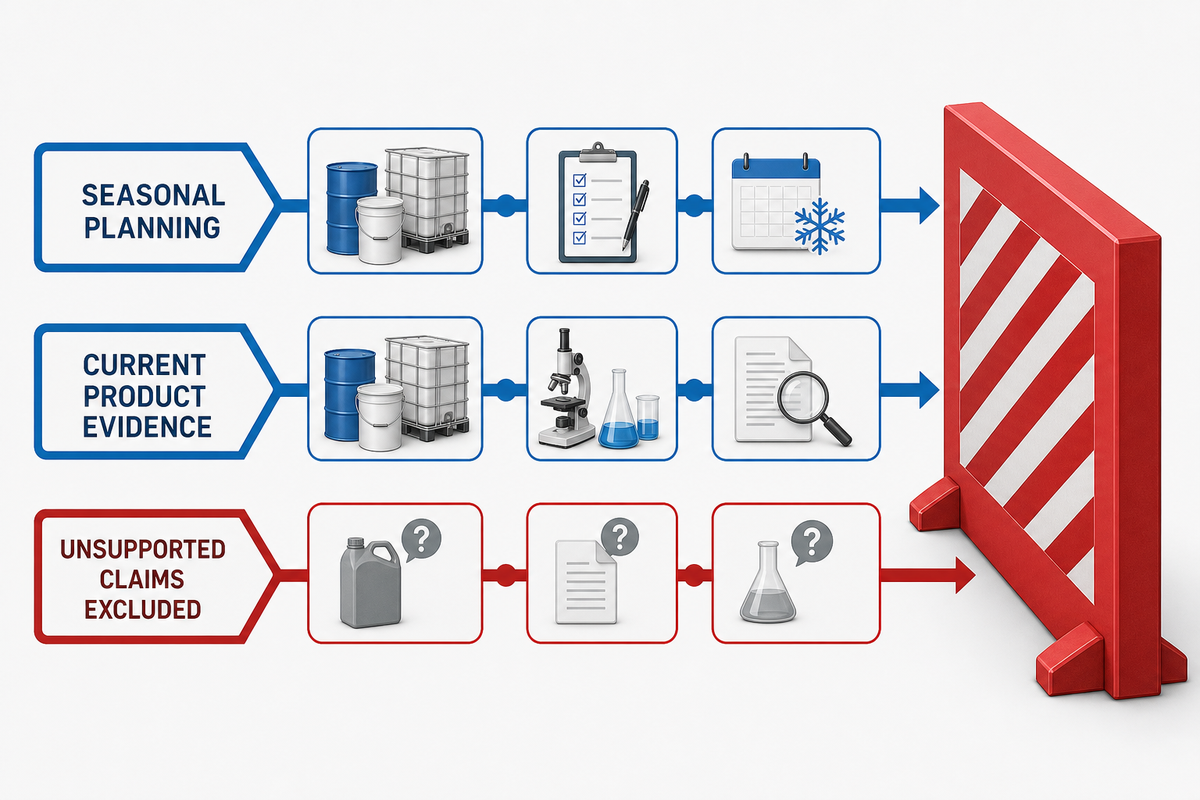
Current search and product evidence support seasonal planning and show continued supplier attention to controls, documentation, and hazardous-area variants. They don’t establish market size, sales growth, installed-base growth, or adoption. A product announcement may reflect compliance work, portfolio positioning, or replacement demand rather than expansion of the overall market.
In the United States keyword history reviewed for this guide, drum- and IBC-related queries were stronger in colder months than in summer, while the broad head term was smaller and declining over the longer comparison window. That makes pre-autumn content and inventory planning reasonable, but the series is not a sales forecast and should not set a production budget by itself.
For evidence-class comparison, the U.S. Census Bureau distinguishes shipments, which measure the value of products sold, from new orders, which represent buying intentions supported by binding documents and reported net of cancellations. This guide has neither a container-heater shipment series nor a binding-order series. Search interest and product releases must therefore remain planning signals. See the Census definitions for shipments and new orders.
Published in 2024, IEEE/IEC 62395 is a genuine standards update for defined industrial and commercial resistance trace-heating systems. Recent supplier releases also show hazardous-area heating jackets and more explicit controller options. Buyers should request current model documentation and check scope rather than assume equal progress across suppliers, products, or markets.
Container Heater FAQ
How do container heaters work?
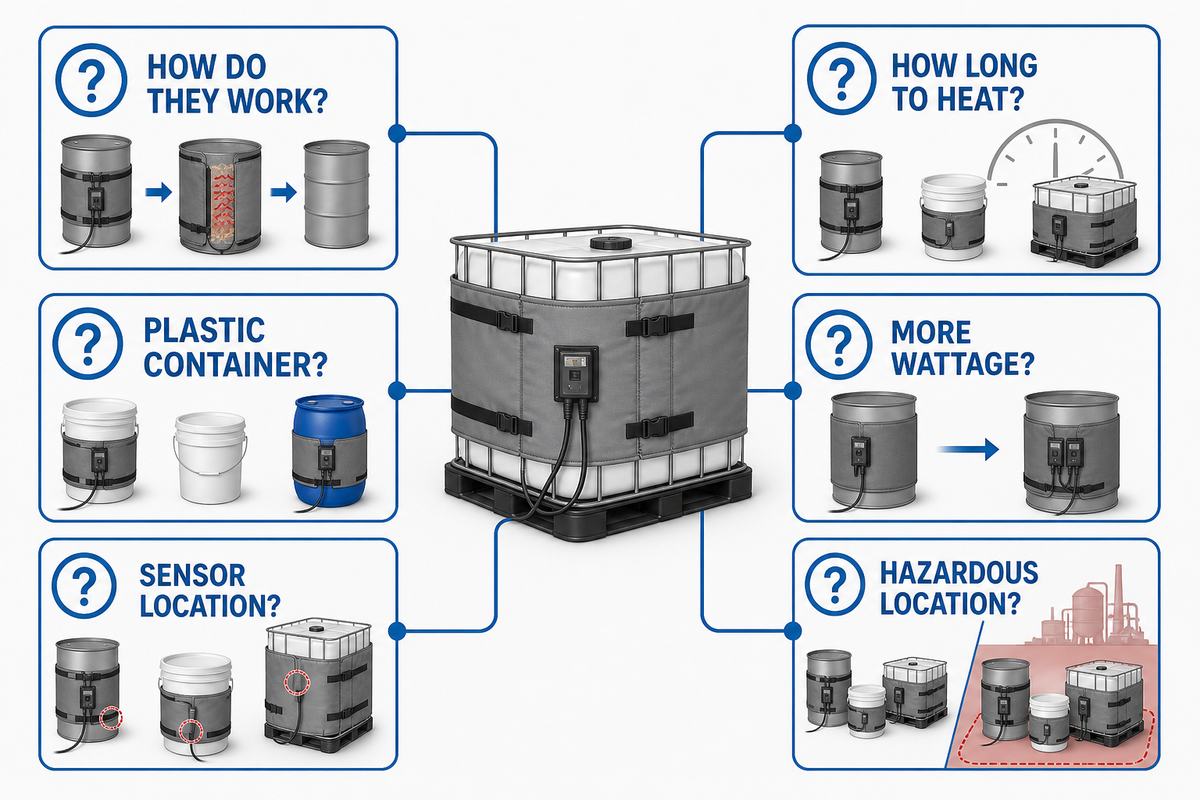
Container heaters convert electrical energy into heat and transfer it to the container or contents through a defined path. External blankets, jackets, or bands conduct heat through the wall; base heaters conduct through the bottom; immersion heaters transfer heat directly to the material. Actual outcomes depend on contact, coverage, material properties, mass, losses, mixing, controls, and sensor location. Product wattage and setpoint alone do not establish bulk temperature or heat-up time.
How long does it take to heat an IBC tote or drum?
There is no universal duration. A responsible estimate needs the contents mass, temperature-dependent properties, starting and target conditions, container and liner, fill level, ambient exposure, insulation, heater configuration, losses, mixing state, control behavior, and the point that reliably defines success.
Supplier tests can be useful when their conditions match the application, but their times should remain attributed examples. Confirm the estimate with an installed validation plan before routine use.
Can a container heater be used on a plastic drum or tote?
Sometimes, but only after the specific plastic container, liner, contents, heater surface, contact arrangement, sensor method, controls, and independent high limit have been checked together against both manufacturers’ documented limits under the intended fill and ambient conditions for this application.
Check the container manufacturer’s temperature limit, the heater’s maximum surface and fault temperatures, local hot-spot sensitivity, fill level, sensor method, and independent high-limit protection. A safe bulk setpoint does not prevent the wall beneath a heater from running hotter, and different plastic totes are not interchangeable.
Does more wattage always heat a container faster?
No. More available power helps only when the container, wall, contents, contact, controls, circuit, and local-temperature limits can accept it. Transfer-path limits may restrict useful heat, while concentrated watt density can raise wall or heater temperature without producing the expected bulk response. A higher power rating is therefore not a universal shortcut to faster heating. Higher kW ratings can also require a different V supply, A capacity, plug, cable, overcurrent device, and high-limit arrangement.
For a plastic wall or temperature-sensitive material, the local limit may govern before the energy balance does. Compare calculated duty, heated area, W/cm² or W/in², distribution, loss assumptions, controller response, protective limits, and the defined process endpoint rather than ranking products by total watts alone. If two offers predict different recovery times, ask both suppliers to disclose the same mass, specific heat, ambient, contact, insulation, and sensor assumptions.
Where should the temperature sensor be placed?
Placement depends on what the sensor is intended to control or protect. Heater or wall sensors can support an equipment or material limit, while representative contents sensors address the process condition. One sensor may not perform both jobs. Document the type, exact location, attachment or immersion method, contact condition, response, and failure behavior. Installation should follow the responsible designer’s basis and manufacturer instructions; this guide does not prescribe a universal point.
When does a container heater need hazardous-location approval?
Hazardous-location suitability depends on the jurisdiction, area classification, gas, vapor, dust, or fiber, temperature class, equipment design, installation, and the applicable safety path. Under U.S. OSHA 29 CFR 1910.307, classified-location equipment may follow intrinsically safe, approved, or demonstrated-safe paths under defined conditions.
Do not generalize one product marking to every site, and do not use IEEE/IEC 62395-1:2024 as an explosive-atmosphere approval because its scope explicitly excludes those applications.
References & Sources
- U.S. Department of Energy — Finding Efficiencies in Process Heat
- IEEE Standards Association — IEEE/IEC 62395-1-2024 scope
- U.S. Occupational Safety and Health Administration — 29 CFR 1910.307
- U.S. Occupational Safety and Health Administration — 29 CFR 1910.305
- Lawrence Berkeley National Laboratory — Pressure Safety
- National Institute of Standards and Technology — Contact-temperature measurement error research
- U.S. Census Bureau — Manufacturers’ Shipments, Inventories, and Orders definitions
- Plant Engineering — Electric heater use and maintenance
MANUFACTURING EVIDENCE
A specified heat path, backed by first-party site context
First-party website statements identify FlexBlanket as the export brand of Qingdao Flex Technology Co., Ltd. They describe custom-to-drawing heating solutions with in-house production and testing for industrial thermal duties.
SITE-STATED FOUNDED2019
SITE-STATED LOCATIONQingdao, China
SITE-STATED PLANT5,000+ m²
SITE-STATED TEAM50+ staff
ENGINEERING HANDOVER
From asset dimensions to a site-stated build route
01Site-stated product families include heating blankets and silicone rubber heaters for drums, IBCs, pipes, gas cylinders and composite-curing duties.
02First-party site information describes custom-to-drawing review for fit, voltage, target temperature, controls and installation conditions.
03First-party site information states in-house production/testing and OEM / ODM support; confirm scope for the required application.
First-party site-stated standard lead time is 7–15 days and site-stated warranty is 24 months. Treat ISO 9001, CE and RoHS references as site-stated claims requiring confirmation for the exact product and order.