Get in touch with FlexBlanket Company

How to Plan IBC Tote Heating Without Guessing

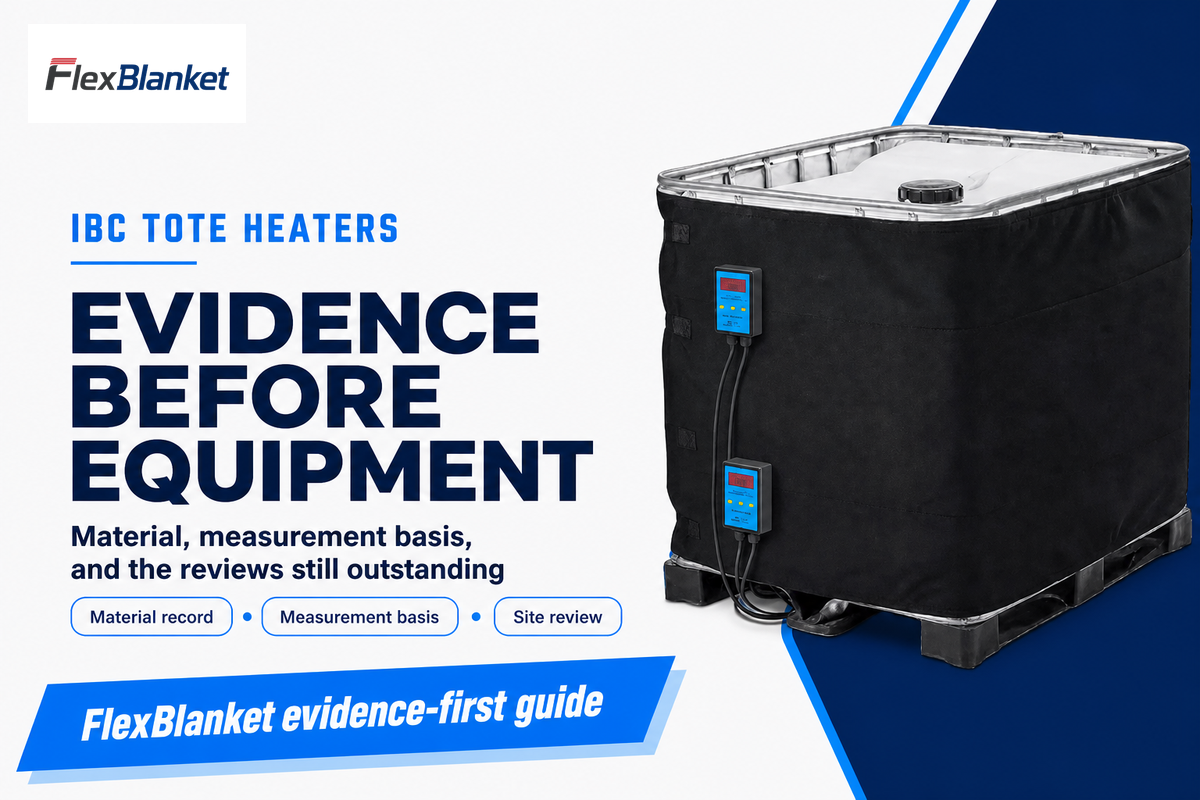
An IBC tote heater can be part of a temperature plan, but the product name doesn’t establish a process result. Before anyone discusses equipment, start with the material, the temperature objective, the measurement basis, and the application risks that still need site-specific review.
This guide is for teams that need a better brief before they evaluate IBC tote heaters. IBC tote heaters are heating arrangements applied to an intermediate bulk container, such as wraps, jackets, insulated enclosures or immersion inserts, to raise or hold the temperature of its contents. This guide is deliberately not a product comparison, a heater-sizing calculation, a hazardous-location determination, or an installation instruction. Those decisions belong to the documented material, container, environment, and operating process.
What an IBC Tote Heater Does, and Does Not Prove
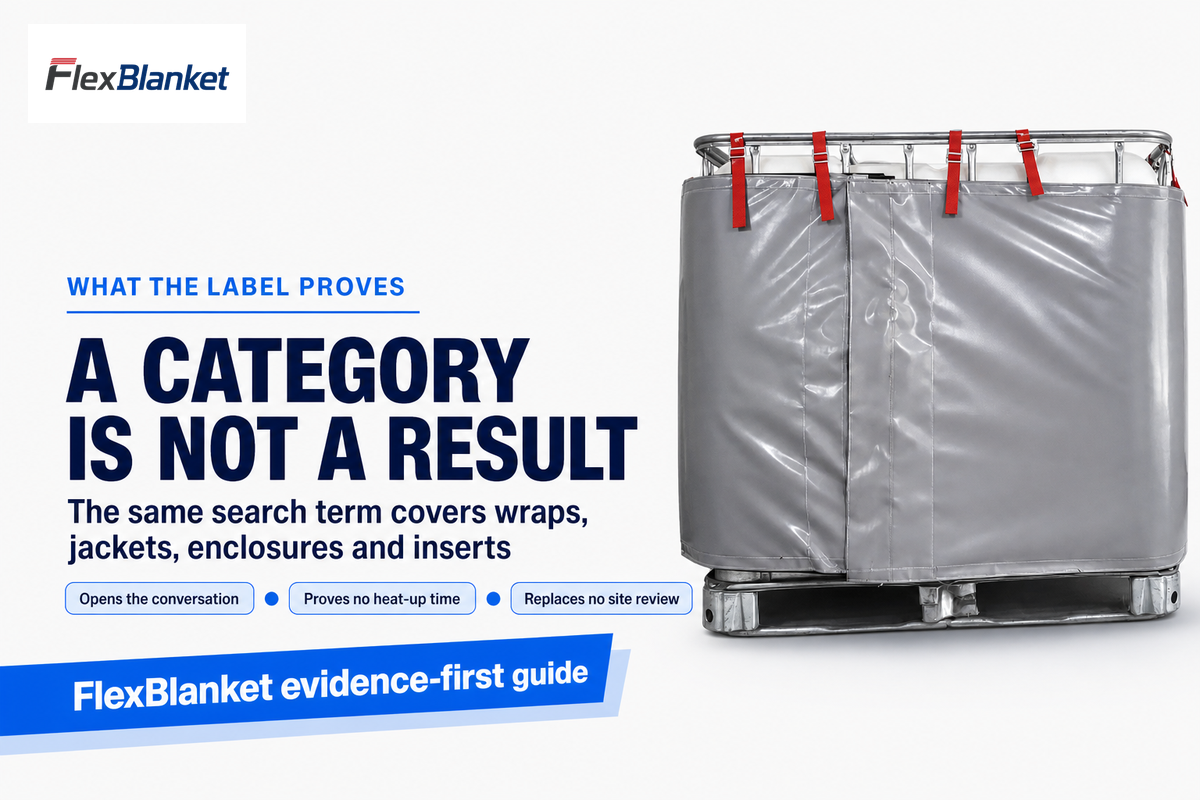
In industrial process heating, thermal energy raises or maintains a material’s temperature. That’s a useful starting point for an IBC tote, and only a starting point: a heating arrangement doesn’t by itself prove the material will be at a desired condition, at a desired point, at a desired time. The U.S. Department of Energy draws the same distinction when it describes process heat as energy transferred from a heat source to a material within an operating system. DOE process-heat basics
The category name is also weaker than it looks as a description of hardware, because it doesn’t identify where the heat is applied. Published patent application US20230024697A1 describes a self-regulating heater located inside an intermediate bulk container, while most catalogue listings under the same search term are externally applied wraps and enclosures. Those two constructions raise different questions about material contact, cleaning, containment and inspection, so a shared product label is a poor starting point for a procurement conversation. The common mistake is to assume the label fixes the construction, and the risk is that a proposal gets compared against the wrong review package. US20230024697A1 (patent disclosure, technical context only)
What “IBC Tote Heaters” Covers: Tote Heating Blanket, Wrap-Around, Tank Heater and Insert Designs
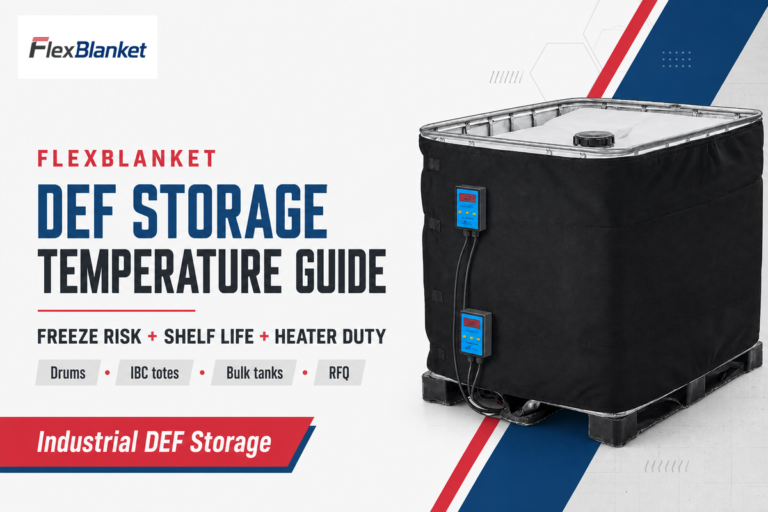
Knowing what the search term actually covers helps at this stage. Listings under “IBC tote heater” include heating blankets and heating jackets that wrap around the outside of the cage, tote heater blankets and a tote heating blanket cut to one container size, wrap-around IBC designs held on by band and strap arrangements, insulated covers, tote warmers built as a full enclosure, and immersion or insert designs that sit in the liquid contents.
IBC Heater Sizes: a 275 Gallon IBC and a 330 Gallon IBC Describe a Fit, Not a Result
Sizes cluster around two nominal capacities that most North American listings are cut for: a 275 US gallon IBC of roughly 1040 L, and a 330 US gallon IBC of roughly 1250 L. So “275 gal” or “275 gallon IBC tote heater” in a product name describes a fit, not a thermal result. Check which gallon a listing means before matching it to a container, because the same number in imperial gallons is a different vessel. The same industrial heating catalogue may file one identical item under IBC tote blanket heaters, IBC tote and tank heaters, tank heater, IBC heater, IBC tank or IBC heating, and will usually stock bucket and drum equivalents beside it. None of that vocabulary states what the arrangement will do with your material or your temperature requirements. Listing copy usually also names the jacket shell, nylon or polyester, and calls the assembly weather-resistant. Those are construction facts the supplier states about its own product, not conclusions this guide can verify for your site.
For an IBC application, the honest question isn’t simply “Can this tote be heated?” It’s “What process condition is being protected, what evidence describes the starting condition, and what remains unknown?” That wording makes room for a material that must remain pourable, an operation that needs a hold condition, or a cold-weather contingency without pretending that all three are identical jobs.
Use the heater category as a conversation opener
- It can identify that temperature management is being considered.
- It can’t prove a heat-up time, a material compatibility result, or a safe operating condition.
- It can’t replace the material owner’s data, site controls, or application review.
Start With the Heating Objective, Not the Equipment Name
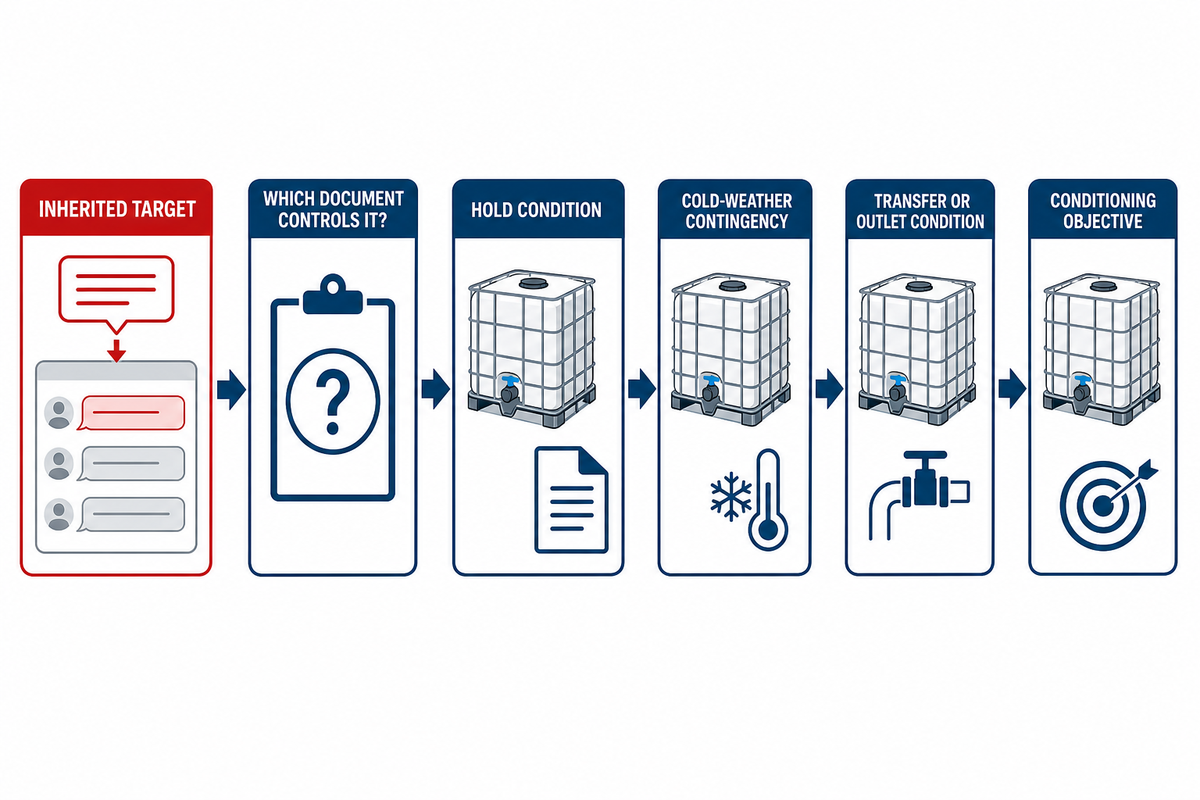
Write the objective in plain operational language before collecting product information. “Maintain a stated range during a shift” is different from “avoid an overnight freeze exposure,” and both are different from “restore movement before a planned transfer.” A useful brief also says who owns the temperature target and where that target came from.
The common failure here is an inherited target. The number travels from another site, another material or a supplier example into a message thread, and by the time it reaches procurement nobody can say which document it came from. The mistake matters because the authority for a temperature target lives in the material record and the process owner’s acceptance criteria, not in the request that quotes it. When the source is unknown, the honest entry is “unverified,” and the next action is to find the controlling document rather than to specify equipment.
Compare two ways of writing the same request. “Keep the tote warm” can’t be inspected, quoted against, or falsified. “Hold the material within the range stated in its material record, verified at the outlet, across a 12-hour shift” names a document, a measurement point and an operating window, so a qualified reviewer can tell whether it was met. The second version is longer, and it’s the one that survives a handover between the process owner, procurement and the site electrical reviewer. FlexBlanket’s six-input heat brief builder lays out the same fields if you would rather fill them in than draft them.
That discipline follows the basic process-heating distinction between raising a material’s temperature and maintaining it. The habit also prevents a common shortcut: treating a heater category as though it answers every later question about the material, the container, or the operating window. DOE: raising versus maintaining a material temperature
| Document first | Why it matters | Do not infer |
|---|---|---|
| Hold condition | Defines the condition to protect over time. | Suitability for every material that the tote might hold. |
| Cold-weather contingency | Sets the exposure that triggered the review. | Any heater rating predicted from a seasonal concern alone. |
| Transfer or outlet condition | Identifies the process point that matters to the next operation. | Outlet or bulk condition proven by a warm outer surface. |
| Conditioning objective | Clarifies what the process owner or the material record must confirm. | Suitability established by a generic “chemical tote heater” label. |
How to heat an IBC tote?
Start by recording the objective, material identity, current condition, intended operating window, and the site facts that still need confirmation. The appropriate heating arrangement is a later question. If the first conversation begins with a configuration or a product family, move backward and establish the process brief first.
What Changes a Warm-Up or Holding Plan?
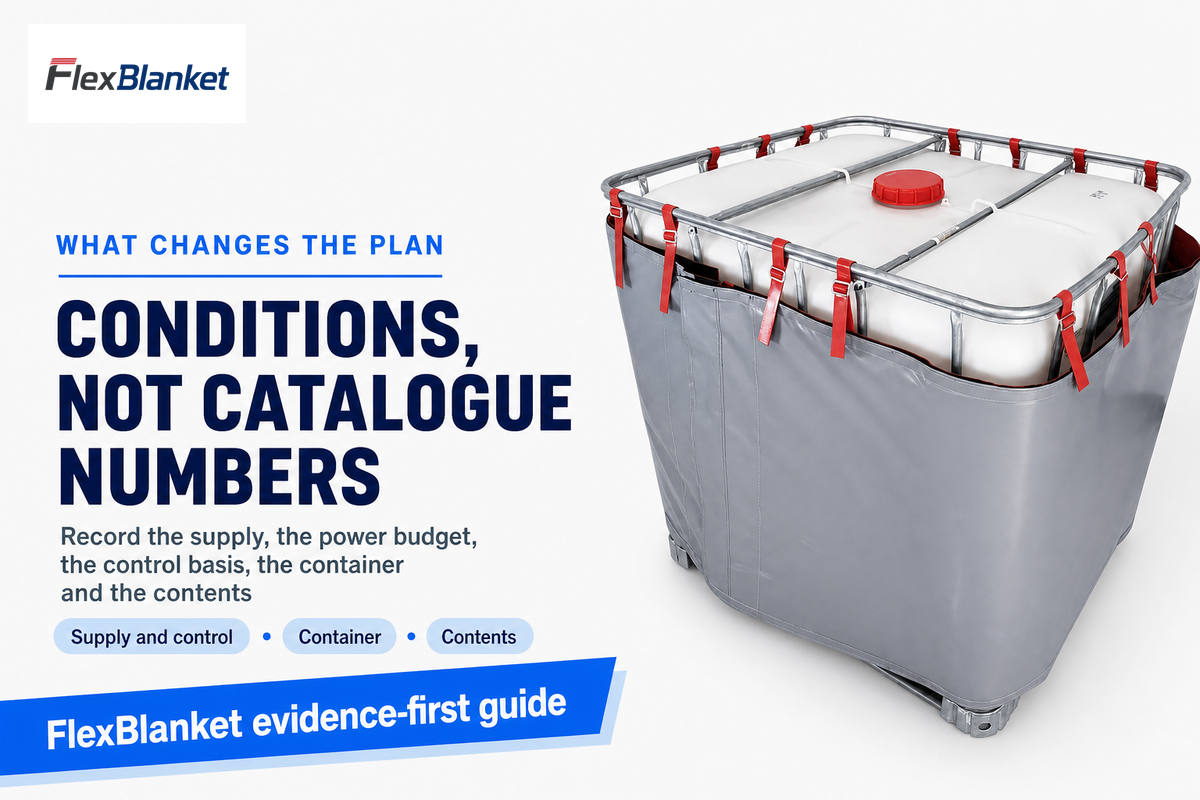
A duration or holding expectation should never be copied from another tote without its conditions. The process-heating literature describes controlled heat transfer and containment losses as dependent on operating requirements, heat-transfer conditions, and the way a system contains or loses heat. That’s a systems principle, not an IBC heat-up formula. DOE’s process-heating roadmap
One material property shows why a bare number is a weak input. Viscosity is unique to each fluid and means nothing without the temperature at which it was measured: industrial data sheets commonly report kinematic viscosity at 40 °C, older sheets report it at 100 °F, and the ASTM D445 test method describes how the measurement is made rather than fixing one temperature for every fluid. Quoted without its reference temperature, a viscosity figure is therefore not a usable planning input, because two materials described as having “the same viscosity” at different reference temperatures are not the same handling problem. Ask the material owner for a certified test report carrying the property, the test temperature and the method, and treat any of the three as missing until it appears in a document. Without its method, the same number arrives with no stated precision, so an inspection of the record is worth more than a figure repeated in an email. Where a rough energy figure helps frame the conversation, the container heat-up energy estimator shows what the duty implies under its own stated assumptions, which is not the same as a promise about your tote.
A DEF Tote Is Not a Generic IBC Heating Problem
The material classes behind these questions are not interchangeable either. A DEF tote holding diesel exhaust fluid, a food and beverage ingredient, a resin and a solvent each carry different controlling documents and different handling constraints, so ask which class the contents fall into before treating any published example as relevant to them. Chemical Engineering: in-service heat-transfer fluid testing
For an IBC brief, gather the information that would change the result rather than inventing a universal number. Record the material identity, the current observed temperature, the fill condition, the container type and condition, the surrounding exposure, and any known insulation or enclosure context. If the material record identifies a viscosity basis, phase state, shear-sensitive behaviour, or a handling limitation, record that too. This is a request for evidence, not a claim that the contents of every tote behave in the same way.
Keep the evidence in a short dated handoff record rather than scattered messages. One line can identify the material document; another can identify the observed condition and who recorded it; a third can name the operating event that makes the temperature question important. If a fact is unknown, write “unknown” instead of substituting a likely value from a different tote, a supplier example, or a past winter event.
This record also helps separate a planning question from a decision. Teams are often ready to ask what evidence a solution review needs long before they’re ready to specify equipment. That’s useful progress: it preserves the uncertainty that must be resolved and avoids making an apparently precise heat-up or compatibility claim from incomplete process information.
Minimum evidence before a time discussion
- What’s in the tote, and which document controls its temperature range?
- What’s the current temperature, at which point, and when was it recorded?
- What fill condition, container state, ambient exposure, and heat-loss context apply?
- What operating event defines success: holding, thaw contingency, transfer, or another material condition?
Supply, Thermostat and Wattage: the 120V Site Facts Behind Any Quote
Site facts a supplier will ask for anyway
- Available supply: the voltage and phase at the point of use, plus the circuit protection serving it. A 120 volt circuit and 240V single-phase are the usual North American answers, and 120V is the one most often assumed without checking.
- Power budget: the wattage that circuit can carry, written in watt terms rather than as “a normal outlet.”
- Control: whether the arrangement is expected to run on a fixed thermostat, an adjustable controller, or no control at all, and who owns the setpoint.
- Container: the tote size, the cage and closure condition, the outlet fitting, and the usable surface area an external arrangement could contact.
- Contents: the liquid contents by name, whether they count as temperature-sensitive materials, and which document states their limits. Supply details can be checked against the voltage and plug compatibility check.
How much heat can an IBC tote handle?
There’s no responsible universal answer in a guide. “Can handle” could refer to the material, the packaging, the thermal objective, the electrical environment, or a supplier’s equipment specification. Keep those questions separate and request the applicable source for each one.
Measure the Material and the Outlet Before You Trust a Setpoint
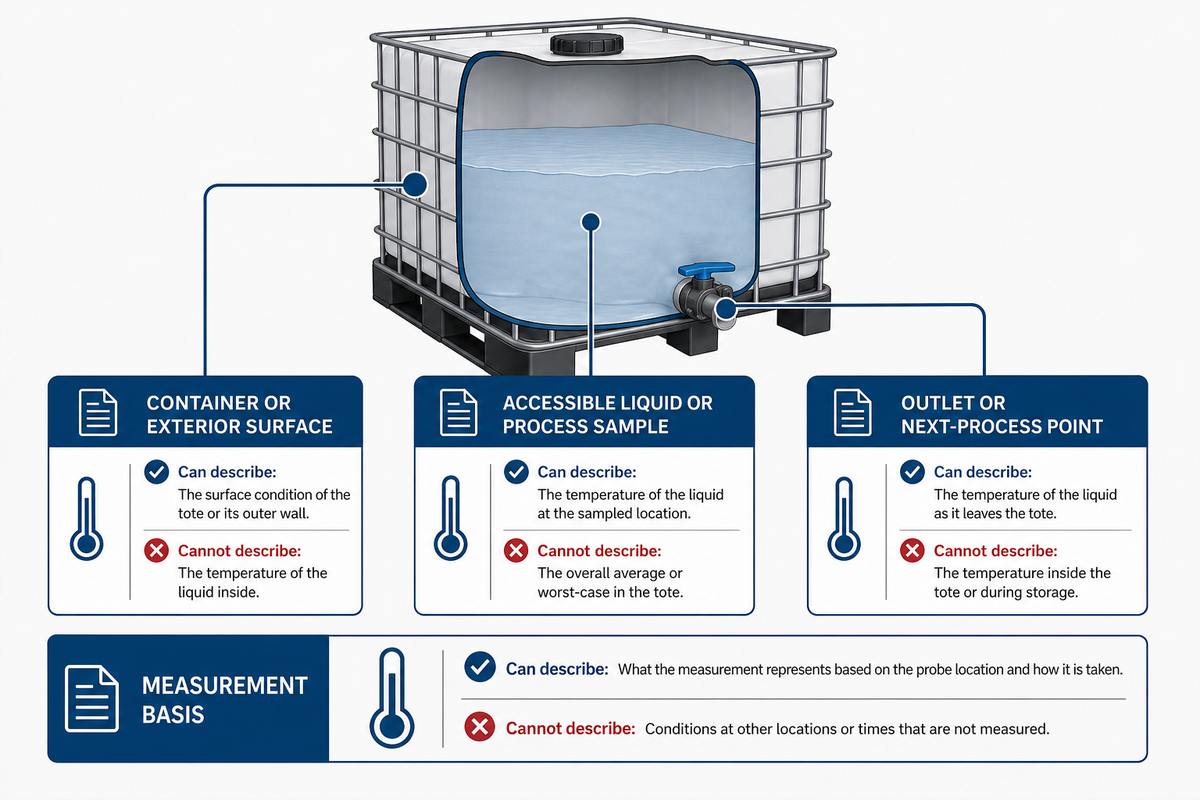
A setpoint is only meaningful when readers know what the sensor represents. A surface reading, a reachable-liquid reading, and an outlet or process-point reading can all be useful, but they answer different questions. The purpose of recording them is to reveal what has and hasn’t been observed before an equipment specification is discussed.
3-Reading Temperature Reality Check
Use this table as an evidence prompt. It isn’t a validation protocol, a guarantee of thermal uniformity, or a substitute for a process owner’s acceptance criteria.
| Reading | What it can describe | What it does not establish | Record alongside it |
|---|---|---|---|
| Container or exterior surface | A local external condition at a stated point and time. | Bulk material temperature or outlet readiness. | Exact location, contact/non-contact method, instrument basis, and timestamp. |
| Accessible liquid or representative process sample | A material condition at one documented sampling point. | Uniformity across every point in the tote. | Sampling location, material state, response timing, and the definition of “representative.” |
| Outlet or next-process point | The condition seen by a downstream transfer or operation. | The whole tote’s average thermal state. | Flow/operation status, point location, timestamp, and any relevant process condition. |
There’s a second check behind all three rows: the measurement basis. NIST notes that uncertainty associated with a probe calibration doesn’t automatically include the uncertainty associated with a digital readout. That doesn’t prescribe a particular IBC instrument or calibration interval; it’s a reminder not to treat a location label as the whole measurement story, and a reason to record the certificate that covers the probe alongside the instrument that displays the number. NIST industrial thermometer calibrations
Sensor position is the third variable behind a reading. Control guidance for liquid heating treats the path between the heat source and the sensor as the thing that creates thermal lag, so two probes that report the same steady-state number can disagree during a warm-up simply because of where they sit. Record the position and the response timing, not only the value. Watlow: sensor placement in a thermal system
A NIST water-heater study makes the same problem concrete in a different system. Two models of 190 L (50 gallon) residential electric water heaters were tested, and the steep gradient near the lower heating element made the average tank temperature difficult to determine because the governing test standards take readings at only six discrete locations. The study’s own remedy was procedural rather than physical: start the test from a 24-hour idling period so that beginning and end conditions match (Healy, ASHRAE Transactions volume 114, part 2, 2008). The equipment, fluid and purpose aren’t an IBC tote, so none of those values transfer here. The transferable lesson is narrower: if a decision depends on temperature, state what was measured, at how many points, and under what starting condition. NIST temperature-stratification study
The opposite overcorrection is also unhelpful. Some validated systems demonstrate adequate uniformity for their own application. The guide therefore asks for verification against the actual material and operation; it doesn’t assume a gradient exists in every tote. Supplier language about uniform heat, consistent heat, the absence of hot and cold spots, or a promise to maintain optimal temperatures describes a design intention rather than a measured result for your tote, so treat heat distribution as something to verify at your own recorded points. The NIST work is itself a study of how a measurement convention shifts a published energy efficiency figure; the reading and the claim it supports aren’t the same object.
Read the three observations together
Start with the process point that matters most, then compare it with the other two observations only when their locations and times are recorded. If the readings don’t answer the same question, don’t average them into one number. Instead, identify the unresolved point and decide whether the next step is more material information, a measurement review, or a site process review.
This keeps the framework practical without making it prescriptive. It doesn’t tell a reader where to install a sensor, how long to wait, or what value proves success. The framework simply makes the gap visible before an equipment conversation turns that gap into an unsupported conclusion.
External Heat, Insulation, and Immersion Answer Different Evidence Questions
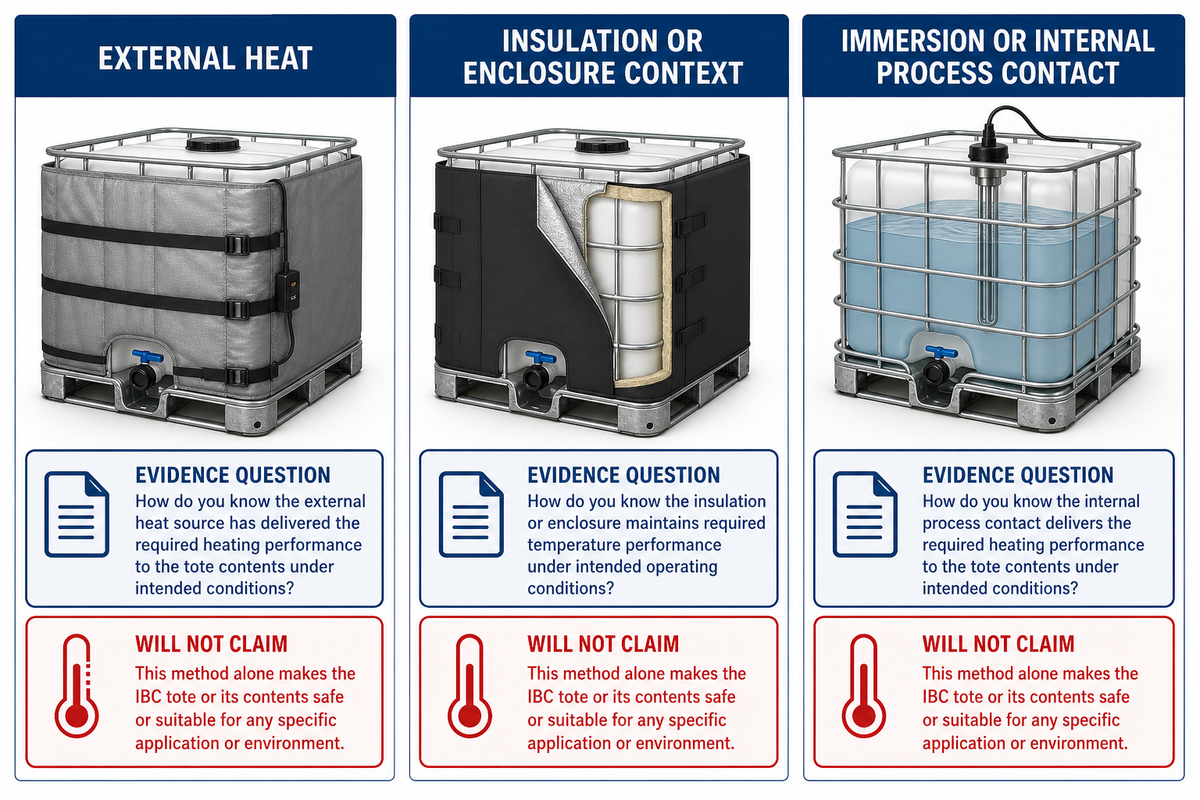
These labels describe different ways heat and heat loss may be considered. They don’t create a universal ranking. The comparison becomes useful only when it makes the missing evidence visible and keeps the product-selection decision outside this guide.
| Topic being discussed | Evidence question to resolve | What this guide will not claim |
|---|---|---|
| External heat | Which material and container facts define the intended thermal objective and observation point? | An external approach is automatically fast, compatible, or suitable. |
| Insulation or enclosure context | Which thermal inputs and surrounding conditions define the heat-loss question? | Insulation alone reaches, maintains, or proves a target condition. |
| Immersion or internal process contact | Which material, containment, cleaning, and process controls does the responsible team still have to review? | An internal approach is appropriate for a particular tote or substance. |
ASTM C680-23a is useful for one limited point: insulated-system heat-gain/loss and surface-temperature calculations depend on physical and thermal inputs, and the practice has a defined calculation scope. It is not an IBC tote design standard and does not select a heating method. ASTM C680-23a
Insulate, Wrap or Immerse: Three Review Packages, Not Three Grades
The practical consequence for a buyer is that the three rows above aren’t three grades of the same product; they’re three different review packages, and the mistake is to rank them as though they were. An externally applied approach puts the burden on the container, the surface condition and the enclosure. An internal or immersion approach adds material contact, cleaning and containment questions that a purchasing conversation can’t settle on its own, because a wetted part changes what has to be inspected, cleaned and certified before the operation restarts. The risk of skipping that distinction is a quotation compared against the wrong evidence set. Asking a supplier which review package a proposal implies, and which parts of it a qualified site reviewer still has to sign, is a fair procurement question. Asking which method is best, in the abstract, isn’t answerable. The IBC heating method selector walks the same three review packages against a documented application.
Safety and Process-Risk Boundaries: Classification Is Only One Check
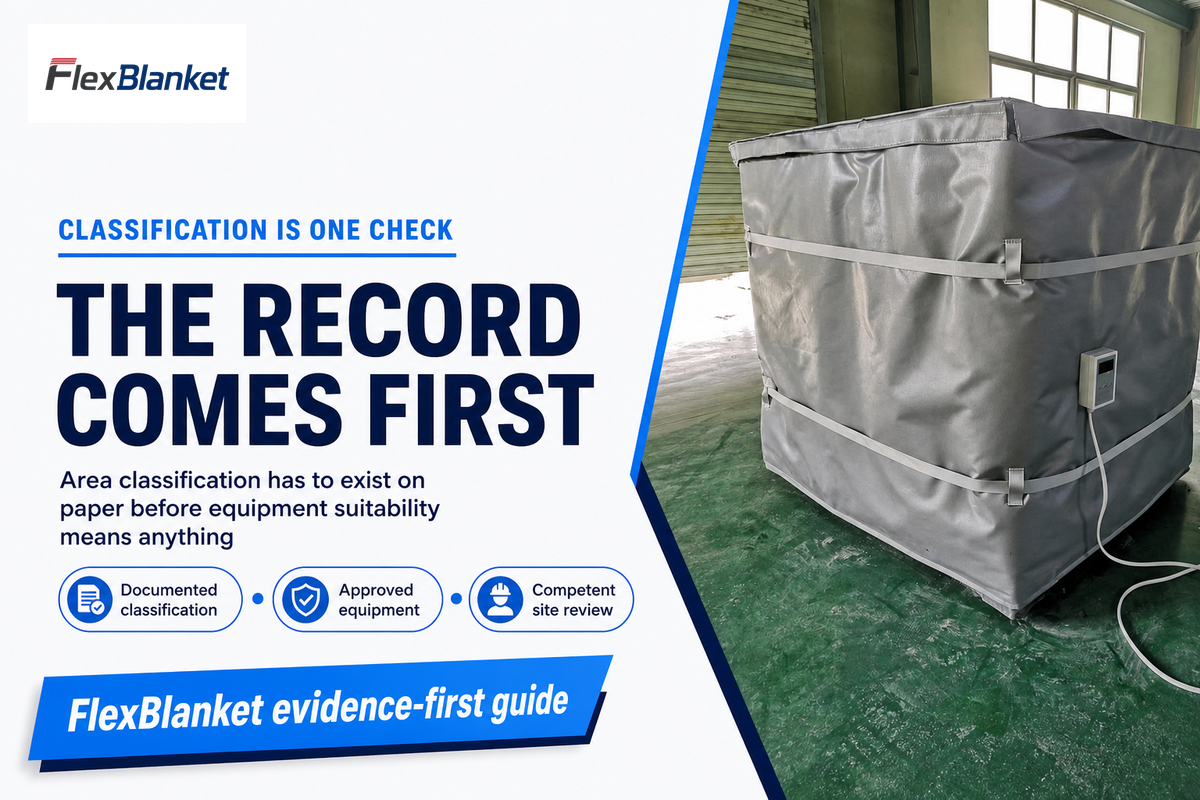
Safety language needs especially careful boundaries. In U.S. classified locations, OSHA requires equipment and installations to be intrinsically safe, approved, or safe for the classified location. A generic heater category isn’t evidence that this requirement has been met for a given site. OSHA 29 CFR 1910.307
The same section is explicit that the area classification itself has to exist on paper before equipment suitability means anything:
All areas designated as hazardous (classified) locations under the Class and Zone system and areas designated under the Class and Division system established after August 13, 2007 shall be properly documented. This documentation shall be available to those authorized to design, install, inspect, maintain, or operate electric equipment at the location.
Several details in the same rule show why a marketing temperature rating isn’t the same fact as an approval. Equipment approved for a classified location must be marked with its class, group and operating temperature or temperature range, based on operation in a 40 °C ambient, and equipment rated for ambients above 40 °C (104 °F) must carry both the maximum ambient and the operating temperature at that ambient. Heat-producing equipment whose maximum temperature doesn’t exceed 100 °C (212 °F) need not carry a marked operating temperature at all, so the absence of a marking isn’t proof of anything either way. Under the zone system the rule goes further and states that classification of areas and selection of equipment and wiring methods shall be under the supervision of a qualified registered professional engineer. The same section names nine classified-location designations: Class I Divisions 1 and 2, Class I Zones 0, 1 and 2, Class II Divisions 1 and 2, and Class III Divisions 1 and 2, and its own worked marking example reads “Class I, Zone 0, AEx ia IIC T6”. Neither the list nor the example says anything about a tote; both show how specific the site’s own paperwork has to become before equipment suitability is a real question. The current edition is available from the Government Publishing Office. 29 CFR 1910.307, 2025 CFR edition
That electrical boundary isn’t the whole process-risk review. The UK Health and Safety Executive describes dangerous-substance risk assessment and notes that high-flashpoint liquids at elevated temperatures can create a fire or explosion concern. The citation is used here as general process-risk context, not as a legal conclusion for another jurisdiction. HSE: dangerous substances and explosive atmospheres
The gap between those requirements and ordinary practice is easy to observe. Public forum threads show operators improvising an enclosure around a tote with a 500 W utility heater and asking afterwards whether it was a reasonable idea. That’s a field question rather than a recommendation or a performance datum, and it’s exactly the situation the documentation requirement above is written for: the classification, the substance and the installation are decided by the site, and an improvised arrangement leaves all three unrecorded.
Stop and obtain site-specific review when any of these facts are unresolved
- The controlling material or safety documentation, including its intended temperature range.
- The actual operation: storage, transfer, outlet use, mixing, or another process step.
- Whether heating changes vapour, static, release, compatibility, containment, or emergency-response considerations.
- The IBC condition, closure and valve condition, secondary containment, and the boundaries of the installation.
- Whether the area is classified and which competent site process and electrical review applies.
No article can establish the condition of a specific IBC, the compatibility of a particular material, the adequacy of a valve, or the adequacy of secondary containment. Those are application facts that should remain open until the responsible site team resolves them. The IBC heater fit checklist records the container-side facts a site team still has to confirm.
Use the boundary to improve the quality of the question, not to move engineering responsibility into a blog post. Good requests say which document is controlling, what changed in the operating plan, and which fact is still unknown. They shouldn’t imply that an external article has cleared a site, approved an installation, or assessed a specific substance.
Seasonal Planning Starts Before the First Cold Week
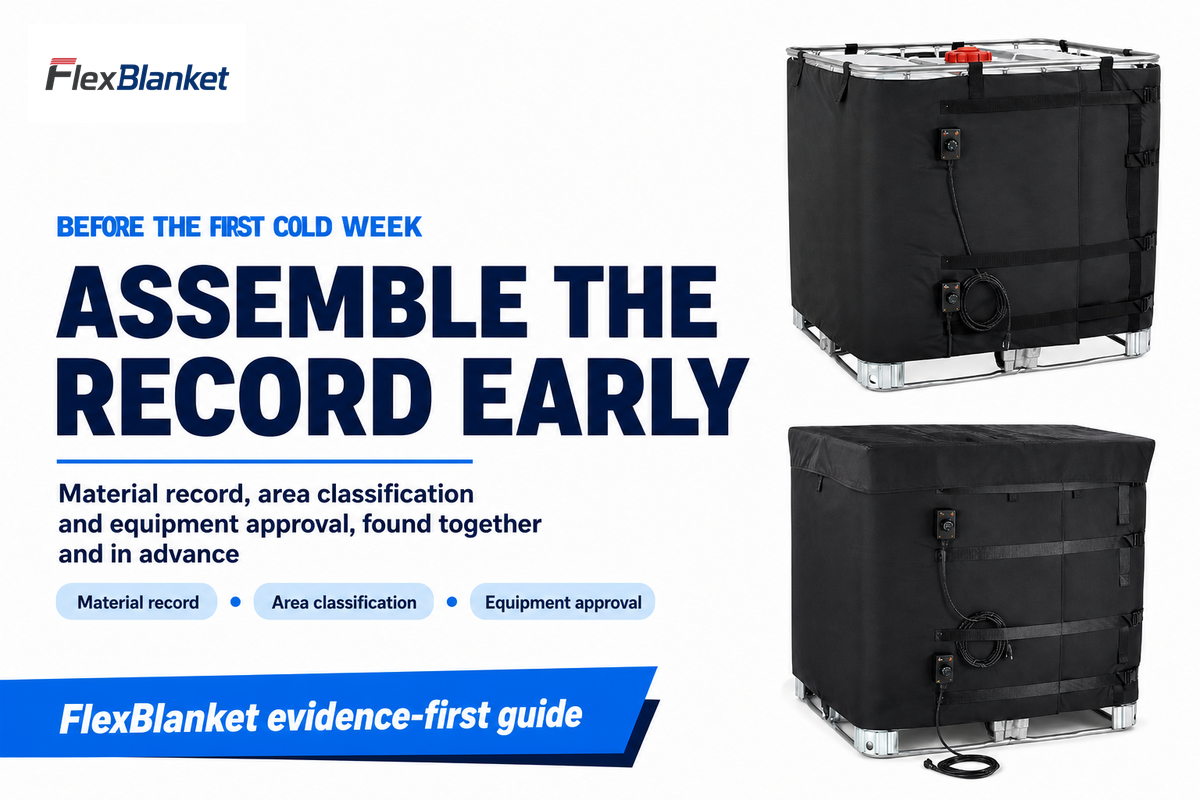
Cold exposure is easier to review before it becomes an emergency. A useful seasonal plan identifies the material owner, records the starting condition, checks the tote and site facts, and sets the point at which a process review is needed. It doesn’t turn a general winter concern into a prediction of heat-up time or product performance. The risk of leaving it late isn’t only a cold tote; it’s a delay in which the material record, the area classification and the equipment approval all have to be found at once, under operational pressure, because nobody assembled them while the yard was still above freezing.
Winter also changes a question most planning notes never ask, which is whether the installed equipment is approved for the ambient the site actually reaches. OSHA’s note on the zone system warns that equipment relying on flameproof protection may not be suitable below −20 °C (−4 °F) unless it’s approved for use at lower temperatures, and observes that low ambient temperatures can equally change whether a flammable concentration is present in a location classified at normal ambient. Neither point is an IBC-specific rule. Both are reasons to raise the cold-weather review with the qualified site reviewer while there’s still procurement lead time, rather than during the first week the yard drops below freezing. OSHA 29 CFR 1910.307, note to paragraph (g)(4) The companion guide on preventing frozen pipes and tanks covers the wider cold-weather exposure this one only touches.
If historical site conditions are relevant, retain the actual local record with the decision. Search trends can show when buyers investigate a topic, but they can’t show what the contents of a specific IBC need, or prove that a heating arrangement will perform as expected.
From a Guide to a Solution Brief
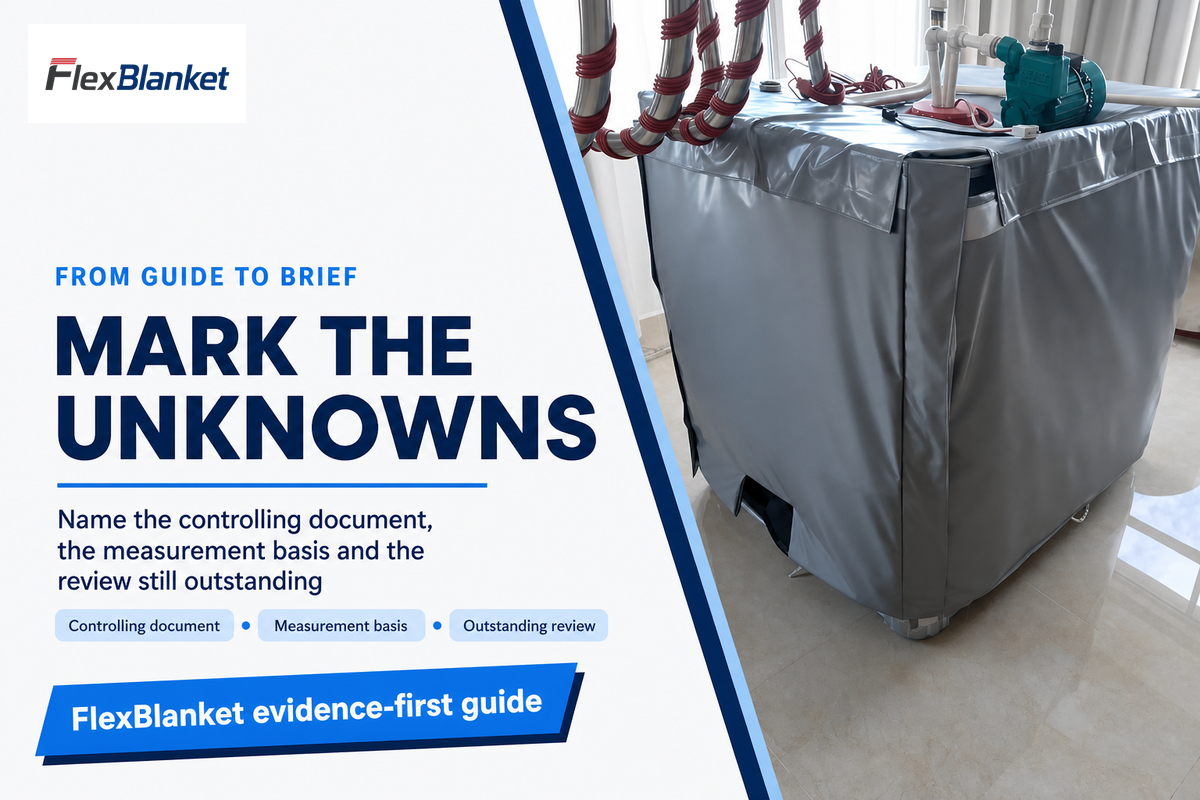
When the evidence checklist is complete, the next conversation can move from a generic heating question to the documented application, and only then does a heating solution become something a supplier can scope. For the existing FlexBlanket solution page, review FlexBlanket’s IBC tote heater solution page. Bring the objective, material documentation, measurement basis, environmental context, and unresolved safety/process questions with you. The wider container heaters range covers pails and drums on the same evidence footing.
A brief assembled this way changes the shape of the supplier conversation, because it moves the unknowns into the open where a specialist can price the risk of resolving them. It names the controlling document, the measurement basis and the site review still outstanding, so nobody has to fill those gaps by guessing. That’s the difference between an inquiry a qualified reviewer can act on and a request that has to be sent back for information.
Evidence Class Matrix: What Each Figure Can and Cannot Establish
One table collects the boundaries this guide has been drawing. Read it as the closing check on a brief before it leaves the building.
| Evidence class | Typical figure or record | What it can establish | What it cannot establish |
|---|---|---|---|
| Thermal objective | A written statement of raising versus maintaining a temperature | Which question the project is actually asking | Any heater rating, duty or configuration |
| Material viscosity | Kinematic viscosity at 40 °C, or at 100 °F on older sheets, by the ASTM D445 method | Handling behaviour at that stated test temperature | Behaviour at any other temperature, or in another fluid |
| Material state | Phase state, shear-sensitive behaviour or handling limits in the material record | Whether the contents need conditions a plain viscosity figure hides | Anything, when the material record is silent on it |
| Surface reading | One contact or non-contact reading at a stated point and time | A local external condition at that point | Bulk material temperature or outlet readiness |
| Accessible-liquid reading | One sample at a documented sampling point | A material condition at that one point | That every point in the tote matches it |
| Outlet reading | A reading at the transfer or next-process point | The condition the downstream operation sees | The whole tote’s average thermal state |
| Instrument basis | A calibration certificate covering the probe | Uncertainty attributable to the probe | Uncertainty contributed by the digital readout |
| Measurement design | How many points were read, and the starting condition; the NIST study used six discrete locations and a 24 hour idle | How much of the vessel the average actually represents | That a six-point convention transfers from a 190 L water heater to an IBC tote |
| Container fit | Nominal capacity: 275 US gallon of roughly 1040 L, or 330 US gallon of roughly 1250 L | Whether a given wrap or enclosure physically fits | Any thermal result for the contents |
| Supply and power | Voltage and phase at the point of use, commonly 120V or 240V single-phase, with the circuit wattage | What can physically be connected on that circuit | Whether the arrangement is approved for the area |
| Equipment marking | Class, group and operating temperature referenced to a 40 °C ambient; no marking required at or below 100 °C (212 °F) | The equipment’s rating under the stated reference conditions | Anything about your material or your area classification |
| Area classification | The documented classification required by 29 CFR 1910.307(b) | That the area has been classified on paper and the record is available | That a particular heater category satisfies it |
| Cold-ambient limit | Flameproof protection may not suit below −20 °C (−4 °F) unless approved for lower temperatures | A reason to open the cold-weather review early | An IBC-specific rule, or a site conclusion |
Where Each Statement Here Comes From, and Where It Stops
Every source below was read for this article, and each row states the exact job it was asked to do. The last column is the part most guides leave out: what the source doesn’t support. A citation that’s never scoped is how a general reference quietly becomes a specific promise about your tote.
| Source | What it publishes | Cited here for | Not offered as |
|---|---|---|---|
| DOE, Process Heat Basics | Definition of industrial process heat | The raise-versus-maintain distinction | Any IBC performance figure |
| DOE, Roadmap for Process Heating Technology | Programme-level process-heating survey | Heat transfer and containment losses being condition-dependent | A tote heat-up calculation |
| NIST, Industrial Thermometer Calibrations | Calibration service scope | Probe uncertainty not covering readout uncertainty | A required instrument or calibration interval |
| NIST / ASHRAE Transactions 114 part 2, 2008 | Stratification in two 190 L electric water heaters | Why a six-point average can misrepresent a vessel | Evidence about any IBC tote |
| ASTM D445 | Kinematic-viscosity test method | Why a viscosity figure needs its test temperature | A mandated temperature for every fluid |
| ASTM C680-23a | Insulated-system heat-loss calculation practice | Calculations depending on physical and thermal inputs | An IBC design standard or method ranking |
| OSHA 29 CFR 1910.307 | Hazardous classified-location electrical rule | Documentation, marking and supervision requirements | Approval of any product for any site |
| GPO, 2025 CFR edition | Current published text of the same section | Confirming the requirement still reads that way | A change specific to IBC heating |
| HSE, DSEAR background | UK dangerous-substances risk-assessment guidance | Heating changing a fire or explosion context | A legal conclusion in any jurisdiction |
| Chemical Engineering, fluid testing | Trade-technical note on in-service fluids | Viscosity being fluid-specific and temperature-stated | A primary standards reference |
| Watlow, sensor placement | Vendor engineering knowledge base | Heat-source-to-sensor path creating thermal lag | A sensor-placement prescription |
| US20230024697A1 | Published patent application | That internal self-regulating constructions exist | Product performance, safety or availability |
FAQ
Can an IBC tote heater prevent freezing?
No heater category on its own can promise to prevent materials from freezing. Freeze protection is an application objective, and what decides whether it’s met is the material’s documented limits, the exposure, the fill and container condition, the heat-loss context and the site controls. Two totes in the same yard with the same equipment can behave differently because their contents and enclosures differ. Treat the phrase as a requirement to be evidenced.
Should I use a surface temperature as my control point?
A surface reading is useful when it’s clearly labelled, but it doesn’t automatically represent the material or the outlet. Record what the reading is intended to show, how it was measured, when it was taken, and which process point still needs confirmation.
Does insulation replace active heating?
Insulation and active heating answer different questions. Insulation changes the heat-loss context; on its own it doesn’t establish that contents will reach or maintain a target, because the result still depends on the starting condition, the exposure and how long the condition has to hold. Active heat doesn’t remove the paperwork burden either: the material, the exposure and the measurement basis all still have to be written down.
Is an IBC tote heater safe in a classified location?
A general product description can’t answer that. OSHA ties the evaluation to a documented area classification and to equipment that’s intrinsically safe, approved, or demonstrably safe for that location. Refer the actual site, substance and installation to the competent people who govern it.
What information should I collect before asking for a solution?
Collect the material identity and its controlling paperwork, the thermal objective, current observations with their measurement basis, the tote and fill condition, the surrounding exposure, the relevant operating step, and any unresolved electrical or process-risk facts. Note explicitly which of those are unverified rather than leaving the gap silent. A brief that marks its own unknowns lets a specialist scope the work honestly, and it makes a later application discussion specific without forcing the guide to guess at configuration.
Why not use a standard warm-up time from another application?
Another application may differ in material, starting condition, container, fill, heat-loss environment, heating path, observation point and operating goal. Even a supplier’s conditional example isn’t a universal result. Keep the conditions attached to the number, or don’t use the number.
What does a temperature marking on the equipment actually tell me?
Under 29 CFR 1910.307 a marked operating temperature is referenced to a 40 °C ambient, and equipment rated for hotter ambients must show both the maximum ambient and the operating temperature at it. Heat-producing equipment whose maximum stays at or below 100 °C (212 °F) need not be marked at all, so a missing marking isn’t evidence in either direction. The marking describes the equipment under stated conditions; it says nothing about your material or your area classification.
Who signs off on the classified-location question?
Under the zone system the rule is explicit: classification of areas and selection of equipment and wiring methods must be supervised by a qualified registered professional engineer. A supplier, a guide, and a purchasing conversation can’t substitute for that review.
References & Sources
- U.S. Department of Energy: Process Heat Basics
- U.S. Department of Energy: Roadmap for Process Heating Technology
- National Institute of Standards and Technology: Industrial Thermometer Calibrations
- National Institute of Standards and Technology: Temperature Stratification Study (Healy, ASHRAE Transactions 114, 2008)
- ASTM C680-23a
- OSHA 29 CFR 1910.307
- Government Publishing Office: 29 CFR 1910.307, 2025 CFR edition
- Health and Safety Executive: DSEAR in Detail
- Chemical Engineering: In-Service Heat-Transfer Fluid Testing
- Watlow: Sensor Placement in a Thermal System
- USPTO/Google Patents: US20230024697A1
MANUFACTURING EVIDENCE
A specified heat path, backed by first-party site context
First-party website statements identify FlexBlanket as the export brand of Qingdao Flex Technology Co., Ltd. They describe custom-to-drawing heating solutions with in-house production and testing for industrial thermal duties.
SITE-STATED FOUNDED2019
SITE-STATED LOCATIONQingdao, China
SITE-STATED PLANT5,000+ m²
SITE-STATED TEAM50+ staff
ENGINEERING HANDOVER
From asset dimensions to a site-stated build route
01Site-stated product families include heating blankets and silicone rubber heaters for drums, IBCs, pipes, gas cylinders and composite-curing duties.
02First-party site information describes custom-to-drawing review for fit, voltage, target temperature, controls and installation conditions.
03First-party site information states in-house production/testing and OEM / ODM support; confirm scope for the required application.
First-party site-stated standard lead time is 7–15 days and site-stated warranty is 24 months. Treat ISO 9001, CE and RoHS references as site-stated claims requiring confirmation for the exact product and order.