Get in touch with FlexBlanket Company

Water Curing of Concrete: Methods, Moisture Control, and Cold-Weather Limits

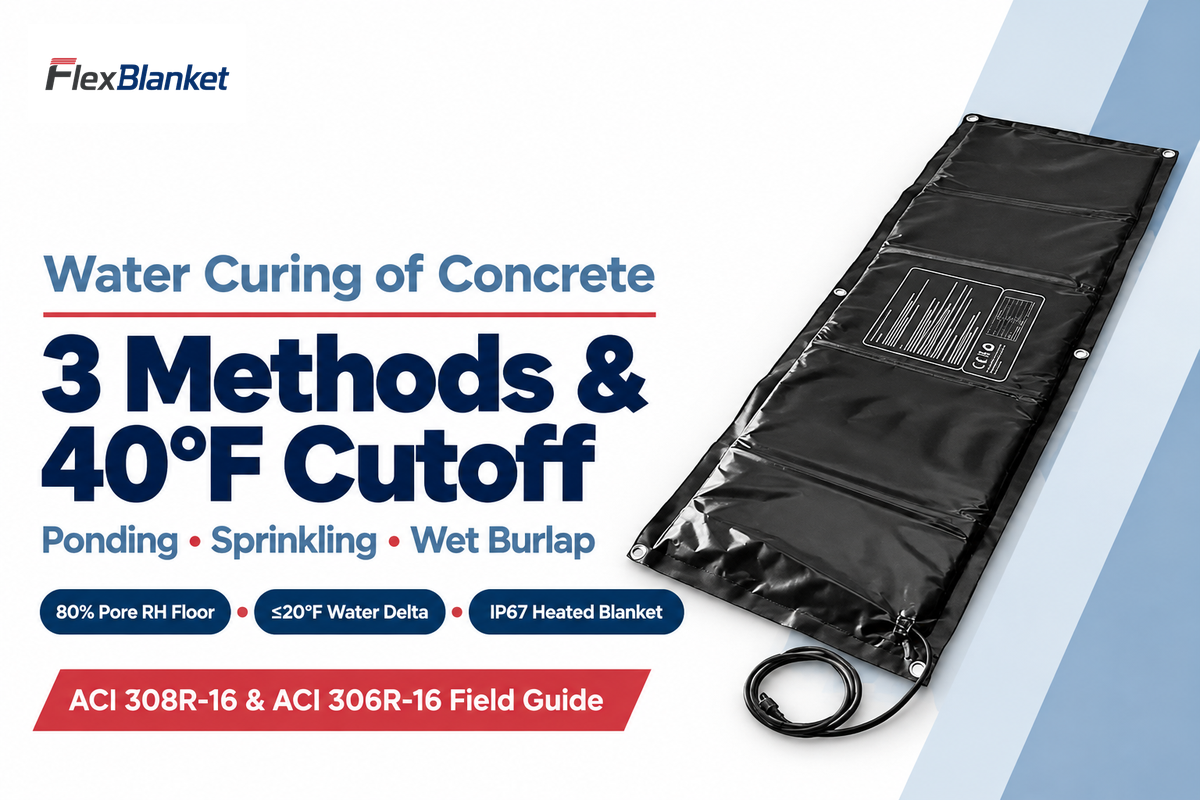
Water curing of concrete is the controlled application of external liquid water, via ponding, fogging, continuous sprinkling, or saturated fabric coverings, to keep capillary pores saturated after final set so the chemical reaction between cement and water can build optimal strength and durability. Newly placed wet concrete doesn’t harden by drying out; proper curing requires careful control to prevent concrete from drying prematurely while the reaction between cement and water continues. As documented in the FHWA Guide for Curing Portland Cement Concrete Pavements, hydration halts whenever internal pore relative humidity drops below 80%. Yet external water curing has a strict cold-weather boundary: when temperatures are near 40°F (4°C), free surface water creates a freeze-expansion hazard, requiring field crews to retain moisture in concrete using sealed vapor barriers and heated curing blankets once the concrete is hard enough to walk on.
What Is Water Curing of Concrete and Why Does Hydration Stop Below 80% Relative Humidity?
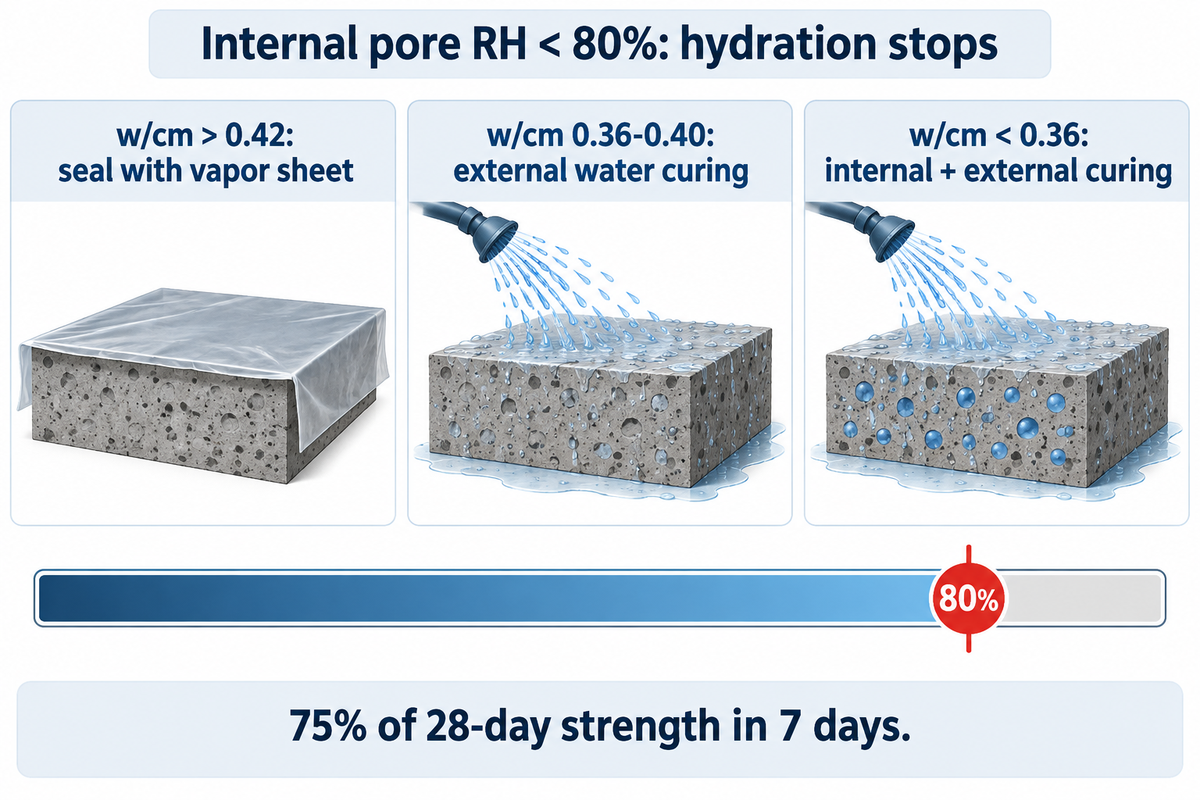
Water curing of concrete involves the use of external moisture replenishment to maintain full saturation of capillary pores following final set, as stipulated by the hydration guidance of the National Precast Concrete Association (NPCA). Drying of concrete is stopped to maintain the relative humidity of the internal pores at 80% to allow standard mixes to develop about 75% of the 28-day compressive strength within 7 days.
Crews using the term “curing and drying” refer to a couple of physical opposites. In concrete construction, curing is the process of maintaining satisfactory moisture content and temperature near the surface of concrete so the hydration process can fill capillary voids with load-bearing calcium silicate hydrate (C-S-H) crystals. Allowing rapid moisture evaporation when ambient humidity is low starves the concrete’s top wear zone of the water needed to hydrate the cement.
curing process occurs at full speed only in water-filled capillary spaces. According to the FHWA Guide for Curing Portland Cement Concrete Pavements (FHWA-HRT-05-038), when surface evaporation pulls moisture within the concrete below 100% internal pore relative humidity, hydration slows down; and below 80%, it virtually stops. Losing moisture from the top 6 to 12 mm (0.25 to 0.5 in) of a concrete slab during the first 72 hours leaves a permeable, dusty surface layer with poor abrasion resistance that scales under deicing salts.
As reported by the NPCA (citing data from the Portland Cement Association), moist-cured concrete typically achieves approximately 75% of its own 28-day compressive strength in about 7 days; ACI 308R-16 separates 70% of the specified design compressive strength (f’c) to define the field curing limit. Three water-to-cementitious materials ratio (w/cm) brackets determine if external water addition or vapor sealing is needed:
- Conventional slabs with w/cm above 0.42 retain enough batch water to sustain hydration if sealed with impermeable vapor sheet, though external wet curing increases surface density.
- Low w/cm industrial floors with w/cm between 0.36 and 0.40, undergo chemical self-desiccation as hydrating cement consumes capillary water; external water curing is needed to replenish near surface pores. Topical curing compounds help retain water, but don’t affect dry pores.
- Ultra-dense blended mixes with w/cm below 0.36 containing silica fume or slag develop such tight pore networks that external curing water penetrates only a few millimeters, as shown in National Institute of Standards and Technology (NIST) research; these mixes require pre-wetted lightweight aggregate internal curing alongside external wet curing.
Liquid water should be applied just before hydration, or when the surface bleed water sheen disappears. Once the surface bleed water sheen disappears and the concrete is hard enough that a firm thumb press leaves zero indentation, crews can start wetting the slab without washing paste out of the top millimeter.
How Do Ponding, Sprinkling, and Wet Coverings Compare for Concrete Slabs?
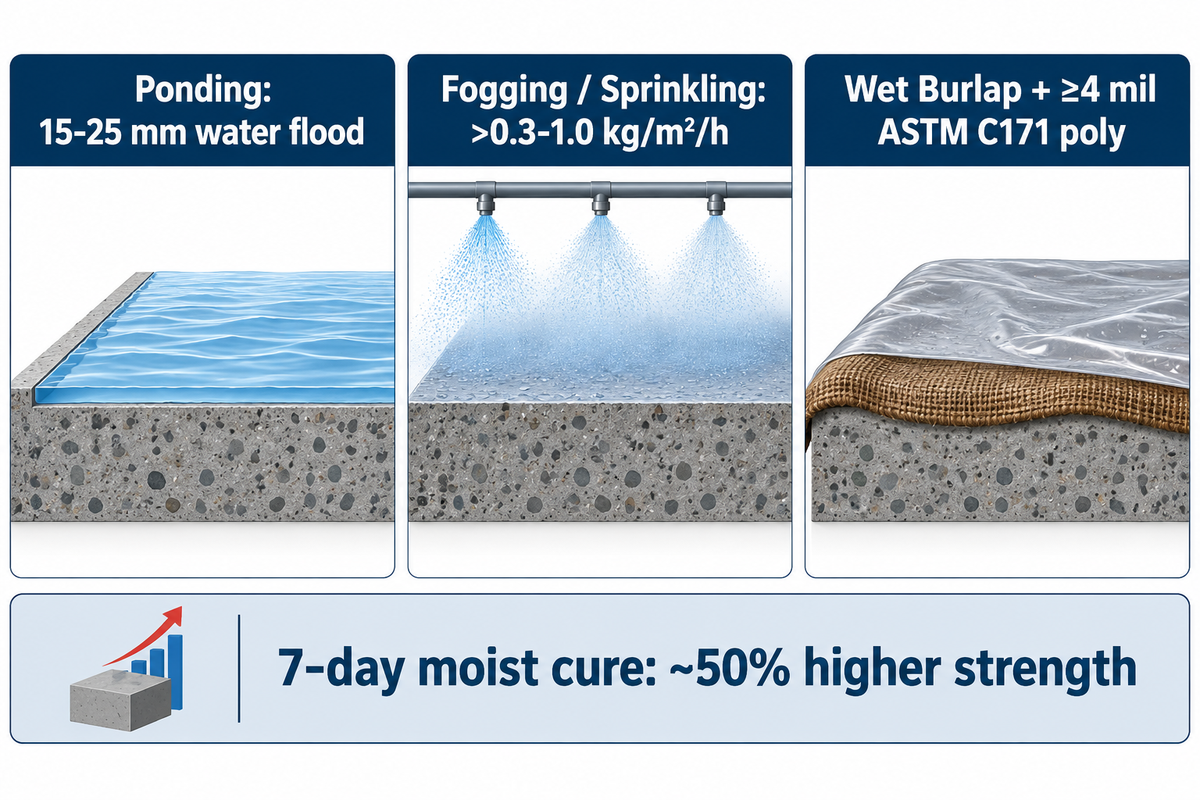
Select ponding only for dead-flat slabs where earth or sand dikes can hold a 15–25 mm water flood, continuous fogging or sprinkling when dry weather pushes evaporation above 0.3 to 1.0 kg/m²/h, and wet burlap capped with ≥4 mil ASTM C171 polyethylene sheeting to prevent loss of moisture on general flatwork.
Per American Concrete Institute (ACI) moisture-curing guidance, water-addition methods supply liquid water directly to new concrete so capillary pores stay saturated after initial concrete set. Water-addition methods vary with placement geometry and the type of water supply, creating different constraints for highway paving and warehouse flatwork.
Ponding and Immersion on Flat Surfaces
Ponding builds a temporary perimeter dike of earth, sand, or waterproofed lumber around flat surfaces such as industrial warehouse floors or bridge decks (where surface slope stays near-zero per FHWA HRT-05-038 pavement curing guidance), then floods the basin with 15 to 25 mm (0.6 to 1.0 in) of water. Total immersion of the concrete slab negates dry spots and helps mitigate daily temperature fluctuations, however it requires a constant water supply and immediate dike repair if leaks undermine the subbase.
Fogging and Continuous Sprinkling
When hot wind and dry weather cause evaporation above critical limits, atomized fogging and continuous sprinkler lines are used to keep slab constantly wet. Under ACI 305R and FHWA HRT-05-038, normal-bleeding concrete faces high plastic shrinkage cracking risk when evaporation exceeds 1.0 kg/m²/h (0.2 lb/ft²/h), whereas low-bleeding silica-fume concrete can suffer critical moisture loss at evaporation rates as low as 0.3 kg/m²/h (0.06 lb/ft²/h). Overhead fogging works by suspending fine mist droplets above fresh concrete to lower the rate of evaporation without pitting the finish. Lawn-style sprinkler headers are used after final set and must run continuously while managing runoff.
Wet Burlap, Hessian Fabric, and ASTM C171 Plastic Sheets
For commercial pavement, saturated wet coverings offer control of moisture with reasonable labor. Crews lay pre-soaked burlap (hessian fabric) or cotton mats across hardened concrete, and cover the fabric with clear or white polyethylene plastic sheets (meeting ASTM C171; minimum 4 mil thickness ASTM C171). As reported in the Concrete Network curing guide, concrete moist-cured for 7 days develops roughly 50% higher compressive strength than uncured concrete left exposed to dry air. Sheet composite designs (described in U.S. Patent US7572525B2) bond an impervious polymeric film to a non-woven fleece, allowing crews to use a single moisture-locking blanket, eliminating the need to re-wet burlap every 4 hours.
| Curing Method Type | Governing Standard | Eligible Geometry | Water or Energy Rate | Inspection Interval | Floor Coating Impact | Safe Ambient Window |
|---|---|---|---|---|---|---|
| Ponding / Earth Dike Flood | ACI 308R-16 §3.2.1 | Dead-flat slabs & bridge decks (level / near-zero slope) | 25–45 L/m² initial flood + makeup | Every 12 hours (dike & flood depth) | Clean open pores; requires internal moisture drying check | >50°F (10°C) steady; forbidden near 40°F (4°C) |
| High-Pressure Atomized Fogging | ACI 308R-16 / ACI 305R | Flatwork & silica-fume decks pre- and post-set | 4–10 L/m²/h continuous misting | Continuous nozzle & wind-drift check | Zero residue; stops plastic shrinkage crusting | >50°F (10°C); evaporation >0.3–1.0 kg/m²/h |
| Continuous Soaker / Sprinkler Hose | ACI 308R-16 §3.2.2 | Slabs, pavements & walls after final set | 15–30 L/m²/h (runoff containment needed) | Every 4–6 hours (dry-spot & drainage check) | Clean open pores; avoid soft-water calcium leaching | >45°F (7°C) rising; halt before 40°F (4°C) |
| Exposed Wet Burlap (Uncapped) | AASHTO M 182 / ACI 308R | Slabs, columns, beams & curved forms | 8–15 L/m²/day re-wetting spray | Every 2–4 hours in sun or dry wind | Risk of tannin staining if burlap is unwashed | >50°F (10°C); poor choice in arid wind |
| Wet Burlap + ≥4 mil Polyethylene Cap | ASTM C171 / ACI 308.1 | Industrial floors, sloped slabs & piers | 3–5 L/m² initial soak; minimal re-wetting | Every 24 hours (edge tape & 300 mm overlap) | No film residue; prevents mottled plastic marks | 45°F to 90°F (7°C to 32°C) |
| ASTM C171 Polyethylene Film Alone | ASTM C171 (≥4 mil) | Conventional slabs (w/cm > 0.42) | 0 L/m² added water (seals mix water only) | Every 12–24 hours (wind ballast & tear check) | Clean pores, but wrinkles cause dark/light mottling | 40°F to 85°F (4°C to 29°C); white film in sun |
| Composite Absorbent-Poly Curing Mat | ASTM C171 / US7572525B2 | Bridge decks, warehouse floors & pavements | 4–6 L/m² pre-wet + locked vapor barrier | Every 24 hours (seam tape & perimeter weights) | Uniform hydration color; zero chemical bond breaker | 45°F to 90°F (7°C to 32°C) |
| Liquid Membrane Curing Compound | ACI 308R-16 / FHWA HRT-05-038 | Exterior pavements, curbs & broom-finished slabs | 0.15–0.25 L/m² spray-applied resin/wax | Single application after bleed sheen disappears | Blocks epoxy/tile adhesives; requires shot-blasting | 40°F to 95°F (4°C to 35°C); fails at w/cm < 0.40 |
| Passive Insulated Curing Blanket | ACI 306R-16 Table 7.1 | Thick slabs & mass footings (>300 mm thickness) | 0 kWh (traps exothermic hydration heat only) | Every 8–12 hours (corner probe check per ACI 306R) | Must pair with poly vapor barrier; clean surface | 25°F to 40°F (-4°C to 4°C) on thick mass pours |
| Poly Vapor Barrier + Electric Curing Blanket | ACI 306R-16 / IEC 60529 IP67 | Thin slabs (100–200 mm), repairs & cold pours | 1500 W rated (36 kWh per 24-hour day per 3.41 m²) | Every 12 hours (core probe & GFCI check) | Zero chemical residue; accelerates early strength | Sub-40°F (4°C) down to sub-zero winter conditions |
Curing Duration, Wetting Frequency, and ACI 308R Moisture Control Standards
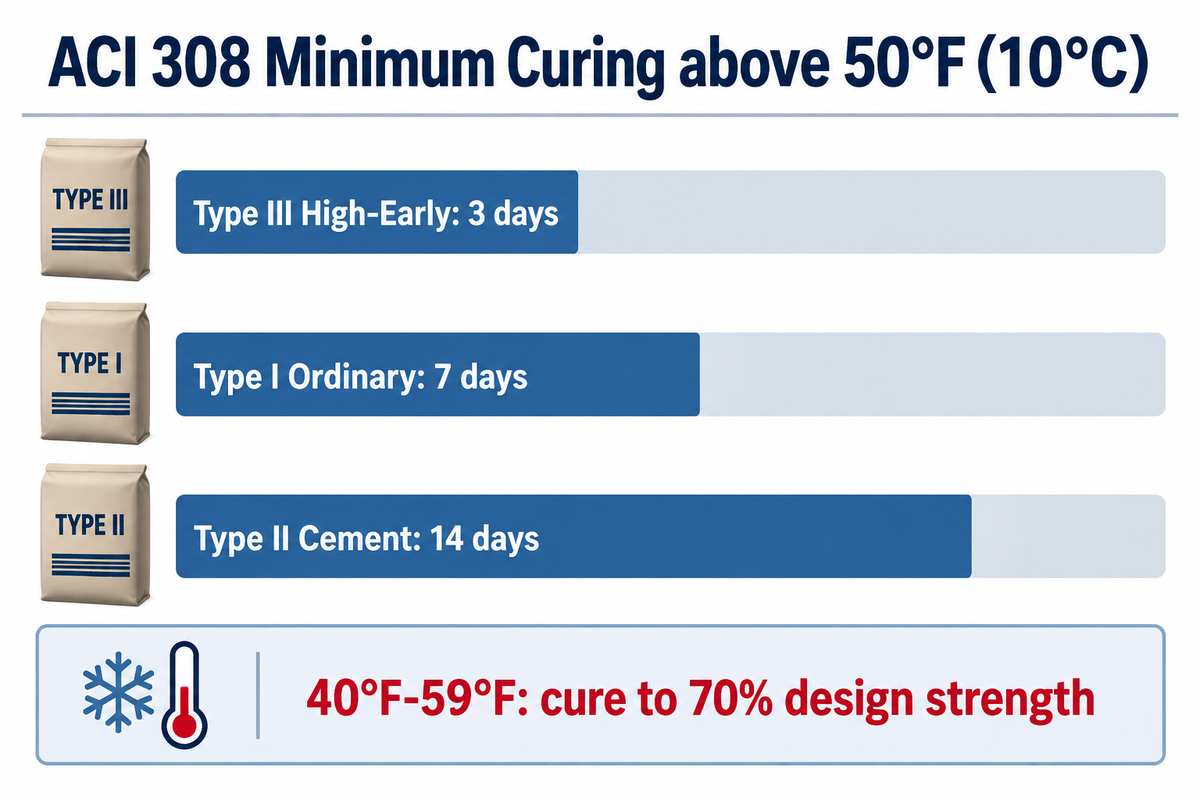
According to ACI 308 guidelines in FHWA-HRT-05-038 Appendix A, the recommended minimum curing period is 7 days for ASTM C150 Type I ordinary Portland cement, 14 days for Type II, and 3 days for Type III high-early-strength cement if concrete temperatures are above 50°F (10°C).
In contract documents, structural engineers can distinguish between non-mandatory committee guides and enforceable specifications. The ACI 308R-16 report, Guide to External Curing of Concrete, includes many useful recommendations. ACI 308R-16 ( Guide to External Curing of Concrete ) provides engineering recommendations; to make curing time and moisture retention legally binding on a contractor, project manuals must cite ACI 308.1 ( Specification for Curing Concrete ) or ACI 301 ( Specifications for Structural Concrete ).
Curing time is never a fixed calendar count divorced from slab temperature. As documented in the FHWA Guide for Curing Portland Cement Concrete Pavements, the standard 3-7 day and 7-day schedules assume the concrete stays at or above 50°F (10°C). When concrete temperatures sit between 40°F and 59°F (5°C and 15°C), tricalcium silicate hydration slows markedly; crews must extend wet coverings until in-place strength reaches 70% of specified design strength as verified by field-cured cylinders or maturity testing. While 28 days remains the standard laboratory acceptance age, keeping the surface continuously moist and choosing to cover the concrete through the first 7 to 14 days determines whether the outer 15 mm cover zone achieves the impermeability needed to resist deicing salts.
Once crews start wetting a slab, keeping the surface constantly wet is mandatory. A slab that’s hosed down at 8:00 AM, bakes dry in the noon sun, and is re-wetted at 4:00 PM, suffers worse micro-cracking than concrete sealed with simple polyethylene sheets.
Common Water Curing Failures: Thermal Shock, Crazing, Efflorescence, and Wet-Dry Cycling
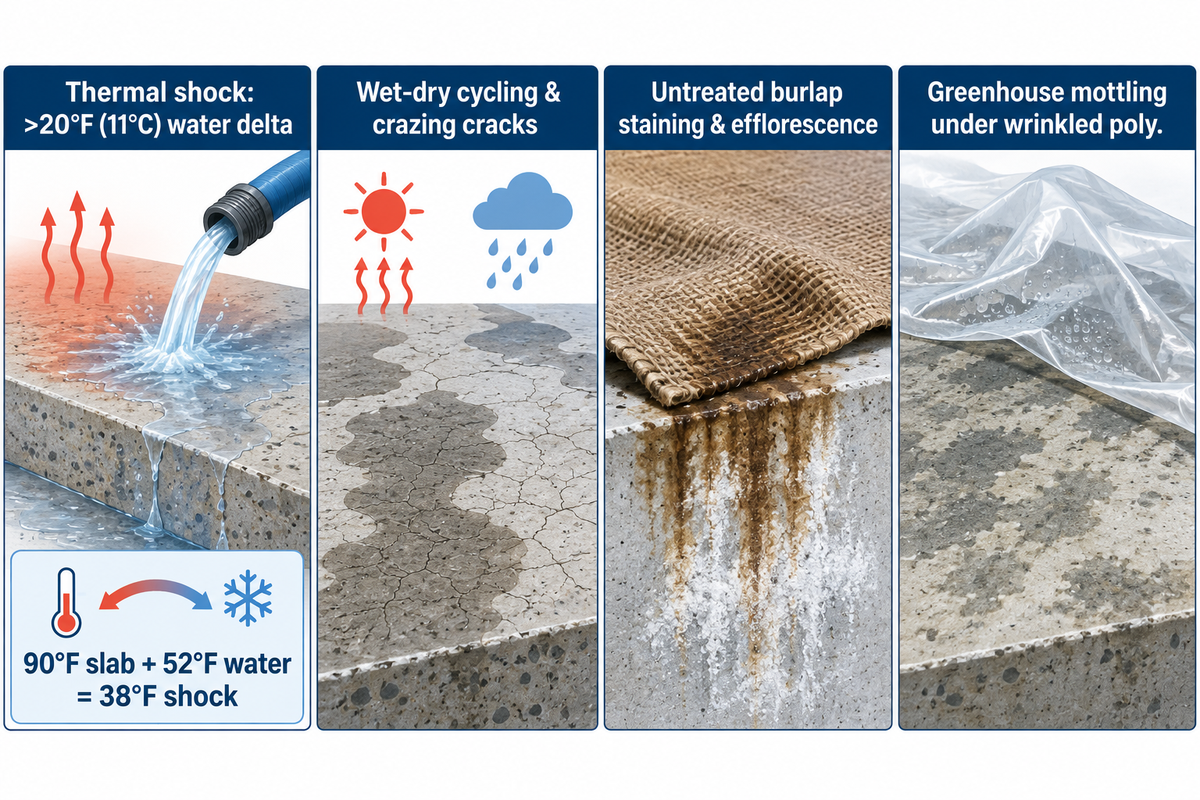
Four preventable field errors cause most water-curing defects: spraying cold well water that violates the 20°F (11°C) thermal differential limit, allowing wet coverings to dry between hosings, using unwashed burlap or mineral-heavy water that stains flatwork, and trapping condensation channels under wrinkled polyethylene sheeting.
The 20°F Thermal Shock Rule [ACI 308R-16 / FHWA HRT-05-038 — Metric: ≤20°F (11°C) Water-to-Slab Differential] governs every hose and sprinkler connection on a warm pour. Freshly placed concrete generates exothermic heat during the first 12 to 36 hours, often pushing slab surface temperatures above 90°F (32°C). Under ACI 308R-16 and FHWA-HRT-05-038 ponding and sprinkling guidance (with general moist-curing practice summarized in the Concrete Network curing guide), curing water shouldn’t be more than 20°F (11°C) cooler than the concrete surface. Flooding a 90°F (32°C) slab with 52°F (11°C) well water creates a 38°F (21°C) thermal shock that contracts the outer 5 mm skin against the warm core and opens a web of tensile concrete cracks.
Three additional moisture-control failures routinely trigger floor inspection disputes:
- Uncovered burlap that’s allowed to dry out in the afternoon wind creates wet-dry cycling and crazing cracks, as meniscus forces across capillaries pull pore walls together and subsequent re-wetting fatigues surface layer into map like cracks.
- The use of new, untreated jute burlap causes staining and efflorescence, unless the fabric is pre-rinsed to remove excess tannins. High dissolved salts in the curing water can also cause concrete to effloresce.
- Placing polyethylene film directly on architectural concrete creates “greenhouse mottling under wrinkled polythene.” This is due to water condensation along the flat surface of the film and evaporation in the air folds.
While these defects harm concrete pours during the warm months, an even more harmful failure occurs when contractors continue open water curing as the ambient temperatures drop during the fall and winter.
Why Must Contractors Stop Water Curing Concrete When Temperatures Approach 40°F?
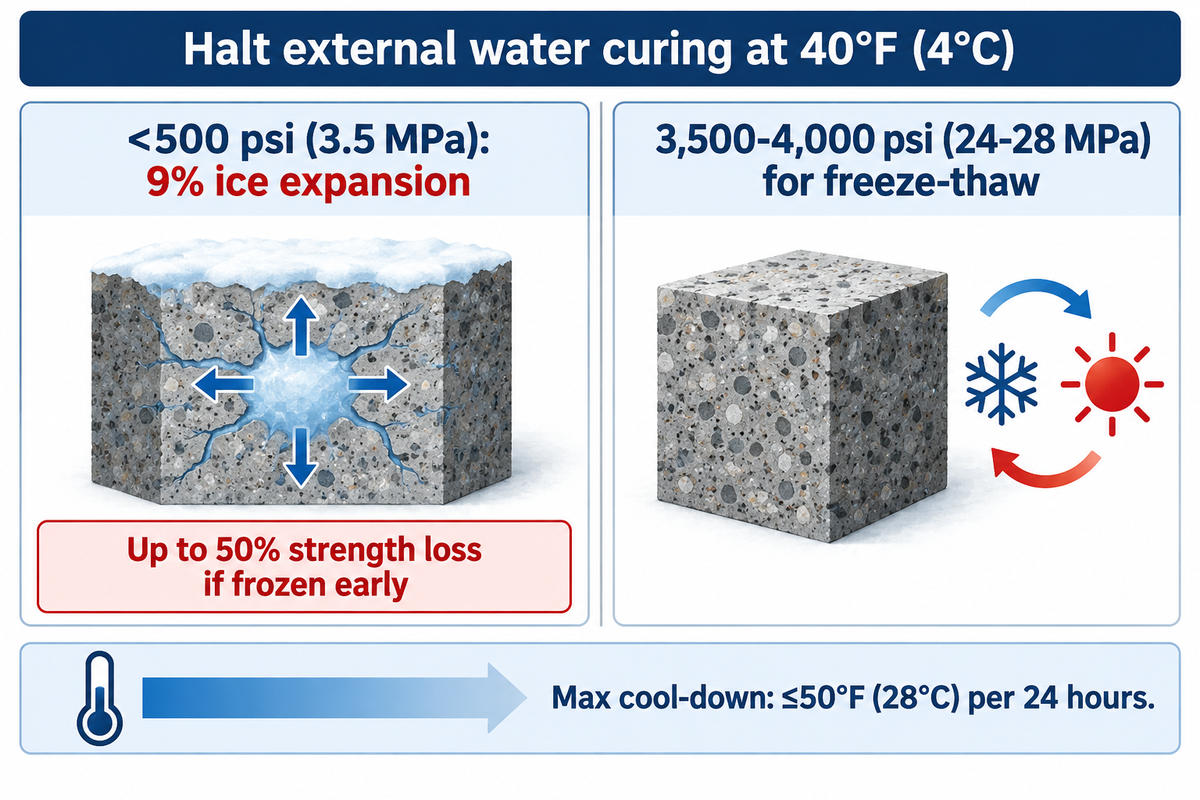
Under ACI 306R-16, contractors must halt external water curing whenever ambient temperatures drop toward 40°F (4°C) because liquid water expands by approximately 9% upon freezing. Saturating green concrete before it reaches 500 psi (3.5 MPa) ruptures capillary pores, while saturated slabs exposed to repeated freeze-thaw cycles require 3,500–4,000 psi.
The 40°F / 500 psi Cold-Weather Curing Cutoff Matrix [ACI 306R-16 — Metric: 40°F (4°C) Ambient Cutoff & 500 psi (3.5 MPa) Single-Freeze Threshold] defines the exact temperature boundary where water curing turns from a strength builder into a structural hazard. To protect concrete from freezing, ACI 306R-16 triggers cold-weather concreting protocols whenever ambient air falls below 40°F (4°C). When water-saturated green concrete freezes before reaching 500 psi (3.5 MPa), the 9% volumetric expansion of ice crystals shatters young C-S-H bonds, permanently cutting ultimate compressive strength by up to 50% and causing severe surface spalling.
As explained in American Society of Concrete Contractors (ASCC) cold-weather guidance, external water curing is discouraged in cold weather because even after a slab passes the 500 psi single-freeze benchmark, concrete kept saturated by sprinklers or wet burlap remains vulnerable to multi-cycle freeze-thaw scaling until compressive strength reaches 3,500 to 4,000 psi (24 to 28 MPa). In addition, winter sprinkler runoff coats adjacent rebar, forms, and scaffolding in dangerous ice.
Stopping water addition at 40°F (4°C) doesn’t mean leaving the slab uncovered. The air during the winter months contains very little water vapor. As cold wind blows over a warm slab, the rate of evaporation spikes, and the excessive loss of surface moisture occurs. Contractors must transition immediately to a sealed polyethylene vapor barrier topped by an active electric curing blanket, and at the end of the heating cycle, for slabs less than 300 mm thick, ACI 306R-16 specifies a maximum gradual surface-temperature decrease of 50°F (28°C) during the first 24 hours after protection ends.
Transitioning From Wet Curing to Heated Concrete Curing Blankets With a Vapor Barrier
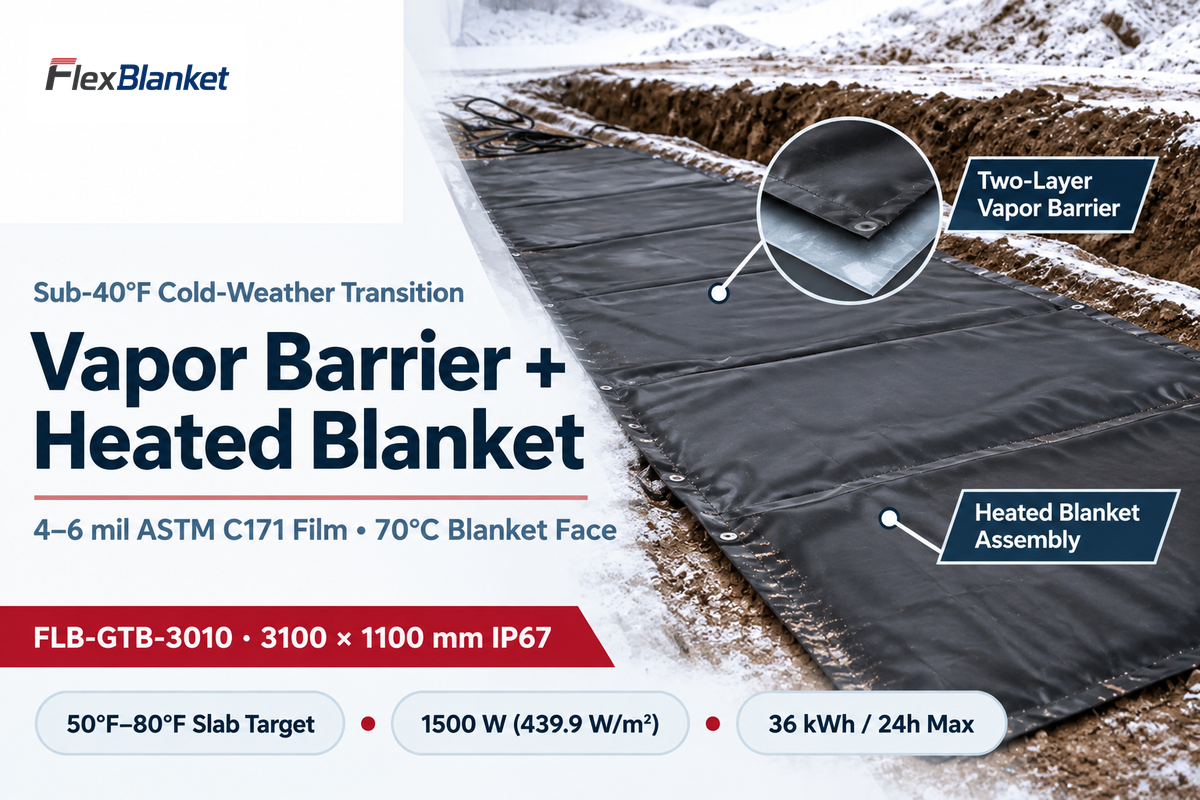
When ambient temperatures fall below 40°F (4°C), replace wet curing with a step-by-step two-layer thermal retention assembly: lay a 4 to 6 mil ASTM C171 polyethylene vapor barrier directly on the finished slab to trap internal mix water, then place an IP67 electric concrete curing blanket over the film.
Unrolling an electric heating blanket directly onto bare fresh concrete without a vapor barrier underneath is a costly cold-weather mistake. As verified on our IP67 electric concrete curing and ground thawing blankets product specification page, the FlexBlanket FLB-GTB-3010 standard heated curing and ground-thawing blanket covers 3100 × 1100 mm (122 × 43 in, 3.41 m² blanket area / 36.7 sq ft blanket footprint) at 1500 W electric blanket rating (439.9 W/m² power density), holding a fixed 70 °C (158 °F) heated face inside an IP67 heat-welded PVC jacket (IEC 60529) and consuming 36 kWh per 24-hour day (1.5 kWh/h blanket draw) at continuous full-load draw. Placing that warm PVC surface directly onto unsealed concrete drives surface moisture out of the top 10 mm of the slab.
Field engineers responsible for winter pours track three distinct zones of temperatures and humidities beneath the blanket:
- The 70°C (158°F) blanket heated-face setpoint is the internal bimetallic thermostat limit of the heating coils within the PVC covering, designed to transport heat into cold, frozen ground or concrete, and prevent scorching of the jacket.
- The under-film vapor barrier (4 to 6 mil ASTM C171 polyethylene sheeting) seals mix water inside conventional slabs (w/cm > 0.42); for low-w/cm mixes (<0.40) where chemical hydration consumes pore water, place a pre-dampened non-staining curing fleece beneath the polyethylene vapor barrier before laying the heated blanket on top. In this case, a pre-dampened non-staining curing fleece must be placed under the polyethylene vapor barrier before the heated blanket is laid out.
- The in-place concrete temperature target of 50°F to 80°F (10°C to 27°C) must be verified with embedded thermocouples placed 50 mm from slab corners per ACI 306R-16, preventing overheating above 100°F (38°C) that would coarsen the pore structure.
As stated in a 2025 Applied Sciences review of concrete curing strategies (secondary review citing Zhang et al. 2025), it’s reported that the use of electrically activated curing systems has improved energy efficiency by approximately 40% compared to conventional steam curing and has reduced the occurrence of steam-induced thermal micro-cracking. In multi-blanket layouts and schedule planning, refer to our engineering guide on selecting industrial heating blanket wattage and coverage area, which leads directly into assessing the winter energy costs vs summer water curing and chemical curing compounds.
Water Curing vs Curing Compounds, Steam, and Electric Curing Blankets: Cost and Schedule Trade-Offs
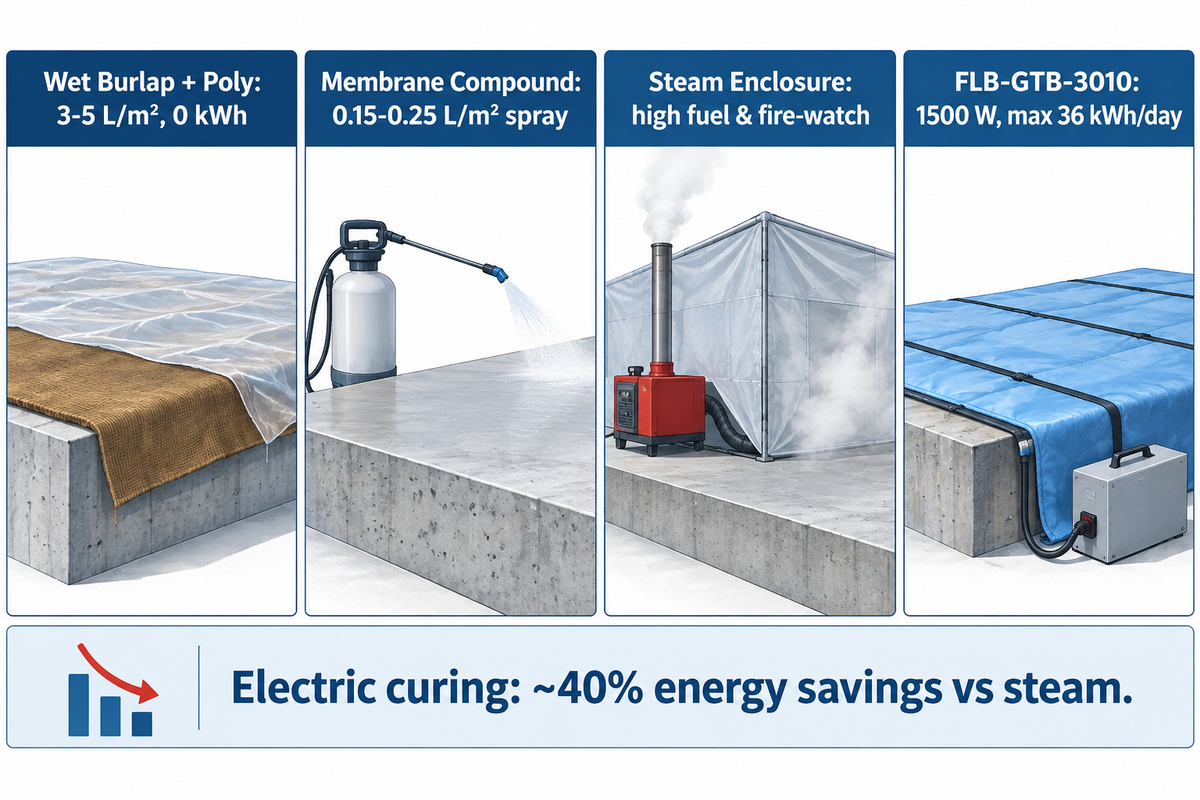
While inexpensive water and polyethylene film can be used for warm-weather water curing, this method increases hose labor and floor-drying time. Liquid membrane curing compounds spray sprayed-on systems do it faster, but require mechanical shot-blasting before epoxy floor coatings. On the other hand, reusable 1500 W electric curing blankets eliminate winter freeze delays associated with water-based curing at a predictable kWh operating cost.
A curing method evaluation includes consideration beyond the first day of materials invoiced to analyze total project schedule impact, secondary floor-coating preparation, and cold-weather risk over the materials used.
Resin- or wax-based liquid membrane curing compounds and topical sealer sprays (governed by ASTM C309 and ASTM C1315 per FHWA HRT-05-038) apply in a single pass after finishing, making them convenient for exterior pavements. However, topical curing compounds leave a bond-breaking film that blocks polyurethane joint sealants, tile mortars, and epoxy floor coatings, forcing contractors to pay for mechanical shot-blasting or diamond grinding. Wet burlap capped with polyethylene sheeting leaves a residue-free concrete surface, though saturating a slab during wet curing extends the subsequent drying period required to meet the flooring system’s specified internal relative humidity limit, as measured using ASTM F2170.
In cold weather, comparing electric curing blankets against diesel/propane heated enclosures or chemical accelerator admixture packages shows why reusable electric blankets dominate thin-slab winter work. Per our blanket sizing and daily kWh run-cost worksheet, a 1500 W (1.5 kW) FLB-GTB-3010 blanket running continuously for 24 hours has a theoretical nameplate upper bound of 36 kWh per 24-hour day (1.5 kWh/h) across its 3.41 m² (36.7 sq ft) footprint. In real field operation over a polyethylene vapor barrier and under a wind tarp, the internal 70°C (158°F) thermostat cycles off once the contact zone warms, so actual daily kWh draw is lower and varies with wind speed and slab thickness.
| Decision Dimension | Wet Burlap + ASTM C171 Poly | Topical Membrane Compound | Steam / Hydronic Enclosure | Poly Vapor Barrier + FLB-GTB-3010 Blanket |
|---|---|---|---|---|
| Moisture & Thermal Mechanism | Supplies external liquid water + seals vapor | Resin/wax sealer film slows water evaporation | Heated steam vapor or glycol tubing loops | Poly film locks mix water + 439.9 W/m² active heat |
| Standard & Code Basis | ACI 308R-16 / ASTM C171 (≥4 mil) | ACI 308R-16 / FHWA HRT-05-038 | ACI 306R-16 / MDPI 2025 Review | ACI 306R-16 / IEC 60529 IP67 |
| Low-w/cm (≤0.40) Performance | High (feeds near-surface capillary pores) | Low (cannot stop autogenous self-desiccation) | High (steam) / Moderate (dry hydronic air) | High when paired with damp fleece under poly film |
| Sub-40°F (4°C) Freeze Protection | Fails (freezing water expands ~9% per ACI 306R) | Fails alone (zero thermal insulation or heat) | Viable, but high fuel & fire-watch overhead | Engineered for sub-40°F curing to ≥500 psi (3.5 MPa) |
| Epoxy & Sealer Coating Prep | Zero chemical residue; requires drying check | Requires mechanical shot-blasting removal | Clean pores; watch heater soot condensate | Residue-free clean concrete surface under poly sheet |
| Water or Power Consumption | 3–5 L/m² initial soak; 0 kWh electricity | 0.15–0.25 L/m² spray; 0 kWh electricity | High fossil-fuel draw; ~40% more energy than electric | 1500 W rated; max 36 kWh per 24-hour day (1.5 kWh/h) |
| Branch Circuit Electrical Load | None (gravity hose or water tank pump) | None (hand or backpack sprayer) | Requires 240V blower / boiler power + fuel tank | 12.5 A @ 120 VAC (1/20A) or 6.5 A @ 230 VAC (2/20A) |
| Post-Curing Cool-Down Control | Keep water within ≤20°F (11°C) of slab surface | Ambient exposure (white pigment reflects sun) | Gradual enclosure venting over 24 hours | De-energize in place; ≤50°F (28°C)/24h for slabs <300 mm |
| Multi-Project Reusability | 3–8 pours before burlap rots or poly tears | Single-use consumable chemical spray | Hoses reusable; enclosure tarps & fuel consumed | Multi-season reusable IP67 heat-welded PVC shell |
Specifying Industrial Heated Curing Blankets for Cold-Weather Slab Protection
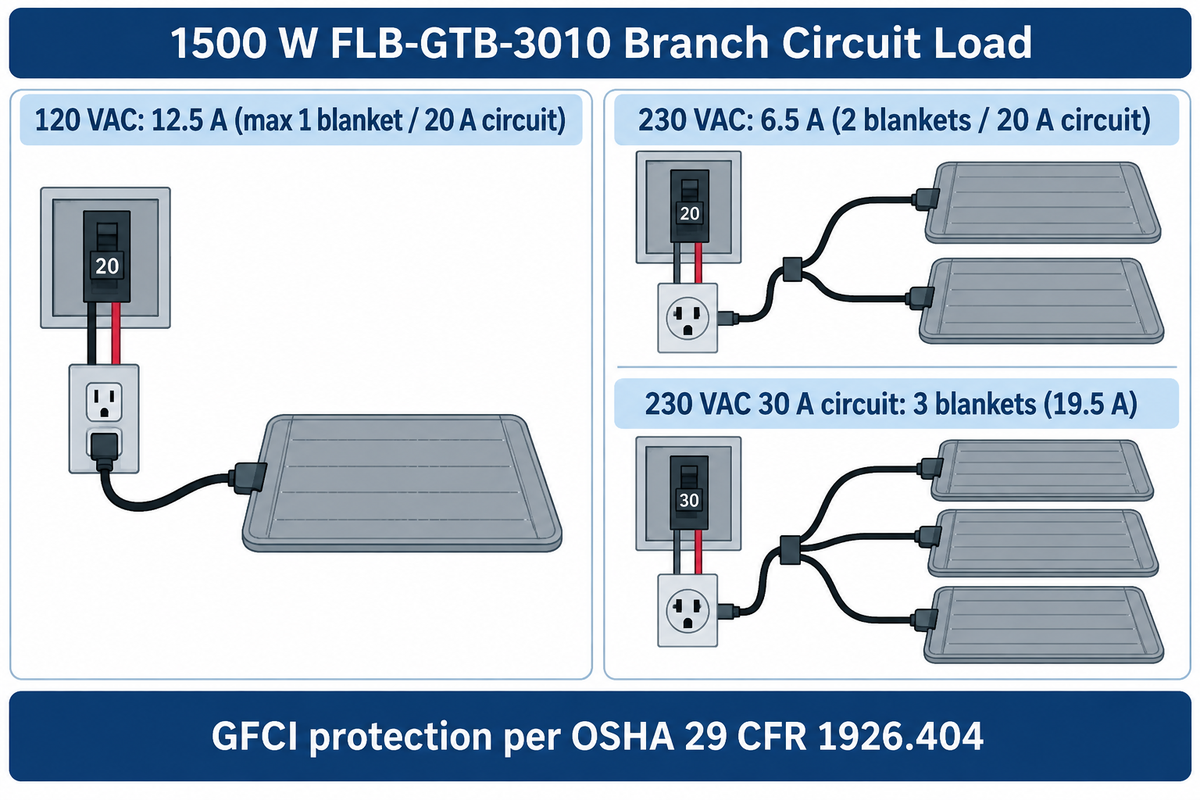
When specifying industrial electric concrete curing blankets for sub-40°F jobsites, verify IP67 waterproof seam construction under IEC 60529, branch-circuit amperage loading (12.5 A at 120 VAC versus 6.5 A at 230 VAC under continuous-load rules), and ground-fault circuit interrupter protection per OSHA 29 CFR 1926.404(b)(1)(ii) before winter placement begins.
Electrical branch-circuit loading benchmark for 1500 W curing blankets: 120 VAC configuration draws 12.5 A (maximum 1 blanket per 20 A circuit under the 16 A / 20 A continuous-load rule), while 230 VAC configuration draws 6.5 A (allowing 2 blankets per 20 A circuit), with 5–10 working day sample lead time and 10–25 working day small-batch production. Specifically, under the 16 A / 20 A continuous-load electrical guideline:
- At 120 VAC, each 1500 W
FLB-GTB-3010blanket draws 12.5 A; under the 16 A / 20 A continuous-load rule (16 A on a 20 A breaker, 24 A on a 30 A breaker), connect no more than 1 blanket to either a 20 A or a 30 A branch circuit. - At 230 VAC, each 1500 W
FLB-GTB-3010blanket draws 6.5 A, allowing 2 blankets per 20 A branch circuit (13.0 A total) or 3 blankets per 30 A branch circuit (19.5 A total).
Before turning on any fleet on site, we’ll verify receptacle and cord sizes by running through the 120V and 230V branch circuit compatibility check.
7-Day Slab Curing Field Inspection & Cold-Weather Transition Checklist [FlexBlanket FLB-GTB-3010 / OSHA 29 CFR 1926.404 — Metric: 12.5 A @ 120V vs 6.5 A @ 230V Branch Load]:
- Check for surface bleed water evaporates and a firm thumb press leaving a zero mark on the concrete (typically 2 to 6 hours after completing the placement depending on the temperature of the mix), and then verify that any curing water is within 20°F (11°C) of the slab surface temperature.
- Halt all external water addition whenever the 7-day forecast drops below 40°F (4°C), and immediately cover the concrete with ≥4 mil ASTM C171 polyethylene sheeting (adding a damp non-staining fleece beneath the film for w/cm ≤ 0.40 mixes).
- Unroll
FLB-GTB-3010blankets (IP67 to IEC 60529 with heat-welded PVC seams) heated-side down over the polyethylene vapor barrier, powering every circuit through a listed Ground-Fault Circuit Interrupter (GFCI) per OSHA 29 CFR 1926.404(b)(1)(ii). - Log concrete temperatures 50 mm from slab corners every 12 hours to maintain 50°F to 80°F (10°C to 27°C) until compressive strength reaches at least 500 psi (3.5 MPa) for single-freeze safety or 3,500 psi (24 MPa) for saturated freeze-thaw exposure.
- De-energize the blankets while leaving the insulated cover in place so slabs less than 300 mm thick cool by no more than 50°F (28°C) during the first 24 hours after protection ends per ACI 306R-16.
For precast beds, bridge deck closure pours, or custom foundation footprints, FlexBlanket builds custom-dimension industrial heating blankets engineered to your exact length, width, watt density, voltage (120 VAC or 230 VAC), and sensor port layout, backed by a 24-month warranty.
Frequently Asked Questions About Water Curing of Concrete
How long should you water cure concrete before letting it dry?
According to ACI 308, in the FHWA-HRT-05-038 appendix A, continuous moist curing above 50°F (10°C) requires at least 7 consecutive days for ASTM C150 Type I Portland cement, 14 days for Type II cement, and 3 days for high-early Type III cement (or 14 to 21 days under USACE criteria for slow-reacting pozzolan blends) to gain 70% of the specified 28-day compressive strength.
How soon after pouring concrete can you start water curing?
Crews should start wetting the slab only after the surface bleed water sheen has disappeared and the concrete reaches final set, which you can confirm on site when a firm thumb press leaves zero indentation (typically 2 to 6 hours after finishing). Spraying pressurized hose water or dragging heavy wet burlap across fresh concrete too early washes cement paste out of the top wear layer, raises the surface water-to-cement ratio, and causes permanent surface dusting or scaling under traffic. Early (prior to final set) application of the slab in hot weather may lead to cementitious pits forming on the surface of the concrete. To avoid these, spray an atomized mist of water into the air above the concrete slab.
Can you water cure concrete every other day instead of keeping it continuously wet?
Intermittent wetting every other day damages flatwork. Allowing a slab to dry between hose sprayings lets internal pore relative humidity fall below the 80% hydration cutoff reported by the NPCA, permanently halting calcium-silicate-hydrate crystal growth in the top 6 to 12 mm wear zone and causing map crazing cracks from alternating wet-dry shrinkage.
Why is water curing forbidden when temperatures drop below 40°F (4°C)?
Whenever ambient temperatures approach or fall below 40°F (4°C), ACI 306R-16 cold-weather concreting rules take effect and free water addition must stop immediately. Green concrete that hasn’t yet reached 500 psi (3.5 MPa) compressive strength can’t resist the 9% volume expansion of freezing water inside saturated capillary pores, which fractures the cement matrix and causes severe surface scaling. Even after reaching 500 psi, saturated concrete remains vulnerable to repeated freeze-thaw cycles until hitting 3,500 to 4,000 psi per ASCC cold-weather guidance. Contractors instead seal mix water under a 4 to 6 mil polyethylene vapor barrier and deploy an IP67 electric curing blanket to hold 50°F to 80°F hydration heat.
Does wet curing concrete delay floor coating or adhesive installation?
Saturating a slab during wet curing extends the subsequent drying period required to meet the flooring system’s specified internal relative humidity limit, as measured using ASTM F2170. However, water curing leaves a clean, open pore structure that needs zero chemical stripping, whereas liquid membrane curing compounds leave waxy or acrylic films that must be mechanically shot-blasted off before epoxy or urethane coatings can bond.
References & Sources
- Federal Highway Administration (FHWA), Guide for Curing Portland Ratour Concrete Pavements, Publication No. FHWA-HRT-05-038, Appendix A: Annotated List of Pertinent Standards (materials used in the concrete and curing specifications) fhwa.dot.gov
- American Concrete Institute (ACI), Frequently Asked Question #793: What methods are commonly used to ensure sufficient moisture for curing concrete? (referencing ACI 308R-16) concrete.org
- National Precast Concrete Association (NPCA), The 28-Day Myth of Concrete Curing: Hydration, Relative Humidity, and Strength Gain precast.org
- Concrete Network, Curing Concrete: Methods, Timing, Water Curing vs. Membrane Compounds, and ASTM C171 Sheeting concretenetwork.com
- American Society of Concrete Contractors (ASCC) / For Construction Pros, “How to Plan for a Cold Weather Concrete Pour” (Bruce Suprenant, P.E. & Ward R. Malisch, P.E.) – forconstructionpros.com
- United States Patent and Trademark Office (USPTO), U.S. Patent US7572525B2: Concrete Curing Blanket With Impervious Polymeric Film and Absorbent Non-Woven Layer patents.google.com
- Haigh, R. & Sianaki, O.A. (2025), Traditional and Advanced Curing Strategies for Concrete Materials: A Systematic Review of Mechanical Performance, Sustainability, and Future Directions, Applied Sciences, 15(20), 11055 mdpi.com
MANUFACTURING EVIDENCE
A specified heat path, backed by first-party site context
First-party website statements identify FlexBlanket as the export brand of Qingdao Flex Technology Co., Ltd. They describe custom-to-drawing heating solutions with in-house production and testing for industrial thermal duties.
SITE-STATED FOUNDED2019
SITE-STATED LOCATIONQingdao, China
SITE-STATED PLANT5,000+ m²
SITE-STATED TEAM50+ staff
ENGINEERING HANDOVER
From asset dimensions to a site-stated build route
01Site-stated product families include heating blankets and silicone rubber heaters for drums, IBCs, pipes, gas cylinders and composite-curing duties.
02First-party site information describes custom-to-drawing review for fit, voltage, target temperature, controls and installation conditions.
03First-party site information states in-house production/testing and OEM / ODM support; confirm scope for the required application.
First-party site-stated standard lead time is 7–15 days and site-stated warranty is 24 months. Treat ISO 9001, CE and RoHS references as site-stated claims requiring confirmation for the exact product and order.