Get in touch with FlexBlanket Company

This DEF Storage Temperature Guide is a practical storage policy for separating preferred storage, freezing risk, shelf life, container limits and heater duty so a plant manager, QA lead or procurement team doesn’t turn one temperature number into a bad storage policy.
Diesel exhaust fluid is simple only when it stays clean and inside a compatible container. Temperature matters, but contamination, package scope, fill level and transfer equipment usually decide whether stored DEF reaches the diesel engine as on-spec DEF or as a quality problem.
Fast answer: don’t use one universal DEF storage temperature band. Treat preferred storage, the 12 °F / -11 °C freezing point, shelf-life heat thresholds, package-specific label guidance and heater setpoints as separate decisions. Start with clean, sealed, compatible storage containers, then decide whether insulation, indoor storage, a heated tank, a tote heater or a controlled blanket is needed.
Quick Answer: Preferred DEF Storage Is Not One Temperature Band
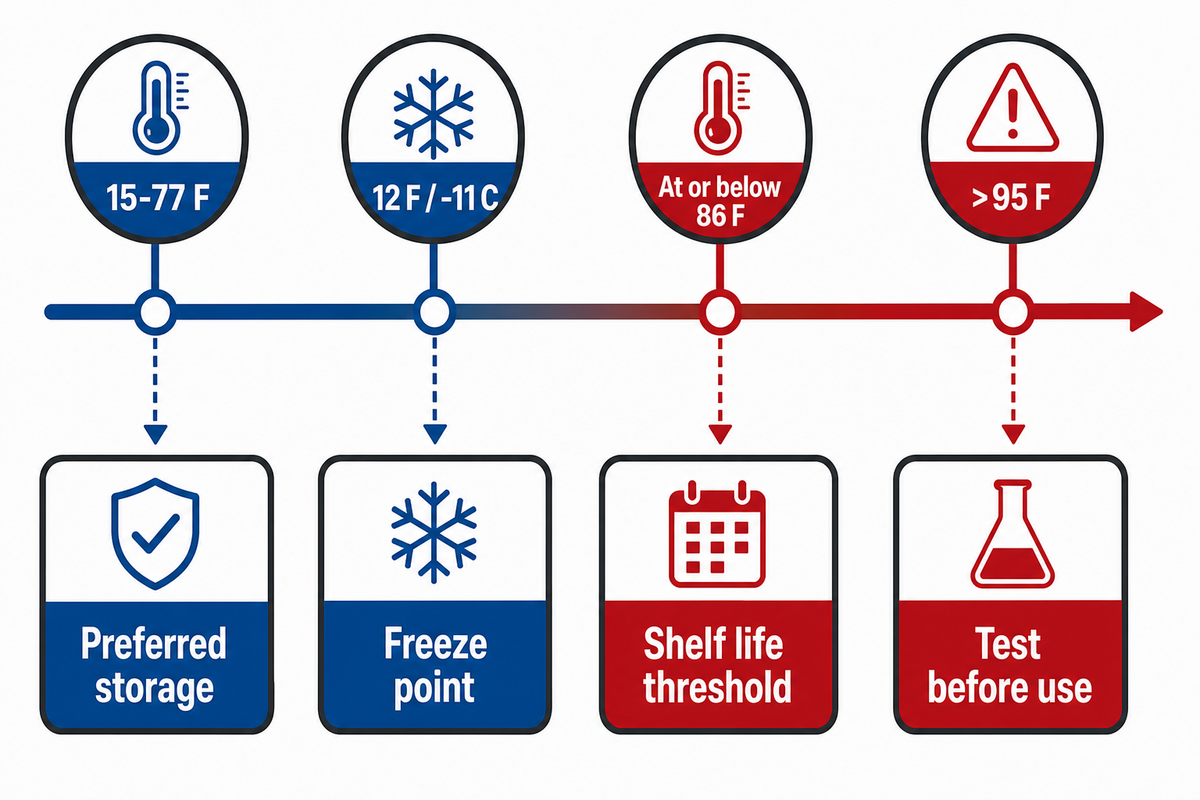
A buyer who asks for the best temperature range for DEF is usually asking several questions at once. QA cares whether the quality of the DEF stays within specification. Maintenance cares whether DEF freezes in the tote, pump cabinet or vehicle tank. Procurement cares whether the product label, container approval and shelf life match the way the material will be stored.
15-77 °FCaterpillar ideal storage range, source-specific
12 °FApproximate DEF freeze point, not a target setpoint
>95 °FAPI 2024 test-before-use heat threshold
Caterpillar’s 15 °F to 77 °F number is useful, but it isn’t the same as the freeze point, and it isn’t a blanket certificate for every storage tank. VDA Recommendation 267 gives narrower guidance for AdBlue containers up to 5 L, including package-specific temperature limits. API’s 2024 fact sheet uses different shelf-life thresholds, including a distinction between storage at or below 86 °F and storage above 95 °F. That keeps the source scopes visible.
For a site policy, write the question first. If the question is “Will the fluid freeze tonight?”, use the freeze point and expansion allowance. If it’s “How long can we store a pallet?”, use the label and shelf-life evidence. If it’s “What heater should we buy?”, use lowest ambient, target hold range, container type and transfer duty.
What Freezing Does to DEF and the Container
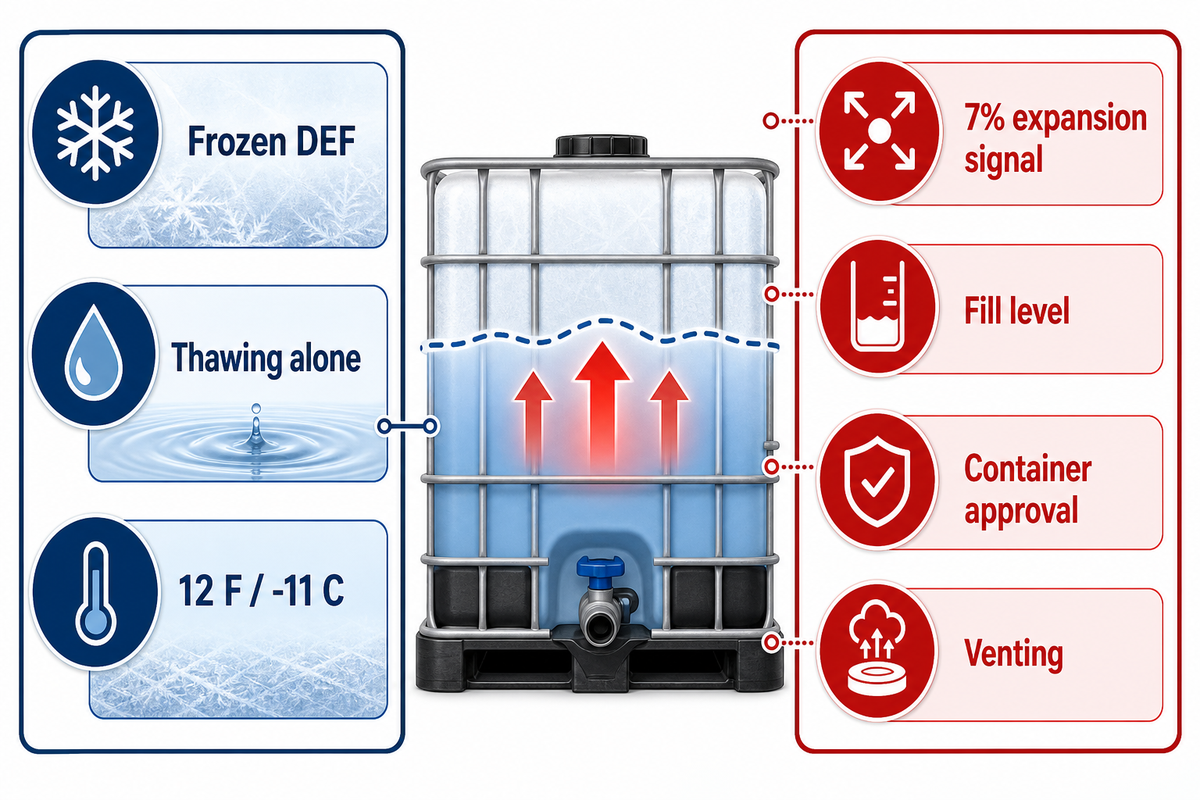
Frozen DEF is not automatically bad DEF. Diesel exhaust fluid is an aqueous urea solution, and public OEM guidance supports the practical point that freezing and thawing don’t by themselves ruin on-spec DEF. The storage risk is often mechanical: a full or nearly full DEF tank, drum or tote can be stressed as frozen DEF expands.
Use 12 °F / -11 °C as the common freeze-point reference for DEF, not as a heater target. In winter, the duty is usually to keep DEF above the freeze point for dispensing or to restore transfer availability after a cold event. Extra heat from a blanket can create a different problem when the inventory is old, contaminated or sealed in a full container.
API and Cummins evidence support treating roughly 7% frozen expansion as a planning signal. That number isn’t a design constant for every tank shape, closure or material. It tells the owner to check fill level, container approval, venting or sealed closure status and the manufacturer’s storage instructions before a freeze event arrives.
Shelf Life Changes by Temperature Threshold and Package Scope
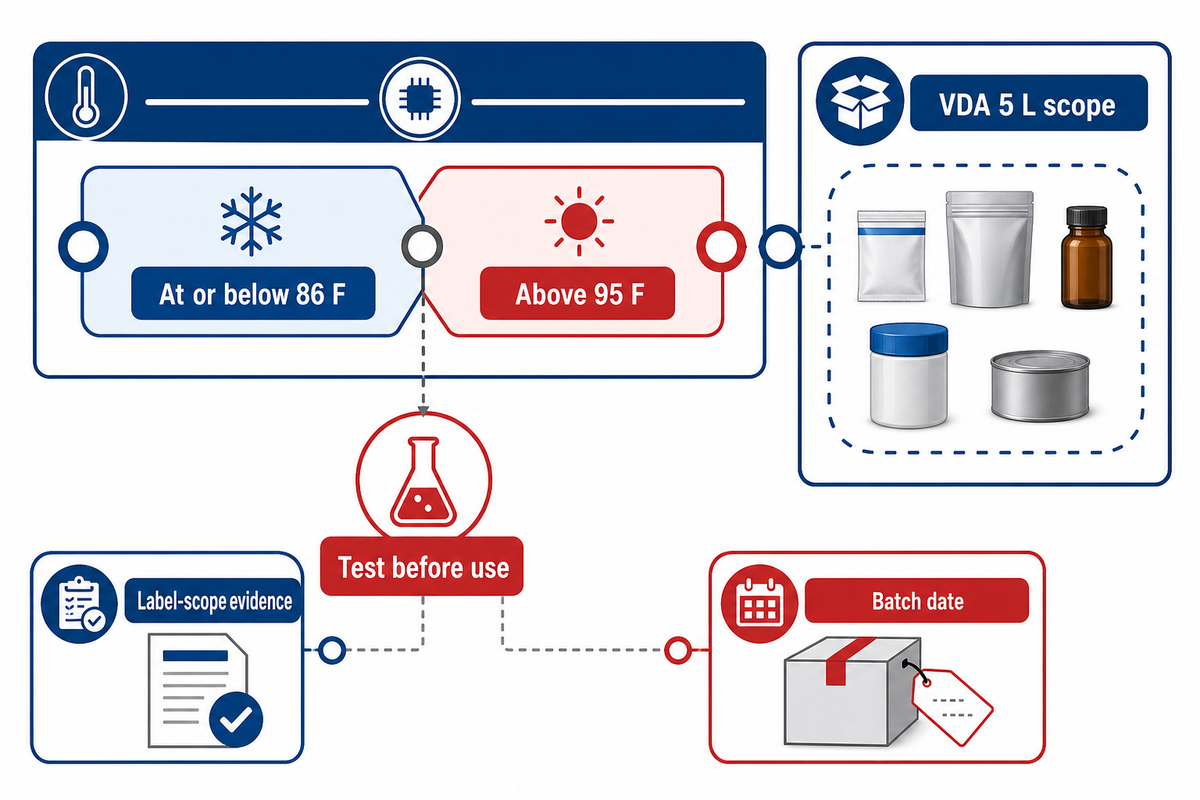
DEF shelf life changes with storage conditions. Lower-temperature storage can extend useful life, while high temperature can shorten it. The mistake is turning one row from one chart into a universal expiration rule for every jug, drum, IBC tote and bulk tank.
“Test before use”
API’s 2024 fact sheet is especially important because it separates heat thresholds. It doesn’t support a shortcut that treats every exposure beginning at 86 °F as a fixed six-month rule. The safer buyer wording is: storage at or below 86 °F belongs in one API threshold, and storage above 95 °F moves into a test-before-use decision before the fluid is poured into a diesel exhaust aftertreatment system.
VDA’s AdBlue guidance has a narrower package scope. It addresses containers up to 5 L for passenger-car use and includes package-specific limits such as avoiding storage below -5 °C and a 25 °C maximum for an 18-month case. Use that as label-scope evidence, not as a bulk storage tank rule.
When the storage of DEF is warm, exposed to sunlight, or held long past the expected turnover date, check DEF before using it. Use a refractometer or concentration check to help flag a urea concentration problem, but DEF concentration alone doesn’t prove full DEF conformity. Even when a shop calls it DEF fluid, supplier documentation, sealed handling, water quality, contamination control and any required quality records still matter.
Storage Requirements Before Any Heater Choice
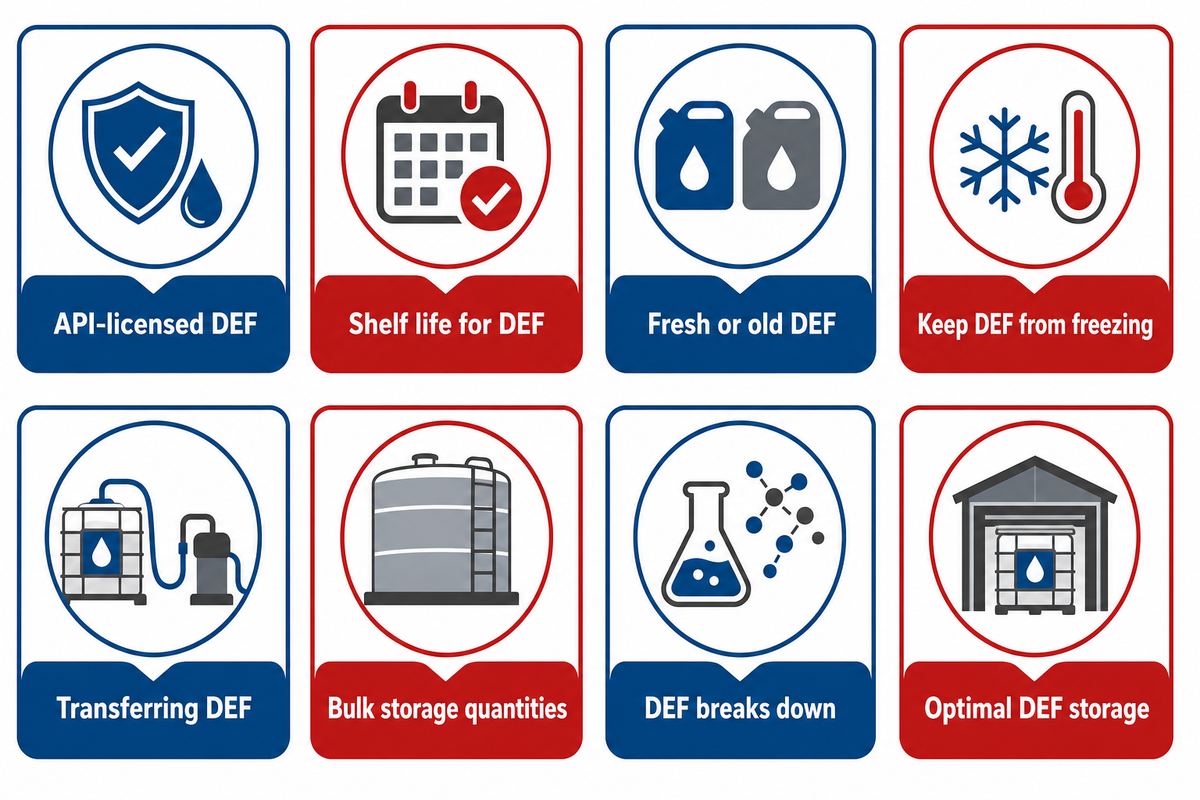
Proper storage starts with cleanliness. These products are sensitive to contamination from dust, diesel fuel, oil, tap water, shared funnels and incompatible metals. No heater can repair contaminated DEF, and warming the wrong storage setup may only move bad DEF more quickly into the DEF system.
API guidance points buyers toward dedicated DEF dispensing equipment and proper handling. MTU/Rolls-Royce handling guidance supports compatible storage choices such as high-density polyethylene and stainless steel, with caution around copper contamination. In day-to-day terms, dedicated for DEF means the drum pump, hose, nozzle, funnel, tote adapter and transfer system shouldn’t be borrowed from diesel fuel, coolant or shop chemical service.
Quality teams should also decide what counts as acceptable receiving evidence. For small packaged DEF, that may be the label, batch date, intact seal and turnover policy. For bulk storage, it may include supplier certificate, delivery record, tank cleanliness, system for transferring DEF, sample method and a documented plan for old DEF or suspect DEF.
Storage best practices also depend on the language inside the purchasing document. Teams that handle diesel exhaust fluid should handle DEF as a controlled quality material, not as a generic shop liquid. Depending on storage conditions, high-quality DEF can still have a limited shelf life, and the quality of DEF can be lost through contamination long before a heater choice is made.
| Decision type | Safer technical translation | Reason to include it |
|---|---|---|
| API-licensed diesel exhaust fluid | Ask for the product label for recommended storage temperatures, plus the batch date. | Connects shelf life of DEF to the exact product received. |
| Shelf life for DEF | State temperature, sunlight exposure, package size and turnover instead of one date. | Prevents a shortcut that can limit the shelf life or misstate the shelf life of the DEF. |
| Fresh DEF, new DEF or old DEF | Record when DEF was made, delivered, opened, stored and transferred. | DEF over time is a storage and handling issue, not a visual inspection issue. |
| Keep DEF from freezing | Protect the container, pump, hose and dispensing of DEF; do not write “DEF freezes at 11 degrees” without the minus sign and Fahrenheit context. | The correct boundary is about 12 °F / -11 °C, and frozen DEF will expand. |
| Transferring DEF from a drum | Use dedicated transfer equipment and clean caps, not diesel tank tools or shared funnels. | Reduces DEF contamination during pouring DEF or pumping bulk material. |
| Bulk storage quantities of DEF | Check bulk storage tanks, venting, sampling point, turnover and whether systems use DEF daily or seasonally. | Fluid storage rules change with package size and usage rate. |
| Does DEF break down? | High heat can encourage DEF to decompose over time; test suspect inventory before use. | Answers “DEF breaks” searches without implying an instant failure point. |
| Optimal DEF storage | Use the narrowest valid source scope, then verify storage tank, pump and QA controls. | Avoids using one optimal DEF phrase for every gallon of DEF or bulk tank. |
DEF is used in selective catalytic reduction to reduce NOx emissions, a term often tied to nitrogen oxide control in diesel exhaust. The fluid is made from urea and purified water, and heat or contamination can change the ammonia odor or chemistry that a QA team investigates. The International Organization for Standardization public page for ISO 22241-1 is a useful reference point for quality requirements, while the actual storage decision still depends on the product, site and container.
7-Asset DEF Temperature Boundary Decision Table for Drums, IBC Totes and Bulk Tanks
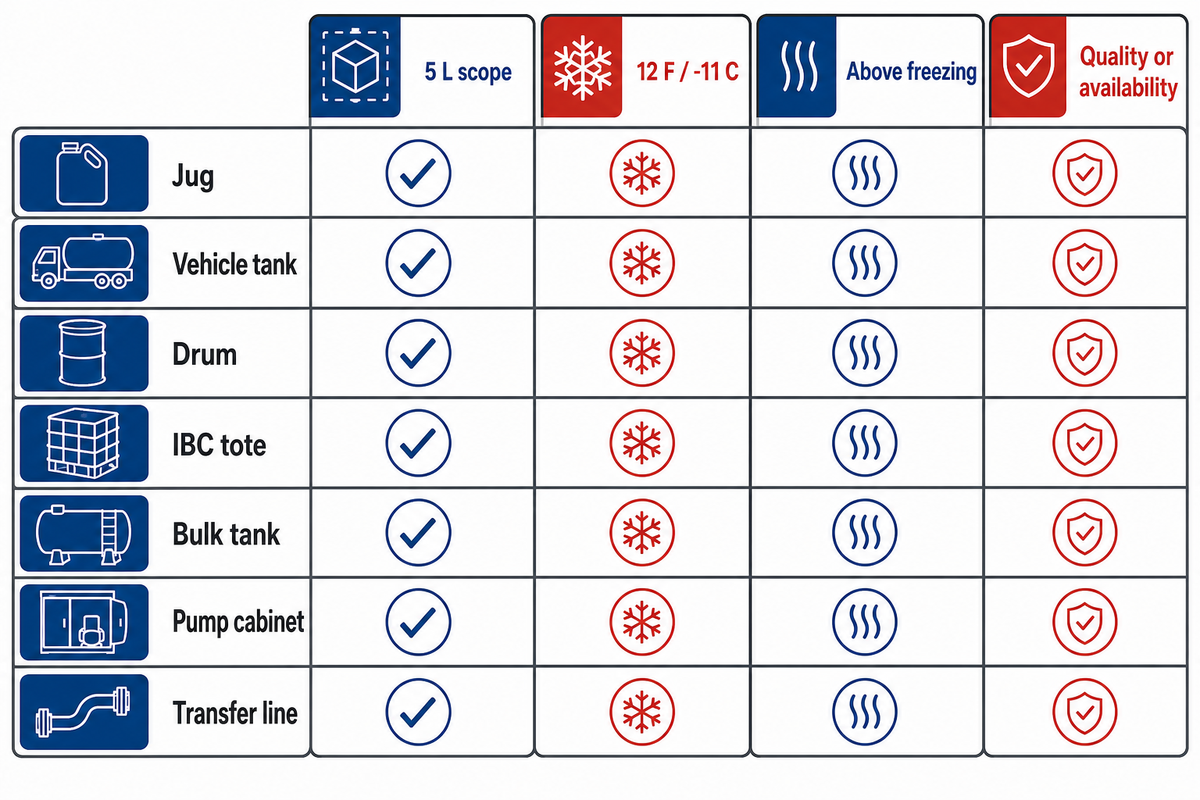
The table below is the working version of the DEF Temperature Boundary Decision Table. It turns the public evidence into a buyer-facing storage decision. It isn’t a substitute for the product label, OEM manual or local quality procedure.
| Storage asset | Temperature question | Evidence boundary | Buyer action |
|---|---|---|---|
| Passenger-car jug | How long can this package sit? | Use label and VDA 5 L scope where applicable. | Store sealed, shaded and clean; rotate by batch date. |
| Vehicle DEF tank | Will freezing hurt the fluid? | Freezing begins near 12 °F / -11 °C; thawing alone does not ruin on-spec DEF. | Follow OEM operation guidance; do not add anti-gel. |
| Drum or barrel | Can the drum pump transfer in winter? | Freeze point and expansion risk are separate from shelf life. | Check fill level, closure, drum approval and pump compatibility. |
| IBC tote | Should the tote be heated? | Hold above freezing only as needed; avoid needless high temperature. | Use insulation, indoor storage or controlled heat based on lowest ambient and turnover. |
| Bulk tank | Is this a quality or availability issue? | High temperature can limit shelf life; cold can stop transfer. | Control sunlight, inventory age, tank material, venting and sampling method. |
| Pump cabinet | Will the transfer path freeze first? | Small lines, valves and nozzles lose heat faster than bulk volume. | Protect the pump, hose, nozzle and cabinet, not only the tank wall. |
| Transfer line | Can DEF move from storage to equipment? | MTU supports heated tanks, heated lines and insulation in winter context. | Specify line length, fittings, valves, sensor point and insulation. |
For a plant manager, the table creates operating rules. For procurement, it becomes a quote filter. For finance, it separates a low-cost insulated cover from a controlled heating system that protects uptime during repeated freezes.
When a DEF Tote Heater or Blanket Is Justified
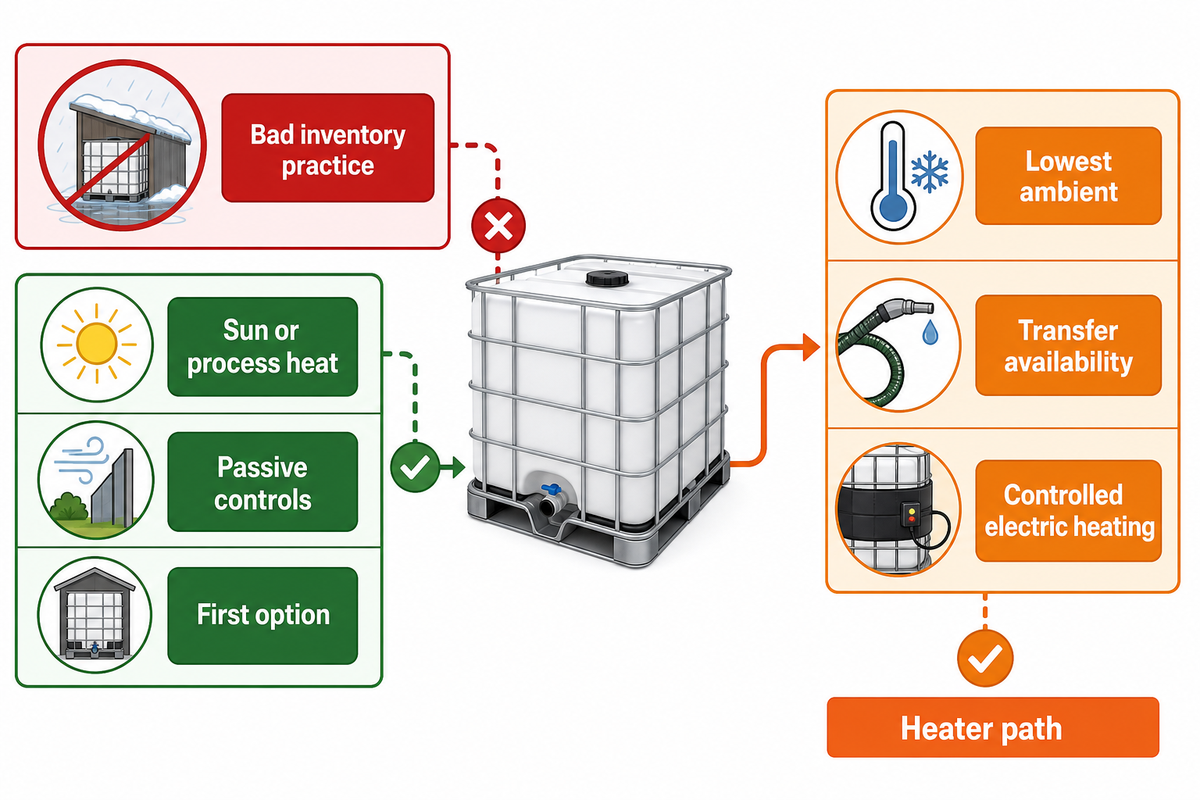
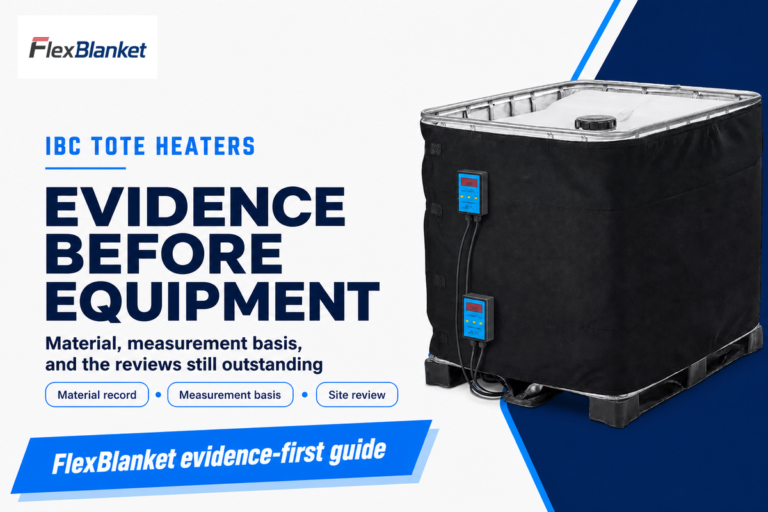
A DEF tote heater is justified when the problem is controlled winter availability, not when the problem is bad inventory practice. If the tote sits in the sun, near process heat or in a hot equipment room, reducing heat exposure should come before adding more heat. If the tote freezes at night and must pump every morning, controlled heat or insulation may be justified.
FlexBlanket’s container heaters include heater families for pails, drums and IBC totes. The IBC tote heater and drum heating blanket pages are relevant product families for an RFQ, but the storage team still needs to confirm DEF compatibility, container approval, controller settings and site requirements for the actual project.
In practice, choose the least aggressive method that preserves transfer. Indoor storage, shaded storage, inventory rotation and insulation may solve mild conditions. Controlled electric heating belongs in the discussion when the lowest ambient temperature, operating schedule and transfer path make passive controls unreliable.
Fill-Level Freeze Expansion Guard
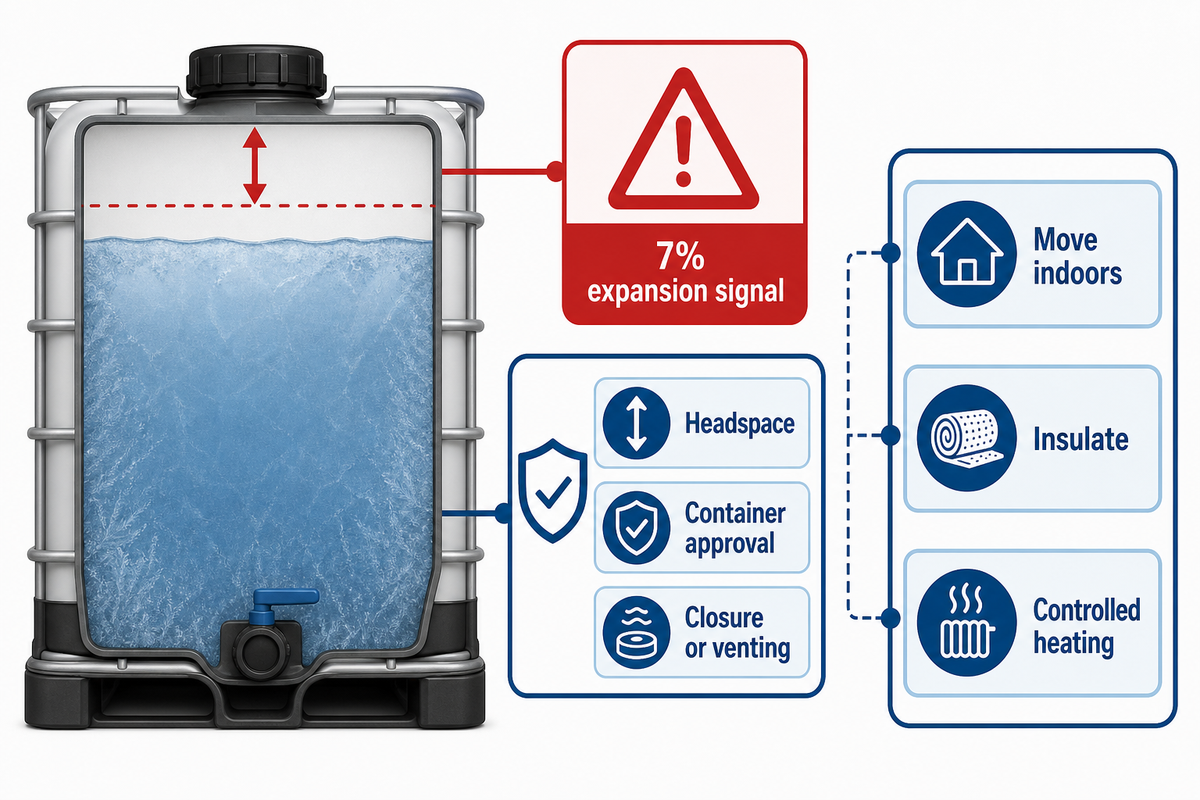
The Fill-Level Freeze Expansion Guard is a winter policy, not a tank design calculation. It prevents a common failure pattern: purchasing DEF in containers, parking them outside, filling them to the top, then discovering that roughly 7% frozen expansion has stressed a container or fitting that wasn’t ready for it.
| Condition to check | Low concern | Review before freeze | Escalate |
|---|---|---|---|
| Fill level | Clear headspace and normal turnover | Near-full drum, tote or storage tank | No headspace and repeated freeze exposure |
| Container approval | Approved DEF container with manufacturer guidance | Unknown tote, reused drum or missing label | Container not intended for DEF or freezing exposure |
| Closure or venting | Closure status matches the container design | Sealed cap, vent or breather status unclear | Blocked vent, damaged cap or altered fitting |
| Exposure | Indoor or shaded location above freezing | Outdoor night lows below 12 °F / -11 °C | Freeze-thaw cycles plus delayed transfer need |
| Action | Rotate stock and keep clean | Reduce fill, confirm container status, protect pump access | Move indoors, insulate, or specify controlled heating |
Caterpillar’s approved-container point matters here. Containers designed for DEF expansion and contraction are different from random storage containers that happen to hold liquid. When that status is unknown, treat the risk as unresolved until the supplier confirms container scope.
DEF Heater RFQ Worksheet
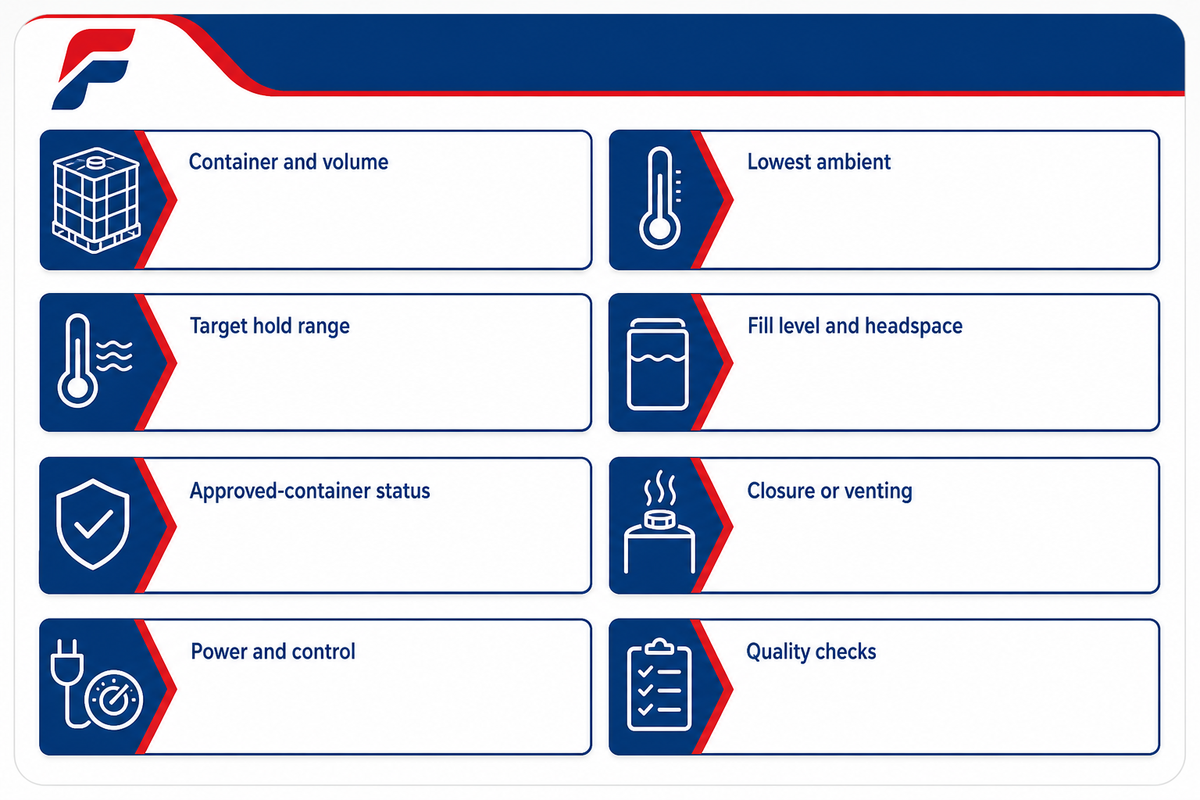
Send engineering enough information to size the duty. Requests that say “need a tote blanket for DEF” are too thin because they hide the storage volume, minimum ambient temperature, heat-up window, fill range, container approval, closure status, sensor location and electrical limits.
DEF Heater RFQ Worksheet, copy these into your quote request:
| Parameter | Recommended range | Why it matters | How to verify |
|---|---|---|---|
| Container and volume | Jug, drum, IBC tote, bulk tank; state gallons or liters | Surface area, heat loss and fit change by package | Photo, drawing and container label |
| Lowest ambient | Site minimum, exposure and available site voltage | Defines freeze duty and wattage need | Site weather record or design winter temperature |
| Target hold range | Above 12 °F / -11 °C only as duty requires | Avoids treating the freeze point as a storage target | Controller setting and sensor location |
| Fill level and headspace | Minimum, normal and maximum fill percentage | Frozen expansion can stress full containers | Receiving and operating procedure |
| Approved-container status | Container approved for DEF service or documented project review | Material and expansion scope affect risk | Container supplier documentation |
| Closure or venting | Sealed, vented or cabinet-connected status | Pressure, contamination and vapor path differ | Cap, vent, breather and adapter drawing |
| Power and control | Available voltage, controller, sensor point, access | Heater duty needs controlled input, not blind heat | Electrical specification and site approval |
| Quality checks | Concentration check plus supplier and contamination records | Concentration alone does not prove full DEF quality | QA procedure, batch record and sample method |
FlexBlanket’s custom heating blanket, heater sizing worksheet, duty and material selector and voltage and plug compatibility check pages can support those conversations. Treat them as RFQ inputs, not as a claim that one product is automatically approved for every DEF storage system.
What Not to Do With DEF in Cold Weather
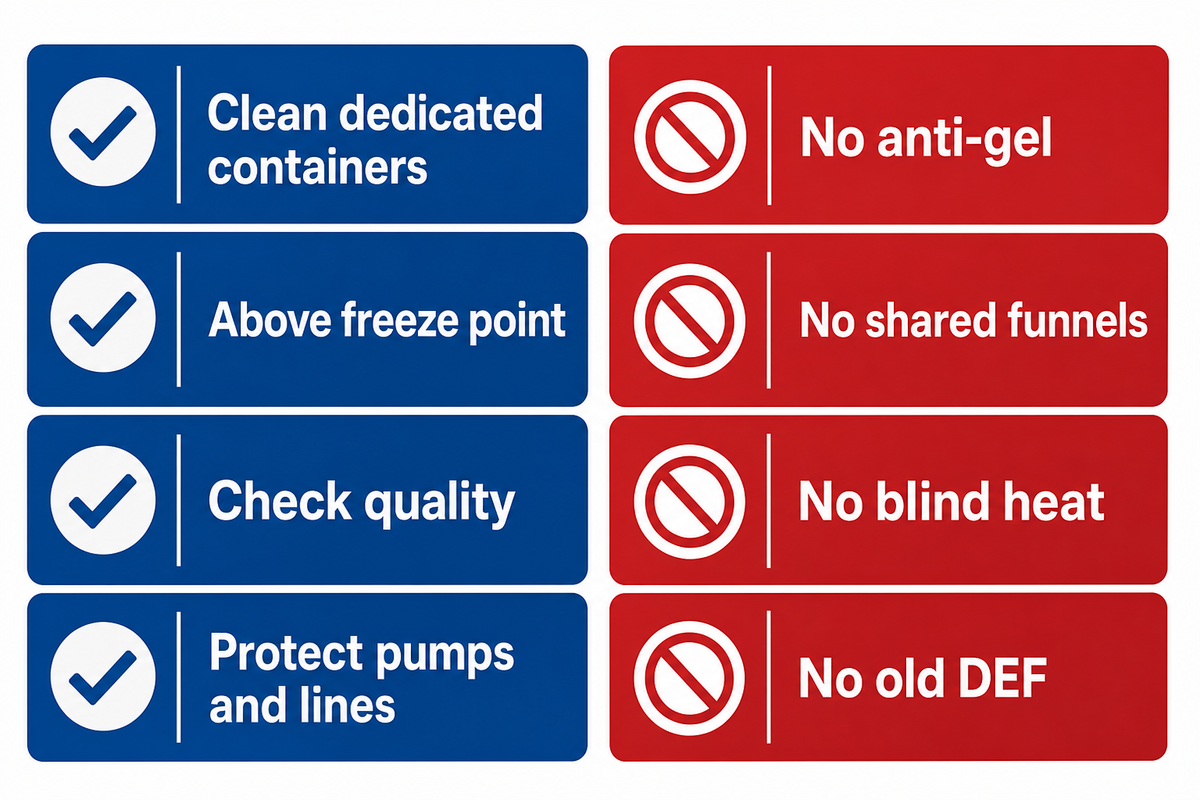
Cold-weather shortcuts cause expensive damage because DEF isn’t diesel fuel. It belongs in its own clean handling path. Anti-gel, improvised thawing, shop funnels and shared pumps can contaminate the DEF or send the wrong fluid into selective catalytic reduction equipment.
Do
- Store DEF in clean, compatible and dedicated containers.
- Keep the DEF above the freeze point only when transfer duty requires it.
- Check DEF quality when heat exposure, age or contamination is suspected.
- Protect pumps, lines and nozzles as well as the storage tank.
Don’t
- Do not add anti-gel or freeze-point improver to DEF.
- Do not use diesel fuel tools, dirty funnels or tap water around DEF.
- Do not heat blindly without a controller and sensor plan.
- Do not pour old DEF into equipment because it looks clear.
If DEF dries on a tool, cap or transfer connection, treat the residue as a cleanliness warning. Clean equipment for DEF service should stay capped, dedicated and protected from dirt. Pouring DEF through a shared funnel is a small action that can create a large SCR problem.
Where FlexBlanket Fits After the Temperature Limits Are Settled
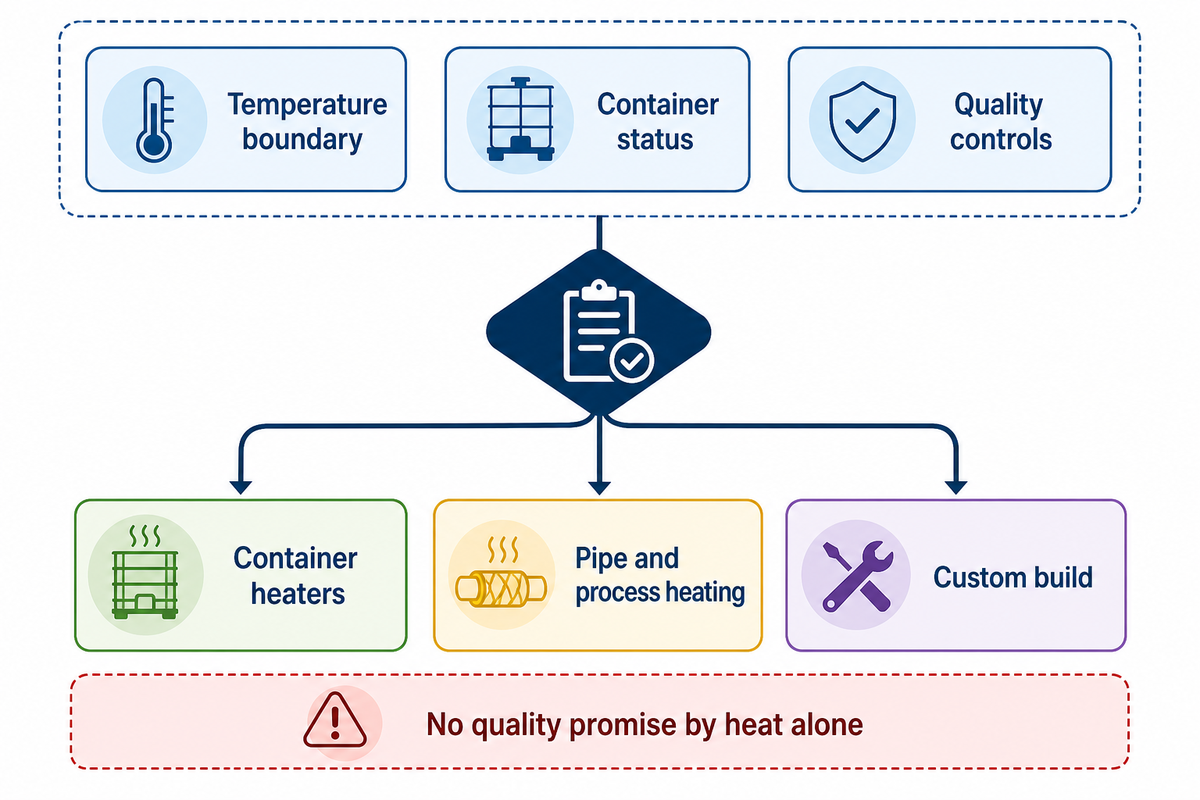
After those cold-weather handling limits are set, FlexBlanket manufactures industrial electric heating blankets and flexible heating solutions for containers, pipes, cylinders, process equipment and custom shapes. In a DEF storage project, the right conversation starts after the temperature boundary, container status and quality controls are clear.
For container duty, begin with the container heater family. For pump cabinets, valves, elbows or exposed transfer lines, review pipe and process heating or pipe heating blankets. For unusual tanks or layouts, a custom build may be the correct path once drawings, duty, voltage and control needs are known.
This boundary matters commercially. Heater quotes shouldn’t promise DEF quality by themselves. They should help the owner keep a clean, compatible storage system available at the required temperature without creating avoidable heat exposure.
Key takeaway
Select DEF heat by duty: keep clean fluid available above 12 °F / -11 °C when needed, but verify shelf life, container approval and contamination controls before treating heat as the solution.
FAQ
What temperature should DEF be stored at?
There’s no single universal storage temperature that answers every DEF question. Caterpillar gives an ideal storage range of 15 °F to 77 °F in its own guidance. Freezing begins around 12 °F / -11 °C. API’s 2024 fact sheet separates shelf-life thresholds such as at or below 86 °F and above 95 °F. Use the label, OEM guidance and container scope for your material.
Does DEF go bad if it freezes?
Freezing alone doesn’t usually make on-spec DEF unusable after it thaws. The bigger storage risk is expansion, container stress and blocked transfer. Confirm that the DEF tank, drum or IBC tote is approved for DEF service and has enough headspace for cold exposure. Never add diesel anti-gel or other additives to thaw the DEF.
At what temperature does DEF go bad?
Quality declines with time and heat exposure rather than failing at one instant temperature. API’s current consumer guidance uses shelf-life thresholds and tells users to test before use when DEF has been exposed to higher temperatures above 95 °F. If inventory is old, hot, unsealed or possibly contaminated, check DEF and review supplier documentation before using DEF in equipment.
Can DEF be stored outside?
Yes, but outside storage needs protection from sunlight, contamination, freezing, heat exposure and damage. The storage container, closure, pump, hose and nozzle all matter. Outdoor bulk storage may need insulation, cabinet heat or controlled tank heat in cold climates.
Should a DEF tank be full or empty in winter?
Near-full tanks and containers leave less room for frozen DEF to expand. Follow the container manufacturer’s instructions and keep enough headspace for the actual storage condition. Don’t reuse unapproved containers for winter DEF storage.
Do I need a DEF tote heater or an insulated blanket?
You need a DEF tote heater or insulated blanket when passive storage can’t keep DEF available for transfer at your site. Start with lowest ambient temperature, turnover rate, tote size, fill level, pump location, voltage, controller and sensor point. Insulation may be enough for mild exposure. Controlled heat is more relevant when the tote, pump cabinet or transfer line repeatedly falls below freezing before work starts.
Can I add anti-gel or freeze-point improver to DEF?
No. This fluid isn’t diesel fuel. Additives can contaminate the fluid and create SCR system problems. Use clean storage, thawing, insulation or controlled heating instead.
References & Sources
- American Petroleum Institute, 2024 DEF fact sheet, used for shelf-life threshold and test-before-use framing.
- American Petroleum Institute, proper DEF handling guidance, used for handling, dedicated equipment and contamination controls.
- Cummins, six answers about diesel exhaust fluid, used for freezing, thawing and additive caution.
- Caterpillar, tips for managing DEF, used for source-specific preferred storage and approved-container context.
- MTU/Rolls-Royce, DEF storage and handling guidance, used for materials, contamination and winter transfer context.
- VDA Recommendation 267, AdBlue in 5 L containers, used only for its passenger-car package scope.
- ISO 22241-1:2019 public standard page, used as the public quality-standard reference for AUS 32 / DEF.
- FlexBlanket container heaters, custom heating blankets and related first-party pages, used for RFQ and product-family scope only.