Get in touch with FlexBlanket Company

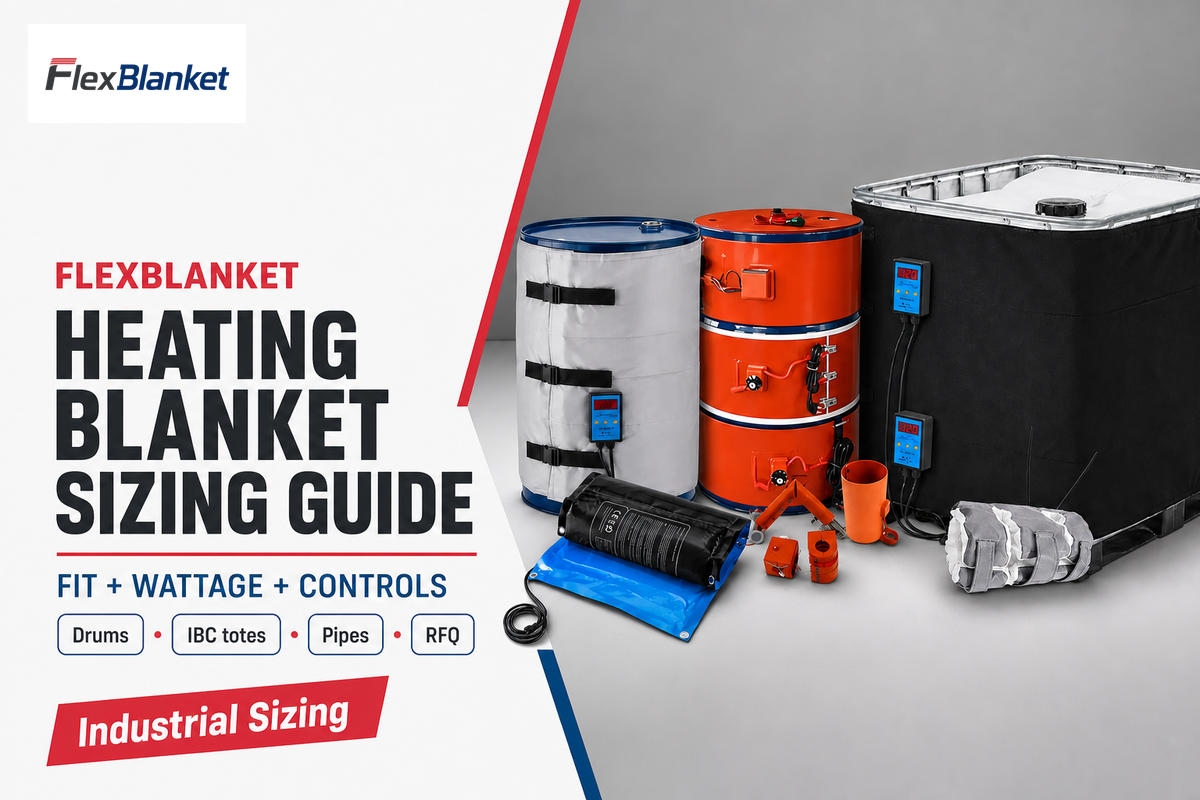
FlexBlanket industrial sizing guide
This Heating Blanket Sizing Guide is for industrial drums, IBC totes, pipe sections and custom surfaces, not bed coverings, so the right heat blanket size comes down to fit, heat path, duty, material, voltage and control limits. Only then is wattage calculated.
Fast answer
Select an industrial heating blanket by the asset it must heat, the surface it can contact, the temperature duty, the material risk, the available power and the environment. For manufacturing, construction, chemical and energy users, the heating solution should deliver reliable temperature control and consistent heat without creating hot and cold spots or avoidable downtime. Drums, 1000 L totes and pipe valves can all need different heater shapes even when the requested target temperature looks similar.
Industrial Heating Blanket Size Means Fit, Heat Path and Duty
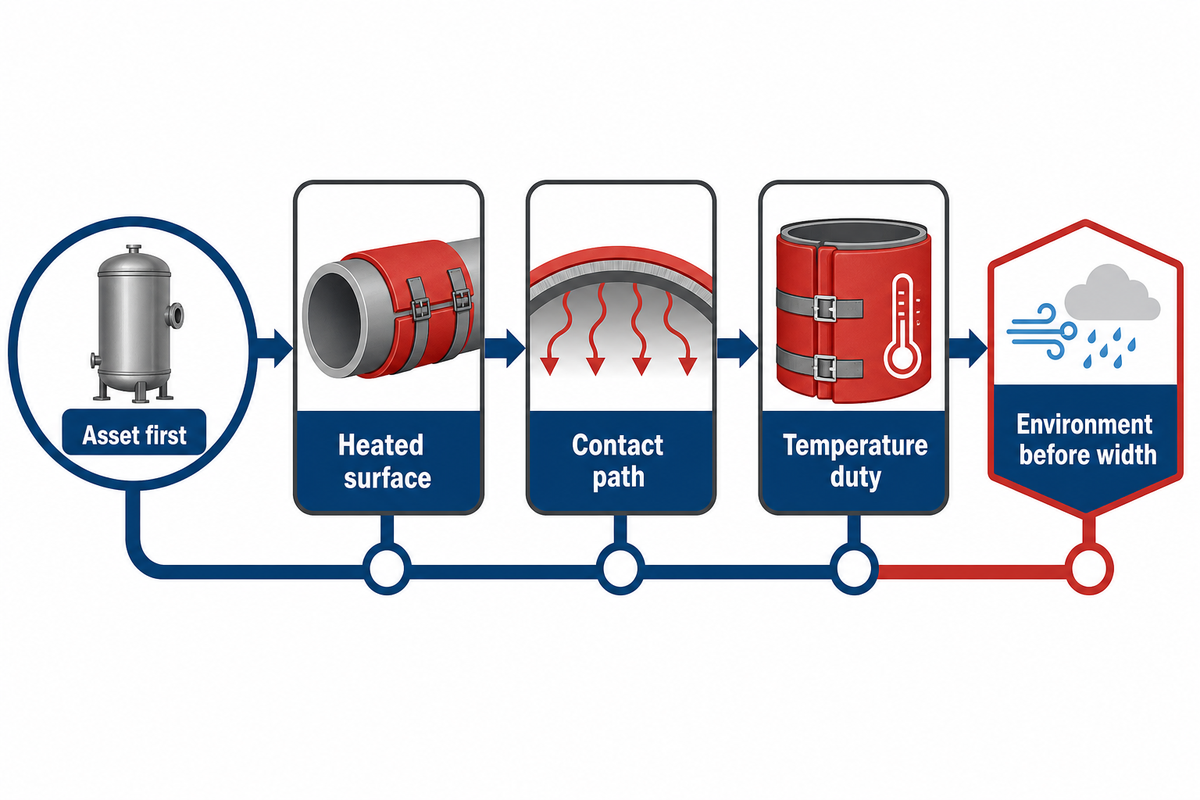
Industrial heating blanket size starts with the asset, not a bedding chart. Useful size answers name the heated surface, the contact path, the temperature duty and the application family: drum, IBC tote, pipe section, tank, cylinder, ground thawing area, silicone rubber heater or custom surface.
Electric resistance trace heating standards such as IEEE/IEC 62395-1-2024 frame design and installation requirements around the actual heated system, which is why a useful sizing brief must identify the asset, duty and environment before blanket width is fixed.
This matters because the same rectangle can behave differently on a curved drum wall, a caged tote, a pipe flange or a flat curing tool. Poor contact weakens the heat path. If the blanket covers the wrong obstruction, outlet or sensor area, the job can still fail even when the stated length and width look correct.
The search intent behind the phrase is mixed. Some pages answer household or general blanket size questions, while industrial pages organize heating blankets by size and application. This article uses the focus phrase but keeps the scope industrial so procurement teams do not copy a consumer size chart into a plant request. Because industry uses heating blankets in many plant and jobsite heating jobs, the range of applications should be split into container heating, pipe work, curing, cylinder jobs and frozen ground before size is discussed.
The Six-Input Heating Blanket Sizing Brief
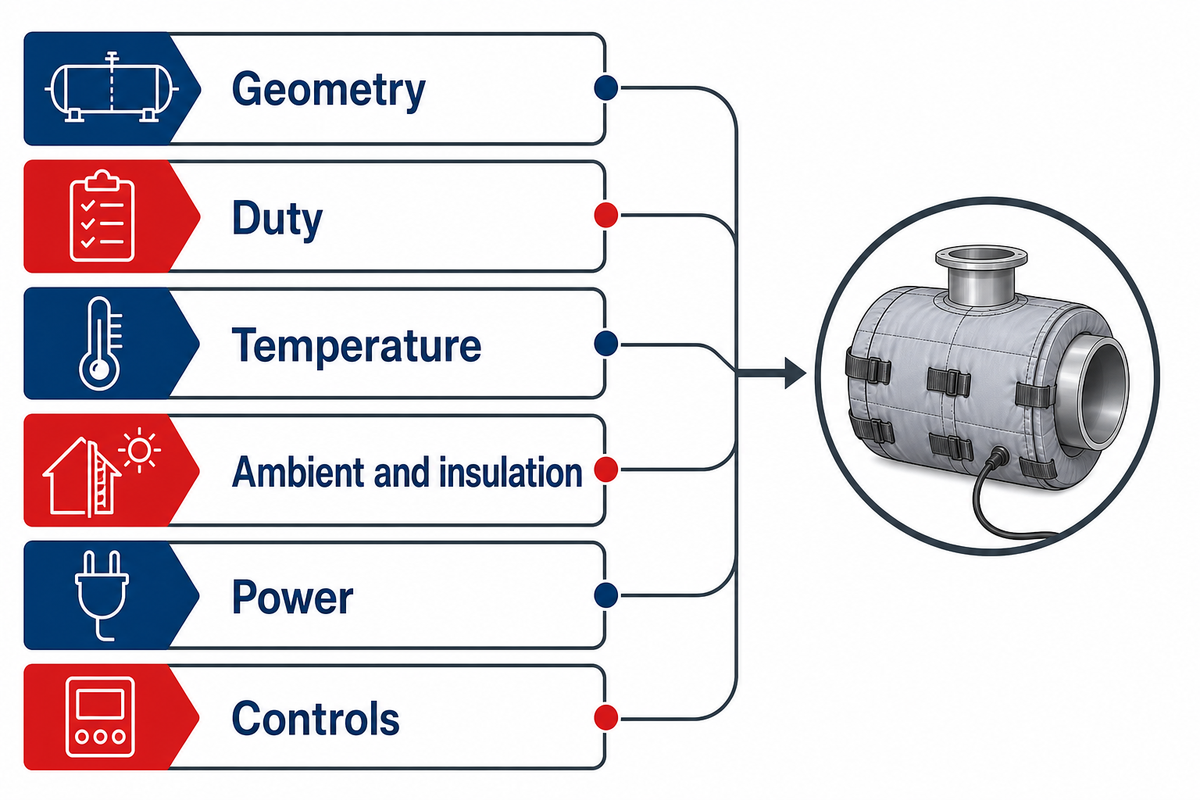
Quote requests should collect six inputs before anyone fixes blanket size or wattage: geometry, duty, target temperature, ambient and insulation, electrical supply and controls. FlexBlanket first-party worksheet and RFQ checklist cover warm-up time, volume, starting and target temperature, dimensions, voltage, wattage, sensor position, control needs and operating environment before quoting. At that point, a heater blanket is no longer a generic pad; it becomes a specified electric heating assembly with a precise contact path.
For illustration, the Northline Drum Case might record a 200 L drum, a 20 °C starting product temperature, a 60 °C target temperature, 120 V supply and a 10 A circuit limit. Those example values help organize the request; they are not a finished heater design.
| Input | What to send | Why it changes size | Owner |
|---|---|---|---|
| Geometry | Drawing, diameter, wall height, wrap width, obstructions | Controls contact area and edge clearance | Maintenance |
| Duty | Maintain, warm up, cure, thaw or freeze protection | Changes wattage, control response and cycle time | Plant manager |
| Temperature | Start point, target setpoint, allowable product limit | Protects material from underheating or overheating | Process owner |
| Ambient and insulation | Indoor/outdoor, wind, insulation status, washdown risk | Changes heat loss and enclosure needs | Maintenance |
| Power | 120 V, 230 V, amperage limit, plug or connector | Can limit heating power before size does | Electrical |
| Controls | Thermostat, sensor location, over-temperature cut-out, zones | Controls what temperature the system actually reads | Quality or engineering |
Use this brief before comparing blanket options. It reduces false shortcuts: “200 L drum” is not enough, “1000 L IBC” is not enough, and “pipe diameter” is not enough when valves, cages, fittings, insulation or wet-area exposure affect the job.
There is no optimal or universal best size until the duty is defined. Vendors may carry many sizes, but the request still needs to be tailored by surface, load, temperature limit and control method. A blanket is versatile only after those fit checks are passed for the actual asset.
Use the FlexBlanket heater sizing worksheet when the request includes warm-up time, volume and target temperature, and use the RFQ specification checklist when the shape or voltage is custom.
Drum and Barrel Heater Sizing Starts With Diameter and Contact Height
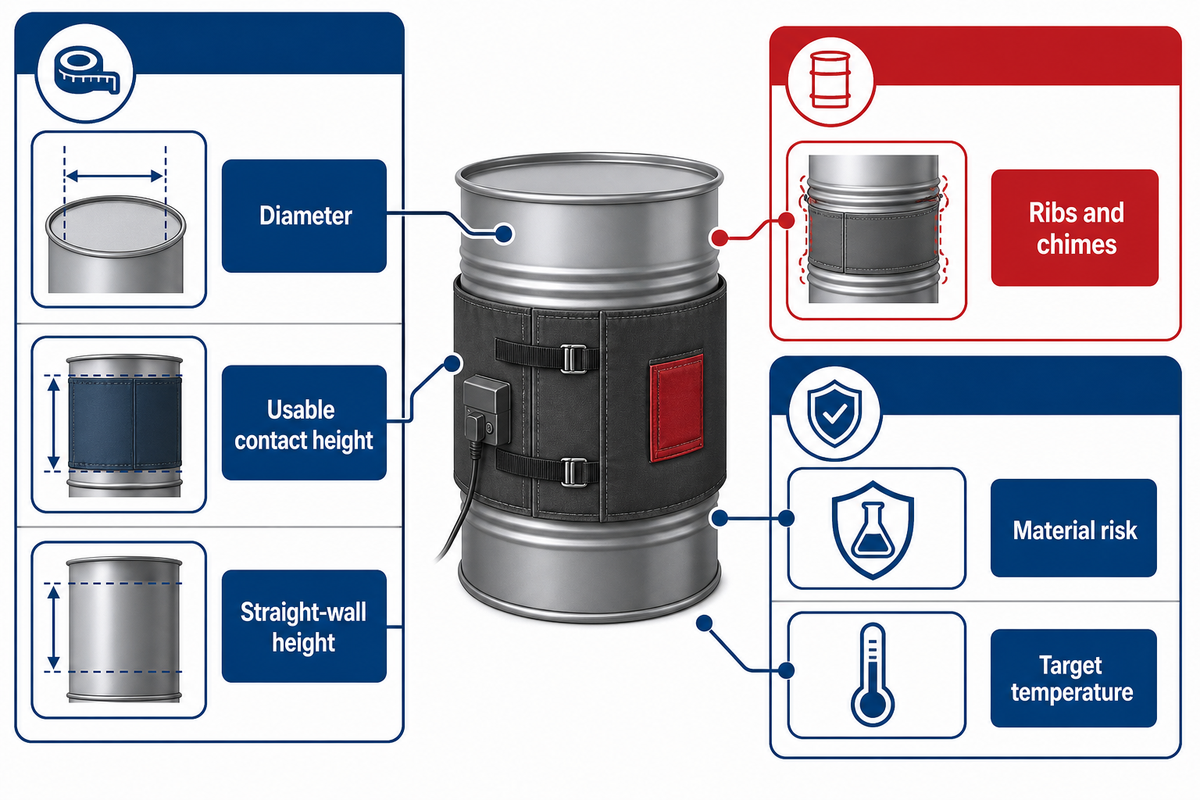
Drum heater or barrel heater sizing begins with diameter and usable contact height. The nominal container volume tells you the product family, but the heated wall area, fill level, material viscosity, thermostat position and available voltage decide whether the blanket can maintain temperature or recover after a cold start.
For common drum work, record the straight-wall height that can safely accept a blanket, not just the total drum height. Handles, ribs, chimes, labels, outlet fittings and pallets can all reduce useful contact. Pails, 60 L drums, 120 L drums and 200 L or 55 gallon drums may need different wrap heights even when the target temperature is the same.
Material risk is the next filter. Wax, resin, adhesive, chemical fluids, food ingredients and oil grades do not tolerate heat identically. One buyer may need gentle viscosity reduction; another may need freeze protection; another may ask for rapid heat-up. Do not translate that into an “extra hot” request. State the target temperature, allowable upper limit and warm-up time instead.
Reference the FlexBlanket Drum Heating Solutions branch for drum-specific product data. This guide stays at the measurement and decision level so it does not duplicate a drum-only product page or a silicone drum heater article.
IBC Tote Heater Sizing Needs Volume, Zones and Viscosity Risk
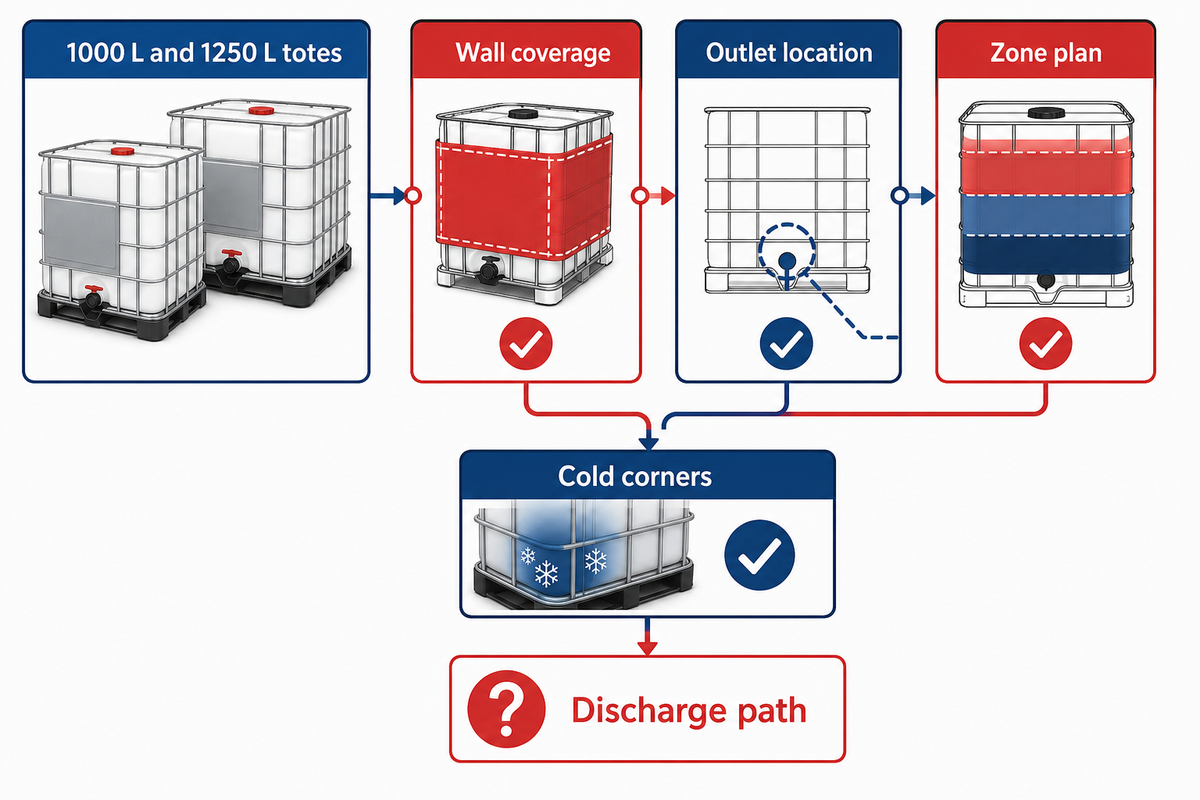
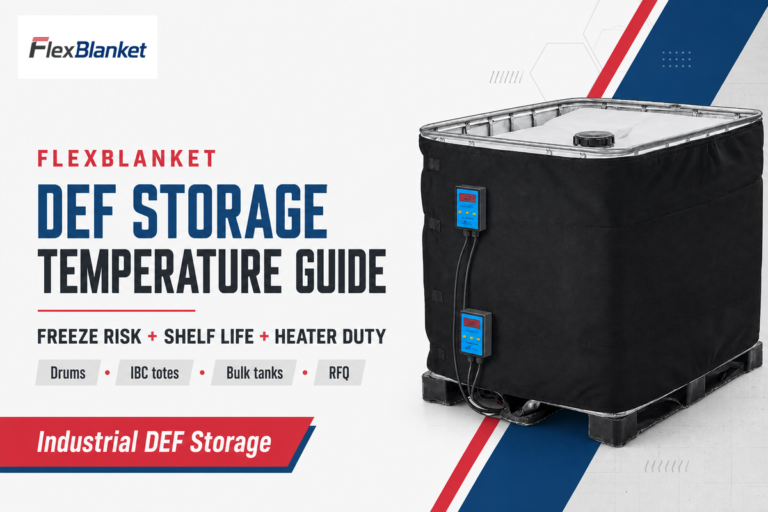
Size an IBC or tote heater by wall-coverage, outlet location and zone plan, not solely by liter capacity. Common 1000 L and 1250 L metal-caged totes need the right wrap height, cage clearance, lower-corner heat path, electrical supply and controller plan before the blanket size is final.
Cold material often moves first at the outlet and last in the corners. If a tote blanket heats the broad wall but leaves the discharge area cold, operations can still see slow transfer, pump strain or inconsistent flow. The goal is even heat that reaches the product path evenly enough for transfer, not just a warm outer wall. Multiple heater zones or controllers may be needed to overcome cold pockets.
Some products only need freeze protection. Others need a hold temperature, and some need a warm-up target before transfer or processing. Ask whether heat must reach the discharge path, the lower corners, the full wall or only a defined process area.
For IBC and tote applications, consult the FlexBlanket Tote Heaters page and sizing questionnaire. Use this guide for general heater sizing logic, then complete the questionnaire for each application that needs a special shape, size, voltage or control plan.
Pipe Heating Blankets Belong on Irregular or Serviceable Sections
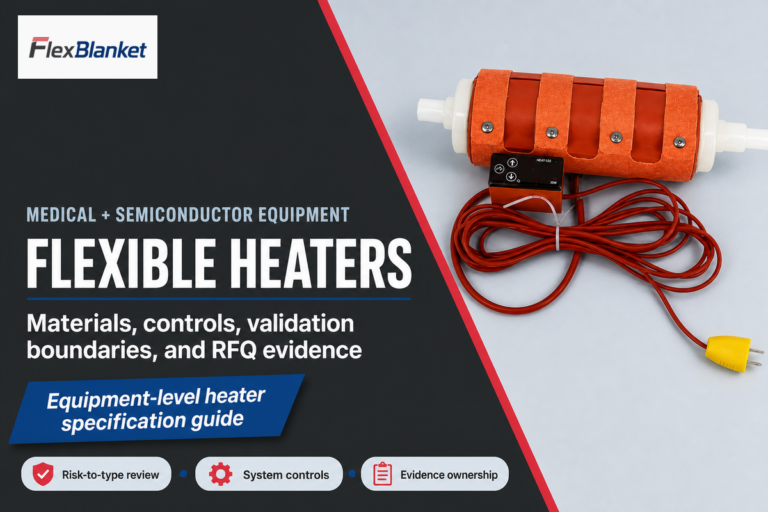
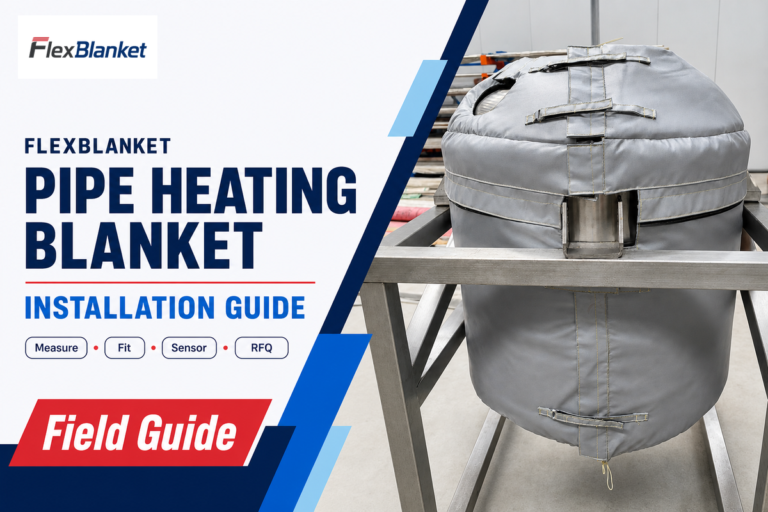
Pipe heating blankets are best used as fitted heaters for ad hoc, removable or maintainable sections. Intermittent heater sections for long straight pipe runs are better left to heat tracing review; corners, valves, elbows, flanges, pumps and access points need customized blanket support or a removable pipe heating blanket.
The pipe-trace tools cited here do not size from diameter alone. They use pipe length, pipe diameter, minimum ambient, holding temperature, insulation and added allowance for valves, flanges or hangers. Those factors reinforce the same caution for pipe blankets: diameter is only the starting line.
The real decision point for the buyer is access. If a maintenance person has to remove the heater for flange inspection or valve service, then a permanent tracing path may not support that task. If the pipe run is long, rambling and well insulated, then a dedicated tracing solution may be more efficient than a patchwork of blanket sections.
For pipe-only detail, direct to FlexBlanket’s pipe heating blankets page or the build your own pipe configuration blog. This article focuses on cross-product sizing tips.
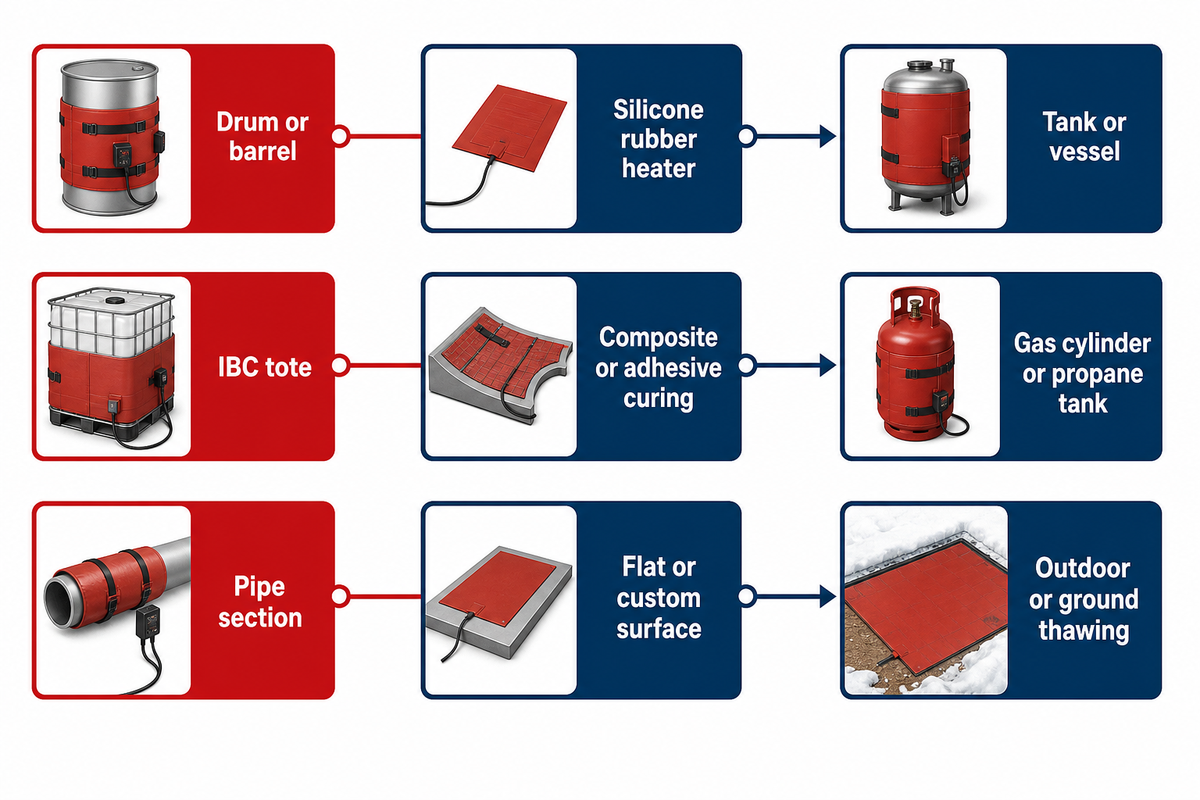
| Application category | First sizing input | Hidden blocker | Buyer action |
|---|---|---|---|
| Drum or barrel | Diameter plus straight-wall contact height | Ribs, low fill level, high-viscosity material, plug amperage | Send photos and measure usable wrap band |
| IBC tote | Volume, wall dimensions and outlet location | Cold corners, cage clearance, lower discharge path | Confirm zones and outlet access |
| Pipe section | Diameter, length, fittings and insulation | Valves, flanges, supports and service access | Mark removable and permanent sections separately |
| Flat or custom surface | Drawing, heated area and edge clearance | Sensor pocket, clamp points, bend radius, cure uniformity | Send drawing and temperature map |
| Outdoor or ground thawing | Area, weather exposure and duty window | Moisture, traffic, power distribution, installation timing | Check environment before size |
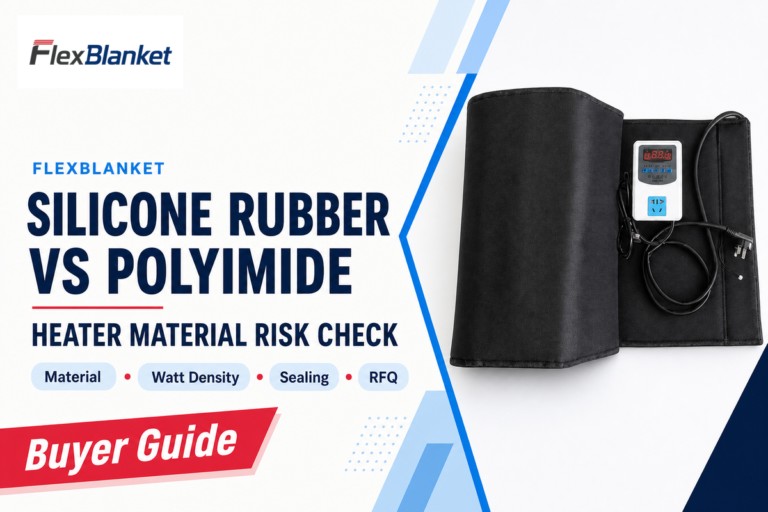
| Silicone rubber heater | Drawing, heated area, holes and edge clearance | Bend radius, sensor pocket, lead exit and clamp points | Send a marked drawing, not only outside dimensions |
| Composite or adhesive curing | Tool size, cure area, ramp target and hold time | Cure uniformity, thermocouple position and part sensitivity | Define ramp, hold, maximum temperature and sensor count |
| Tank or vessel | Diameter, wall height, liquid level, nozzles and insulation | Heat loss, headspace, supports and uneven fill level | Send volume, material data and insulation condition |
| Gas cylinder or propane tank | Cylinder diameter, valve guard, service and placement | Valve clearance, gas-service limits and safety documentation | Request safety review before normal sizing |
Watt Density and Warm-Up Estimates Need a Worked Example
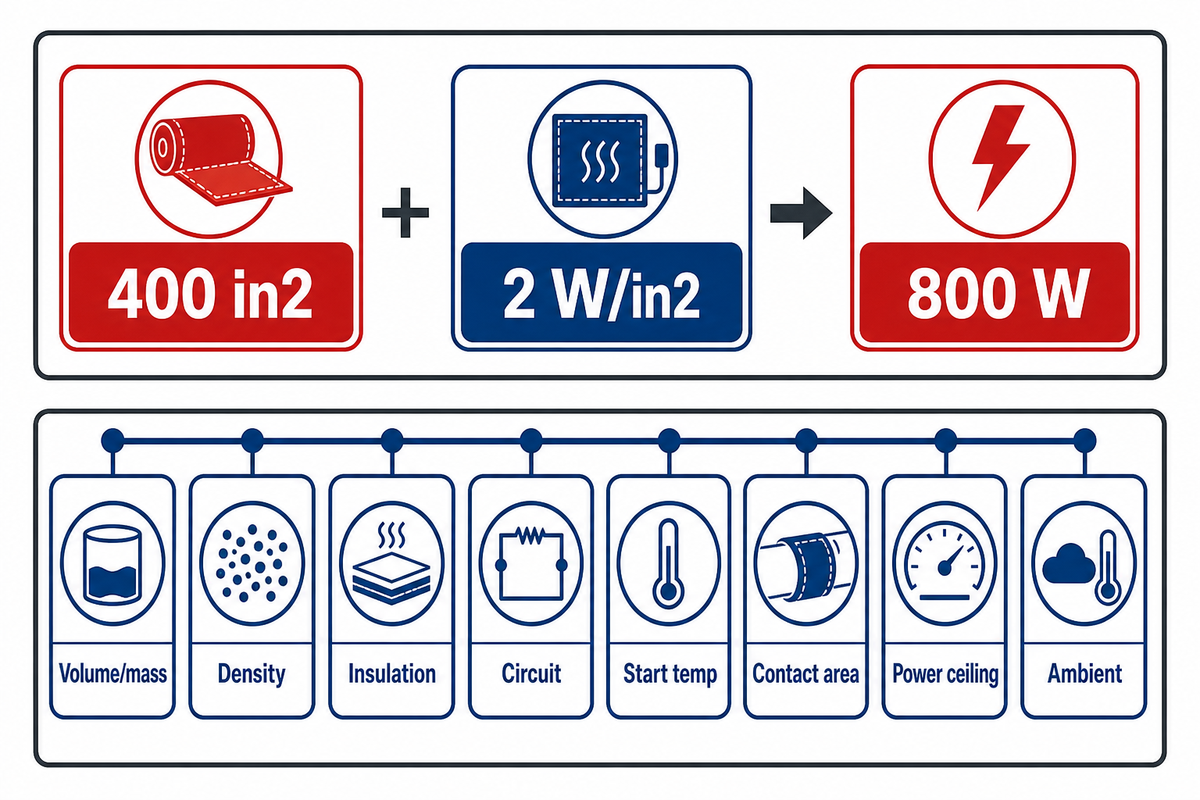
Watt density is a quick rule of thumb because it relates heating power to heated area. It is still not a complete industrial heating blanket size. The finished size needs heat loss, material thermal response, insulation, input voltage, controls and warm-up assumptions.
This simple screening calculation can nonetheless be instructive. In the Northline Drum Case, if a flexible heater needs 400 in2, then a hypothetical 2 W/in2 early screen gives 800 W as the first-pass power estimate. That power number only reveals the arithmetic; it does not prove the blanket has enough power density to raise a 200 L drum, recover overnight or protect a temperature-sensitive resin.
Engineering boundary
Estimate watt density to eliminate clear mismatches, then collect heat-balance data before final heater specification. Fluid specific density, specific heat, quantity, vessel construction, insulation, minimum ambient, wind velocity, startup time and safety margin can all shift the final power requirement.
| Question | Why it matters | Unknown input |
|---|---|---|
| What volume or mass is being heated? | Heat-up power changes with actual load, not only surface size. | Use hold-temperature language, not rapid warm-up claims. |
| What are the density and specific heat? | Different fluids need different energy per temperature rise. | Ask engineering or supplier for material data. |
| Is the vessel insulated? | Uninsulated surfaces lose heat faster. | Treat the estimate as a pre-screen only. |
| What circuit capacity is available? | Voltage and amperage can cap heater power before size does. | Check the voltage and plug compatibility check. |
| What is the starting temperature? | A 20 °C start and a 60 °C target describe a different duty than freeze protection. | Record the measured start point and the allowable maximum. |
| How much contact area is available? | A 400 in2 contact area limits wattage and sensor placement differently from a full wrap. | Measure usable area after ribs, handles and fittings are excluded. |
| What power ceiling applies? | A 120 V circuit with a 10 A limit can cap preliminary power before size is chosen. | Confirm circuit limit before promising warm-up speed. |
| What is the ambient exposure? | A 5 °C indoor shop and a -10 °C outdoor job can need different insulation assumptions. | Separate indoor holding duty from winter startup duty. |
Voltage, Controls and IP Rating Can Override the Physical Size
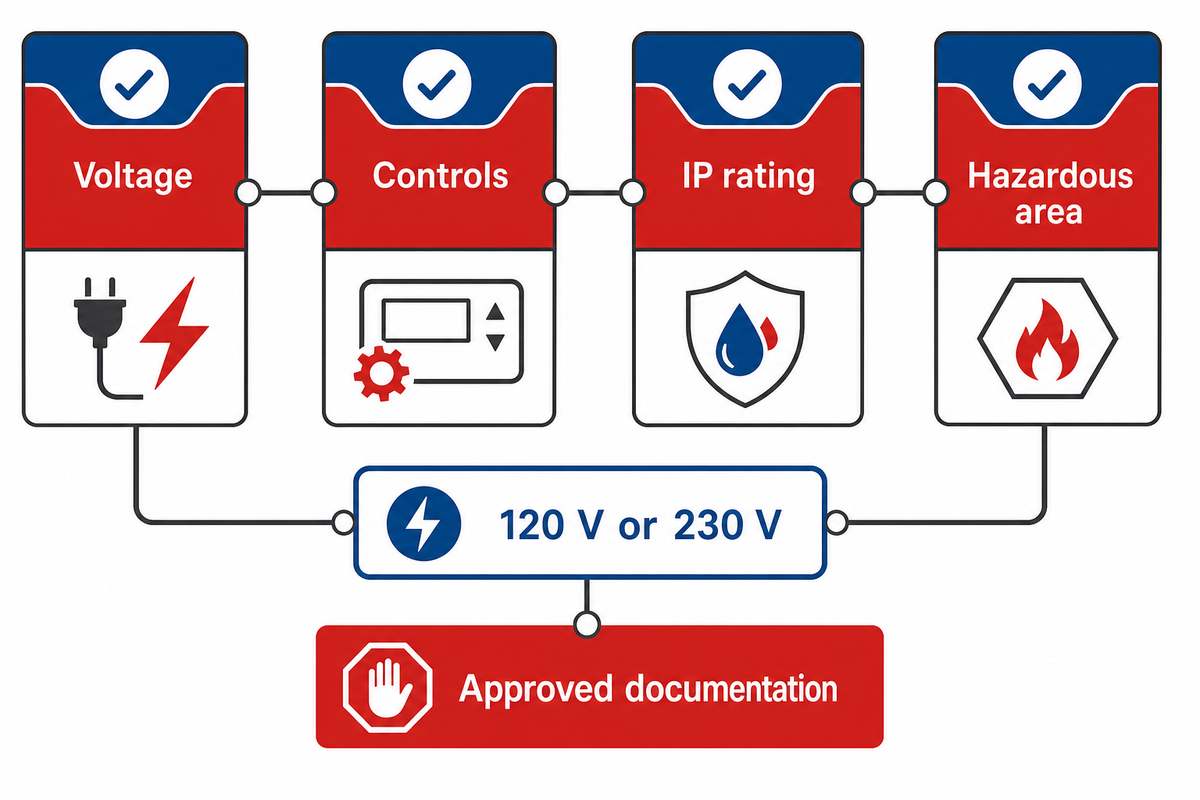
Even when a blanket suits the process parameters, it can still be a poor capital purchase if the plant can’t power it, manage it, control it or operate it in its hostile environment. Confirm voltage, amperage, controller type, sensor placement, overload protection and ingress rating before finalizing a physical footprint.
IP rating addresses ingress by dust and liquids. IEC defines IP standards through IEC 60529, which ranks enclosure resistance to intrusion by solids and liquids. While that is helpful for outdoor and wet locations, it does not grant a heater approval for Category 1, 2 or 3 flammable vapor, gas, dust or fiber areas.
“Equipment shall be approved not only for the class of location”
OSHA 1926.407(b)(2)(i), hazardous classified locations
That OSHA rule is not an absolute mandate for every industrial site, but it is a useful warning for purchasing teams. For U.S. OSHA-classified locations, flammable vapor, liquid, gas, dust or fibers move the question out of ordinary size selection and into hazardous-location approval, class, group and temperature-marking review. The RFQ should mark that safety review item plainly so the plant can confirm the required approval basis before product selection continues. IP65 or IP67 ingress language is not the same evidence.
The IEEE/IEC 62395-2 application guide is useful context for electrical trace heating, heated panels and pads in industrial or commercial heating, but the public version states that potentially explosive areas are outside its scope. Use it as system-design context only, not as justification for using a blanket in a hazardous location.
| Gate | Normal sizing question | Stop condition | Next action |
|---|---|---|---|
| Voltage | Is local supply 120 V, 230 V or another standard? | Circuit cannot support required amperage. | Rework wattage, zones or power supply. |
| Controls | Where does the sensor read temperature? | Sensor reads blanket, not product or target surface. | Define sensor and over-temperature cut-out. |
| IP rating | Is dust or liquid ingress a concern? | Washdown, rain, immersion or abrasive dust exceeds product rating. | Specify required ingress protection. |
| Hazardous area | Is flammable gas, vapor, dust or fiber present? | Any classified-location risk exists. | Stop normal sizing and request approved documentation. |
Outdoor, Ground Thawing and Cylinder Jobs Need a Separate Safety Gate
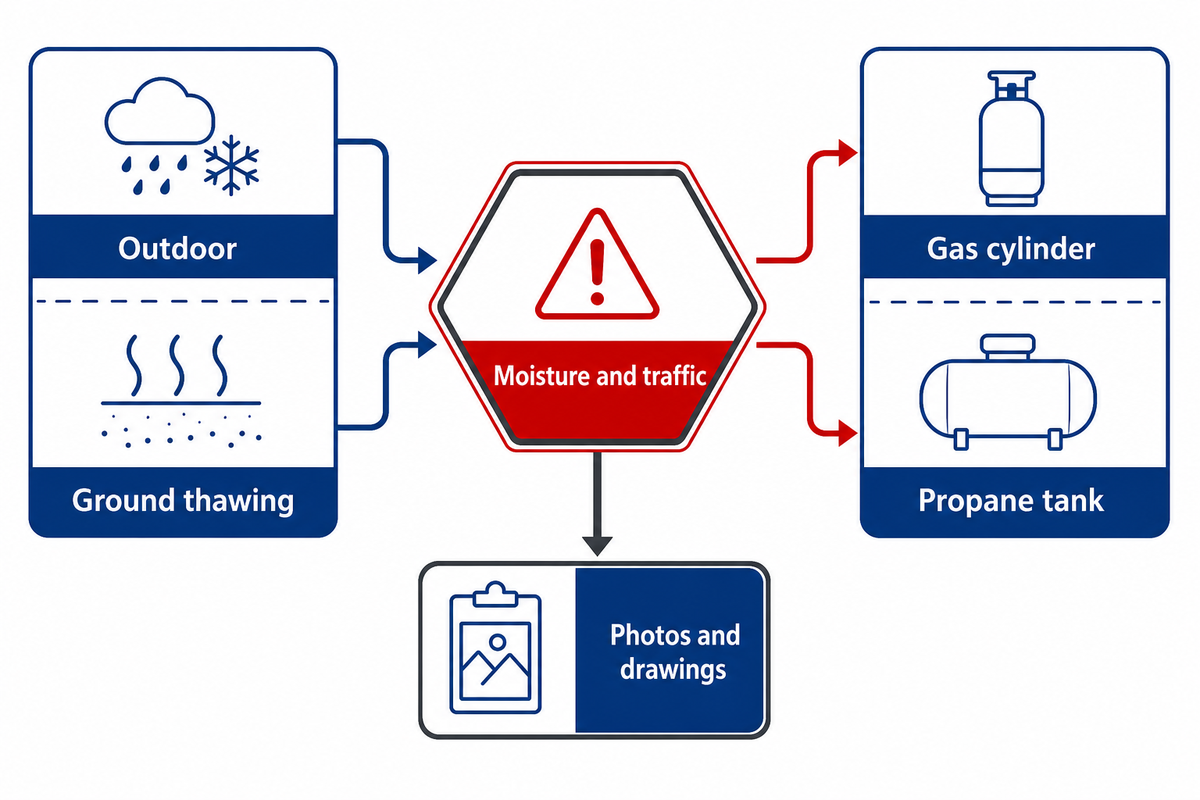
Outdoor, ground thawing, gas cylinder and propane tank jobs should not be sized by the same shortcut used for an indoor drum. Moisture, mechanical abuse, traffic, cylinder shape, fuel type, thermostat operation and wiring can all matter before blanket dimensions are chosen.
Ground thawing for frozen ground adds area, soil condition, weather window and jobsite power. Cylinder and tank work adds curvature, valve clearance and safety documentation. Wet outdoor service adds ingress protection, weatherproof cable routing, moisture-resistant construction, rugged handling assumptions and exposure to extreme temperatures. In these cases, the first question is whether the environment and product rating allow the job.
An indoor-drum blanket that is easy to install may still need a different cord exit, fastening method or protective cover outdoors. Ask for durable cover requirements as part of the sizing packet, not after purchasing has selected a length and width.
This guide does not replace product manuals, electrical design or safety approval. It gives procurement a way to flag the job before a wrong heater reaches purchasing. When the environment is unusual, send photos, drawings and safety requirements with the quote request.
Winter Timing and Lead Time: Specify Before the Cold Snap
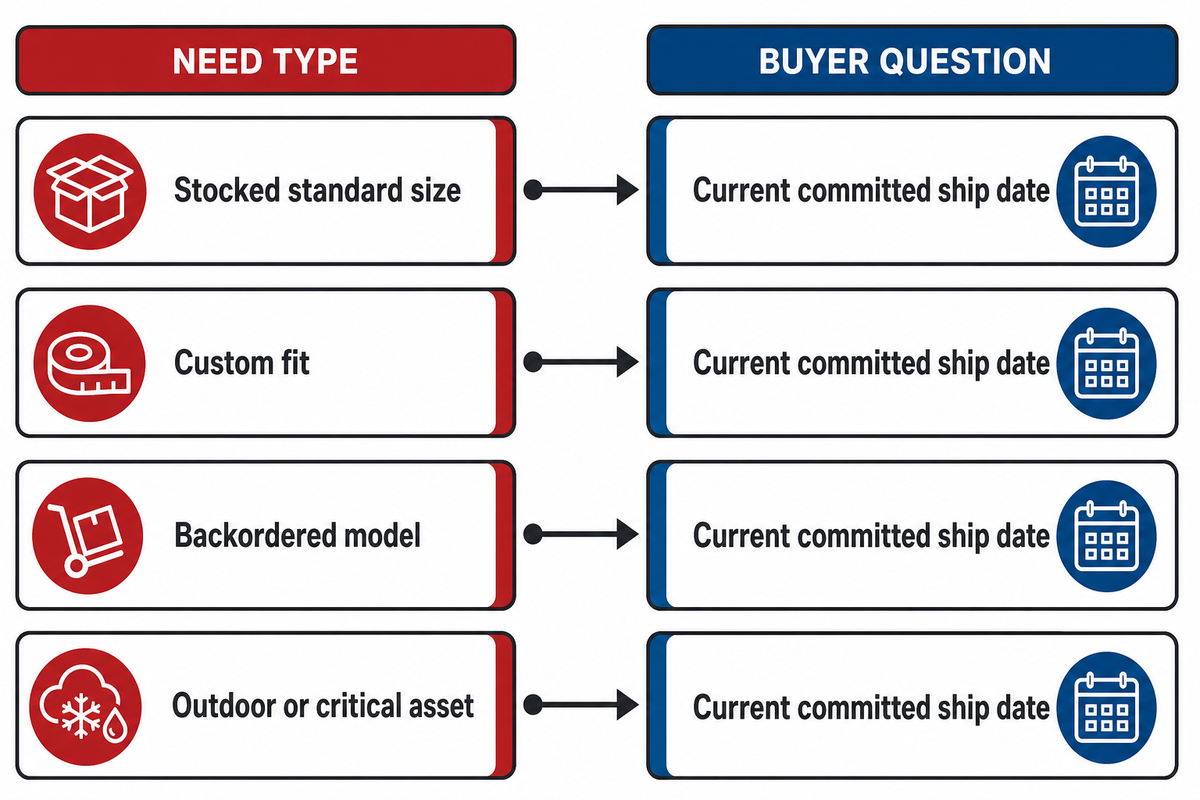
Winter ordering should change the quote sequence, not become a scare claim. During winter months, especially the cold winter months before a freeze event, standard heating blankets may ship quickly from some suppliers, while custom, backordered or configuration-specific blankets need supplier-confirmed lead time after dimensions, voltage, control logic and environment are known.
The practical risk is timing compression. Measurement, engineering review, drawing confirmation, production, shipping, receiving, installation and power checks all need to happen before a freeze event. National Weather Service cold-weather guidance supports planning before extreme cold, but it does not prove industrial heater backlog or universal long lead times.
| Need type | Timing risk | Question to ask |
|---|---|---|
| Stocked standard size | Shipping and receiving window | Is this exact size and voltage in stock today? |
| Custom fit | Drawing review, confirmation and production | What lead time starts after approved drawing? |
| Backordered model | Supplier-specific availability | What is the current committed ship date? |
| Outdoor or critical asset | Installation and power checks before cold weather | Who owns installation before the forecasted cold event? |
RFQ Spec Sheet: The Fields FlexBlanket Engineers Need Before Quote
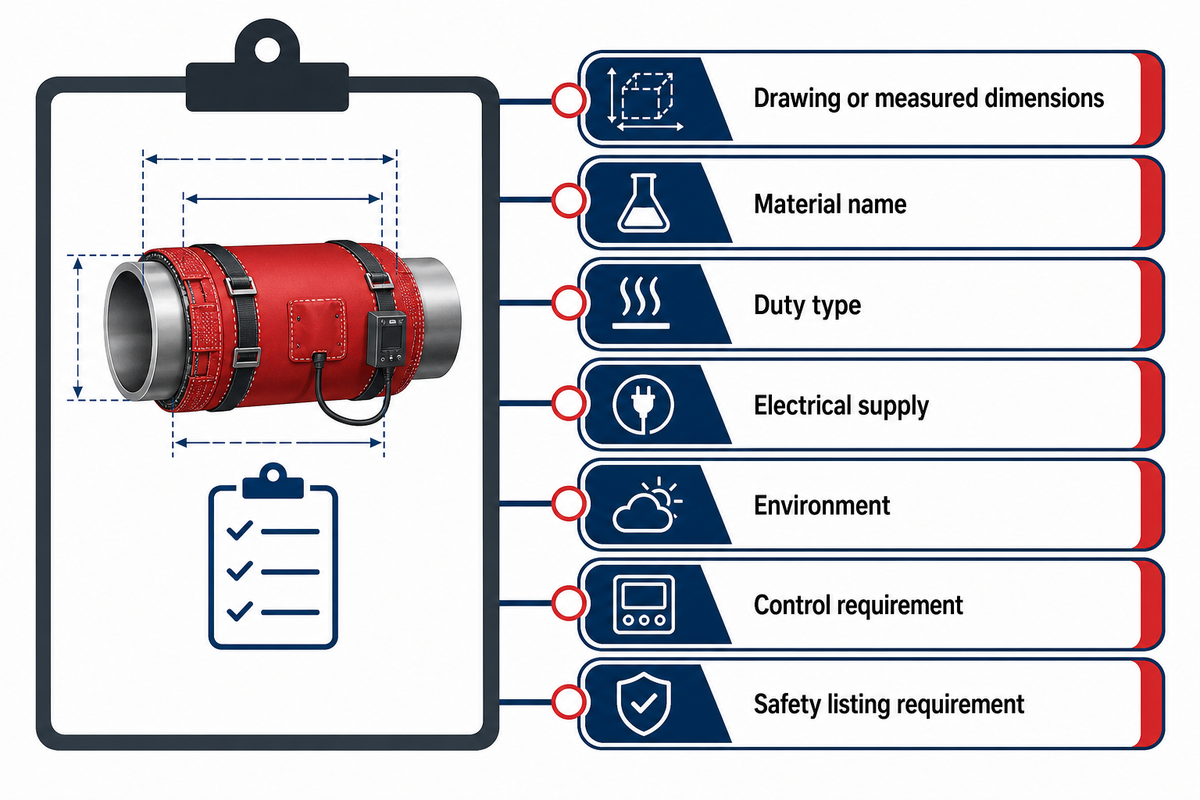
Effective custom heating blanket quotes fully identify the item, duty and utilities. They do not ask for a best estimate of a rectangle. For quotes, supply a detailed drawing or accurate on-site measurements, photos of valves, seams and handles, warm-up or hold duty, operating conditions, utility information, control requirements and environmental specifications.
When providing ordering information, use consistent units. This can include measurements in mm or inches, volumes in L or gal, temperatures in °C or °F, supply in V, circuit limit in A, heater power in W or kW and plant PSI only when it factors into industrial hazard reviews.
For the Northline Drum Case, the quote packet would keep the 200 L volume, 20 °C start, 60 °C target, 120 V supply, 10 A circuit limit, 400 in2 contact area and 800 W screening result together, then mark every value as example-only until FlexBlanket checks the material, surface and control plan.
Quote-ready packet
- Drawing or measured dimensions, with photos of seams, handles, valves, outlets and clearance limits.
- Material name, fill volume or level, initial ambient temperature, target temperature, and allowable maximum.
- Duty type: maintain temperature, warm up, cure, thaw, freeze protection or process hold.
- Electrical supply: voltage, amperage limit, plug or connector preference and country of use.
- Environment: indoor, outdoor, wet area, dust, washdown, insulation and any hazardous-location concern.
- Control requirement: thermostat, digital controller, over-temperature cut-out, zones and sensor location.
- Safety listing requirement: if UL and CSA or another listing is required, state it as a plant requirement and wait for product documentation.
For a standard container family, start with Container Heaters. For non-standard shapes, start with a Custom Heating Blanket application. For electrical checks, use the voltage and plug compatibility check before the quote is finalized.
When the packet is ready, ask FlexBlanket for a custom heating blanket quote with the sizing worksheet attached.
FAQ
What are the available sizes for industrial heat blankets?
Industrial heat blanket sizes start from the asset family: drums, IBC totes, pails, pipes, gas cylinders, ground thawing areas or custom surfaces. The practical size label should name the object, contact area, voltage and duty, not only length by width.
How do I choose a heating blanket size for a drum or barrel?
Measure drum diameter and straight-wall contact height first, then add fill level, material, target temperature, ambient temperature and voltage. A 55 gallon or 200 L drum may need a different wrap height because ribs, chimes and outlets change contact area.
Can one heating blanket size fit drums, IBC totes and pipes?
One heating blanket size should not be treated as universal. Drums need cylindrical contact and thermostat placement. IBC totes need broad wall coverage, outlet awareness and zone decisions. Pipes need diameter, length, supports, valves, flanges, insulation and access planning. Reusable sizing briefs can use the same six inputs across all three, but the final shape and power path should change by asset.
Is a 30 by 40 inch heat blanket big enough for industrial use?
A 30 inch by 40 inch heat blanket may suit a flat surface, but it is not enough for every industrial duty. Check contact area, watt density, voltage, controls, ambient exposure and asset type: drum, tote, pipe or custom tool.
What is the difference between a pipe heating blanket and heat trace cable?
Heat trace cable is usually evaluated for long pipe runs that can be insulated as a system. Pipe heating blankets are often considered where the heater must be removable, fitted around an irregular section, or placed near valves, elbows, flanges and pump bodies. In both cases, pipe length, diameter, insulation, ambient temperature and holding temperature matter, but the blanket choice adds access, fastening, sensor placement, cord exit and maintenance-removal questions.
What should I send before requesting a custom heating blanket quote?
Send asset dimensions or a drawing, material or fluid name, target temperature, starting ambient temperature, warm-up or hold duty, insulation status, voltage, plug preference, controller requirement, sensor location, IP or outdoor exposure and any safety listing expected by the plant. Add photos of valves, outlets, seams, handles, cages, ribs and clearance limits. If the heater is for a classified or unusual environment, state that before asking for size, and include plant-required listing or review language before hardware is selected.