Get in touch with FlexBlanket Company

Last updated: August 29, 2026
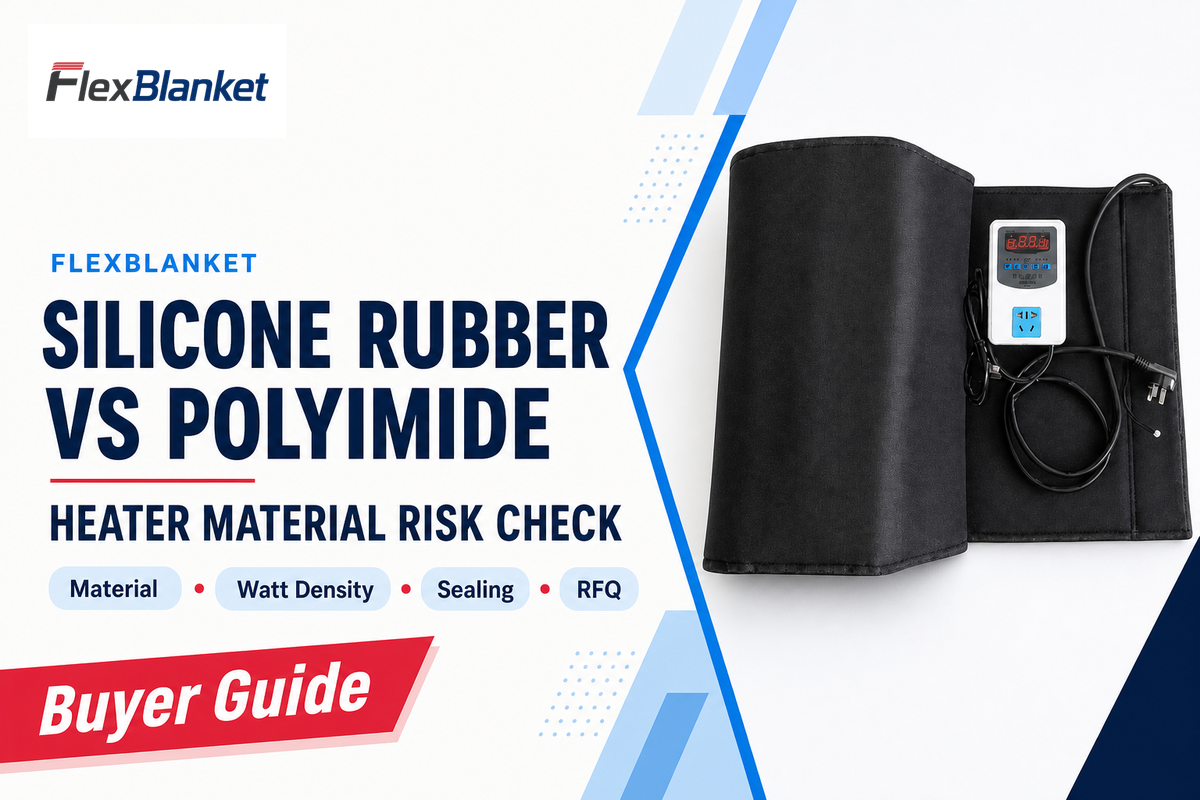
Silicone Rubber vs Polyimide Heaters is not a contest between one tough material and one precise material. It is a risk check for a flexible heater stack: surface, contact method, watt density, bend path, sealing, sensor location, voltage, and approval boundary.
BLUF: Start with silicone rubber for large, handled, damp, or rugged plant-floor assemblies. Start with polyimide for thin, light, fast-response bonded zones. Final selection depends on surface, watt density, bend, sealing, sensor, and approval needs.
Quick Specs
| Question | Silicone rubber heater path | Polyimide heater path |
|---|---|---|
| Typical fit | Larger surfaces, industrial blankets, drums, pipes, tanks, and handled assemblies | Thin bonded surfaces, compact instruments, low-mass heat zones, and tight clearances |
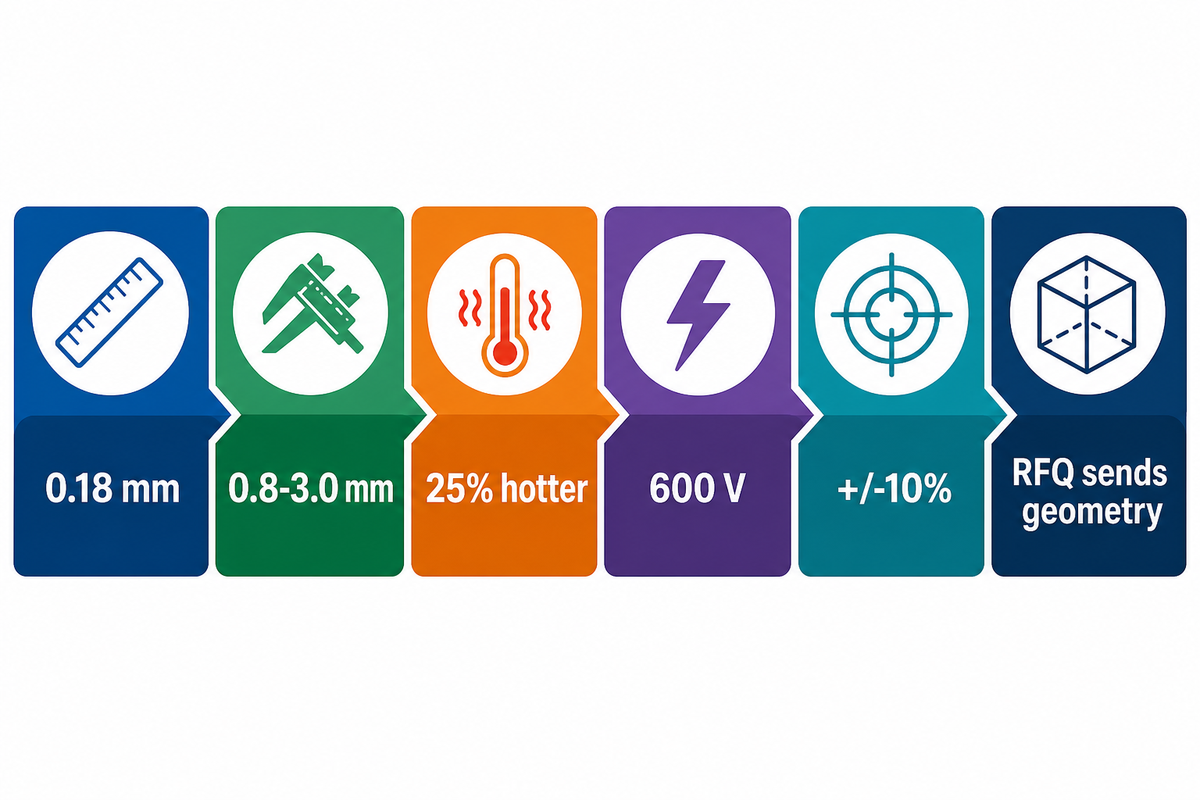
| Example commercial rating | Watlow lists silicone rubber examples up to 500°F / 260°C, 80 W/in2, and 0.055 in / 1.4 mm | Durex lists polyimide examples at 0.007 in / 0.18 mm, -319°F / -195°C to 392°F / 200°C, 50 W/in2, +/-10% wattage tolerance, and 1000 V dielectric strength |
| Main hidden limit | Open-air use, poor contact, lead sealing, chemical exposure, and wrong sensor position | Edge sealing, adhesive limit, humidity effect on dielectric margin, bend duty, and lead reinforcement |
| Safety file | Check controller, ground-fault plan, high-limit cutoff, wiring, and installed environment | Check the same controls plus exact film, adhesive, seal, and qualification records |
These are source-specific examples, not universal material limits. OMEGA warns that an internal heating element can run up to 25% hotter than the outside blanket surface.
Key takeaways
- Both are resistive flexible heaters; neither is a complete temperature control system by itself.
- Silicone rubber often starts the discussion for larger industrial heater assemblies where handling, moisture, and protection matter.
- Polyimide, often searched as Kapton heater, starts the discussion when low thickness, low mass, and fast thermal response matter.
- Ingress, chemicals, oil, coolant, icing, vacuum, and approvals are system questions, not material-name promises.
- The strongest RFQ sends geometry, load, target temperature, heat-up time, voltage, watt density, sensor, control, lead exit, sealing, and documents.
Quick Answer: Choose by Risk, Not by Material Name
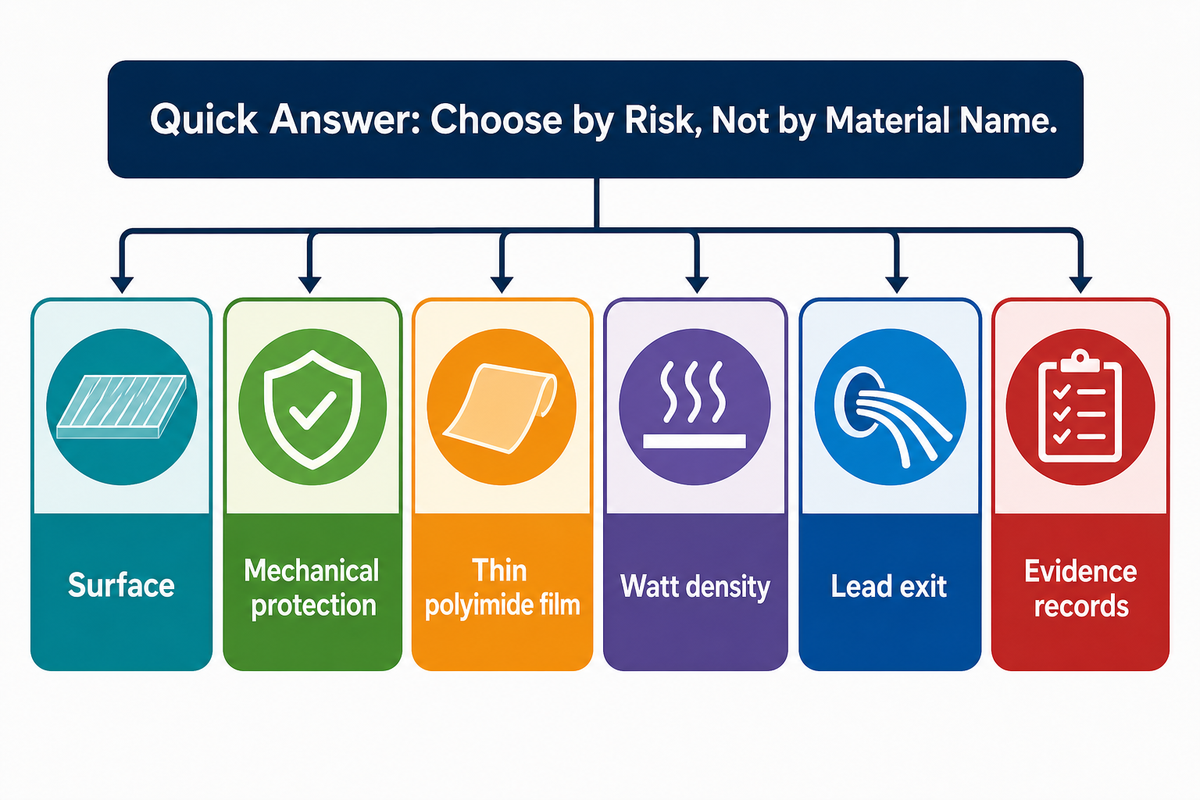
For an engineer or sourcing team, the right first question is not “which heater type is better?” It is “what failure risk is the heater stack most likely to meet?” A flexible heater on a clean, flat, compact aluminum block has a different risk map than a heater wrapped around a damp drum, pipe valve, IBC tote, or composite curing tool.
Choose silicone rubber first when the heater needs mechanical protection, broader surface coverage, and a forgiving industrial form factor. Choose polyimide first when the design needs a thin polyimide film, low mass, fast response, and precise placement on a compact heat sink. Then force both candidates through the same review: heated surface, operating temperature, wattage, watt density, adhesive or clamp, sensor, controller, bend, lead exit, and evidence records.
0.18 mmDurex polyimide example thickness
0.8-3.0 mmFlexBlanket silicone example thickness
600 VUL 499 public-scope ceiling
What Silicone Rubber and Polyimide Heaters Have in Common
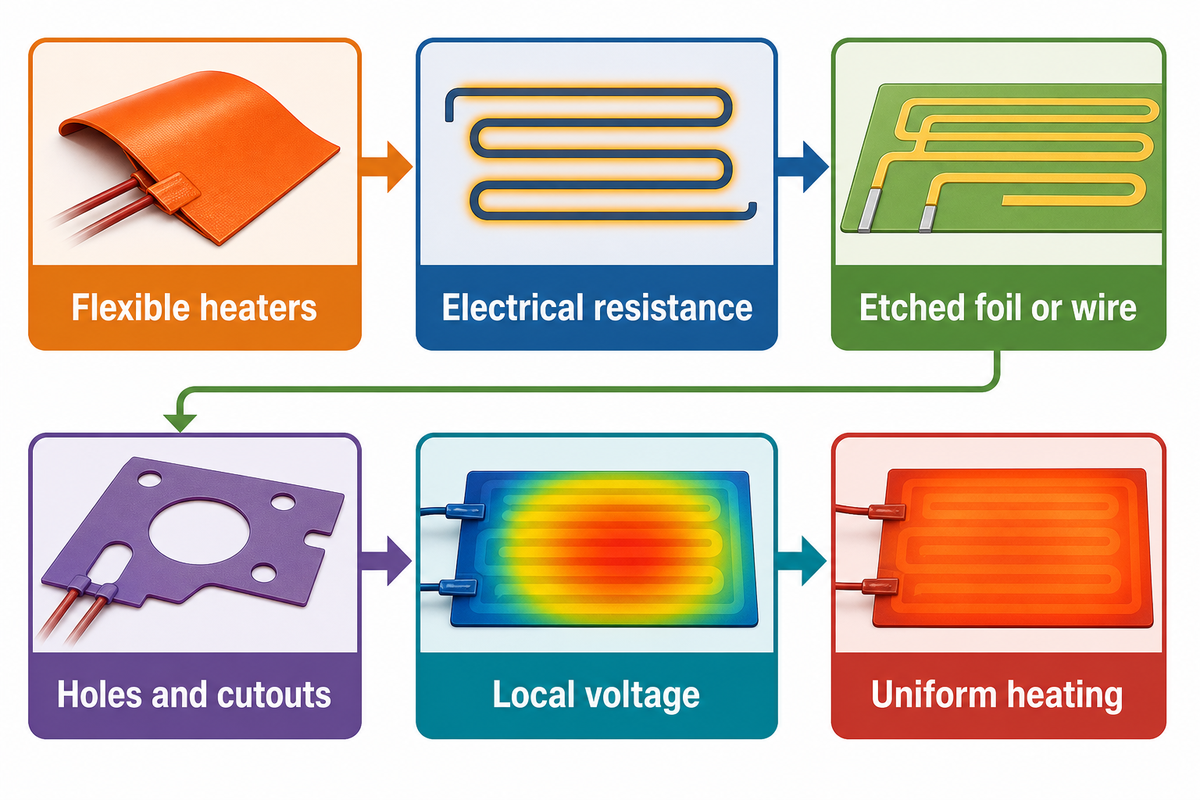
Both material families are types of flexible heaters. Inside each heater, a heating element is placed within an insulating material stack so electrical resistance creates heat close to the target surface. The element can be etched foil, wire wound, or another circuit design. Heat distribution depends on that pattern as much as the outside material.
Either silicone heater or polyimide heater can fail if the surface is uneven, the adhesive is misused, the sensor reads the wrong location, or the controller cannot react to a hot spot. That is why heater manufacturing drawings should show holes, cutouts, cold zones, lead reinforcement, bend zones, mounting method, and test values. The material name is only one line in the design file.
For heaters and silicone or polyimide builds, choosing the right material means matching application requirements to environmental factors. Flexible heaters are used across various industries because heaters are designed around many application categories, but uniform heating is required only when the contact path, heat output, and precise temperature control are specified together. Extreme temperature language should be tied to the actual heater stack, not copied from a catalog range.
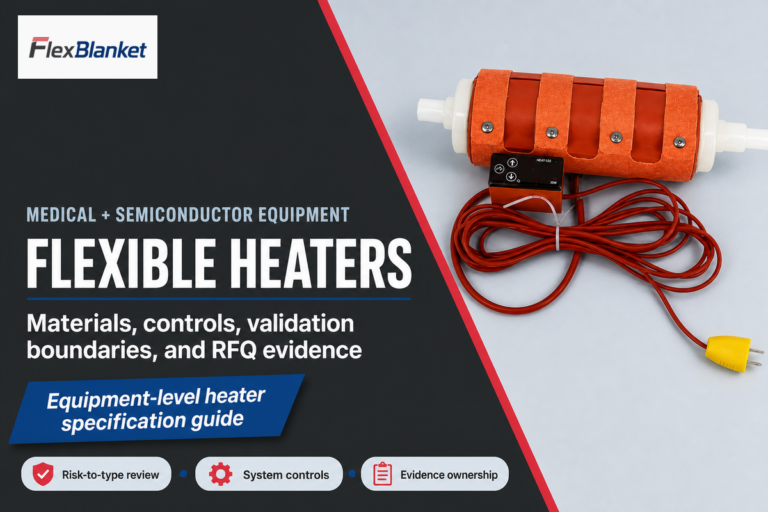
FlexBlanket’s flexible heaters page uses the same practical framing: define geometry, temperature, environment, and local voltage before a heating solution is quoted.
Material-to-Risk Decision Matrix
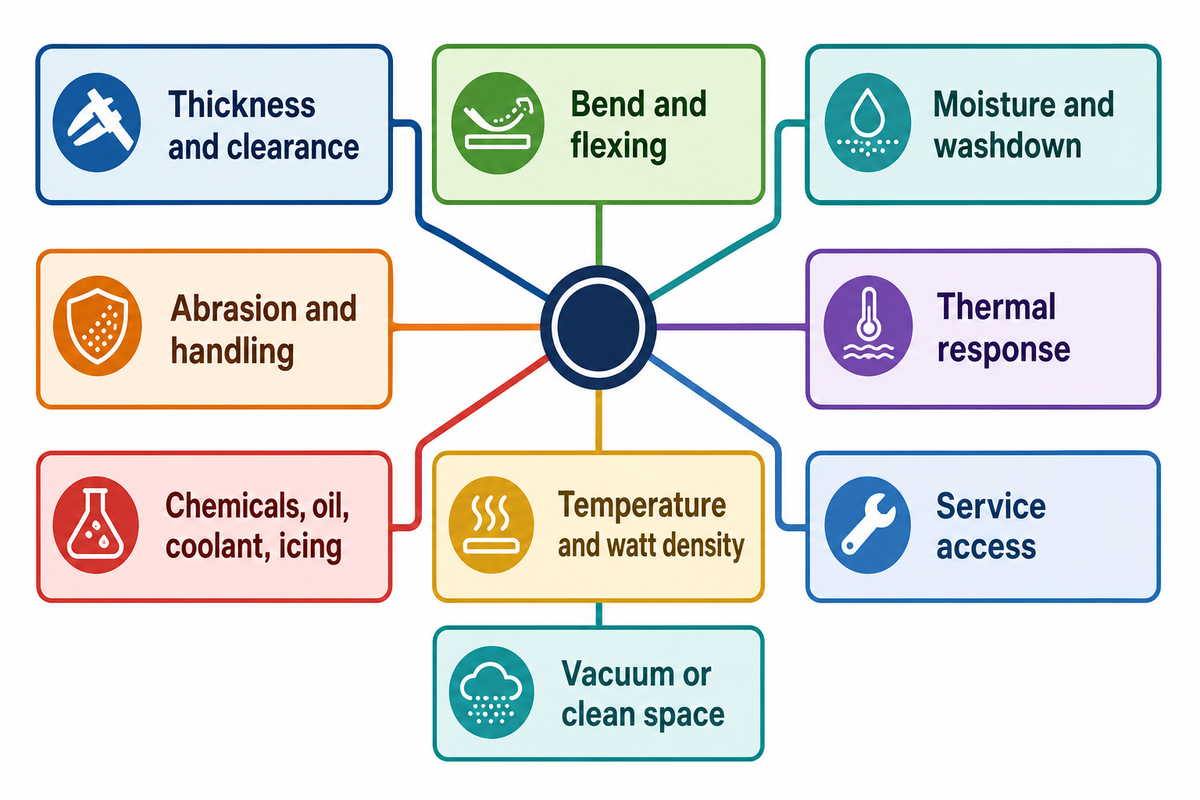
Use this Material-to-Risk Decision Matrix before sending a drawing. It is meant for process engineers, procurement managers, and quality reviewers who need to compare polyimide and silicone rubber without turning supplier ranges into false absolutes.
| Risk category to screen | Silicone rubber is usually stronger when… | Polyimide is usually stronger when… | Proof to request |
|---|---|---|---|
| Thickness and clearance | The assembly accepts a thicker heater and needs protection | The heater must fit under tight covers or bonded parts | Stack height, adhesive, lead patch, and drawing tolerance |
| Bend and flexing | The heater is bent once around a drum, tank, or pipe | The bend radius is known and the film stack is qualified | One-time install bend versus powered dynamic flex cycle count |
| Moisture and washdown | Edges, leads, controller, and connector can be sealed for the site | The supplier can seal edges and leads for the actual exposure | Lowest-rated component, IP record, seal method, and maintenance condition |
| Abrasion and handling | Operators remove, store, or reinstall the heater | The heater is protected inside the equipment | Jacket, lead strain relief, packing, and service method |
| Thermal response | The load is large and response speed is less important than coverage | Low mass and fast ramp matter more than mechanical shielding | Heat sink, warm-up time, sensor placement, and controller behavior |
| Chemicals, oil, coolant, icing | The complete assembly is rated for the actual fluid and service | The film, adhesive, seal, and lead exit have matching evidence | Chemical list, exposure time, cleaning method, and rating boundary |
| Temperature and watt density | Larger areas can spread heat with better contact | The bonded heat sink can remove heat from a small zone | W/in2, surface map, duty cycle, controller, and high-limit cutoff |
| Service access | The heater may be removed, stored, or reinstalled during maintenance | The heater stays protected inside a fixed equipment assembly | Handling method, packing limit, cable bend route, and replacement plan |
| Vacuum or clean space | Only when the exact silicone stack has outgassing and cleanliness evidence | Only when the exact polyimide material, adhesive, and lead patch are qualified | Low outgassing properties, lot record, sealant data, and test condition |
Polyimide Flex Heaters vs Silicone Rubber Flex Heater Limitations
PCEA’s discussion of flexible heater temperature limits shows why materials used in the stack matter: adhesive systems can move a zero-power limit from about 125°C to above 200°C, and trace-to-space layout may sit around 40% to 60% depending on the circuit. PCEA frames those figures as examples for a heater bonded void-free to a rigid metallic heat sink, with no flexing after installation and power reduced to zero at peak temperature; its 125°C example also assumes low watt density below 10 W/in2. Those values make chemical resistance, wide temperature range claims, and lower cost quotes secondary to the actual construction.
Where Silicone Rubber Usually Wins
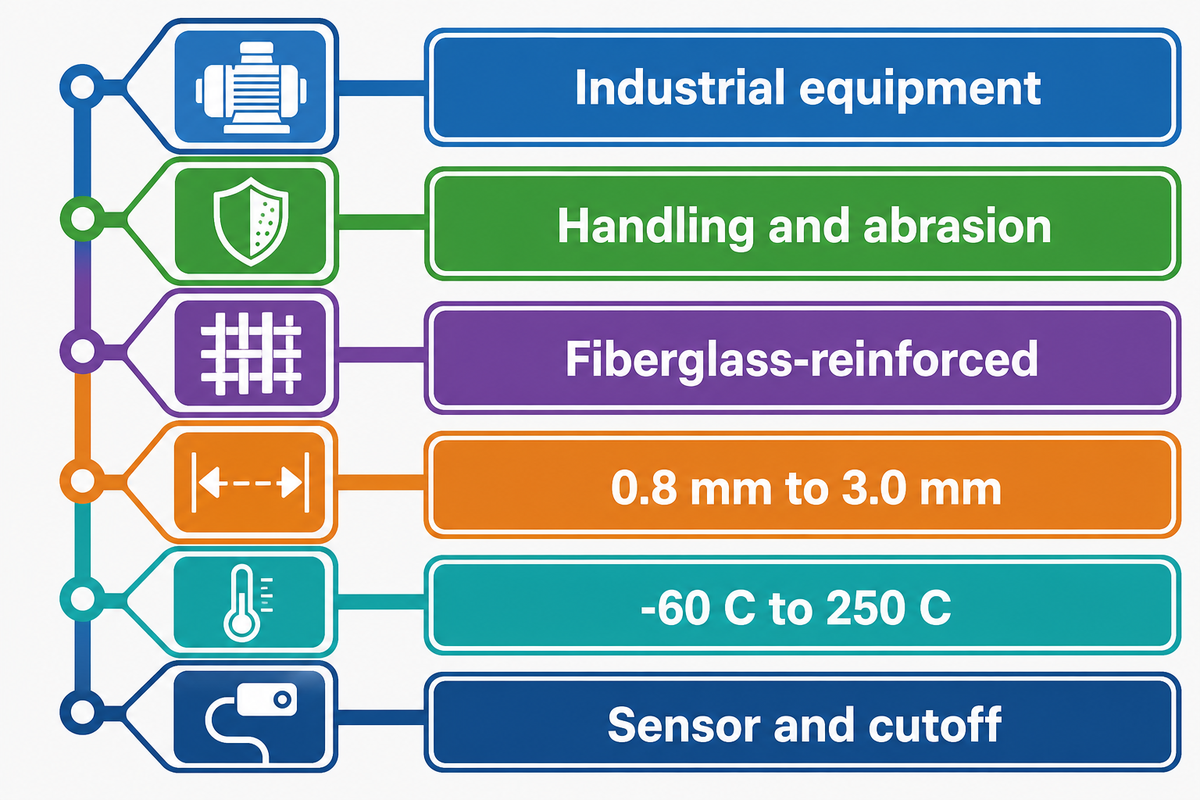
Silicone rubber heaters usually win when the heater has to behave like industrial equipment, not a lab film. Think drums, barrels, pipe sections, valve bodies, vessels, removable blankets, composite tooling, and plant-floor surfaces that see handling, vibration, abrasion, moisture, or imperfect contact.
FlexBlanket’s silicone rubber heaters page describes fiberglass-reinforced silicone rubber heaters with custom shapes, holes, cutouts, DC and AC voltage options, thickness from 0.8 mm to 3.0 mm, and a product-file operating range from -60 C to 250 C. Treat those as first-party component data for quotation review, not a promise that every installed heater is outdoor, hazardous-area, washdown approved, or cleared for that full range in the final assembly. Confirm the current project limit in the quote drawing because overview pages and finished assemblies can carry narrower limits.
The Durex analytical-equipment case also shows why surface contact matters: air gaps on a cylindrical aluminum vessel raised uniformity and premature-failure risk, so the corrected path used a factory-vulcanized silicone rubber heater, sensor, and over-temperature cutoff. The lesson is not that silicone is always safer. The lesson is that contact, sensor location, and cutoff logic can decide heater life.
Where Polyimide Usually Wins
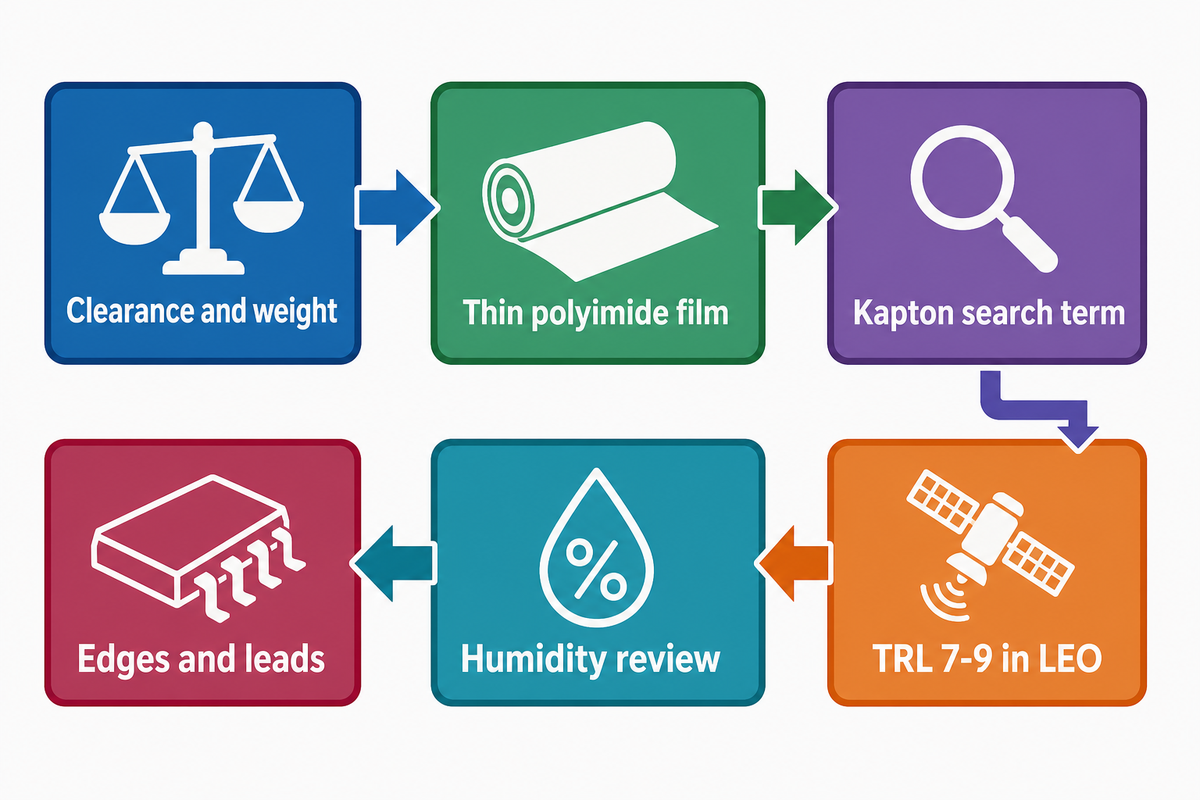
Polyimide usually wins when clearance, weight, and fast response matter. In compact builds, a polyimide flexible heater can fit instruments, aerospace hardware, electronics, battery fixtures, medical devices, and sensor-adjacent surfaces where a thin polyimide film can bond directly to a controlled heat sink.
Kapton heater is common search language, but the drawing should specify the actual kapton polyimide film, adhesive, conductor, lead patch, and rating. NASA SmallSat thermal-control guidance identifies Kapton resistance heaters as common SmallSat thermal-control hardware and lists electrical heaters at TRL 7-9 in low Earth orbit. That is space-context evidence, not qualification or approval for a different heater.
Polyimide also needs environmental review. DuPont’s Kapton film data shows moisture can change electrical properties, including dielectric strength and dielectric constant under different relative-humidity conditions. Minco’s heater FAQ adds a practical distinction: polyimide materials may resist water, but edges and leads need the right sealing if the heater will face immersion or other liquid exposure.
Heat-Stack Fit Ladder
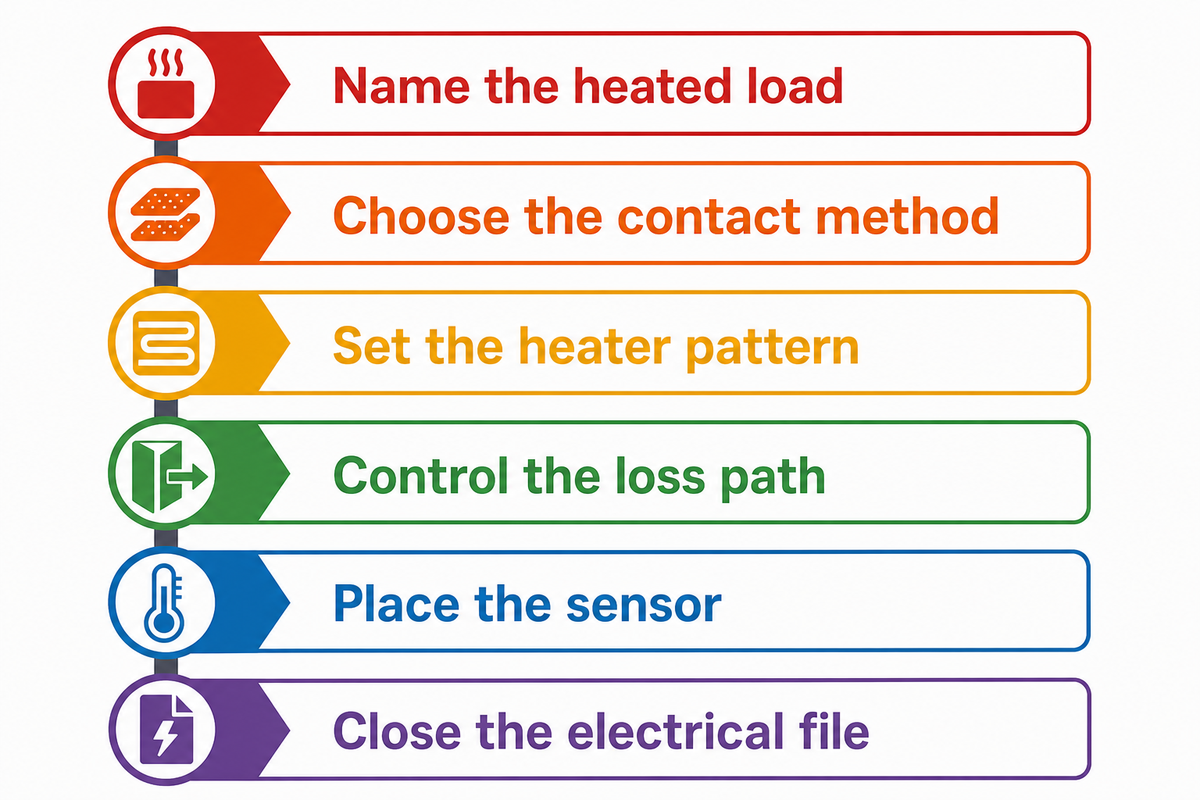
The Heat-Stack Fit Ladder is the design engineer’s check before selecting the right solution. It moves from the heated object outward, because reliable heat transfer starts at the load and ends at the approval file.
- Name the heated load – record material, mass or amount, surface material, geometry, and access limits.
- Choose the contact method – compare adhesive, clamping, vulcanizing, sewn blanket, or removable jacket by heat path and service duty.
- Set the heater pattern – define etched foil, wire wound, holes, cutouts, cold zones, and watt density around heat-loss areas.
- Control the loss path – add insulation, backing, airflow, ambient, and mounting orientation to the heat-transfer review.
- Place the sensor – make the sensor read the risk point, not the easiest wall or comfort point.
- Close the electrical file – define voltage, amperage, controller, ground fault protection, high-limit cutoff, wiring, and documentation scope.
NEL’s failure review points to hot spots, poor heat transfer, moisture ingress, cable sealing, thermal cycling, and wrong controls as causes of early flexible heater failure. OMEGA’s silicone blanket manual also places responsibility on electrical protection and recommends ground fault protection. That makes the ladder a safety and reliability screen, not only a performance checklist.
4 Failure-Mode Heat Map That Makes the Wrong Heater Look Right
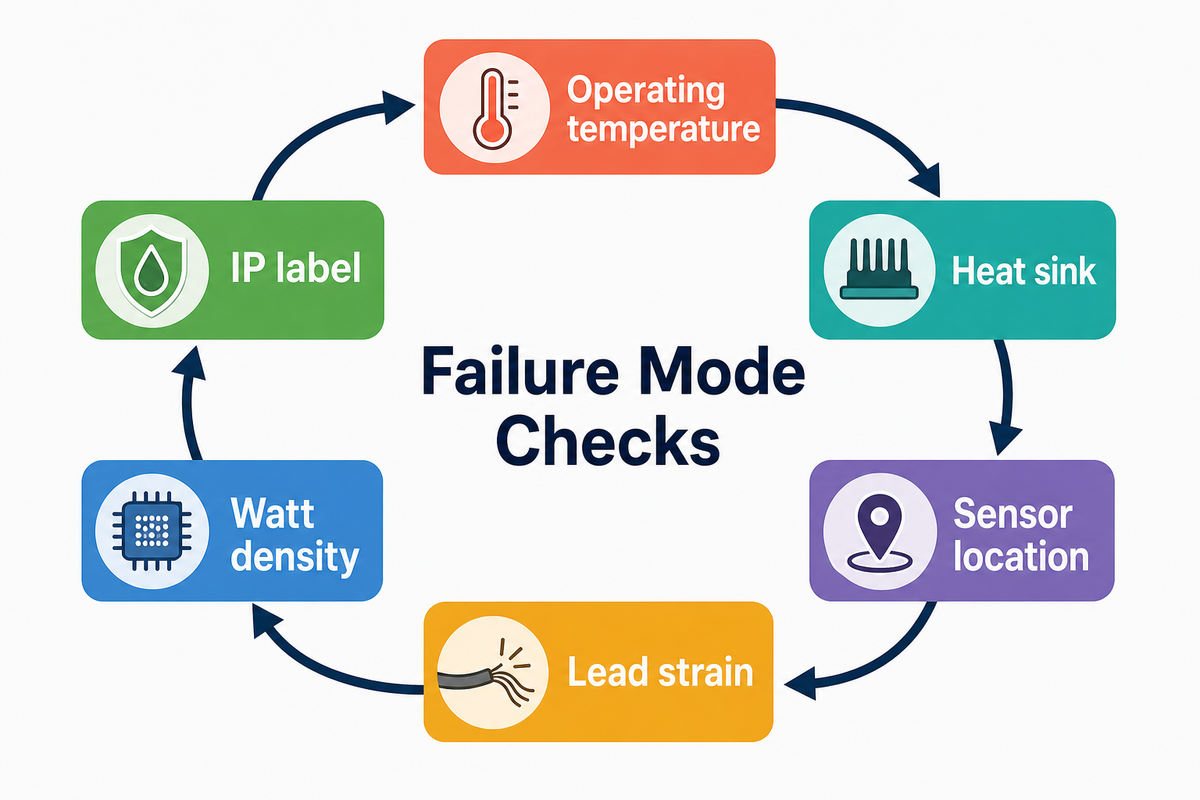
Quote tables can make a heater look correct while the plant still gets the wrong part. These four failure modes are the hidden bottleneck map for project engineers, operations managers, and safety reviewers.
Do
- Compare operating temperature with heat sink, duty cycle, and sensor location.
- Separate one-time bend-to-install from repeated powered flexing.
- Raise heater area or contact quality before raising watt density.
- Ask where the controller reads the real hot spot.
Don’t
- Choose by maximum temperature alone.
- Treat a thin heater as immune to lead strain.
- Use more wattage to hide poor surface contact.
- Assume an IP label covers oil, coolant, corrosion, or icing.
This is where many heater comparisons go wrong. Higher stated operating temperature can be less safe if the adhesive, contact pressure, element pattern, or cutoff is wrong. Thin polyimide material can be the better option in a compact heat sink, but the same choice can fail if the cable exit flexes during service. Silicone rubber heaters and polyimide heaters are made to solve different problems, so the specific application has to control the choice.
How to Write a Useful Request for Quote
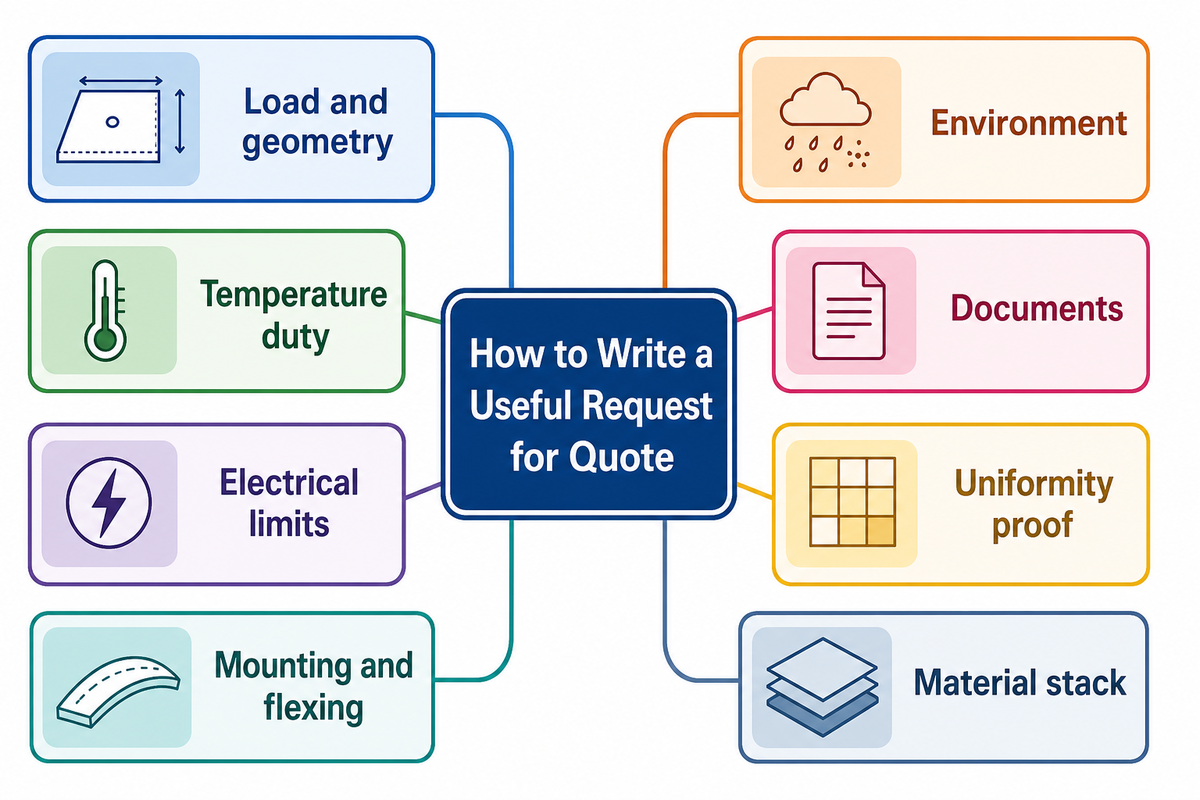
Useful quote requests work as a minimum intake pack, not a complete engineering release. Send enough data for the supplier to reject the wrong heater before a sample is built.
Factors to Consider When Choosing the Right Solution
| RFQ field | What to send | Failure mode it prevents | Owner |
|---|---|---|---|
| Load and geometry | Material being heated, amount, surface material, drawing, holes, cutouts, and access limits | Wrong heat sink or poor contact | Process engineer |
| Temperature duty | Start temperature, target temperature, temperature rise, heat-up time, hold time, and allowable overshoot | Overheated product or slow warm-up | Plant engineer |
| Electrical limits | Voltage, phase, amperage, wattage, watt density, controller, sensor type, high-limit control, and ground-fault plan | Unsafe circuit, wrong control point, or no fault path | Electrical engineer |
| Mounting and flexing | Adhesive, clamp, vulcanized bond, bend direction, minimum radius, dynamic-flex cycles, lead exit, and connector | Cracked circuit or failed lead | Design engineer |
| Environment | Moisture, washdown, chemicals, oil, coolant, outdoor exposure, vacuum, abrasion, and cleaning method | Wrong seal, adhesive, or rating boundary | Maintenance lead |
| Documents | Quantity, sample plan, drawing revision, certification target, test records, and change-control needs | Prototype proof that cannot support production | Procurement manager |
| Uniformity proof | Heat map target, even heat distribution band, sensor point, cold edge allowance, and acceptable overshoot | Hot spot hidden by average surface temperature | QA engineer |
| Material stack | Materials such as silicone rubber, polyimide film, adhesive, sealant, lead patch, and insulation backing; heaters are also checked for cleaning and storage duty | Wrong lowest-rated layer or edge seal | Design engineer |
UL 499’s public listing covers electric heating appliances rated 600 V or less, but any finished-device approval or listing depends on the product boundary, wiring, controller, destination market, and test file. For vacuum or space-adjacent jobs, NASA lessons-learned guidance points to product-specific outgassing data and lot control. Put those needs in the first inquiry, not after price review.
UL 499’s public listing covers electric heating appliances rated 600 V or less, but any finished-device approval or listing depends on the product boundary, wiring, controller, destination market, and test file.
FlexBlanket Fit Notes for Industrial Heating Blankets
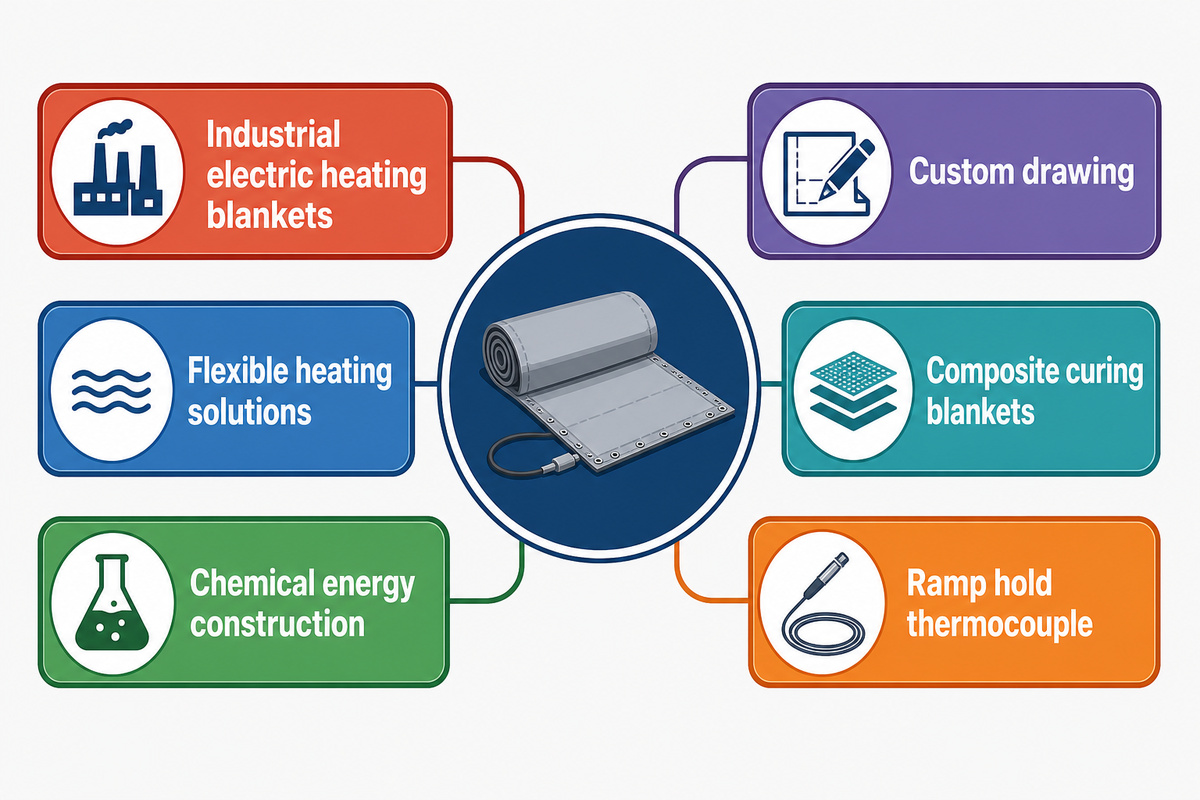
FlexBlanket manufactures industrial electric heating blankets and flexible heating solutions for chemical, energy, construction, and manufacturing users. In this comparison, its public pages are best used as fit notes and quote routes, not as independent proof that one material beats the other.
Use custom industrial heating blankets if the heater shape, wattage, voltage, lead exit, or sensor requires a custom drawing. Use drum heating blankets and IBC tote heaters if the load is a container. Use pipe heating blankets if the load is a serviceable pipe section, valve, or process line.
For bonding, curing, and temperature-hold work, connect the material decision to the process file. FlexBlanket’s composite curing blankets route should receive ramp, hold, thermocouple, and uniformity requirements, not only a blanket size. Company-provided background says FlexBlanket products are trusted by global industrial users, including L’Oreal and wind power operators; treat that as brand context unless the purchase file needs independent case evidence.
Key takeaway
Select the heater material after the heat stack is known. Silicone rubber and polyimide can both be the right choice when the surface, watt density, bend, sealing, controls, and evidence match the duty.
FAQ
Which is better, a silicone rubber heater or a polyimide heater?
Answer
Neither heater type is automatically better. Silicone rubber usually fits rugged industrial assemblies, thicker insulation, larger areas, and handled surfaces. Polyimide usually fits thin, lightweight, fast-response assemblies. Compare temperature range, watt density, bend radius, surface shape, controller strategy, lead exit, sealing, electrical protection, and approval requirements together before releasing a drawing or purchase order.
Is a Kapton heater the same as a polyimide heater?
Answer
Kapton is a well-known polyimide film brand, so buyers often use Kapton heater and polyimide heater as near-synonyms. Safer specification language is “polyimide film flexible heater” with the exact film, adhesive, conductor, thickness, temperature rating, bend allowance, edge seal, and lead construction shown on the supplier drawing and test record.
When should an engineer choose silicone rubber instead of polyimide?
Answer
Choose silicone rubber when the heater must handle rougher service, larger heated areas, removable blanket use, damp exposure with proper sealing, or plant-floor installation where abrasion and lead strain are likely. It is a practical option for tanks, drums, pipes, and industrial blankets when mechanical durability matters more than a very thin profile.
Can polyimide heaters be used in industrial equipment?
Answer
Yes, if the environment and mounting method match the film heater’s limits. Polyimide flexible heaters can suit compact equipment, electronics, instruments, aerospace hardware, and small heat zones. They are not drop-in replacements for every plant-floor blanket, so verify humidity, adhesive, bend duty, edge seal, lead exit, and evidence records.
What specifications should be sent with a heater request for quote?
Answer
Send the surface size and shape, heated material, amount or mass, target temperature, ambient temperature, heat-up time, voltage, phase, amperage, wattage or watt density, sensor type and location, control method, high-limit cutoff, lead exit, connector, adhesive or clamping method, chemical and moisture exposure, insulation limits, quantity, compliance target, drawing revision, sample plan, acceptance test, and the person who owns approval. Procurement should also name whether rubber or polyimide is only a preference or a fixed material rule. That distinction lets the supplier offer the right solution instead of quoting a lower cost part that misses the duty.
Is silicon rubber heaters the right phrase?
Answer
No. Searchers sometimes type silicon rubber heaters, but the material used in this heater family is silicone rubber. Silicon is the element; silicone rubber is the elastomeric insulation material used in many flexible heater assemblies.
How This Guide Was Built
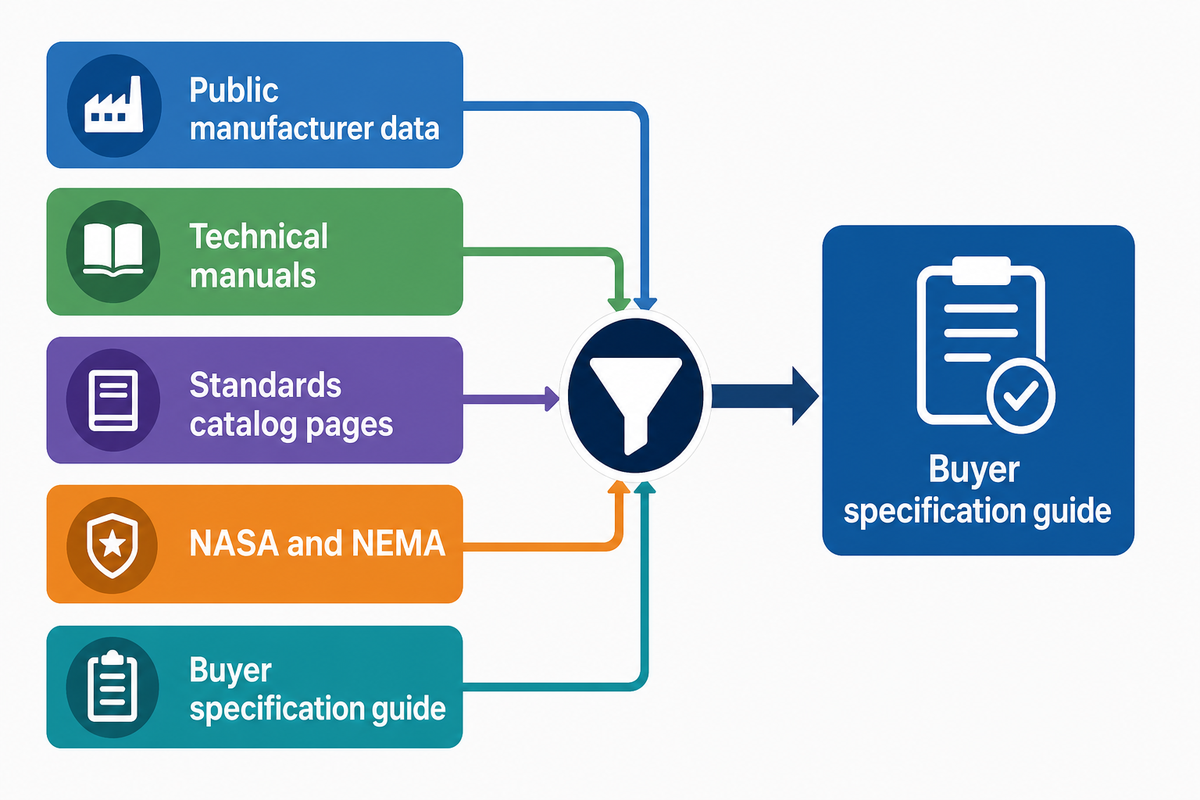
FlexBlanket’s heater comparison guide uses public manufacturer data, technical manuals, standards catalog pages, NASA and NEMA boundary guidance, academic context, and FlexBlanket first-party pages available during the August 2026 workflow. It is a buyer specification guide, not legal, electrical-code, hazardous-location, medical-device, or spacecraft qualification advice.
Related FlexBlanket Resources
References & Sources
- Watlow flexible heaters catalog.
- Durex Industries polyimide heaters.
- OMEGA silicone rubber heating blanket manual.
- GlobalSpec flexible heaters selection guide.
- Minco flexible heater FAQ.
- PCEA flexible heater temperature limits.
- NASA SmallSat thermal control guidance.
- NASA materials and outgassing lesson.
- NEMA bulletin on NEMA and IP ratings.
- UL 499 public listing page.
- NEL flexible heater life and failure causes.
- Durex silicone rubber heater analytical equipment case.
- Tempco request for quote fields.
- FlexBlanket flexible heaters.
- FlexBlanket silicone rubber heaters.