Get in touch with FlexBlanket Company

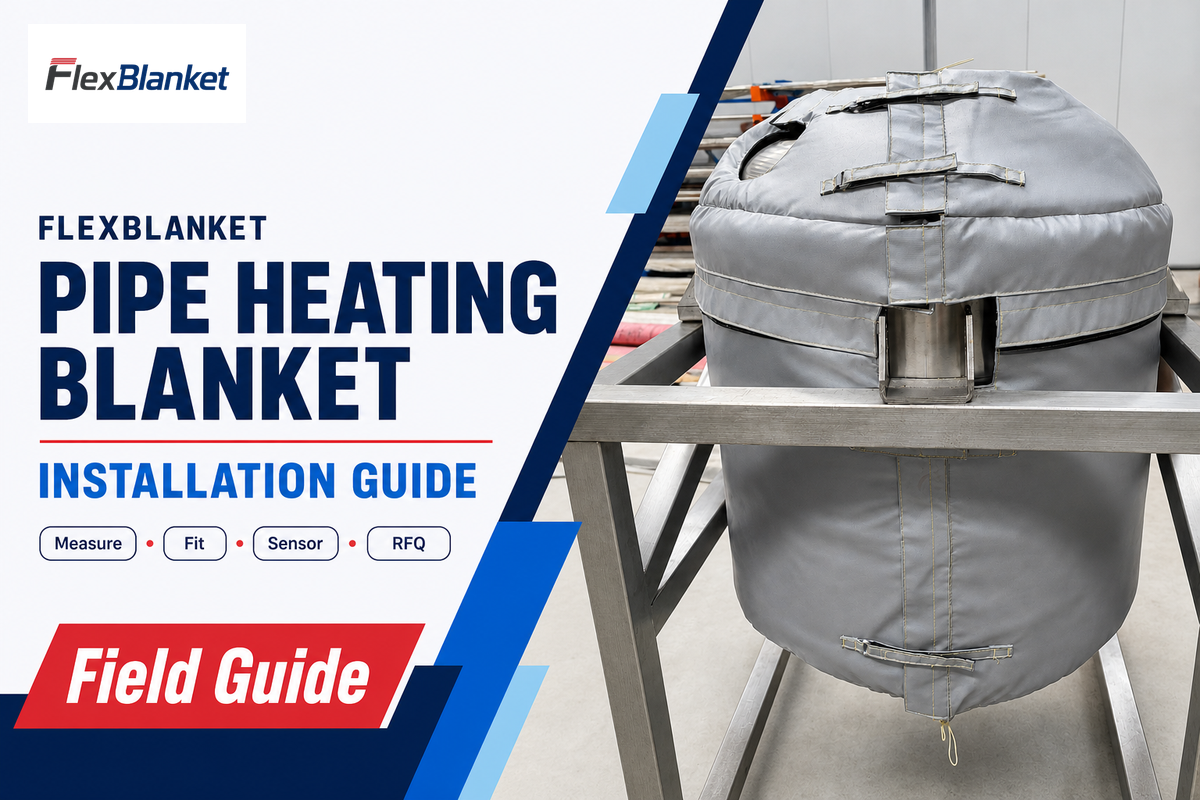
Pipe Heating Blanket Installation Guide for Field Commissioning

Updated August 2026
A Pipe Heating Blanket Installation Guide is a field checklist for matching a flexible electric heater to the measured pipe, placing the heater and sensor, confirming voltage, insulation, and approval boundaries, and recording the first energized run. This guide is written for industrial piping, manifolds, valves, and short heat zones where a removable custom blanket may be a better fit than continuous cable tracing.
On a live industrial site, a pipe heating blanket is not just a warm wrap. The work includes the pipe surface, insulation plan, controller, sensor point, lead exit, voltage at the installation point, and the acceptance record after the first heat cycle. FlexBlanket builds custom industrial electric heating blankets and pipe tracing blankets for standard and custom pipe diameters, so the most useful installation work starts before the blanket is made: measure the pipe, state the process target, mark access limits, and decide how the first run will be accepted.
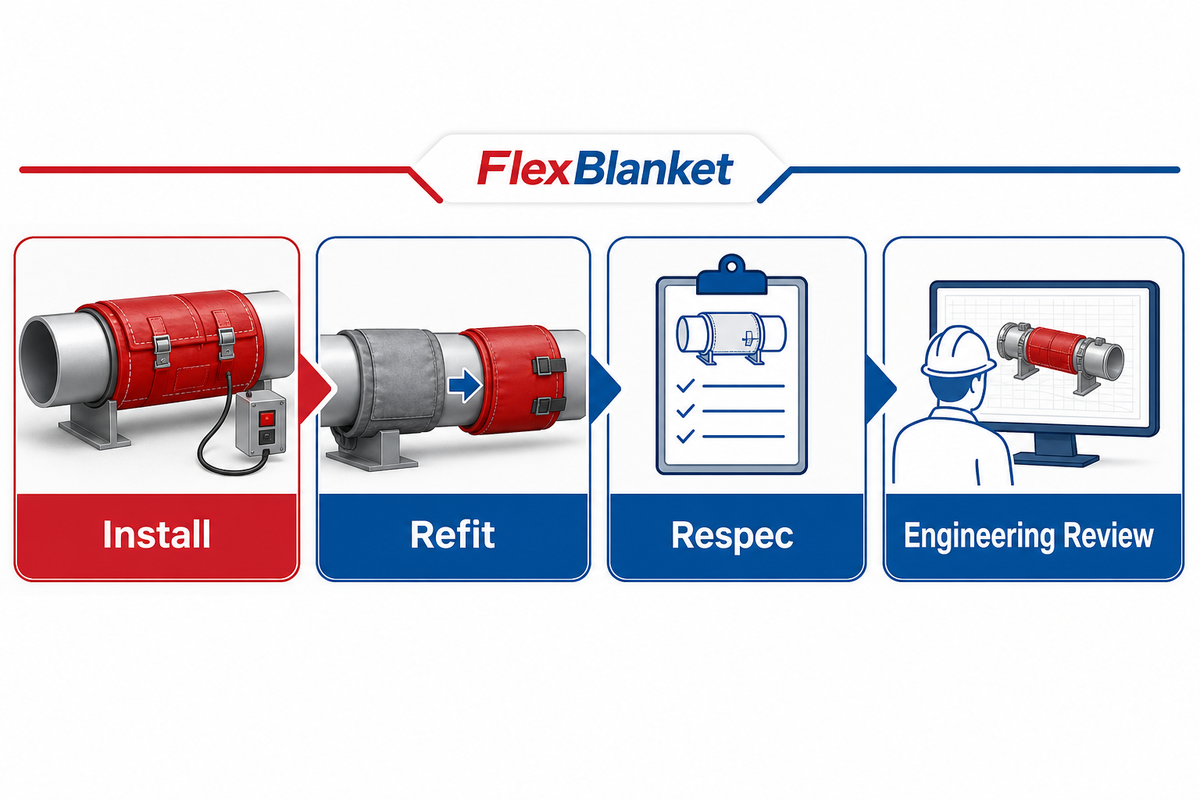
This article does not replace a model manual, site electrical procedure, lockout procedure, classified-location review, or local code review. It gives plant, maintenance, and purchasing teams a field structure for deciding whether to install, refit, respec, or send the project back for engineering review.
Need a custom pipe blanket reviewed? Send pipe outside diameter, heated length, photos, voltage, controller needs, lead exit, insulation plan, and acceptance method to FlexBlanket. Open the RFQ review form.
1. Installation Scope: When a Pipe Heating Blanket Is the Right Method
Use a pipe heating blanket when the heated zone is local, the pipe geometry is irregular, access is needed, or the pipe section must be removed, inspected, or serviced more often than a permanently traced line. Examples include short transfer lines, drain legs, pump suction lines, manifolds, outdoor valve bodies, flange areas, and process points that need a known heated length.
Blankets can be the wrong method when the line needs certified continuous trace heating, long-run freeze protection, explosive-atmosphere trace-heater approval, or a fire-sprinkler system listing. In those cases, the method decision is not only mechanical. It belongs in engineering and compliance review before purchasing.
| Field finding | Decision | Reason |
|---|---|---|
| Short exposed pipe or manifold zone with routine access | Install | A removable blanket can match the local heated area and still allow inspection. |
| Gaps, loose wrap, pinched lead, or blocked sensor point | Refit | The field fit does not match the approved drawing or manual. |
| Wrong voltage, unknown pipe size, missing target temperature, or changed insulation plan | Respec | The heater request has changed from the ordered conditions. |
| Hazardous classified location, certified fire-protection system, safety shower, or regulated process loop | Engineering Review | The approval question is application-specific and cannot be solved by field fit alone. |
For selection-level comparisons, use the existing FlexBlanket article on pipe heating blanket selection and installation planning. The rest of this guide focuses on field acceptance after the method has been chosen.
2. Field Measurements Before Installation
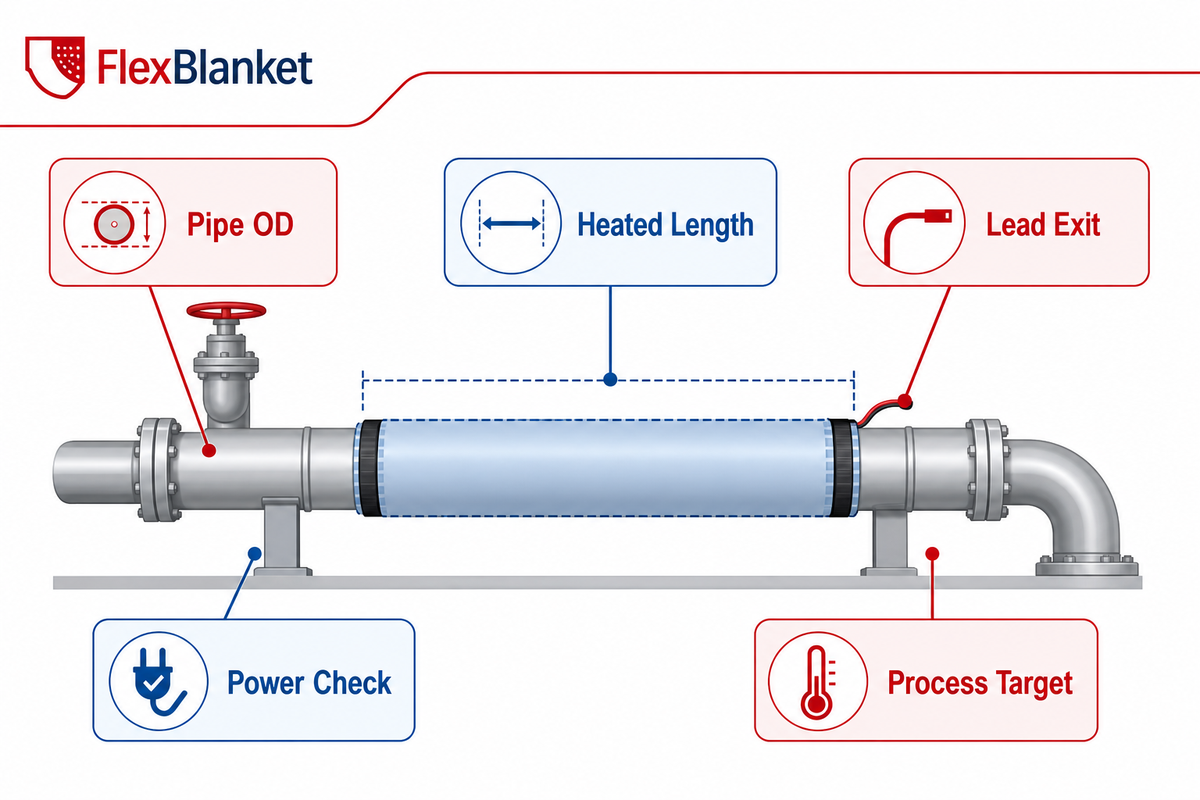
Measure the pipe before the blanket is built and again before it’s installed. The installer shouldn’t rely on nominal pipe size alone. Outside diameter, heated length, supports, elbows, flanges, valves, drain fittings, welded bosses, instrument taps, insulation thickness, and lead-exit clearance affect whether the blanket can lie flat and remain serviceable.
Start with a photograph from each side of the pipe and mark the heated zone with tape or tags. Record whether the pipe is bare metal, painted, insulated, wet, corroded, oily, or exposed to washdown, wind, or chemical splash. If the surface isn’t fit for heater contact under the supplied instructions, stop before energizing.
- Pipe outside diameter: measured value, not only nominal pipe size.
- Heated length: start and end marks, plus any no-heat clearance near fittings.
- Interference points: valves, unions, supports, flanges, elbows, sensors, clamps, and sharp edges.
- Lead exit: preferred direction, strain relief, panel route, and drip or washdown exposure.
- Process target: freeze protection, viscosity hold, cure assist, preheat, or maintenance temperature.
- Power at the location: actual site voltage and frequency, checked against the quoted build before energizing.
FlexBlanket’s RFQ specification checklist, voltage and plug compatibility check, and heater sizing worksheet can turn these field details into a reviewable request.
| Evidence type | Public value to preserve | How it should guide installation |
|---|---|---|
| Thermal insulation | 1 in pipe, about 10 W/ft uninsulated, about 1.5 W/ft with 1 inch fiberglass, under the cited 40 °F temperature-difference example | Treat insulation as part of the heat path, not as decoration. |
| Freeze example | 0.75 in pipe, 25 mm insulation, 13 hours at -10 °C, supplier example with no visible calculation method | Use only as a warning that insulation alone can fail; do not use it as a blanket sizing method. |
| FlexBlanket voltage planning | The current homepage lists 110 V, 220 V, 240 V, and 380 V custom builds, single-phase or three-phase options, and a 1 W/in² to 15 W/in² watt-density example | Treat these as capability examples; final build follows measured site supply, phase, frequency, plug package, and quoted wattage. |
| FlexBlanket material planning | The current homepage lists pipe heating blankets up to 200 °C / 392 °F and silicone rubber heaters up to 230 °C / 446 °F | Use the quote data sheet as binding; do not treat material resistance wording as the installed setpoint. |
| Voltage tolerance boundary | According to a cited flexible-heater manual, a 10% voltage-tolerance example | Record voltage against the specific model manual. |
| Winterization surface loading | 0.6 W/cm2 to 1.5 W/cm2 examples | Keep published values as context, not blanket sizing advice. |
| Hazardous energy boundary | 29 CFR 1910.147 reference | De-energize and service under site lockout procedure. |
| Hazardous-location marking | 40 °C / 104 °F ambient marking basis in 29 CFR 1910.307(c)(2)(ii) | Do not claim approval without location-specific marking evidence. |
| Trace-heating standard update | BS EN IEC/IEEE 62395-1:2026, EN IEC/IEEE 62395-1:2026, and IEC/IEEE 62395-1:2024 | Use official standard-body pages for scope context, not as FlexBlanket product certification. |
| Explosive-atmosphere trace heaters | IEEE/IEC 60079-30-1-2025 | Escalate classified-location projects before installation. |
3. Surface, Fit, and Contact Check Before Energizing
How to install a heating blanket?
Install a heating blanket by confirming the exact product family, matching the blanket to the marked pipe zone, checking surface condition, placing it against the pipe per the supplied drawing, fastening it without lead strain, verifying the sensor and controller arrangement, and recording the first heat cycle before handover. Those measurement records make the fit check traceable instead of visual only.
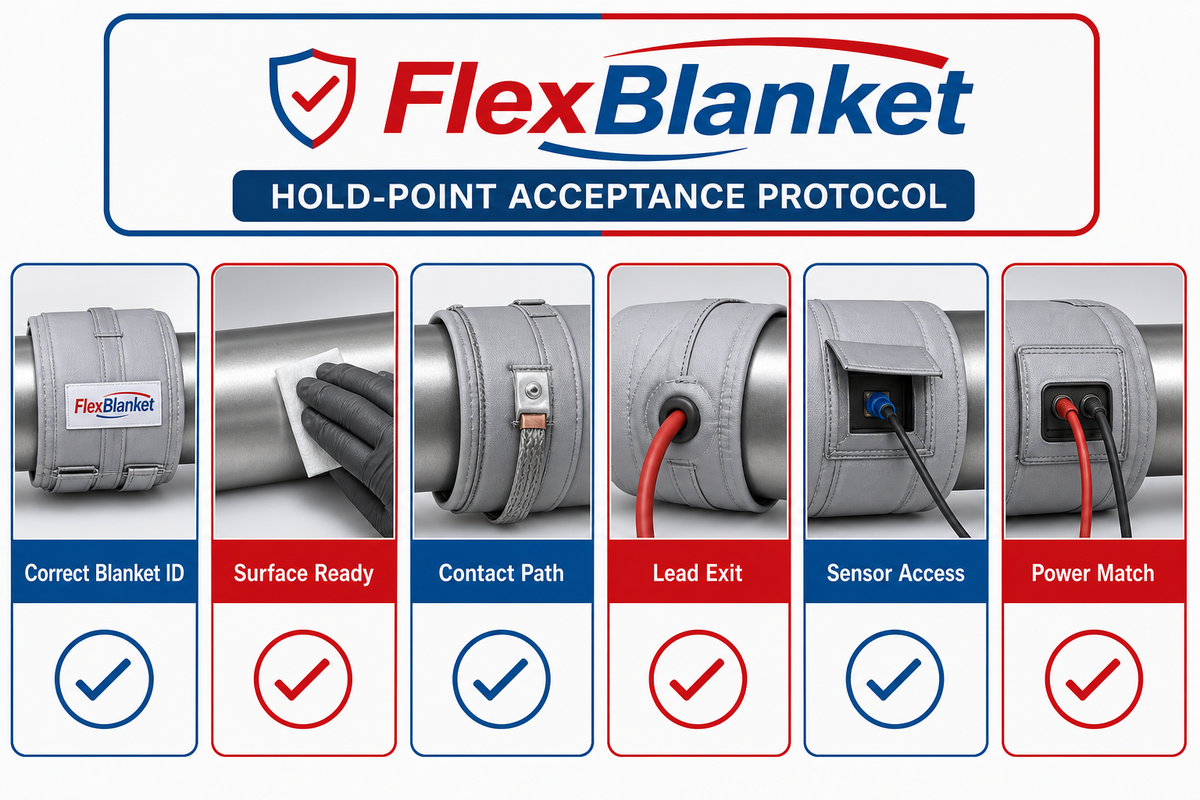
The field mistake to avoid is treating “wrapped around the pipe” as the same as “accepted for operation.” A blanket that bridges over a fitting, traps wet insulation, pulls against a cord assembly, or covers the wrong sensor point may still look installed from a distance. Use the hold-point protocol below before power is applied.
8 Point Pipe Fit Acceptance Protocol
| Point | Pass condition | If it fails |
|---|---|---|
| 1. Correct blanket ID | Label, drawing, and pipe tag match. | Respec. |
| 2. Surface ready | Surface condition matches the manual and site procedure. | Stop and correct surface. |
| 3. Contact path | Heated face sits against the intended pipe area. | Refit. |
| 4. Folds and overlap | Wrap path follows the supplied design. | Do not invent a field overlap rule; ask engineering. |
| 5. Lead exit | Lead is routed without tension, abrasion, pinch, or heat damage risk. | Refit or reroute. |
| 6. Fastening | Tie, strap, hook, or latch method matches the blanket design. | Refit with the correct fastening method. |
| 7. Sensor access | Sensor point is visible, recorded, and not buried under guesswork. | Engineering Review. |
| 8. Power match | Nameplate and installation-point voltage are verified. | Respec before energizing. |
4. Insulation and Moisture Handoff
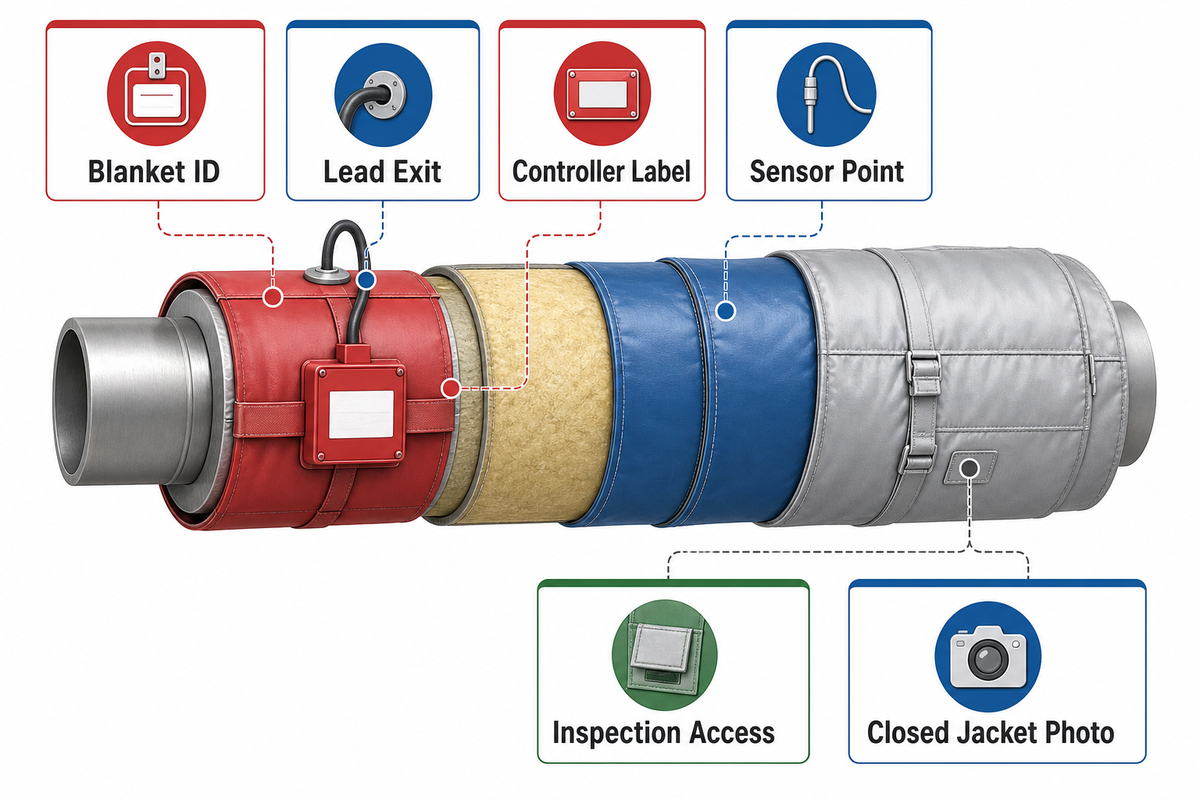
Thermal insulation can make the difference between a heater that holds condition and a heater that is asked to fight wind, water, and exposed metal. It does not generate heat by itself. A common failure path is installing the heater, adding insulation, and then losing visibility of wet spots, loose jackets, gaps at valves, or a sensor that no longer represents the controlled condition.
One NIA heat-tracing insulation example puts a 1 in pipe at about 10 W/ft heat loss without insulation and about 1.5 W/ft with 1 inch of fiberglass under its stated 40 °F temperature-difference example. That kind of difference explains why the blanket, insulation, moisture barrier, and inspection access must be accepted together, not as separate jobs.
Before the insulation contractor closes the area, record the blanket ID, lead exit, controller label, sensor point, insulation type, removable section, and any area that must stay visible for inspection. If insulation has to be removed for service, the reinstall step should include a repeat visual check, not just a note that the blanket was put back.
For outdoor pipe runs, add a handoff photo after the insulation jacket is closed. The photo should show label access, cable route, drain direction, jacket seams, and any removable cover. This small record helps the next shift see whether a later fault is a heater problem, an insulation problem, or a post-installation change to the pipe.
5. Sensor Placement and Controller Verification
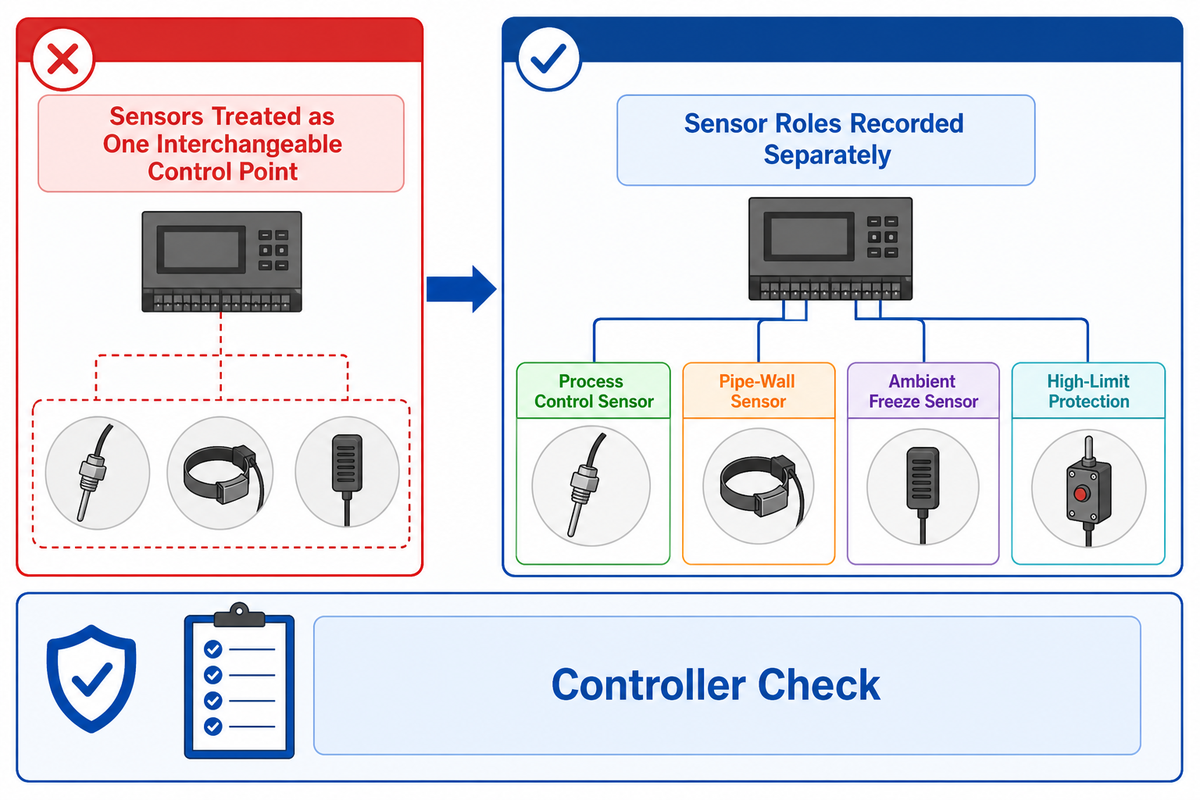
Do not collapse every sensor into one rule. A process-control sensor asks whether the pipe, media, or surface condition has reached the controlled target. A heater high-limit or over-temperature sensor asks whether the heater or nearby surface is being protected. An ambient freeze-protection sensor may only tell the controller when outdoor air has crossed a trigger point. These are not interchangeable.
| Control question | What to record | Do not assume |
|---|---|---|
| Process control sensor | Controlled variable, setpoint, sensor type, location, and attachment method. | That a heater-protection sensor proves process temperature. |
| Pipe-wall sensor | Pipe position, insulation state, contact method, and whether it is under the blanket. | That pipe wall equals liquid temperature in every process. |
| Ambient freeze sensor | Air location, weather exposure, trigger value, and controlled circuit. | That ambient air proves the pipe is above freezing. |
| High-limit or over-temperature protection | Manual-required location, trip value if provided, reset method, and test record. | That it replaces process control or site electrical protection. |
| Controller display and current check | Demand state, output indication, current if site procedure requires it, and alarm state. | That a lit display proves the heater is delivering heat. |
For FlexBlanket custom projects, include the sensor and controlled point in the RFQ. If the controlled point is unknown, the correct answer is not to guess. Mark it for engineering review.
6. First Heat Cycle and the Cold Start Commissioning Log
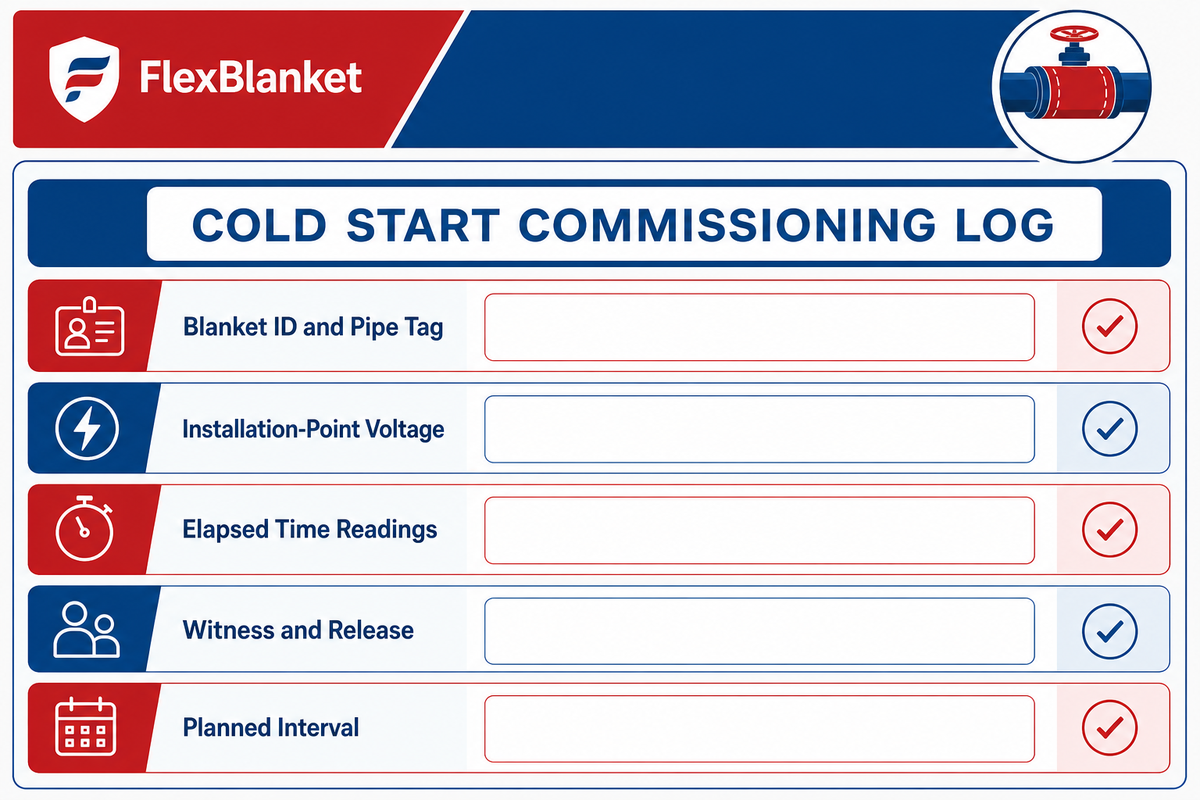
The first energization should be treated as a witnessed acceptance event. It carries forward the sensor and controlled-point decision from the previous review. The log should not contain universal pass/fail numbers copied from another heater family. It should contain blank fields that your manual, site procedure, and process target can fill.
If the site procedure calls for timed observations, write the planned interval before power is applied. Examples such as 5 min, 15 min, and 30 min are record fields only when the project procedure names them; they are not acceptance limits by themselves.
Cold Start Commissioning Log
| Field | Record value | Acceptance source |
|---|---|---|
| Blanket ID and pipe tag | Blank | Project drawing or purchase record. |
| Installation-point voltage | Blank | Nameplate, manual, and site electrical procedure. |
| Resistance, ground path, or leakage/GFCI check | Blank | Only if required by model manual, local code, or site procedure. |
| Starting pipe and ambient condition | Blank | Project acceptance plan. |
| Setpoint and controlled point | Blank | Process target and controller setup. |
| Controller demand/output state | Blank | Controller manual or panel procedure. |
| Elapsed time readings | Blank | Project-defined interval, not a copied threshold. |
| Abnormal observations | Blank | Noise, odor, alarm, loose fit, wet insulation, or unexpected current. |
| Witness and release | Blank | Maintenance, electrical, quality, or process owner signoff. |
The practical value of the log is accountability. If the line fails to hold temperature later, the team can compare what changed: insulation was disturbed, weather changed, the controller lost output, supply voltage was different, or the process condition no longer matches the original heater sizing worksheet.
7. Troubleshooting Heat Fault Symptoms After Installation
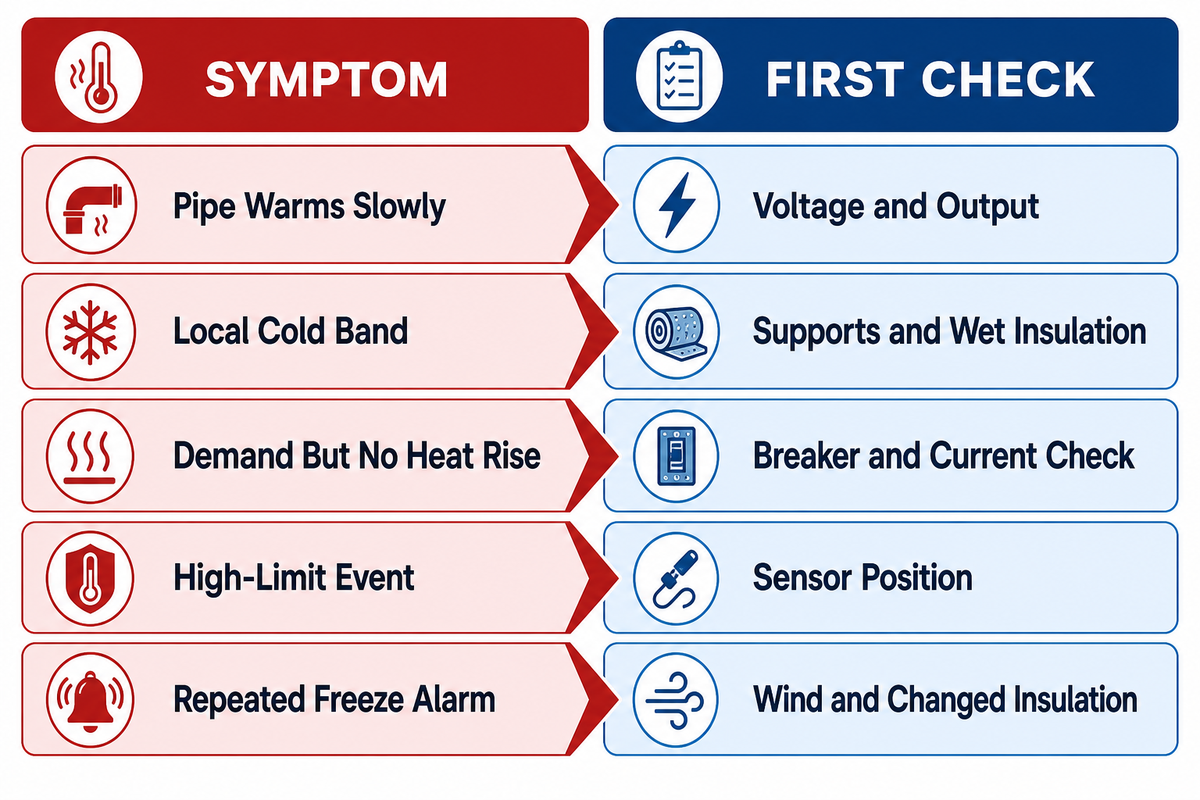
When the blanket is installed but the pipe still falls below target, use the first-cycle log as the baseline for what changed before raising setpoint. Work from visible and testable causes.
| Symptom | First checks | Likely action |
|---|---|---|
| Pipe warms slowly | Voltage, controller output, insulation continuity, starting liquid temperature. | Compare against the sizing worksheet and first-cycle log. |
| Local cold band | Pipe supports, valve mass, flange exposure, blanket contact, wet insulation. | Refit or add engineering review for a changed heat zone. |
| Controller shows demand but no heat rise | Output device, circuit breaker, connector, current check if allowed. | Electrical troubleshooting by qualified personnel. |
| High-limit or alarm event | Sensor position, insulation coverage, controller setpoint, blocked heat path. | Do not bypass protection; review manual and root cause. |
| Repeated freeze alarm | Ambient exposure, wind, changed insulation, empty pipe, stagnant branch, wrong controlled point. | Respec or revise the freeze-protection method. |
8. Installation Boundaries for PVC Conduit and Consumer Blankets
How hot do PVC heat blankets get?
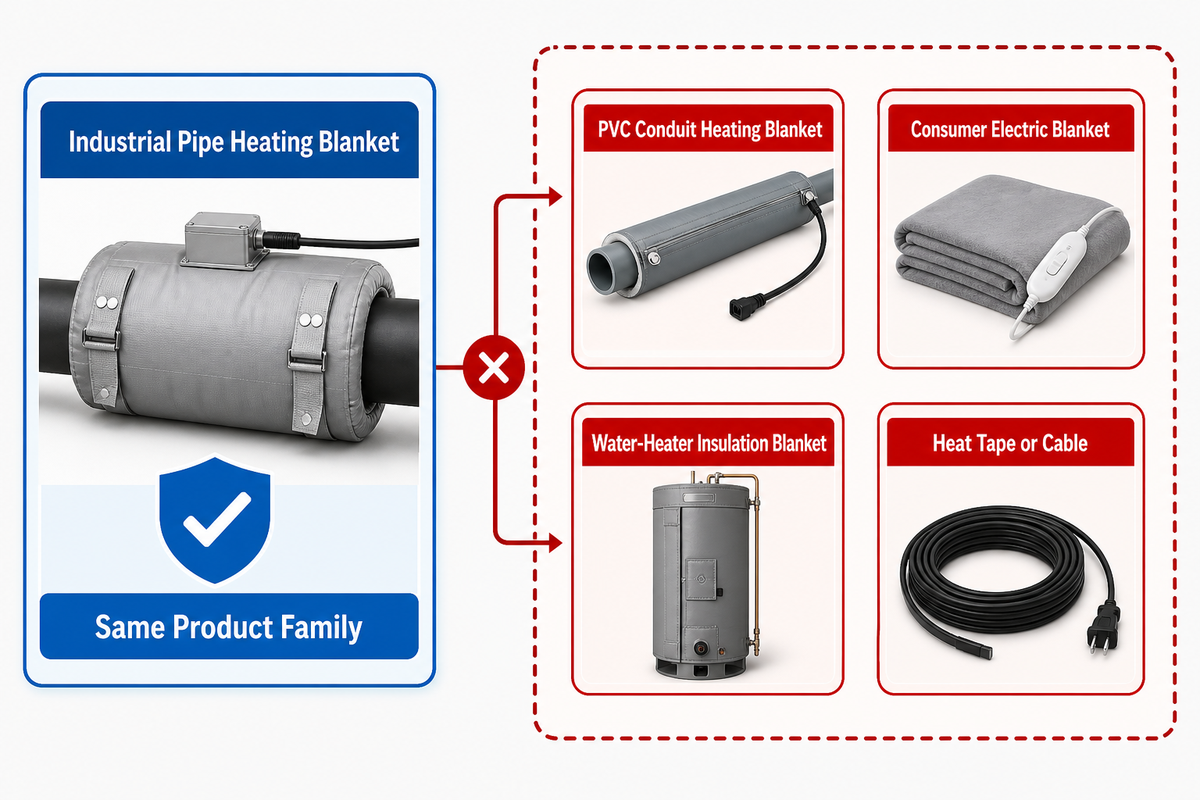
PVC heat blankets have model-specific temperatures for bending electrical conduit, not for maintaining industrial process pipe temperature. Do not borrow a PVC conduit bending temperature, consumer electric blanket tutorial, water-heater insulation video, or heat tape guide as evidence for a pipe heating blanket installation.
The search results for this topic are polluted by several product families. The boundary table below is part of the installation guide because using the wrong tutorial can create the wrong work method.
Search requests often mix an industrial heating blanket for pipe work with a heat blanket for PVC pipe, conduit heat blanket, outdoor heat blanket for pipes, electric blanket for pipes, pipe warming blanket, pipe heating cable, heat trace cable, heat trace for pipes, pipe insulation blankets, and the best way to protect pipes from freezing. Treat those phrases as method-check prompts, not proof that one heater type fits the job.
A useful installation tip is to check whether the guide you are reading belongs to the same product family. Tips and tricks from a video about an easy to install consumer blanket, a PVC bending tool, or a removable insulation blanket may look practical, but they can be unsafe when copied to an energized industrial pipe. Use the right tools, wear the glove or other PPE required by site procedure, secure the lead exit properly, and treat a perfect fit claim as unproven until the pipe tag, drawing, and first heat cycle agree. That is how teams work safely under an approved method instead of repeating a search-result shortcut.
Product Family Boundary Table
| Product family | Correct use | Boundary for this article |
|---|---|---|
| Industrial pipe heating blanket | Local pipe heating, process maintenance, viscosity support, freeze protection. | Requires fit, control, insulation, and acceptance review. |
| PVC conduit heating blanket | Bending conduit with a tool-specific procedure. | Not a pipe process-heating source. |
| Consumer electric blanket | Personal comfort bedding. | Not for industrial pipes, chemicals, liquid lines, or outdoor service. |
| Water-heater insulation blanket | Passive tank insulation. | Insulation only; it is not an electric heater. |
| Heat tape or heat-trace cable | Cable-based pipe tracing across longer runs. | Useful comparison, but cable instructions are not universal blanket instructions. |
“approved for the hazardous (classified) location”
For hazardous classified locations, the installation question is not “Can the blanket get hot enough?” It is whether the equipment, wiring method, installation, and temperature marking are approved or otherwise accepted for the specific class, group, ignitable media properties, and operating temperature basis. That review must happen before the field team treats the blanket as installable.
9. Pre-Season Inspection for Freeze Protection Jobs
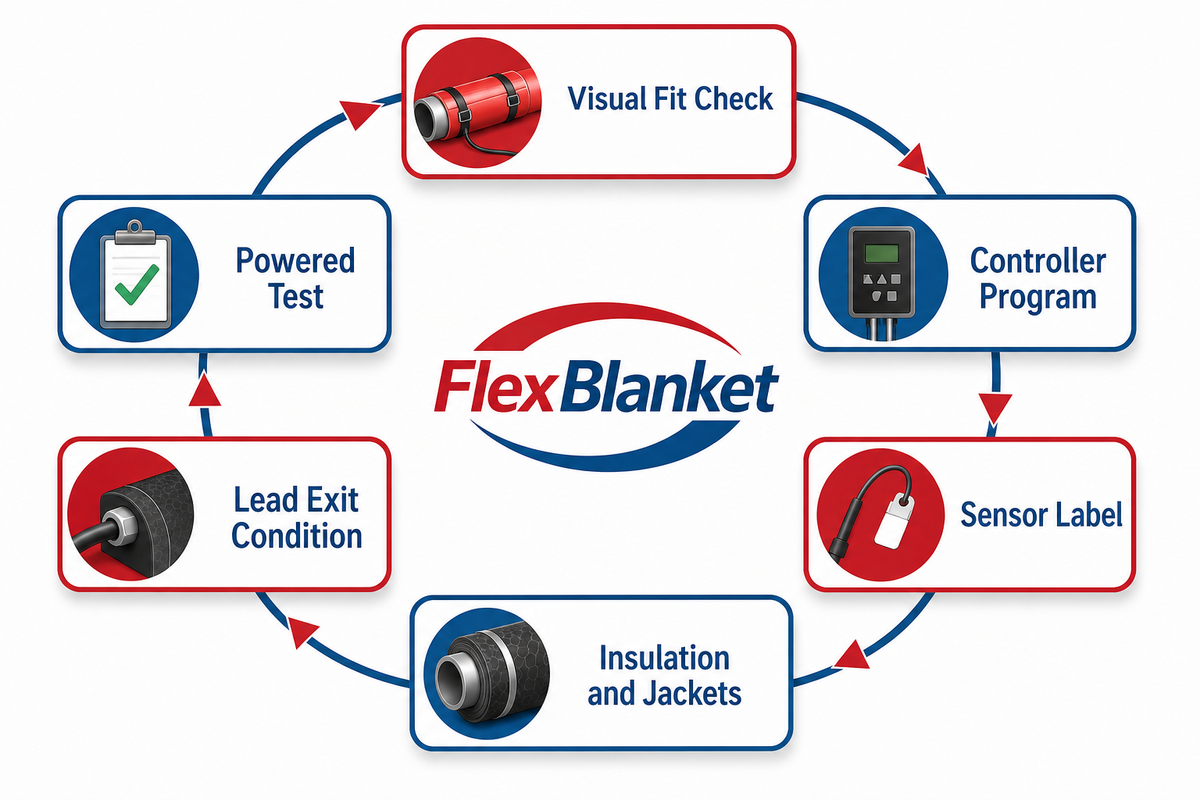
After the product-family and approval boundary check, freeze-protection installations still need a pre-season inspection because the pipe system is often changed during maintenance. Insulation can be removed and replaced poorly. A flange can be added. A sensor can be moved. A controller can be left in manual mode. A cord can be tied tight after cleaning. These are ordinary plant events, and the first cold night often reveals them.
Before the cold season, repeat the visual fit check, confirm the controller program, check the sensor label, inspect insulation and jackets, verify lead exit condition, and compare one powered test against the Cold Start Commissioning Log. If the first-cycle record is missing, create a current baseline before weather forces a rushed diagnosis.
10. RFQ Handoff: What to Send FlexBlanket Engineering
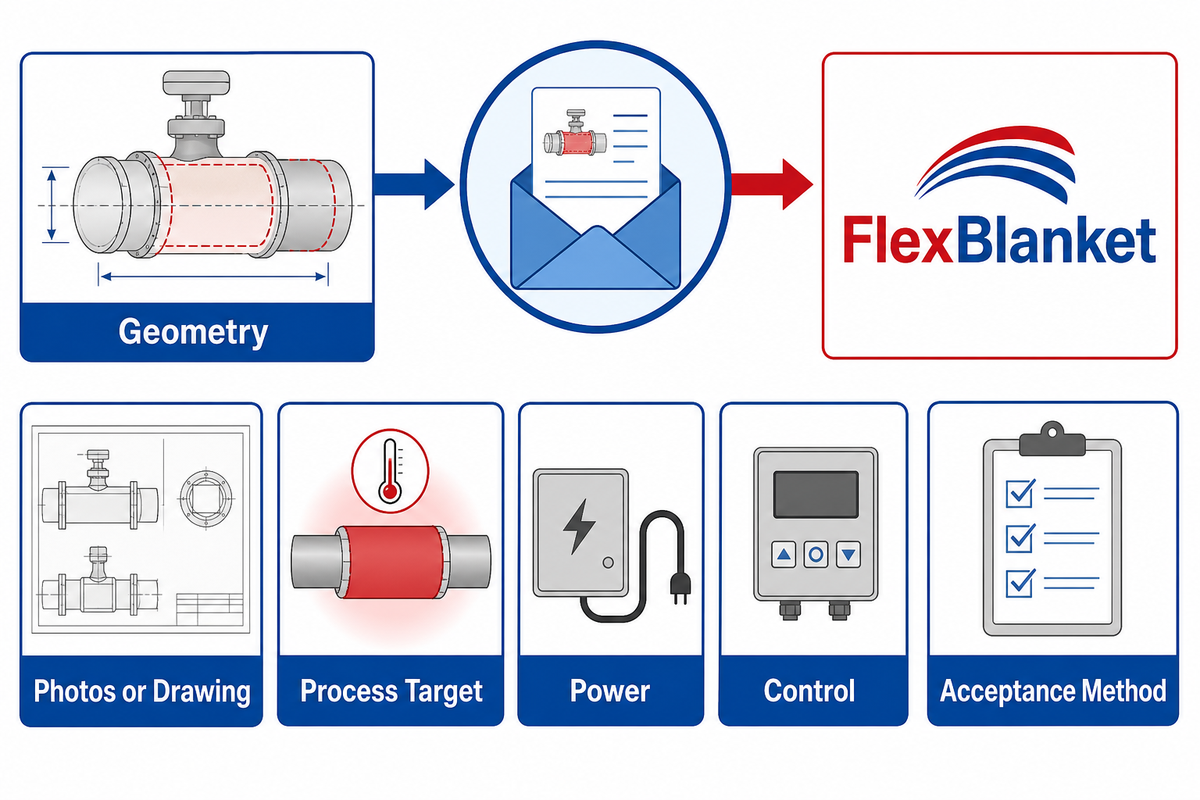
After the pre-season inspection, a good RFQ does not ask a supplier to guess at pipe geometry. The handoff should convert field measurements into a buildable heater request and an acceptance plan. Treat unclear field notes as open engineering questions, not as purchase-ready data.
Geometry to Lead Exit Handoff Sheet
- Pipe tag, service, material, outside diameter, heated length, and surface condition.
- Photos or drawing with valves, flanges, elbows, supports, no-heat areas, and access limits marked.
- Process target: freeze protection, viscosity hold, temperature maintenance, preheat, or cure support.
- Starting temperature, target temperature, contents, warm-up window, and heat-loss allowance if known.
- Power: confirmed installation-point voltage, phase if relevant, plug or lead preference, and panel location.
- Control: sensor type, controlled point, controller/interface, alarm need, and high-limit requirement if applicable.
- Environment: indoor/outdoor, washdown, chemical splash, wind, insulation type, jacket, and inspection access.
- Acceptance method: who witnesses first energization, what values are recorded, and who releases the line.
Send this package through the FlexBlanket RFQ popup or start from the Pipe Heating Blankets page. If voltage is uncertain, check the voltage tool first. If wattage is still open, use the heater sizing worksheet and mark final wattage for engineering confirmation.
FAQ
Can you install a pipe heating blanket without heat trace cable?
Yes, if the heated zone, process target, controls, and approval requirements fit a removable blanket method. This works best for local pipe sections, manifolds, valves, or short heated areas that need access. Long pipe runs, certified systems, fire-protection lines, and some hazardous-area jobs may still call for cable-based trace heating or another approved assembly.
Should the blanket go under or over insulation?
The heater face normally must contact the intended pipe or component surface according to its supplied drawing, while insulation is reviewed as part of the thermal system. Field teams should confirm the blanket position, sensor point, lead exit, moisture barrier, removable inspection area, and insulation jacket before release. The exact stack should follow the product manual and site procedure. For outdoor lines, photograph the closed jacket and visible label after installation, because later troubleshooting often depends on knowing whether insulation, lead routing, or access covers changed after the first accepted heat cycle.
Can a pipe heating blanket overlap itself?
Only if the supplied design and model instructions allow that wrap path. Some heater families treat overlap, bend radius, cold-zone contact, hot-zone contact, and fastening load differently. A field installer should not create one overlap rule for every blanket. If the drawing is unclear, record a photo and send the wrap path back for engineering review.
What should be checked before first power-up?
Check blanket ID, pipe tag, surface condition, fit, fastening, lead exit, sensor point, controller setup, nameplate voltage, insulation handoff, and any electrical tests required by the manual or site procedure. Record the result in the Cold Start Commissioning Log.
Is a pipe heating blanket approved for hazardous locations?
Do not assume that. Hazardous classified locations require project-specific review of equipment, wiring method, installation, class, group, ignitable media properties, and operating temperature marking. Ask for approved equipment evidence before purchase or installation.
References and Sources
- OSHA, Control of Hazardous Energy
- OSHA, 29 CFR 1910.307 Hazardous Classified Locations
- National Insulation Association, electrical heat tracing and thermal insulation reliability
- National Insulation Association, new directions in pipe heat tracing designs
- IEC Webstore, IEC/IEEE 62395-1:2024
- IEEE Standards Association, IEEE/IEC 62395-1-2024
- BSI Knowledge, BS EN IEC/IEEE 62395-1:2026
- IEEE Standards Association, IEEE/IEC 60079-30-1-2025
- UL Solutions, certified trace heating equipment for fire sprinkler pipes
- Plant Engineering, pipe and fitting insulation
- Plant Engineering, process plant winterization strategies
MANUFACTURING EVIDENCE
A specified heat path, backed by first-party site context
First-party website statements identify FlexBlanket as the export brand of Qingdao Flex Technology Co., Ltd. They describe custom-to-drawing heating solutions with in-house production and testing for industrial thermal duties.
SITE-STATED FOUNDED2019
SITE-STATED LOCATIONQingdao, China
SITE-STATED PLANT5,000+ m²
SITE-STATED TEAM50+ staff
ENGINEERING HANDOVER
From asset dimensions to a site-stated build route
01Site-stated product families include heating blankets and silicone rubber heaters for drums, IBCs, pipes, gas cylinders and composite-curing duties.
02First-party site information describes custom-to-drawing review for fit, voltage, target temperature, controls and installation conditions.
03First-party site information states in-house production/testing and OEM / ODM support; confirm scope for the required application.
First-party site-stated standard lead time is 7–15 days and site-stated warranty is 24 months. Treat ISO 9001, CE and RoHS references as site-stated claims requiring confirmation for the exact product and order.