Get in touch with FlexBlanket Company

55 Gallon Drum Dimensions for Steel, Plastic and Fiber Containers

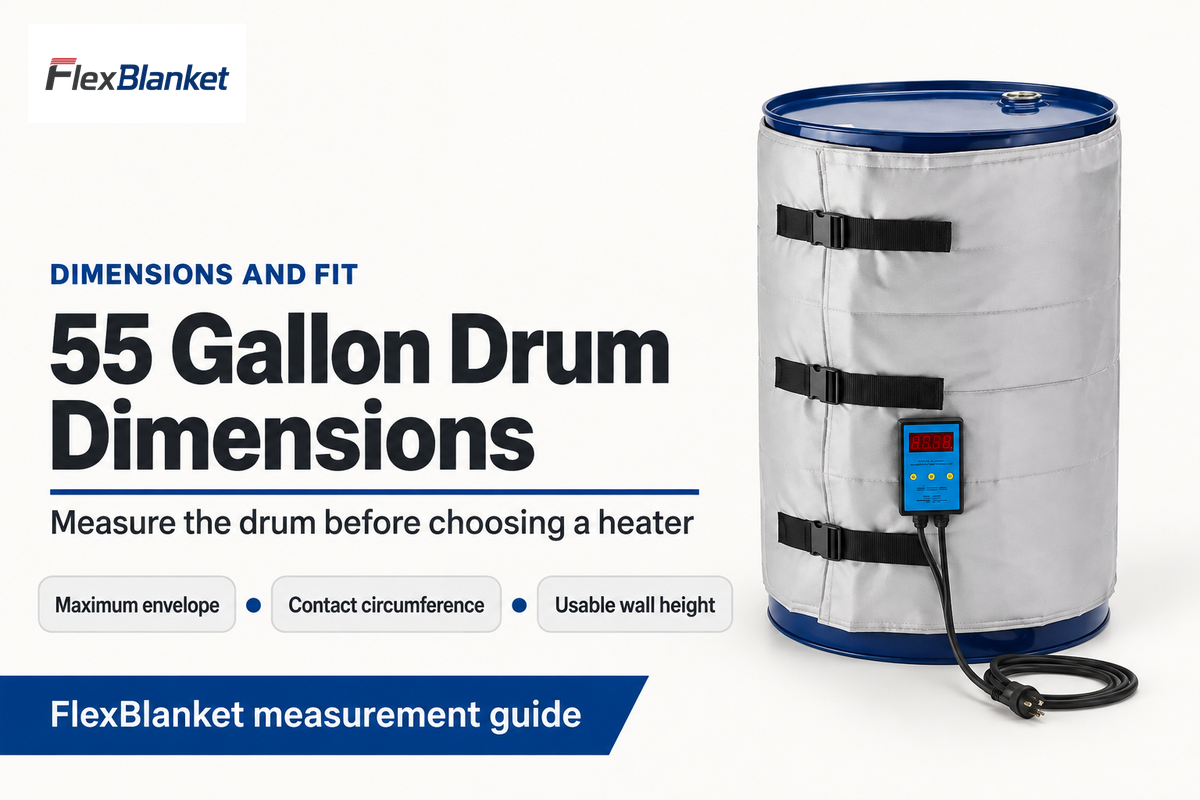
Updated October 2026 · FlexBlanket
55 gallon drum dimensions range from 22.5 to 24 inches across their outside edges when measuring diameter, and from 34.5 to 35.375 inches in height as described in the examples below. A tight-head HDPE model, 56W55D, measures 23.25 by 34.75 inches. Be certain that you match the exact drum and closure before selecting a rack, storage position, or heater.
Quick dimensions
- Capacity: 55 US liquid gallons is approximately 208.2 liters.
- Outside size: material and lid construction change the envelope.
- Heater fit: measure the actual contact circumference and usable wall height.
- Internal dimensions describe the cavity, not doorway or rack clearance.
55 Gallon Drum Dimensions at a Glance
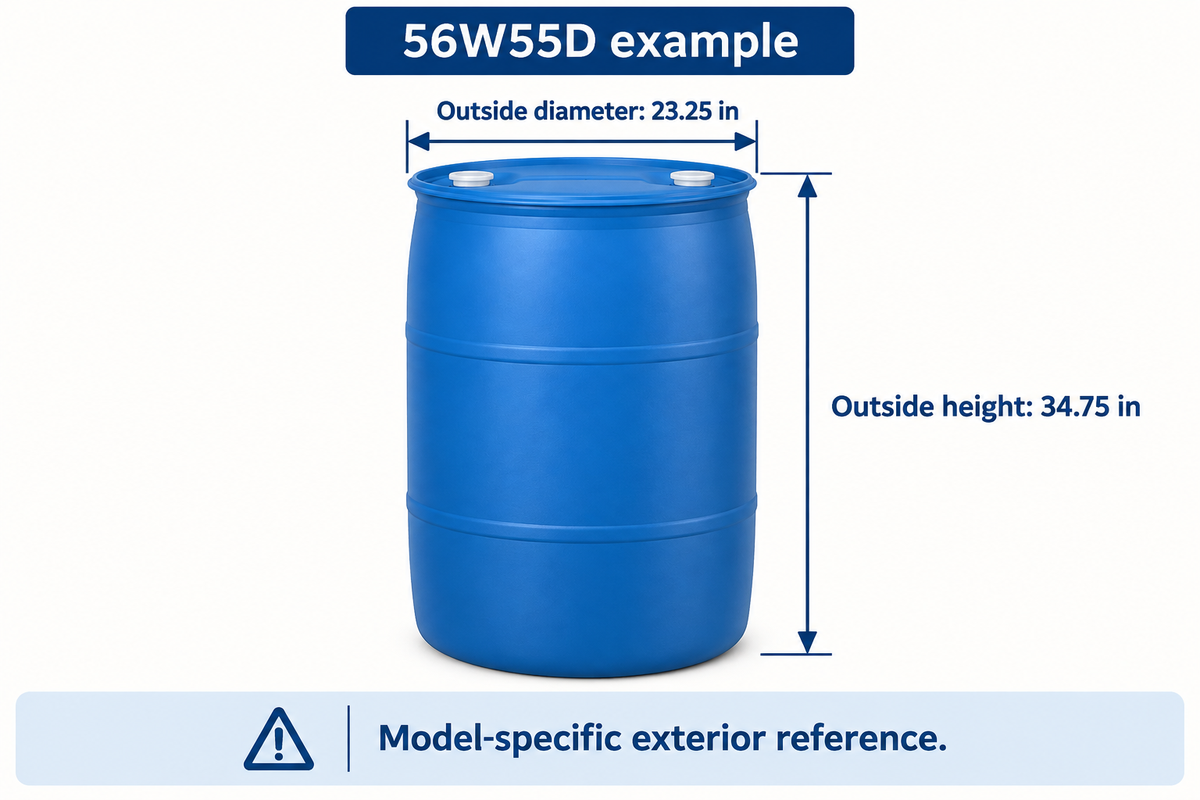
A 56W55D plastic drum measures about 23.25 inches across and 34.75 inches high (approximately 591 × 883 mm). Other listed steel, plastic and fiber examples differ. The table separates exterior measurements from internal cavity dimensions so you can choose the row that addresses your actual fitting question.
| Drum example | Measurement basis | Diameter | Height | Use this row for |
|---|---|---|---|---|
| 56W55D, tight-head HDPE | Outside | 23.25 in / 591 mm | 34.75 in / 883 mm | Model-specific exterior reference |
| Open-top plastic example | Outside | 22.7 in / 577 mm | 35.375 in / 899 mm | Comparing removable-lid construction |
| Closed-top plastic example | Outside | 23.2 in / 589 mm | 34.8 in / 884 mm | Comparing fixed-top construction |
| Open-head steel example | Outside | 24 in / 610 mm | 34.75 in / 883 mm | Checking a larger exterior envelope |
| Closed-top steel example | Outside | 23.125 in / 587 mm | 34.5 in / 876 mm | Comparing a fixed-top steel container |
| Fiber drum with steel cover | Outside | 22.5 in / 572 mm | 35.25 in / 895 mm | Exterior fit |
| Same fiber construction | Inside | 21.5 in / 546 mm | 34.5 in / 876 mm | Internal cavity reference |
| CQ5514, tight-head carbon steel | Inside | 22.50 in / 572 mm | 33.50 in / 851 mm | Internal cavity reference |
| CQ5504, open-head carbon steel | Inside | 22.50 in / 572 mm | 32.80 in / 833 mm | Internal cavity reference |
Metric values are rounded to the nearest millimeter. The unnamed construction rows are older catalog examples that show dimensional variation, rather than industry-wide ordering tolerances. A purchase specification needs the selected manufacturer’s current drawing, including the fitted closure.
Standards also specify dimensions for certain classes. ISO 15750-1 covers open-head steel drums in specified total-capacity classes. That scope is narrower than every container sold under the general 55-gallon label.
Steel, Plastic and Fiber Drum Sizes Compared
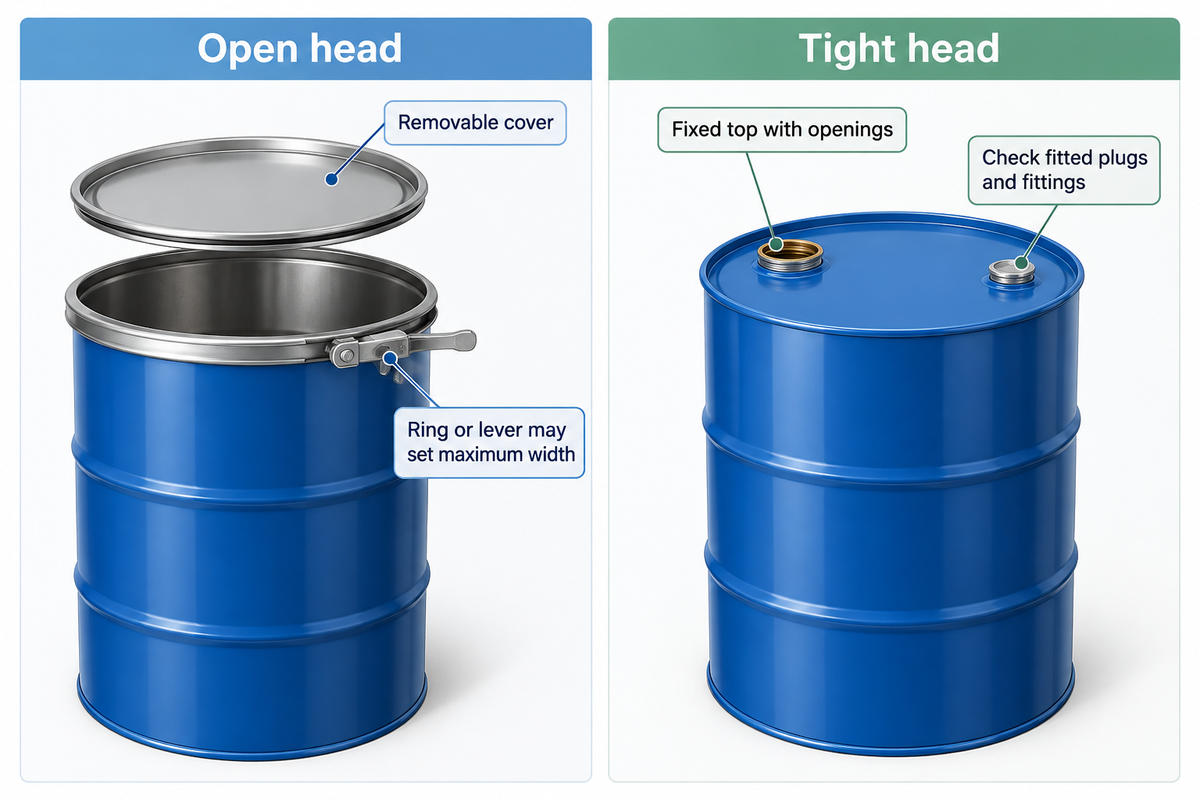
The open-head examples demonstrate that material alone is an insufficient size shortcut. For example, the plastic is 22.7 inches wide and the steel example is 24 inches wide. The closure construction also plays a role. Compare a removable lid and its retaining hardware when checking the dimensions of the drum.
Open head
- Removable cover gives access across the top.
- Closure ring or lever may set the maximum width.
- Measure with the intended lid fully secured.
Tight head
- Fixed top is accessed through its openings.
- Bungs and attached fittings affect available clearance.
- Measure with the intended plugs and fittings installed.
Plastic drums are made from high-density polyethylenes in many industrial applications; the 56W55D is one such HDPE example. Fiber, carbon steel and stainless steel constructions belong in separate product comparisons. A material name does not specify a lining, closure, wall profile or chemical compatibility.
ISO 20848-2 addresses tight-head plastic drums of nominal 208.2 L and 220 L capacity. ASTM D5998-24 covers molded polyethylene shipping and storage drums, including dimensional conformity. Use the relevant class and drawing together; “standard size” alone leaves too much unspecified.
Drum Height and Diameter: Which Measurement Matters?
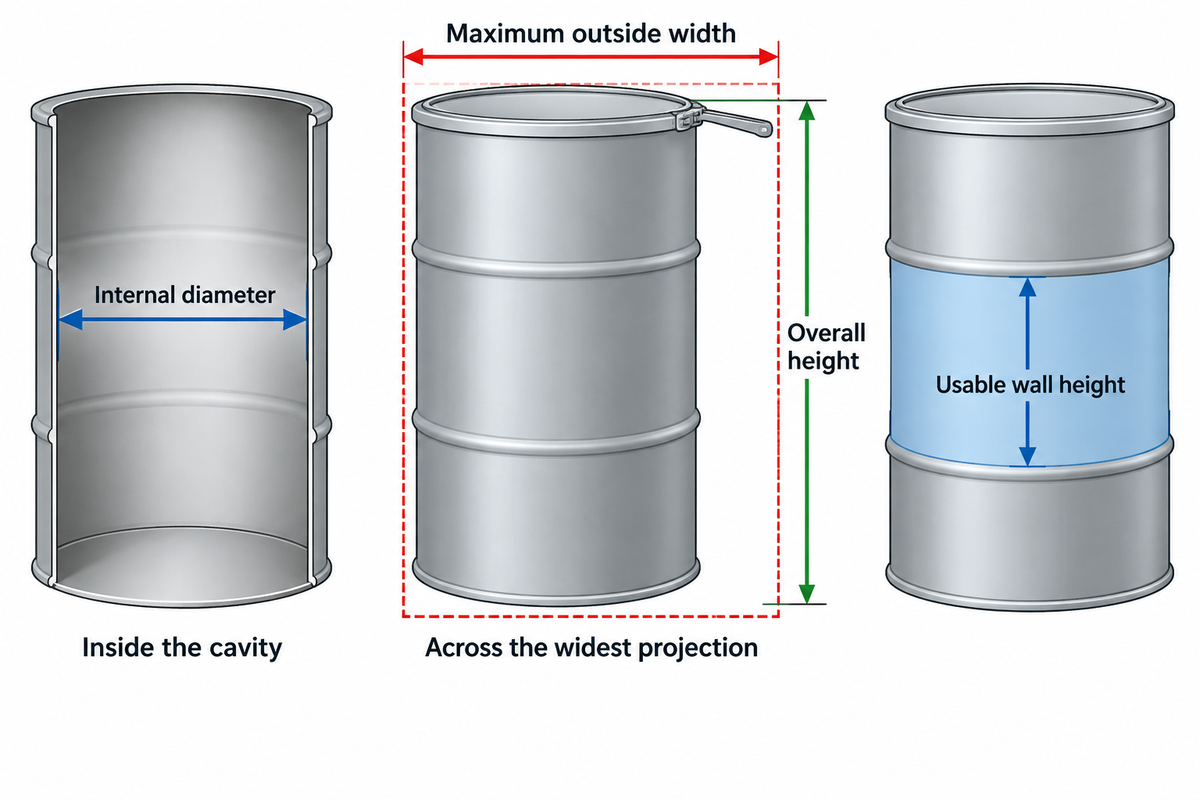
An internal diameter of 22.5 inches describes the cavity of the CQ5514 drum; it does not give its maximum outside width. To define the required width of a holder or door, one must measure the maximum external width and the overall closed height. For a heater, measure the wall surface where the heater is to be positioned. ISO 15750-1 specifies dimensions for defined open-head steel drum classes; use the selected drawing to identify which measurements describe the cavity and which describe the exterior.
Picture a replacement drum passing through a fixed guide. The cylindrical wall is smooth and easily clears the opening; however, a locking lever catches the edge. Buying another container with the same capacity would repeat the problem. Measure the closure in its working position and check the bottom chime and ribs. Record the largest width in each orientation, especially if the lever is projecting. For a round holder, dividing a tape measurement around an irregular closure by pi is not an acceptable way to check clearance. The vendor’s maximum envelope drawing or direct measurements solve this.
| Measurement | Where to measure | Main decision |
|---|---|---|
| Internal diameter | Inside the cavity | Internal space |
| Smooth-body diameter | Across an unobstructed wall section | Local cylindrical geometry |
| Maximum outside width | Across the widest projection | Doorway or holder fit |
| Closure projection | Across secured ring and lever | Handling envelope |
| Overall height | Base to highest fitted part | Vertical clearance |
| Usable wall height | Between obstructions at the heater position | Heater coverage |
| Contact circumference | Along the intended heater path | Wrap length |
| Rib spacing | Between adjacent raised features | Narrow-band position |
| Installed fitting height | With pump or connection fitted | Working access above the drum |
55 Gallon Drum Capacity in Liters
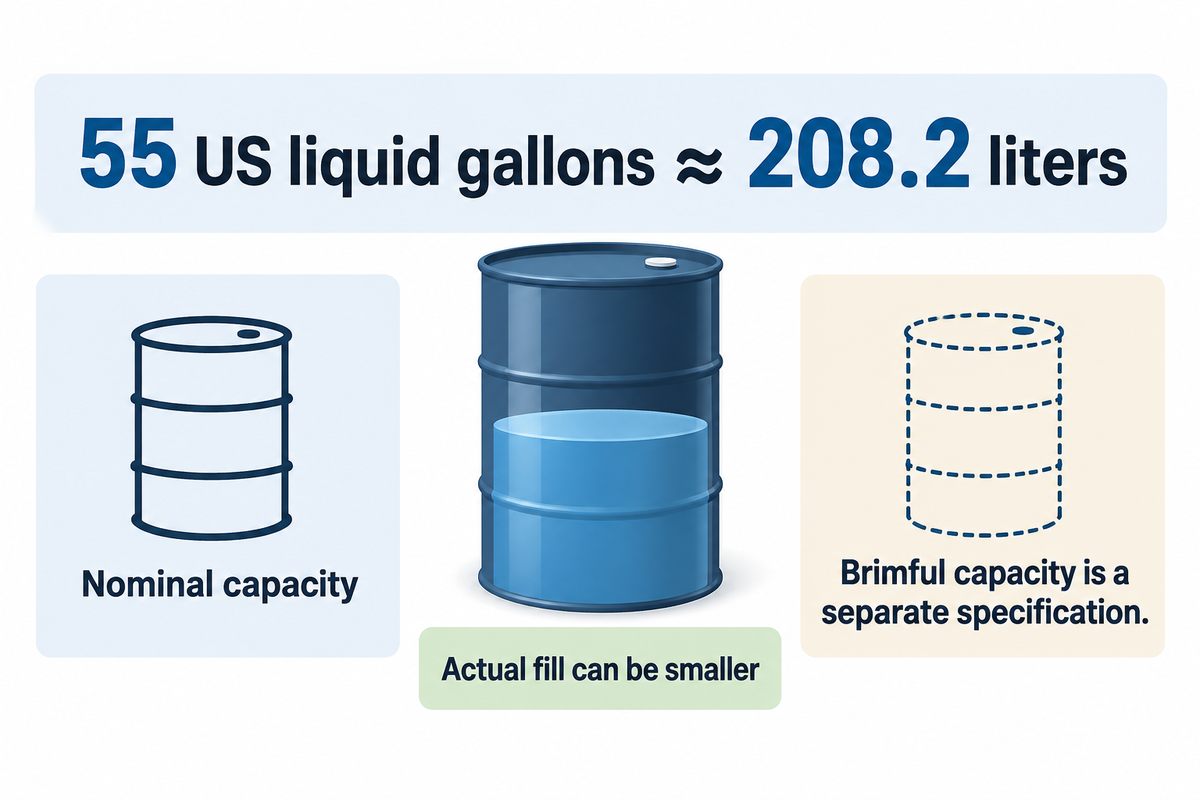
55 US liquid gallons is around 208.2 liters. A 200 liter label is a neighboring nominal size and not an exact unit conversion. Capacity describes contained volume; diameter and height describe the package. The volume actually present depends on the fill, even when the container is designed to hold the stated nominal quantity.
The NIST conversion table gives approximately 3.785412 L per US liquid gallon. Multiplying that factor by 55 gives 208.19766 L before rounding. For the calculations, keep “US liquid,” as Imperial gallons are larger.
How many gallons are actually in a 55 gallon drum?
A drum labeled 55 US liquid gallons has that nominal capacity; the liquid actually present could be any smaller filled quantity. Brimful capacity and the permitted filling level are different specifications. Measure the delivered contents, or use the approved filling instructions, rather than adding an assumed additional number of gallons.
“It also specifies a method for measuring the total and brimful capacity.”
55 Gallon Drum Circumference: A Worked Example
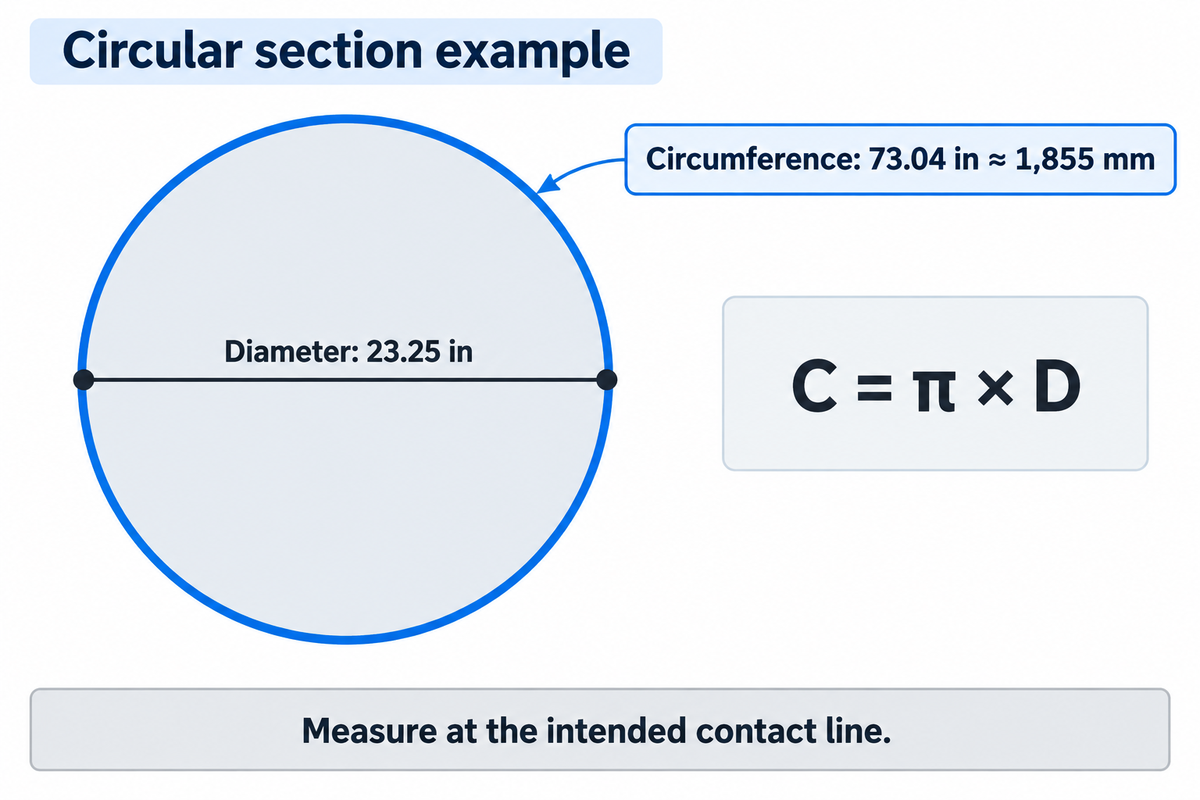
At a presumed circular diameter of 23.25 inches, the circumference is 73.04 inches, approximately 1,855 mm. The calculation uses C = π × D, as described by NIST’s geometry guidance. Measure at the intended contact line. A larger rib changes the path around the drum.
Worked calculation: 3.14159265 × 23.25 in = 73.042 in; then 73.042 × 25.4 = approximately 1,855 mm. A section measuring 23 inches would have a different circumference, even if both containers carry the same gallon barrel label.
Assume a buyer replaces a narrow heater band. Measuring over a raised rib and ordering that length would describe the incorrect contact surface if the band is between the ribs. First mark the band position. Wrap a flexible tape level around that line without pulling it diagonally or bridging a dent. Record the available height of the straight wall separately. The fastening gap belongs to the selected heater design, so do not add an arbitrary overlap allowance. Our drum-band circumference calculator can be of assistance with the calculation once the correct diameter and design are entered.
Storage Footprint and Clearance
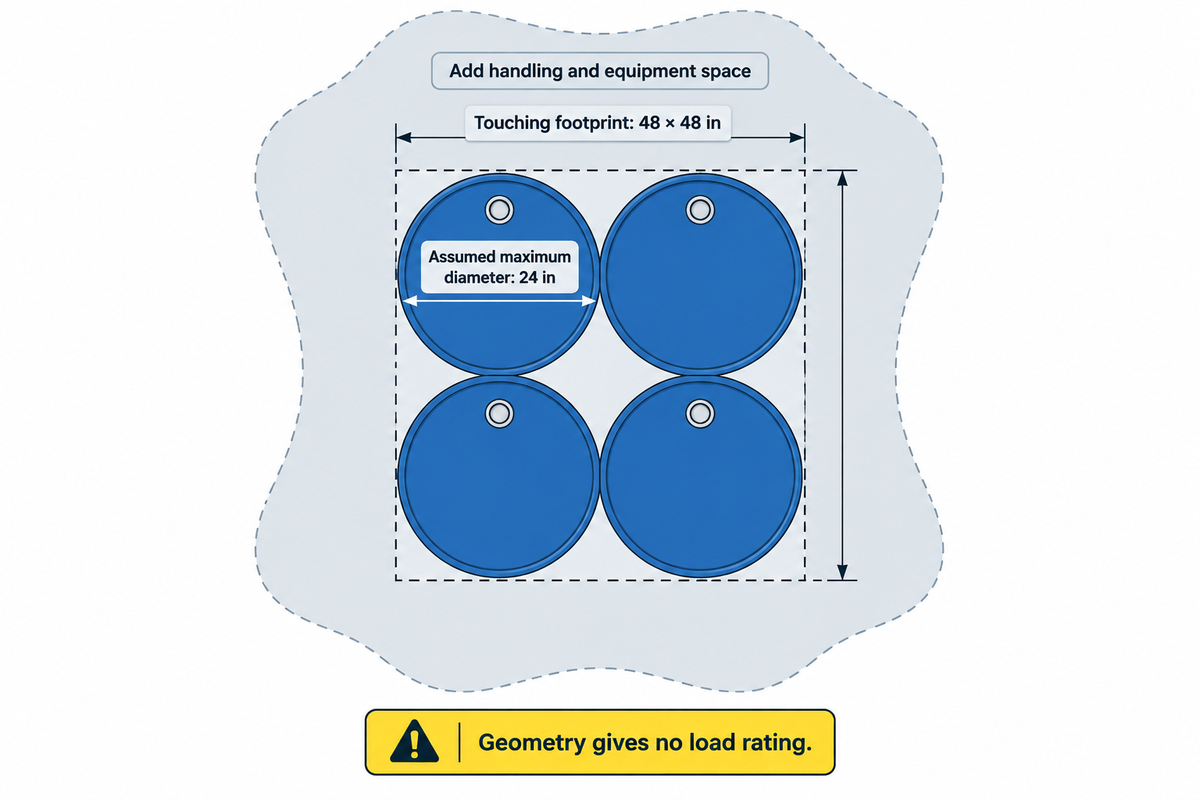
When arranged two by two, the footprint of four circular drums, with an assumed 24-inch maximum diameter, is 48 × 48 inches. This is the touching geometric footprint. Storage and transport require additional space for the closure, containment equipment and handling method, and a suitable load-bearing surface.
The calculation is 2 × 24 in on each side. To store the drums safely on a nominal 48-inch pallet, match the loaded weight to its rating and check the supporting footprint and stability. Shipping dimensions may describe several drums stacked as one package rather than an individual unit.
In a warehouse layout, draw the containment deck’s outside boundary before placing the drum circles. Leave the operating route around that equipment visible on the drawing. A pallet jack needs room to enter and turn; a pump may need room above the closed top. OSHA’s materials-handling rule calls for sufficient safe clearances where mechanical equipment operates and secure storage against sliding or collapse. A drawing that shows only touching circles has not yet answered either task.
Measuring for a Drum Heater Blanket
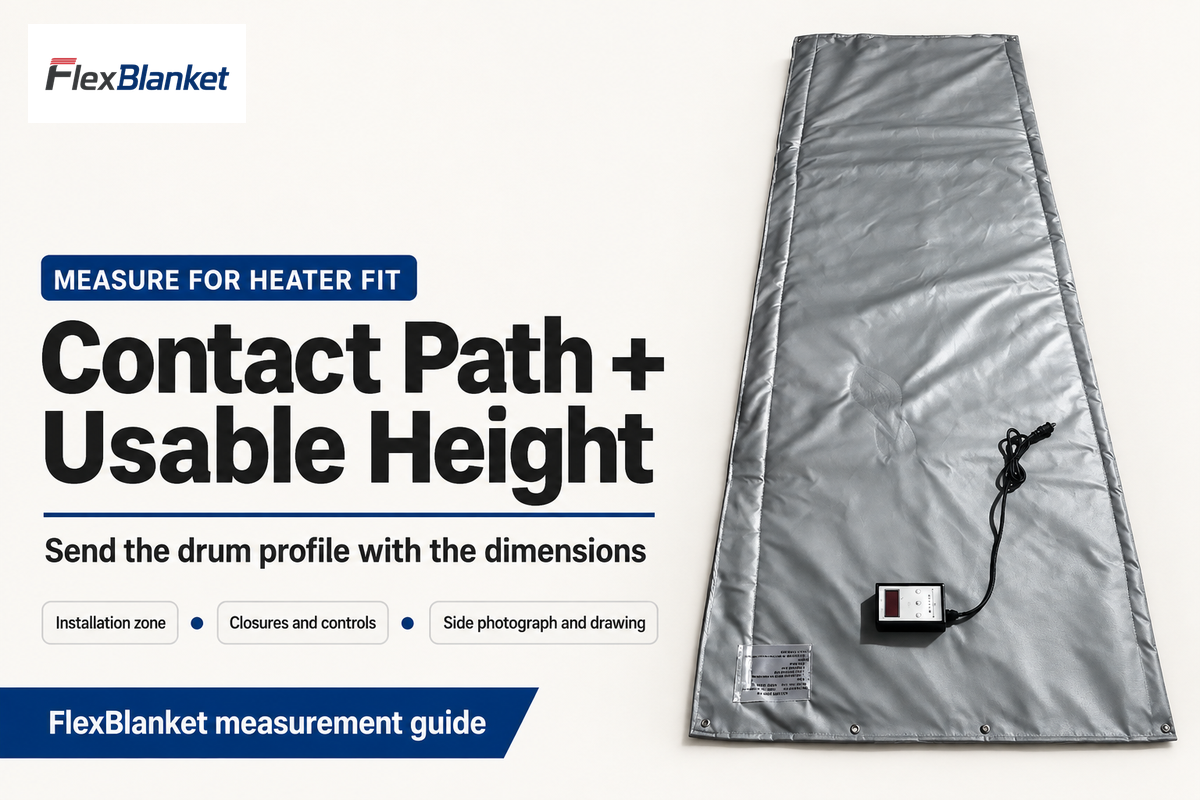
Our FLB-DH-200 blanket measures 1,860 × 860 mm and is listed for the 200 L / 55-gallon drum family. Those are the blanket’s physical dimensions. Selecting insulated drum heating blankets also requires the drum’s actual contour, fastening arrangement and available wall height.
Full-height jackets and silicone drum heater bands have different contact areas. Follow the chosen design’s installation route. For a narrow contact heater, a raised feature can hold part of the heater away from the wall. Do not force a band over a protrusion or overlap it to make the fastening work.
- Identify the installation zone. Locate the surface specified for the selected heater construction.
- Measure the contact path. Keep the tape level and record ribs or obstructions along the route.
- Measure the usable height. Include the space needed for closures, controls and connections.
- Send the profile with the dimensions. A side photograph and the drum drawing show features a capacity label omits.
Think of a production buyer switching from a steel drum to HDPE. The existing blanket closes around the new container, but that does not settle either material’s temperature limits or the process duty. Keep the geometry request along with the content and supply details. Heating blanket size and wattage inputs cover the next step in the selection process. If a hazardous location is involved, electrical suitability for that location needs to be addressed separately. A dimensional match doesn’t ensure a Hazardous Location approval.
Where to Buy a 55 Gallon Drum
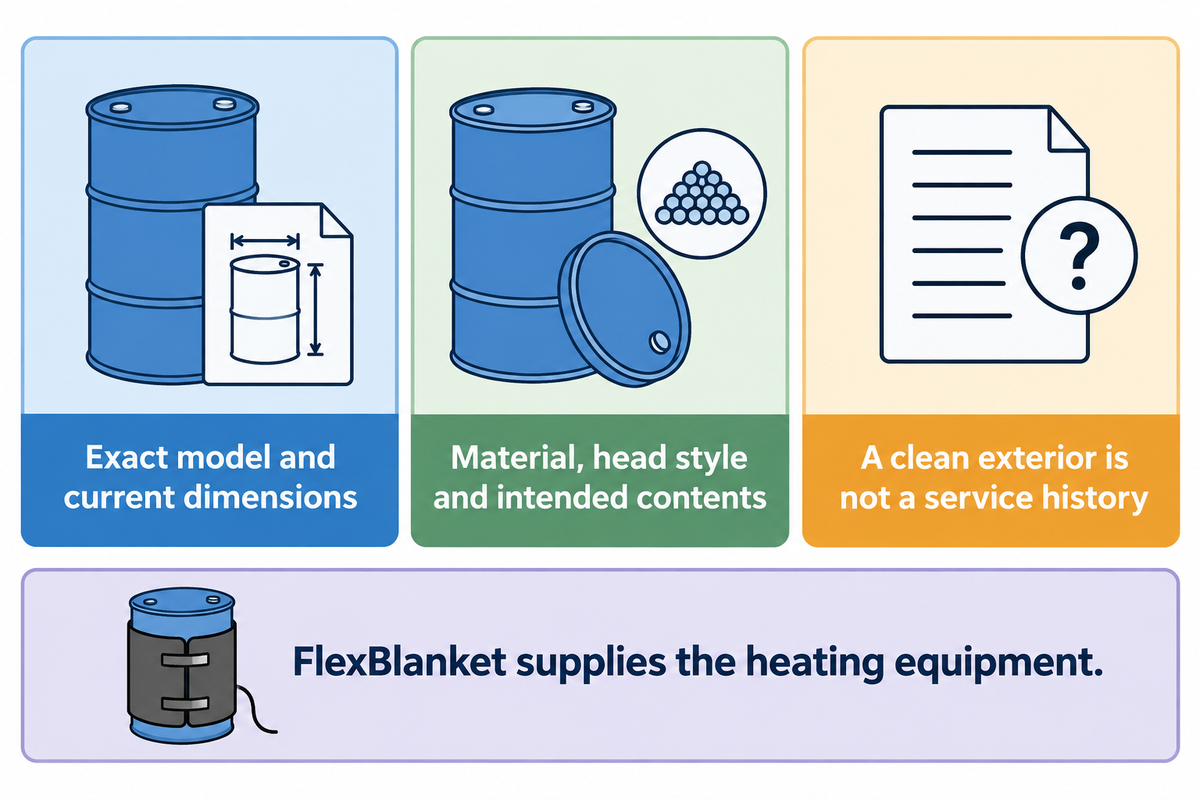
Packaging distributors, like The Cary Company or Yankee Containers, sell 55-gallon drums with a range of materials and closures. Order against an exact model and its current dimensions. FlexBlanket provides the heating equipment discussed here; the empty container, its prior use and its fitness for the contents are other decisions.
Where can I get 55 gallon drums?
Industrial packaging distributors can provide newly manufactured drums, and a drum reconditioning supplier can provide documented reconditioned containers. Start with the material, head style and intended contents, then compare the exact drawing. Local availability and freight pricing vary, so compare delivered quotations for the same model and condition.
The EPA’s used-drum guidance describes reconditioning as cleaning, restoring, testing and certifying containers that may previously have contained hazardous materials. A clean exterior is not a service history. For a chemical, powder or pharmaceutical application, retain the drum container documentation required for that use; a general industrial drum is not automatically suitable for pharmaceutical products.
Specify whether the contents are hazardous or non-hazardous. ASTM D5998’s scope directs hazardous goods drums to the applicable US Department of Transportation (DOT) requirements. Those regulatory checks address the intended shipment while the size drawing addresses physical fit.
The 3-Measure Drum Fit Check
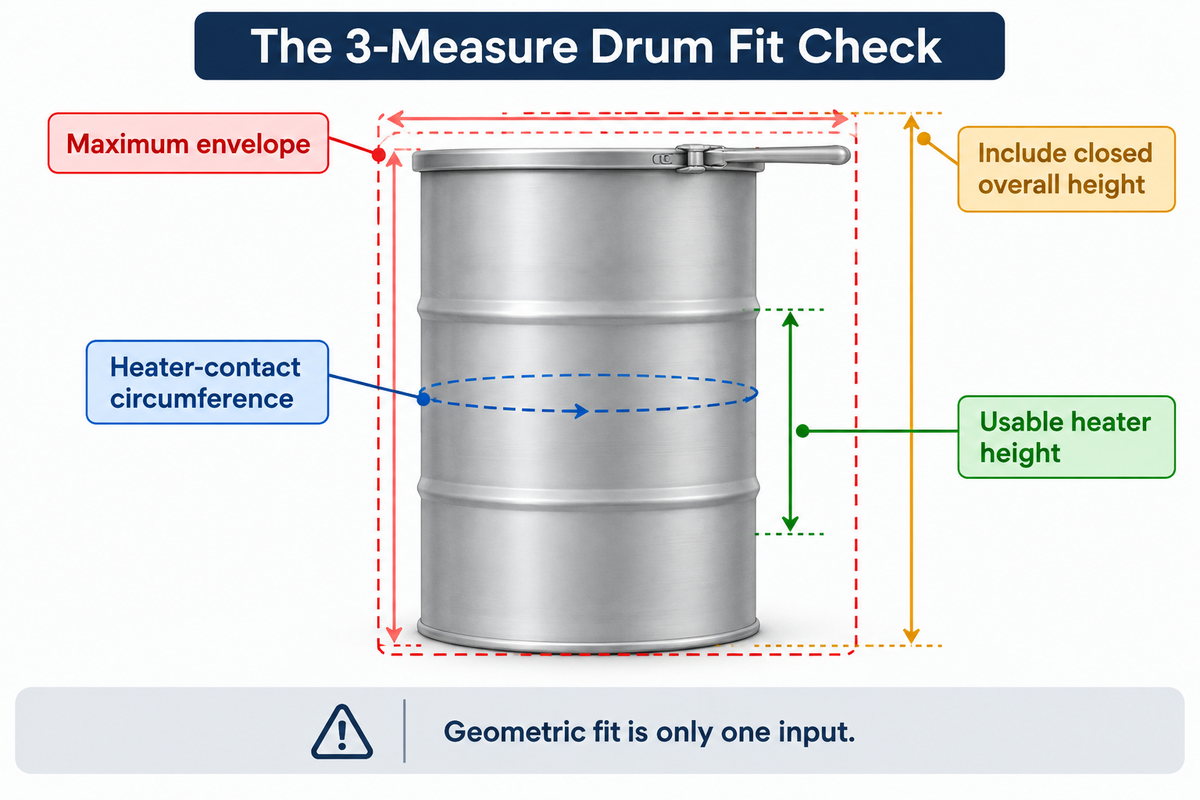
The 3-Measure Drum Fit Check is a measuring guideline with three groups: maximum envelope, heater-contact circumference and usable heater height. Include the closed overall height in the envelope. A matching circumference should not override a projecting closure or a wall section that is too short for the selected heater.
| Observed condition | Decision | Limit to keep visible |
|---|---|---|
| Maximum width exceeds holder opening | Choose another envelope or holder | Body diameter alone is insufficient |
| Closed height exceeds available opening | Change container or access arrangement | Include fitted closures |
| Ring lever projects beyond body | Use its largest installed projection | Orientation can matter |
| Band contact zone is obstructed | Select an approved position or design | Do not bridge an air gap |
| Usable wall is shorter than heater | Change heater coverage | Do not fold a heater to fit |
| Wrap closes but contour differs | Confirm the contact and fastening design | Closure alone does not establish contact |
| Four drums touch on the layout | Add handling and equipment envelopes | Geometry gives no load rating |
| Replacement has unknown prior contents | Resolve service history before reuse | Dimensions give no contamination assurance |
| Dimensions match but process changes | Review material and heater suitability | Geometric fit is only one input |
For a nonstandard contour, our custom heating blankets start with the drawing and application. Send FlexBlanket your drum dimensions with a side view, closure details and intended contents to review the heater construction.
Frequently Asked Questions
Drum size questions often address capacity, outside dimensions and filled weight. Keep the unit and model number with each answer. The questions below address common neighboring sizes and buying concerns; use the dimensional table for exterior comparisons and the measurement check when an existing fixture must fit.
What are the standard sizes of drums?
Industrial drums come in multiple nominal capacities; a capacity family does not specify one outside size.
Manufacturer ranges include small drums through large industrial containers, with 30 gallon and 55-gallon products among the available families. Match capacity with material and head construction before comparing drawings. Standards address defined classes rather than every drum together. For smaller containers, our guide to pail and bucket sizes explains the neighboring product category.
What are the dimensions of a 45 gallon drum?
A “45 gallon” drum label needs its US or Imperial unit identified before it can be compared with a 55-gallon model.
The 45-Imperial-gallon name is sometimes used for the broad 55-US-gallon drum family, but it is not an exact conversion. Precisely 45 Imperial gallons is about 204.6 liters, while 55 US gallons is about 45.8 Imperial gallons. A 45-US-gallon container is different again. Take outside measurements from the actual product drawing rather than assigning dimensions from that label.
What are 55 gallon drum dimensions in centimeters?
The 56W55D example is approximately 59.1 cm in diameter and 88.3 cm high.
Those centimeter values convert one listed plastic model, not the entire drum category. Multiply inches by 2.54 to obtain centimeters, keeping the original measurement basis unchanged. An inside diameter remains an inside diameter after conversion. When matching a tight opening, use the original drawing’s tolerance and maximum outside measurement instead of treating a rounded conversion as extra clearance.
How many inches around is a 55 gallon drum?
A circular drum section measuring 23.25 inches across is about 73.04 inches around.
Measure the section that matters to the application. A rib, smooth wall and closure can produce different paths. A flexible tape measures the actual wrap route directly; the worked example above shows how to calculate a circular route.
How much does an empty 55 gallon drum weigh?
Empty weight varies by model: the 56W55D plastic drum lists 21.5 lb, while the CQ5514 steel drum lists 40 lb.
These are tare weights for identified products, not a universal plastic-versus-steel allowance. Wall construction, fittings and the cover change the result. Filled weight adds the contents to the empty package, so equal liquid volumes need not weigh the same. Specific gravity or density is necessary for that calculation. Use our guide to converting liquid volume to weight when planning handling capacity. Include any installed pump or accessory in the total load, and verify the equipment rating separately.
Are used drums safe?
A used drum can be suitable for a documented reuse, but an unknown service history prevents a blanket assurance of safety.
Buy through a supplier that can establish the container’s history and condition. Do not assume an apparently empty drum is harmless. Unknown residues can affect reuse or disposal even when the outside dimensions match perfectly.
Is a 55 gallon drum the same as an oil barrel?
No. The petroleum barrel is a volume unit equal to 42 US gallons; a 55-gallon drum is a different nominal container size.
“Barrel” is also used informally for a physical drum, which is why the wording can be confusing. On an oil quantity document, identify whether barrels means the petroleum unit. On a packaging quotation, identify the container’s nominal capacity and model. Neither label provides an outside diameter or height by itself. Keep purchase quantities and physical container counts separate when planning bulk storage, manufacturing supply or transportation. A heavy-duty description or UN rated marking also answers a different question from exterior size.
MANUFACTURING EVIDENCE
A specified heat path, backed by first-party site context
First-party website statements identify FlexBlanket as the export brand of Qingdao Flex Technology Co., Ltd. They describe custom-to-drawing heating solutions with in-house production and testing for industrial thermal duties.
SITE-STATED FOUNDED2019
SITE-STATED LOCATIONQingdao, China
SITE-STATED PLANT5,000+ m²
SITE-STATED TEAM50+ staff
ENGINEERING HANDOVER
From asset dimensions to a site-stated build route
01Site-stated product families include heating blankets and silicone rubber heaters for drums, IBCs, pipes, gas cylinders and composite-curing duties.
02First-party site information describes custom-to-drawing review for fit, voltage, target temperature, controls and installation conditions.
03First-party site information states in-house production/testing and OEM / ODM support; confirm scope for the required application.
First-party site-stated standard lead time is 7–15 days and site-stated warranty is 24 months. Treat ISO 9001, CE and RoHS references as site-stated claims requiring confirmation for the exact product and order.