Get in touch with FlexBlanket Company

Reviewed by the FlexBlanket technical team
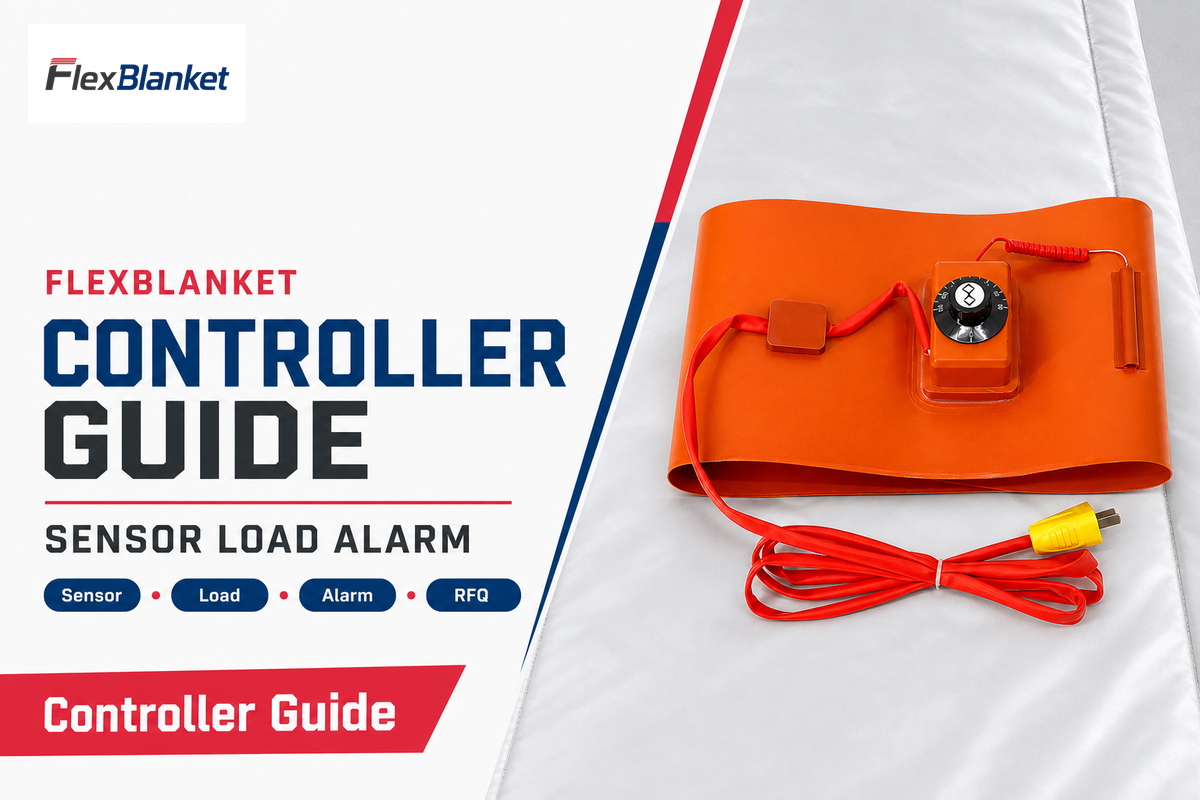
This Temperature Controller Guide is a practical device-selection guide for industrial heating blankets, flexible heaters, IBC tote heaters, drum heaters, pipe heating blankets and silicone rubber heaters. It is not a home heating, ventilation, and air conditioning, refrigeration, or plug-in thermostat setup guide. A controller should be selected around heater load, sensor point, output device, enclosure, alarm layer and quote data, not around a PID label alone.
Quick Specs
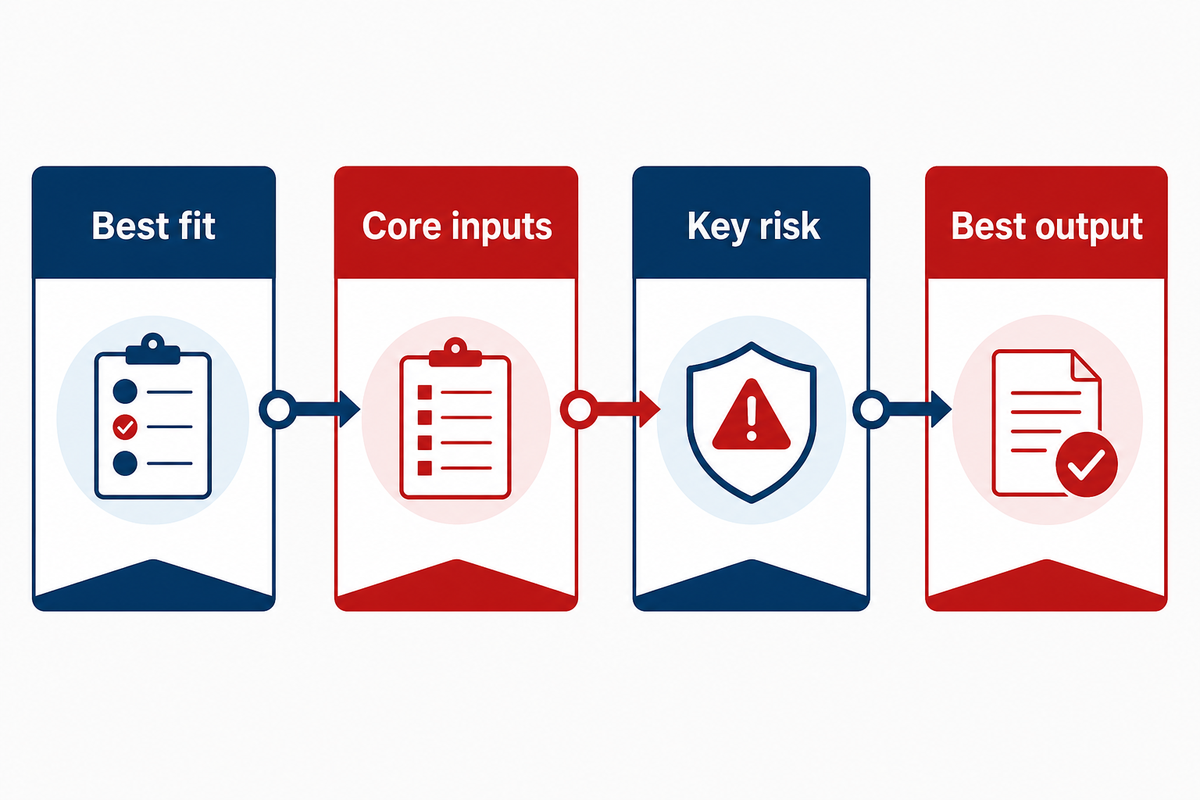
- Best fit: Industrial purchasers selecting on-off, proportional or PID logic for a flexible heating asset.
- Core inputs: voltage, wattage, current, sensor type, set point, allowed swing, alarm limits and environmental conditions.
- Key risk: a controller may read the wrong point, control the wrong load or carry a rating that doesn’t match the supplied assembly.
- Best output: A procurement-friendly request for quotation (RFQ) brief easily understood by facilities teams.
Fast answer
Temperature controller choices should match the sensor, set point, heater load, output device, enclosure and alarm layer before a controller package is quoted. A PID code alone doesn’t prove compatibility.
Key Takeaways
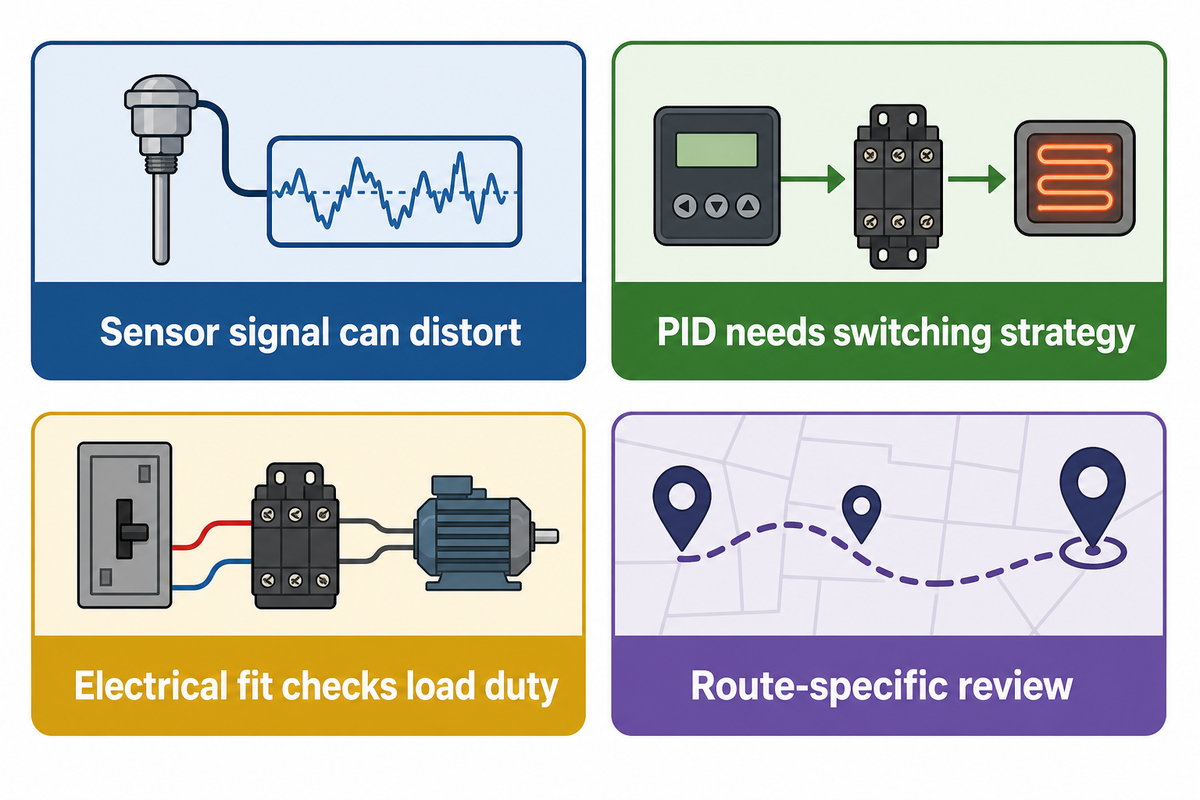
For FlexBlanket RFQ work on drums, totes, pipes and silicone heaters, these checks turn OSHA and UL safety context into questions a buyer can send before model selection.
- Sensor placement can be correct while thermocouple wiring, electrical noise, drift or response time still distorts the reading.
- PID controls necessitate a switching strategy including relay and solid state relay duty ratings and control cycles in addition to tuning values.
- An electrical fit means checking output-device voltage, current rating and load duty cycle together.
- Hazardous-location work needs route-specific review, not a generic claim based only on a controller label.
What a Temperature Controller Does in an Industrial Heater System
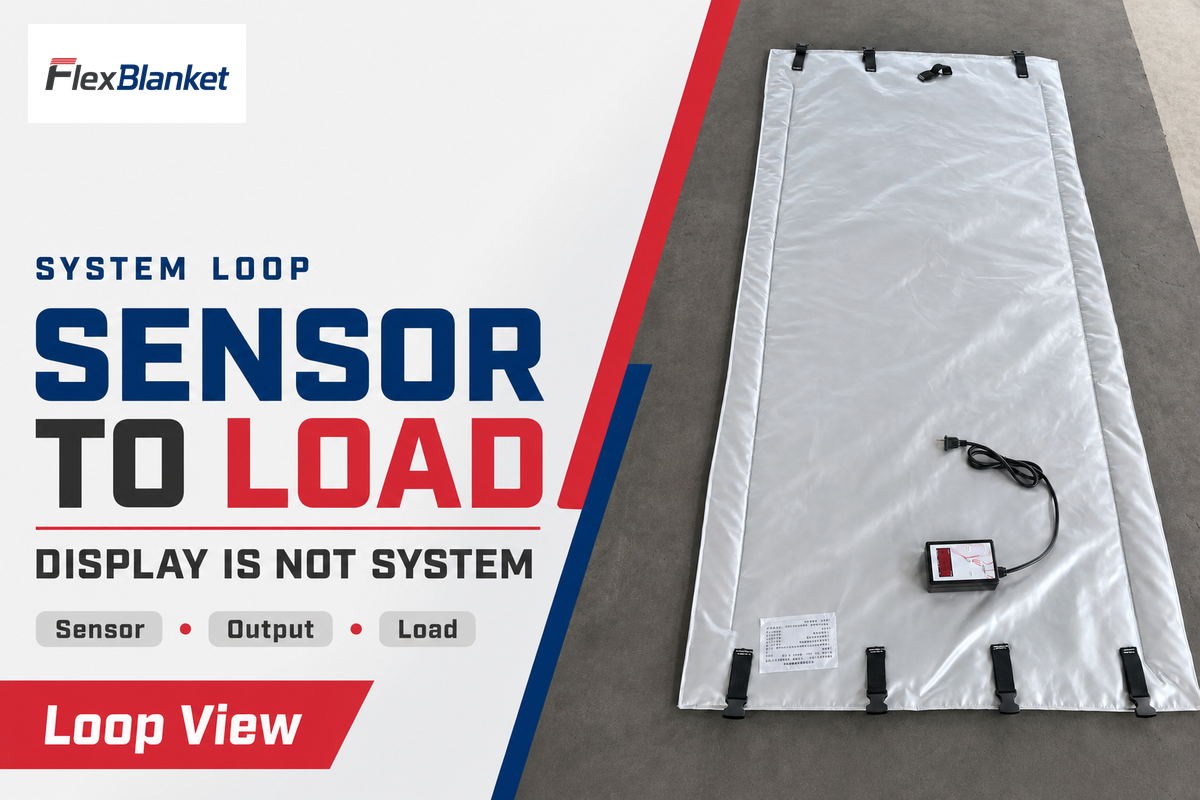
A temperature controller is a device that compares a temperature sensor reading with a setpoint and sends a command to a heating or cooling output. In an industrial heating blanket setup, the controller uses sensor feedback to command a relay, solid state relay or contactor coil; relay contacts, SSR output elements, or contactor power contacts then switch the heater load.
This separation avoids a common buying error: treating the controller display as the whole system. The display may look stable while the sensor sits on the heater face, the product is still cold, or the output hardware is cycling outside its practical switching duty.
With FlexBlanket operations, controlled variables often include the temperature on, in or around pipes, drums, totes, custom silicone heating wraps and composite cure points. The custom industrial heating blankets page is the right internal branch when dimensions, voltage, wattage, sensor and controller choices need to be reviewed together.
Before model numbers, name five parts: measured point, desired temperature, allowed swing, output load and alarm action. The IEEE thermal variables and control topic frames temperature as a variable-and-feedback problem, which is the right starting point for heater controls.
On-Off, Proportional, and PID Control: Choose the Right Control Loop
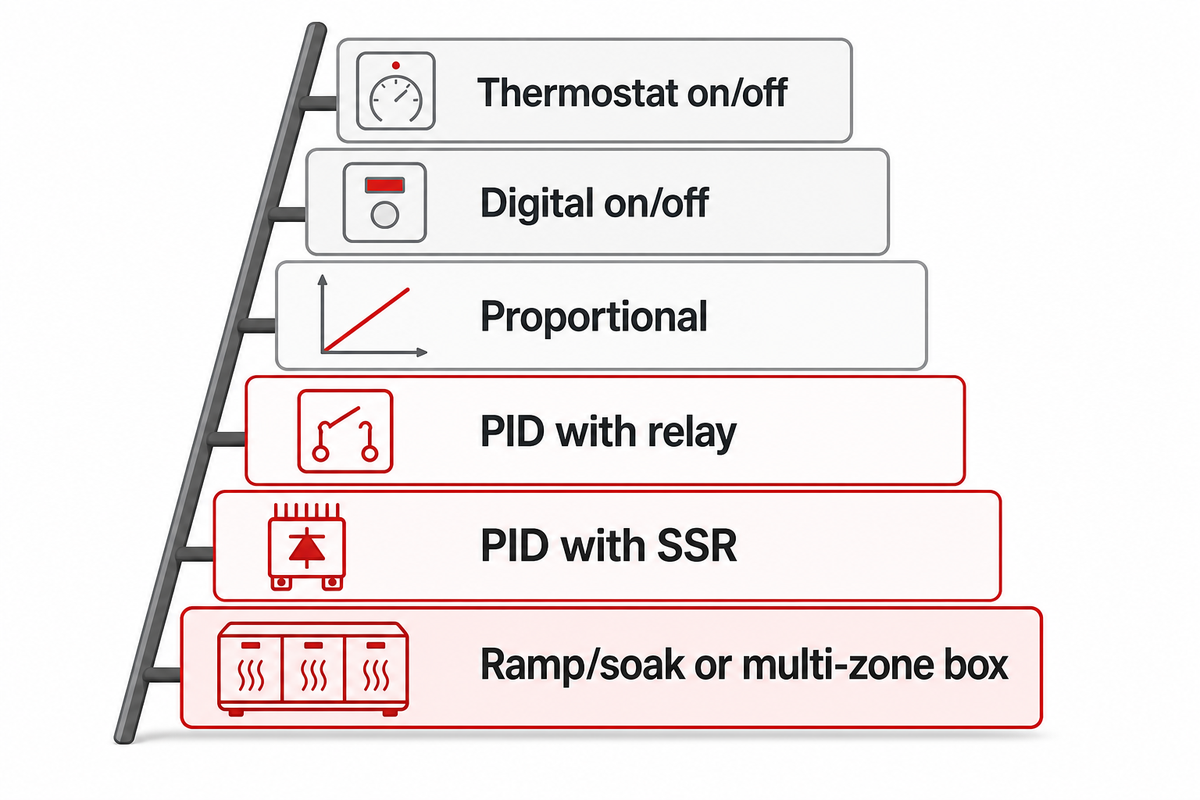
On-off control fits a process that can tolerate a temperature band. Proportional control narrows swing near set point. PID control can help slower or higher-risk heater loops, but output cadence and actuator limits decide whether that theory survives the real heater load.
Control-Loop Fit Ladder
For a small freeze-protection blanket, a thermostat with a defined deadband may be enough. Viscosity holding on a 1000 L tote often needs tighter control, but the tote still responds slowly. Composite or adhesive curing can need ramp, soak and limit review because overshoot can damage the part or bondline.
| Loop choice | Good fit | Check before quoting | Limit |
|---|---|---|---|
| Thermostat on/off | Freeze protection or broad hold band | Deadband, sensor bulb and load rating | Poor fit for tight curing windows |
| Digital on/off | Simple blanket control with display | Input type, relay rating and alarm | Can chatter if hysteresis is too narrow |
| Proportional | Moderate swing reduction | Output type and proportional band | Needs tuning for thermal lag |
| PID with relay | Slow cycles where relay wear is acceptable | Control period, load current and contact life | Wrong for rapid switching |
| PID with SSR | Frequent switching and smoother heat input | SSR current, heat sink and fail action | Not an over-temperature cutout |
| Ramp/soak or multi-zone box | Cure profiles, large blankets or multiple circuits | Ramp rate, zone labels, supply and alarms | More setup for one small pad |
An on-off controller switches heat fully on or off in relation to set point. PID calculates proportional, integral and derivative correction, but it’s only advantageous when the sensor point, control cycle, output hardware and process lag can use those corrections.
Digital Temperature Controller Settings Before the First Heat-Up
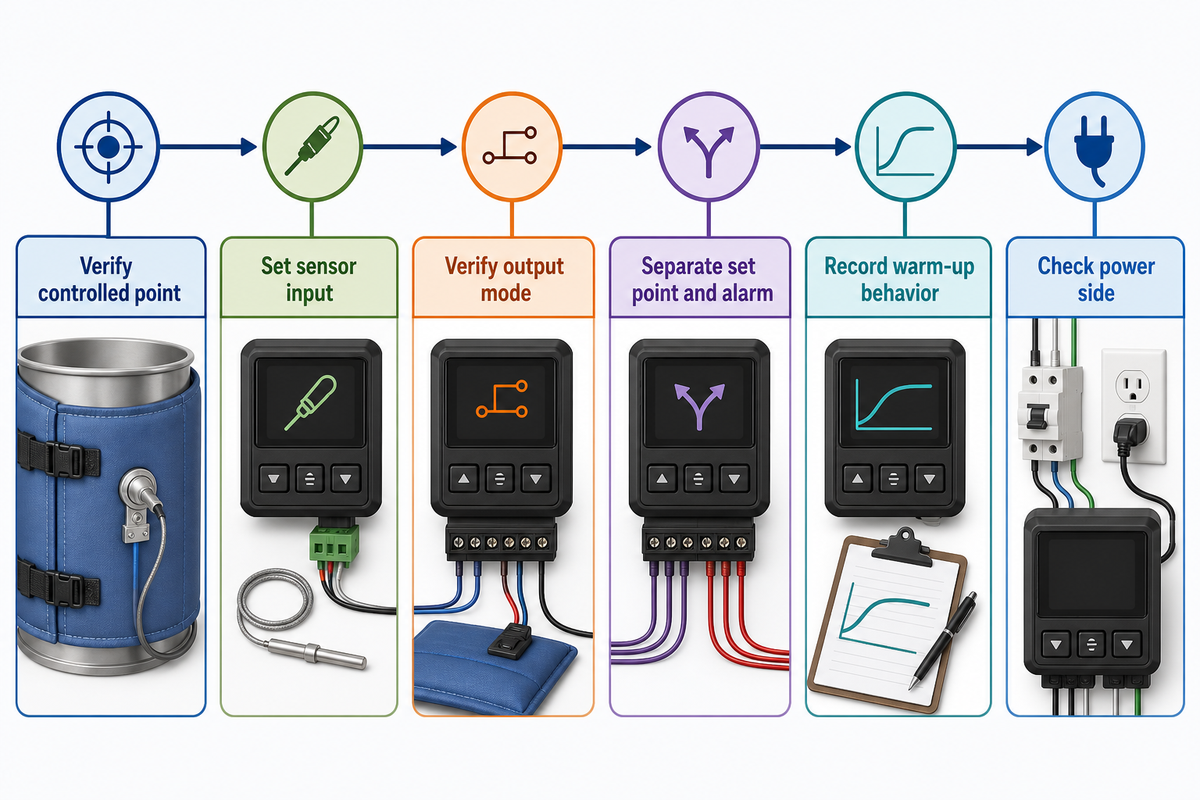
Digital temperature controller configuration should begin with input type, set temperature, current temperature display, output mode, hysteresis or deadband, alarm limit, lockout needs and heater load rating. Factory defaults can energize the wrong output or read the wrong sensor scale.
- Verify the controlled point: heater surface, product, pipe wall, tool face or air space.
- Set the sensor input type and engineering units before heat is applied.
- Verify output mode against relay, SSR, contactor or plant input.
- Set process set point and alarm limit as different values.
- Record allowed swing, warm-up time and operator response.
- Check voltage, wattage and circuit protection on site electrical procedure.
How do I set the temperature controller?
Set a temperature controller by selecting the correct sensor input, inputting the set point, selecting control action, adding an alarm or high-limit value, and checking the heater load against the controller or control-box rating. Use FlexBlanket’s voltage and plug compatibility check when the power side is unclear.
Sensor Type and Placement: Thermocouple, RTD, or Probe?
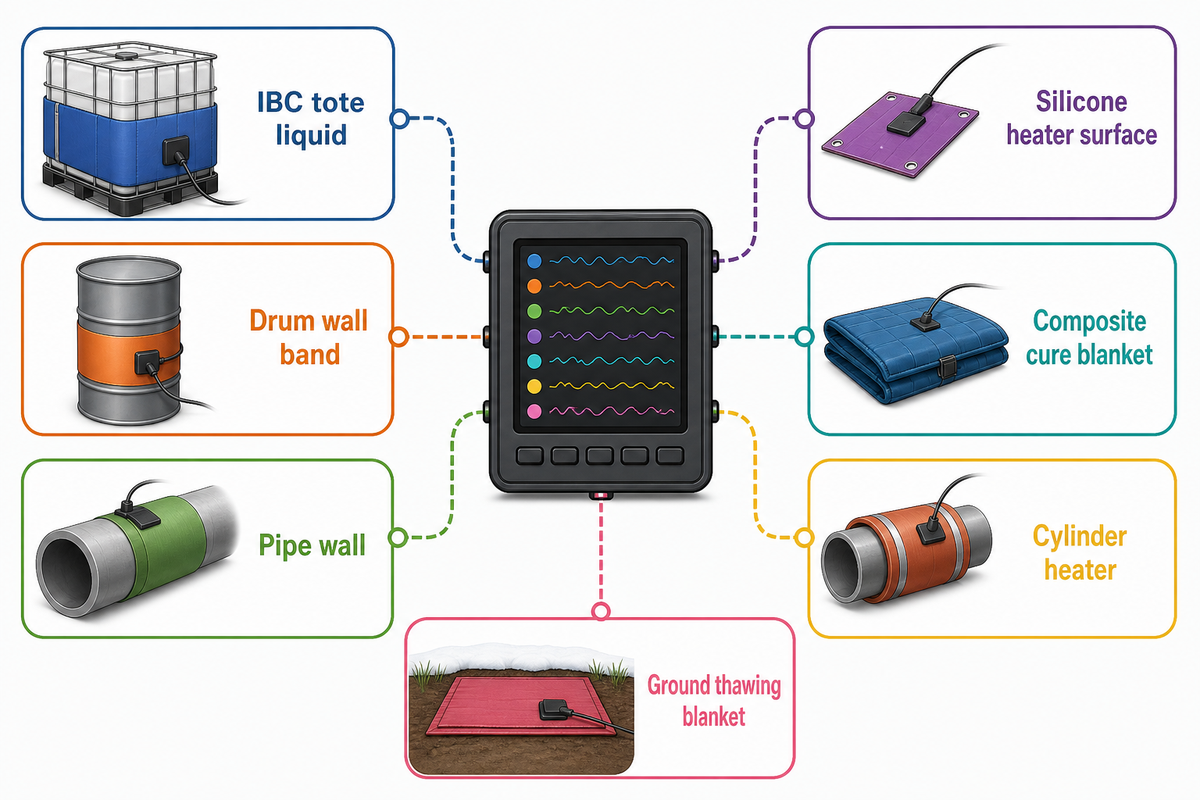
Sensor choice should match what you intend to measure, but placement and signal chain determine what the controller actually sees. Thermocouples taped near the heater, RTDs in product flow and surface probes under insulation can report different values while the same display looks steady; those readings may not equal the actual temperature at the product, pipe wall, or silicone heater surface.
Near-heater sensors react rapidly but may not represent the product. Work-side sensors react to useful temperature but may lag long enough to overshoot. The NIST thermal storage data project shows why measured thermal data must have a defined source, location and test condition.
Thermocouple type, extension wire compatibility, cold-junction compensation, lead resistance, electrical noise, calibration drift and response time can affect what the controller sees. Shielding and routing are mitigation checks, and response time is a transient-lag issue before the measurement electronics feed the controller. State the sensor family, exact location, lead path and controlled point in the same query.
| Controlled load | Better sensor point | Signal-chain check | Limit |
|---|---|---|---|
| IBC tote liquid | Near product or discharge path | Long lead noise and response lag | Wall sensor may miss a cold 1000 L core |
| 200 L drum | Wall band near material level | Probe contact and strain relief | Empty upper wall can read hot |
| Pipe wall | Wall under insulation near coldest point | Lead routing around fittings | Fluid temperature may lag wall reading |
| Silicone heater surface | Embedded pocket or bonded surface point | Lead exit and bend radius | Loose taped sensor can drift |
| Composite cure blanket | Part-side thermocouple at risk zone | Thermocouple type and extension lead | Heater-face sensor may miss part lag |
| Cylinder heater | Contact point from safety review | Cable protection and fail action | Do not infer from drum practice |
| Ground thawing blanket | Soil or surface point tied to duty | Moisture exposure and cable damage | Air reading can hide frozen substrate |
For flat or formed heaters, route sensor questions through FlexBlanket’s silicone rubber heaters page.
Match Controller Output to Voltage, Current, and Heater Wattage
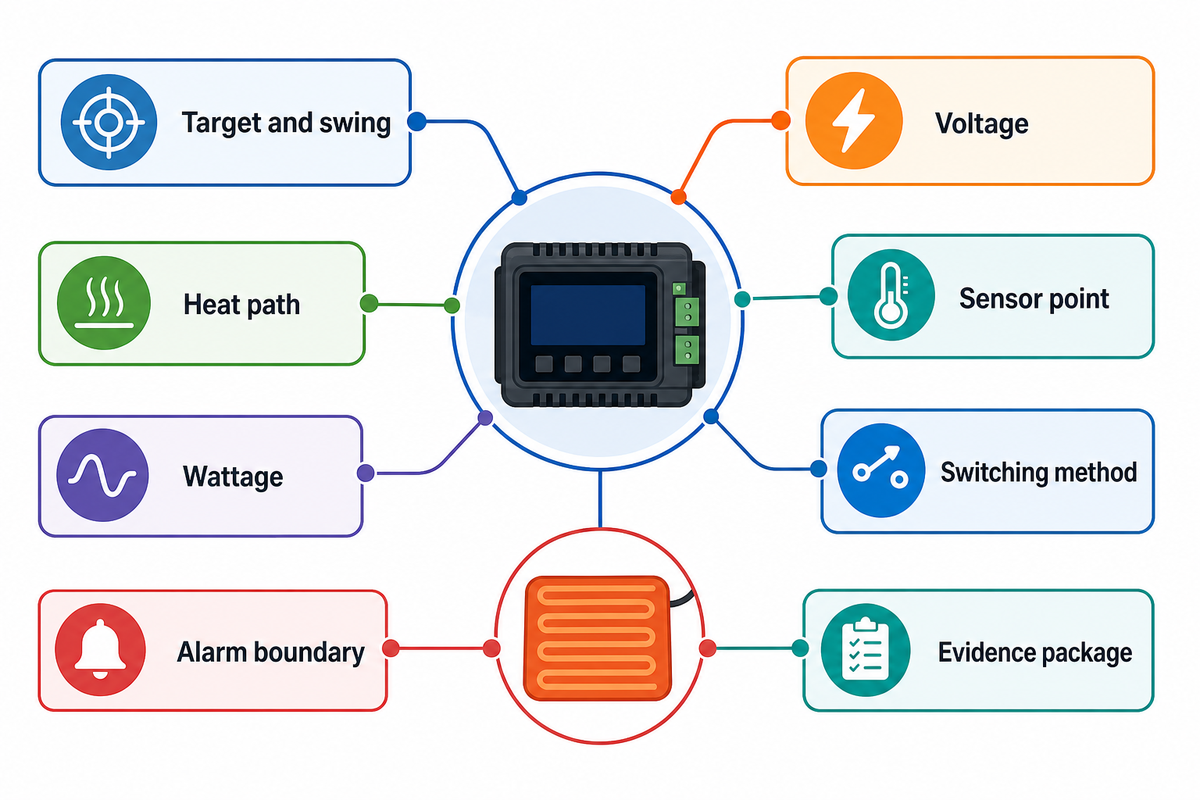
Controller output selection is an electrical load decision long before it’s a temperature decision. The controller, relay, SSR, contactor, fuse, enclosure and heater nameplate must match supply voltage, current, wattage, interrupting duty and site procedure before the set point is meaningful.
The OSHA 1910.303 electrical standard discusses equipment markings, interrupting rating, circuit characteristics and suitability for the operating environment. In buyer language, ask whether the controller can switch the load and where the load is protected.
Time-proportioning PID can require frequent switching. Mechanical relay outputs may be tolerable with a longer control period, while solid state relays can tolerate faster cycling but still need current-rating, heat-dissipation and fail-response checks. Contactors may be appropriate when the controller output is only a signal and the heater load needs a separate power switching path.
Worked load check
In a hypothetical load check, a 240 V, 2400 W blanket draws 2400 W / 240 V = 10 A before derating or start-up behavior is reviewed. That 10 A value is only a load check; controller supply, sensor input, switched load, enclosure and wiring method still need model-specific confirmation.
9-Check Controller Fit Map
| Check type | RFQ input | Why it changes the controller |
|---|---|---|
| Target and swing | Set point, high/low band | Separates process control from limit action |
| Heat path | Material, mass, start temperature | Explains lag and heat-up need |
| Wattage | Nameplate or sizing target | Drives current and switching hardware |
| Voltage | Supply, plug and destination | Sets circuit and controller package |
| Sensor point | Type, mounting and controlled point | Defines the value being controlled |
| Switching method | Relay, SSR, contactor or panel | Prevents signal-only quotes |
| Alarm boundary | Alarm point, reset and shutdown owner | Keeps monitoring separate from protection |
| Environment | Wet, outdoor, chemical or classified area | Changes enclosure and route review |
| Evidence package | Quantity, destination and records requested | Affects release and supplied scope |
Use the heater sizing worksheet for warm-up and wattage inputs, then keep voltage and output-device details in the controller brief.
Standalone Controller, Control Box, or Plant Control System?
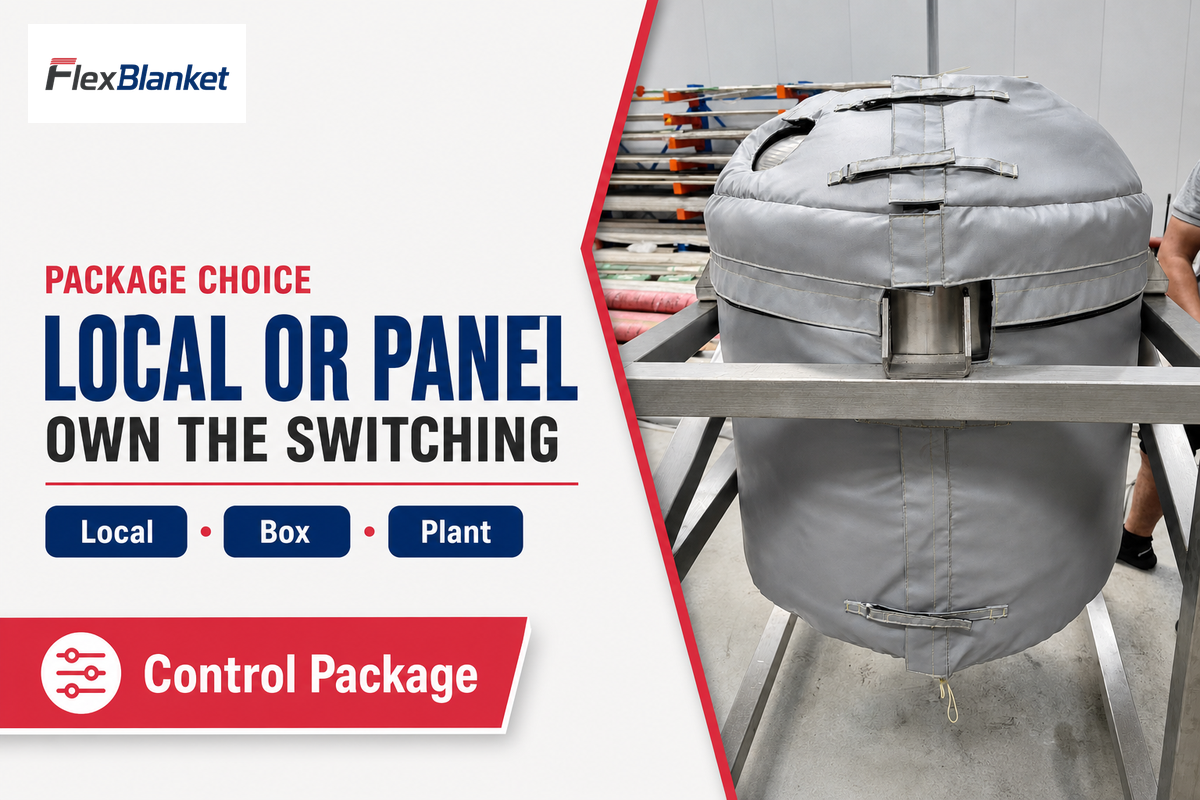
Standalone controllers, control boxes and plant control interfaces are packaging options around the same heat-control problem. Which method is correct depends on the circuit count, output power, alarms, enclosure, communications, operator access and who owns switching responsibility between the heater and the plant.
Small blankets can rely on a local digital controller. Multi-zone tote or pipe packages may need a separate control box with labeled circuits and alarm contacts. Plant interfaces may still need local power switching because a PLC signal alone doesn’t demonstrate the heater load is switched or protected.
Control panels have their own review path. The UL 508A industrial control panel summary frames panel work as a defined standard path, separate from a blanket’s fabric, insulation, lead exit or sensor pocket.
Temperature Switch, Thermostat, Controller, or High-Limit Device?
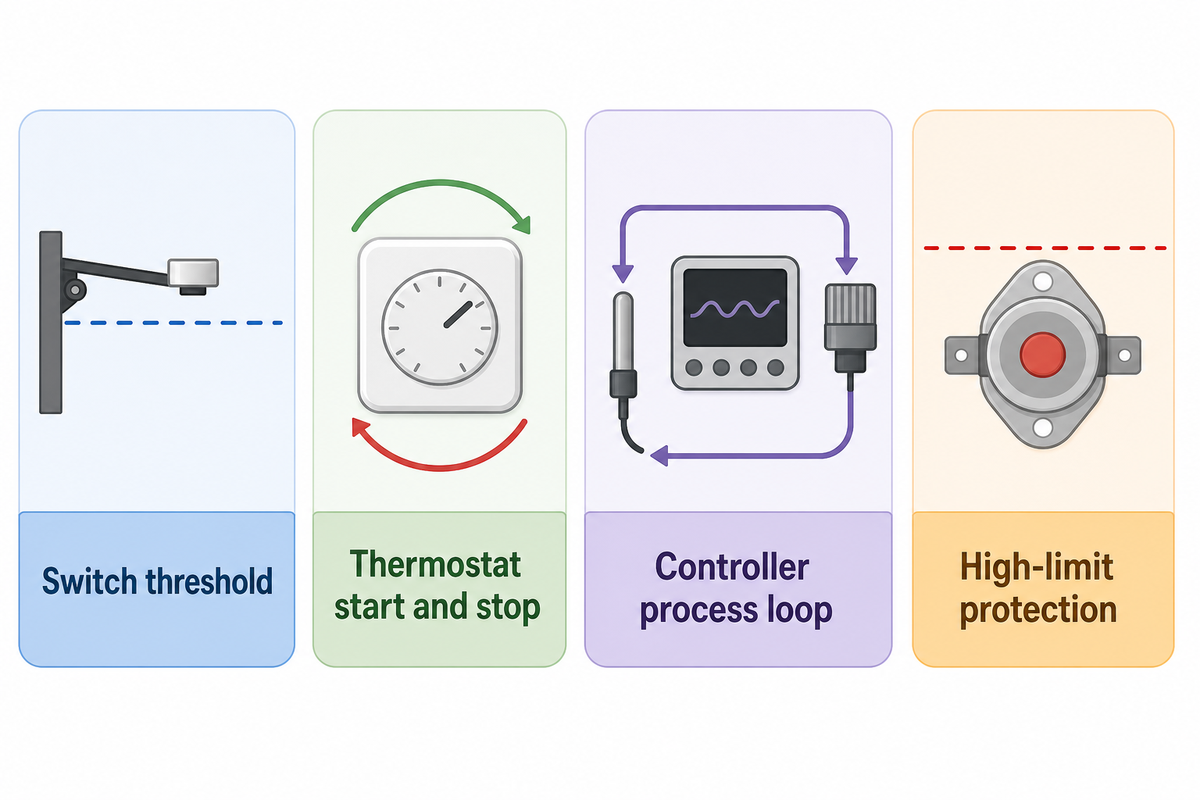
Temperature switches, thermostats, controllers and high-limit devices should not be confused during controller selection. Switches change state at a threshold, thermostats start and stop heat, controllers manage process loops, and high-limit devices protect against unsafe over-temperature when normal control fails.
Low-cost thermostats may fill simple hold duty, but they are poor substitutes for alarm logic, ramp control, multi-zone control or independent protection. Conversely, PID controllers should not be sold as safety layers just because they have high alarm values in the menu.
Thermostat or switch
- Best for simple start/stop heat duty.
- Uses a threshold or broad band.
- Needs load rating and sensor review.
- Can fit freeze protection.
Controller plus high limit
- Best for tighter process control.
- Separates process loop from limit action.
- Needs alarm, output and fail-state review.
- Fits curing and multi-zone duty.
Common failure modes should be named in the quotation: sensor disconnection, heater burnout, a shorted SSR, welded contact, ground fault, lost plant signal or an acknowledged alarm that is not corrected; OSHA electrical-equipment requirements keep the load side from being treated as a menu setting.
Controller Choices by Heating Blanket Application
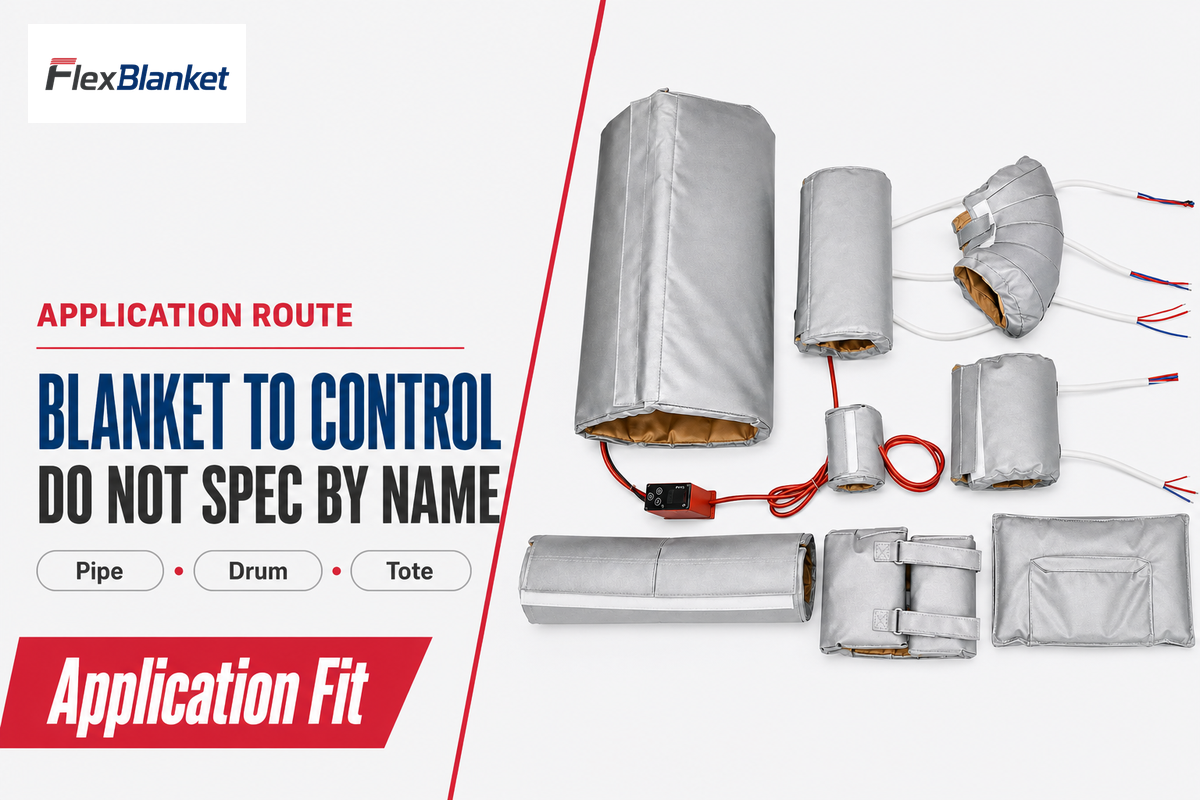
Application names indicate the first control concern, but they don’t determine the controller alone. IBC totes, drums, pipes, silicone heaters, curing blankets, cylinders and ground thawing blankets still require voltage, wattage, sensor point, environment, approval path and acceptance criteria checked.
Use application name as a routing shortcut, not a final specification. An IBC tote heating blanket normally raises thermal-mass and discharge questions. Drum heating blankets start with wall band contact and material sensitivity. Pipe heating blankets add ambient exposure, insulation and access.
Safety Limits, Enclosures, and Approval Boundaries
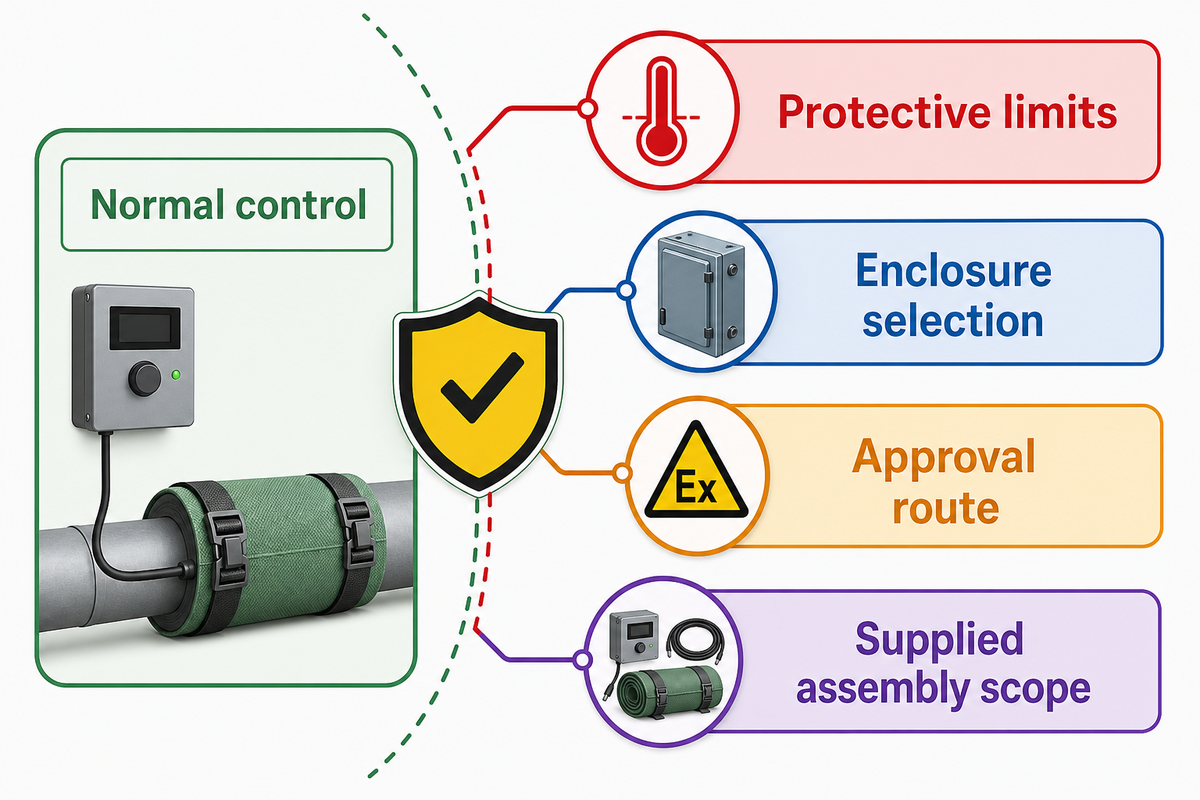
Safety review should isolate normal temperature control from protective limits, enclosure selection, wiring method, hazardous-location route and supplied-assembly scope. A controller rating alone doesn’t prove that the heater, sensor, lead exit, plug, enclosure and control panel are accepted for the application.
For hazardous classified locations, the OSHA 1910.307 hazardous-location rule provides three routes: intrinsically safe equipment, equipment approved for the location, or equipment whose type and design the employer demonstrates as safe. When approval routes and equipment types are required to have markings, class, group and temperature still do matter.
“shall be intrinsically safe, approved… or safe”
The IEC IP ratings guide explains ingress-protection code structure, but the code still has to be assigned to the right part of the package. Heater body, controller box, connector and cable exit can carry different risks.
The Controller Specification Brief to Send with an RFQ
A controller RFQ should let the supplier see the heat path, measured point, power boundary and risk boundary at the same time. Unknown values should stay blank and trigger engineering clarification; guessing wattage, sensor point or approval route creates false readiness.
| Bottleneck | Buying risk | Early question |
|---|---|---|
| Sensor point mismatch | Display value misses acceptance temperature | What exact point should the sensor represent? |
| Output rating versus load | Signal output is mistaken for switching capacity | Who owns relay, SSR, contactor, fuse and panel review? |
| Enclosure and approval scope | A marked component is treated as a marked assembly | Which boundary and environment must be covered? |
| Operator access | A correct set point is changed or bypassed | Which settings are adjustable, locked or recorded? |
| Warm-up window | Sizing problem is blamed on controller selection | What mass, start temperature, target and time window were assumed? |
Use units instead of vague labels in the request. Examples include 12 V DC, 24 V DC, 120 V AC, 230 V AC, 240 V, 480 V, 5 A, 10 A, 20 A, 40 A, 500 W, 2400 W, 4800 W, a 10 s control period, a 1 hr warm-up target and an 8 hr hold window. When known, add site values such as a 5 A alarm relay, 10 A SSR output, 20 A branch circuit, 40 A panel feeder, 30 s restart delay and 15 min hold verification.
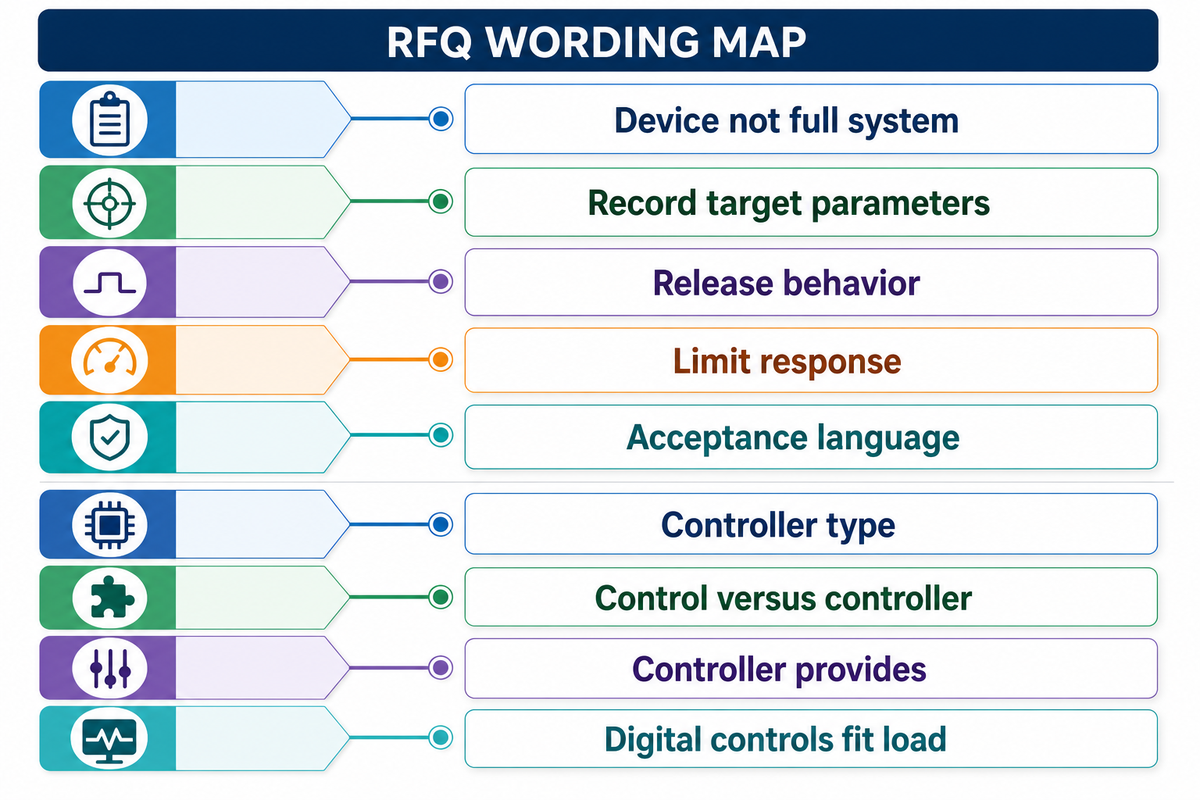
RFQ Wording Check
The wording below keeps controller language precise enough for purchasing and engineering review.
| RFQ wording | Use case | Specification record |
|---|---|---|
| A temperature controller is a device, not the full temperature control system. | Apply this when explaining why temperature controllers are used with a sensor, output device and heater load. | Name whether the feedback control system must control temperature or control the temperature through a local controller module. |
| Record set temperature, preset temperature, setpoint temperature and target temperature parameters. | Apply when the temperature is set before the first heat-up. | State the temperature value, the temperature range and the difference between the setpoint and the allowed band, such as a 2 °C process band and 3 °C alarm gap. |
| Explain when the temperature reaches the band and when temperature is reached for release. | Apply when a batch must maintain the desired temperature through warm-up and hold. | Record whether the controller initiates heat, waits, or turns output off when the temperature rises. |
| State what happens when temperature falls, temperature drops, temperature changes or temperature exceeds the limit. | Flag cases where a temperature alarm, high temperature condition or safe temperature limit matters. | Define how to bring the temperature back, keep the temperature within the band and avoid unsafe restart. |
| Do not promise perfect temperature; define correct temperature, proper temperature and accurate temperature acceptance. | Apply when the buyer asks for precise temperature control or constant temperature. | State how to maintain a consistent temperature and what precise and consistent temperature regulation means for the material. |
| Choose the right temperature controller by naming the type of controller and controller type. | Compare a thermostat controller, digital thermostat, basic temperature controller and digital temperature controllers. | Confirm whether a simple thermostat to control freeze protection is enough or a PID loop is required. |
| Separate types of temperature control from types of temperature controllers. | Map how temperature controllers work across on-off, proportional and PID logic. | Do not mix process-heater temperature readings with temperature and humidity sensors for room monitoring. |
| Say what the controller provides and what temperature controllers also need. | Connect the phrase to temperature controllers are designed around input, output, alarm and enclosure limits. | State whether controllers are specifically selected for the blanket, pipe, drum, tote or silicone heater. |
| Write the phrase “digital temperature controllers are used” only when digital controls fit the load. | Apply when controllers are used to control heaters and precise temperature control is required. | Write “controllers are critical” only when a safe temperature is required and regulating temperature cannot be left to simple switching. |
When reviewing behavior, do not ask for a generic temperature controller for your needs. Specify what measures the temperature, where the temperature threshold sits, how the thermostat allows restart, whether the PID controller continuously pulses output, and whether operators rely on temperature controllers to adjust the temperature, regulate the temperature, and respond to a change in temperature or temperature difference.
RFQ checklist: copy these into your quote request.
| Parameter | Send this | Why it matters |
|---|---|---|
| Target temperature | Set point plus allowed band | Separates hold duty from limit action |
| Voltage and heater load | Supply, wattage, current and circuit count | Selects relay, SSR, contactor or box |
| Sensor point | Type, location and controlled point | Defines actual feedback |
| Output responsibility | Controller relay, SSR drive, contactor or PLC signal | Prevents signal-only quotes |
| Environment | Indoor, outdoor, wet, chemical or classified area | Affects enclosure and route review |
| Alarm and fail action | High alarm, open-sensor action and response owner | Separates control from protection |
FlexBlanket manufactures industrial electric heating blankets and flexible heating products for chemicals, energy, construction and manufacturing users. First-party about-page evidence describes Qingdao, China operations founded in 2019, a 5000+ square meter plant, 50+ skilled staff, 7-15 day standard lead time and 24-month warranty.
For controller quoting, keep the application coverage and conversion path together: custom industrial heating blankets, IBC tote heating blankets, drum and barrel heating blankets, silicone rubber heaters, composite and adhesive curing blankets, ground thawing blankets, cylinder and propane tank heaters, pipe tracing blankets, heater sizing worksheet, duty and material selector, voltage and plug compatibility check, application screen, RFQ specification checklist and contact page. Controller review should stay inside the same quote that covers blanket geometry, voltage, wattage, lead routing, sensor location and environment.
Send Your Controller Requirements to FlexBlanket
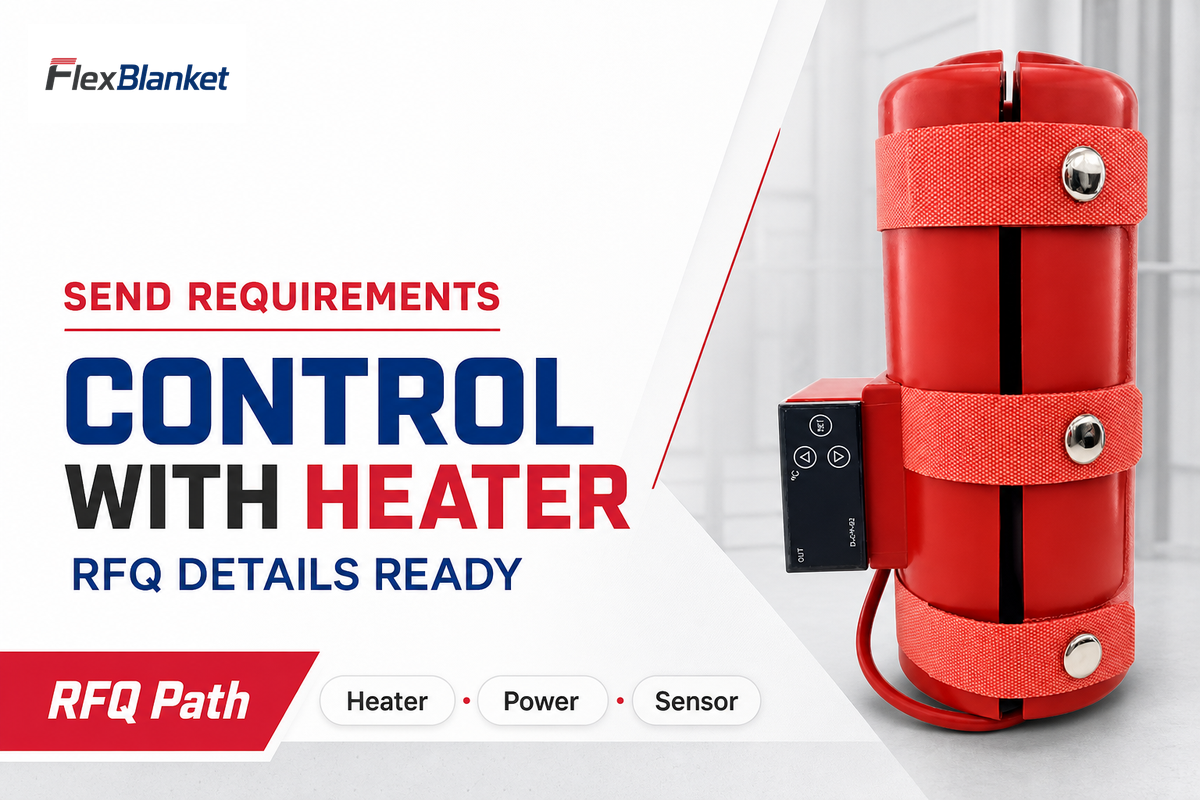
Share the heater type, target temperature, voltage, wattage, sensor point, environment and alarm needs. FlexBlanket can review the controller boundary together with the heating blanket instead of treating controls as an afterthought.
FAQ
What is a temperature controller?
A temperature controller reads a sensor, compares the measured value with a set point and commands an output to add or stop heat. In heating blankets, the controller is not the whole system. Sensor position, thermocouple or RTD wiring, relay or SSR selection, heater wattage, enclosure and alarm layer also decide whether the displayed value represents the process temperature.
How does a PID temperature controller work?
PID control corrects output from present error, accumulated error and rate of change. It can reduce overshoot in slow heater systems, but only when the sensor point, control period and output hardware fit the thermal mass. Relay outputs, SSRs and contactors react differently, so tuning cannot be separated from the switching device.
How do I set a temperature controller?
Set input type first, then the set point, output action, hysteresis or PID parameters, alarm limit and lockout needs. Before energizing a heating blanket, confirm controller output, heater wattage, current draw, supply voltage and circuit protection through site electrical procedure. Record the first heat-up behavior before leaving the system unattended.
Is a thermostat the same as a temperature controller?
No. A thermostat starts and stops heat around a threshold or band. A controller manages a wider process loop, output type, alarm state and PID behavior. A high-limit device is a separate protective layer.
Which sensor is better for industrial heaters: thermocouple or RTD?
Thermocouples often fit rugged heater surfaces and broad ranges. RTDs can help where stable readings matter more than response speed or high range.
What should I send to FlexBlanket for a controller quote?
Send heater type, target temperature, allowed swing, voltage, wattage, sensor type, sensor location, output responsibility, environment, alarm needs, quantity and lead-time target. Add drawings or photos when the sensor or lead route is hard to describe. For classified areas, wet service or control-panel work, also name the required review route instead of asking for a generic controller model.
Transparency Note
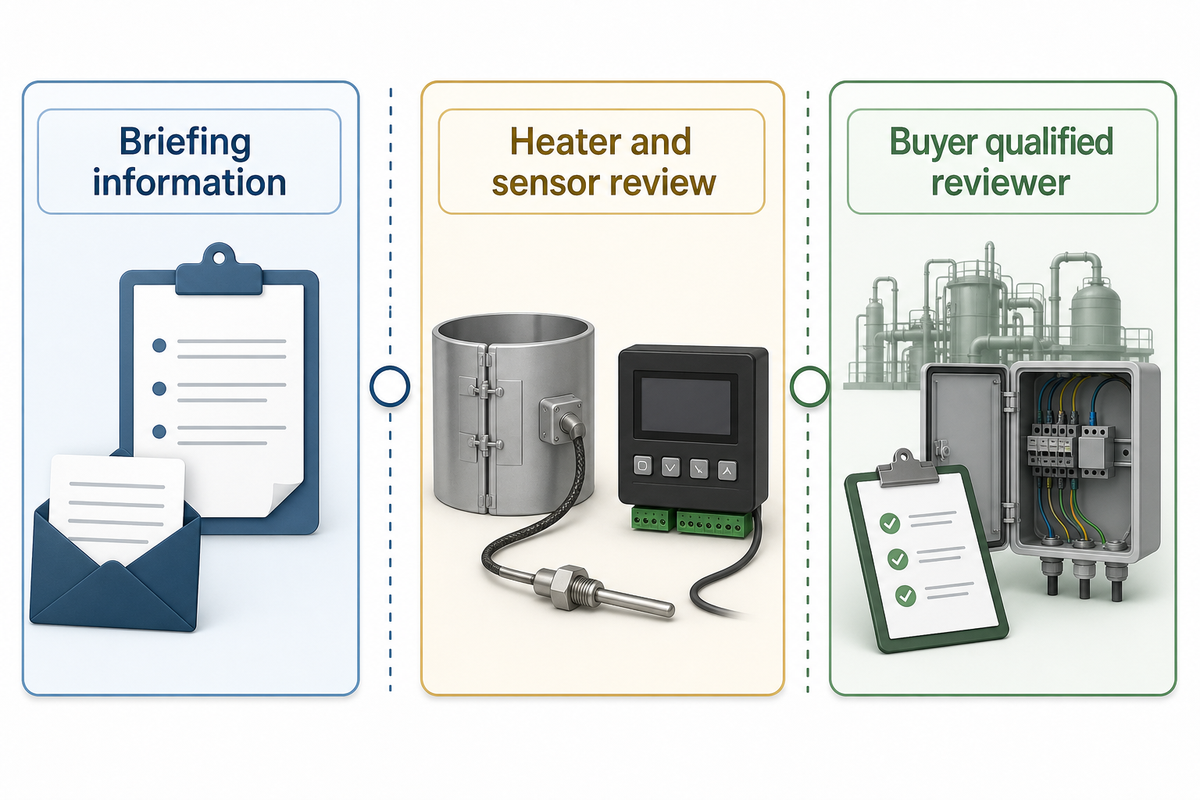
This guide is controller-selection briefing information, not an installation manual or approval certificate. FlexBlanket can review heater geometry, voltage, wattage, controller interface and sensor location for a quote, but site wiring, hazardous-location route and control-panel acceptance must be checked by the buyer’s qualified reviewer.