Get in touch with FlexBlanket Company

Updated October 2026
What is the DEF on a diesel truck, tractor or generator?
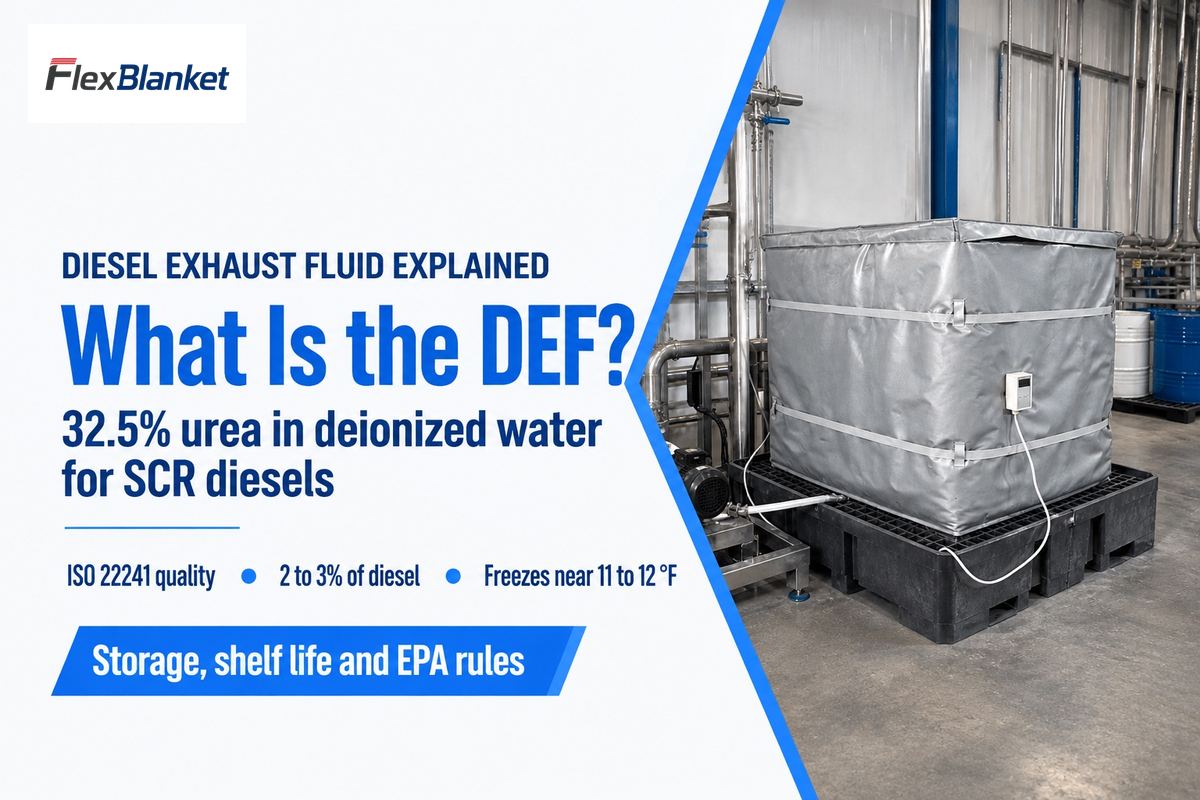
DEF is diesel exhaust fluid: a 32.5% solution of high-purity urea in deionized water that the selective catalytic reduction (SCR) system sprays into hot exhaust to convert nitrogen oxides (NOx) to nitrogen and water vapor. It never goes in the fuel tank. This guide discusses what DEF is made of, how much a diesel uses, how long it lasts, how to prevent totes and drums from freezing, and what the 2025 to 2026 EPA changes mean for the person buying it.
Diesel exhaust fluid is 32.5% urea and 67.5% deionized water, stored in its own blue-capped tank and dosed into the exhaust ahead of the SCR catalyst. Most on-road diesels use 2 to 3 gallons of it per 100 gallons of fuel; let the tank run dry and the engine warns first, then limits power, with a 25 mph cap only after about four work weeks on trucks with updated software.
Quick Specs: Diesel Exhaust Fluid
| Other names | AUS 32, AdBlue, ARLA 32 |
| Composition | 32.5% urea (31.8 to 33.2% allowed) in deionized water |
| Freeze point | About 11 to 12 °F (−11.5 °C) |
| Storage window | 23 to 86 °F (−5 to 30 °C) |
| Dose rate | 2 to 3% of diesel volume on most on-road engines |
| Governing standard | ISO 22241 (quality, test methods, handling) |
What is the DEF on a diesel engine?
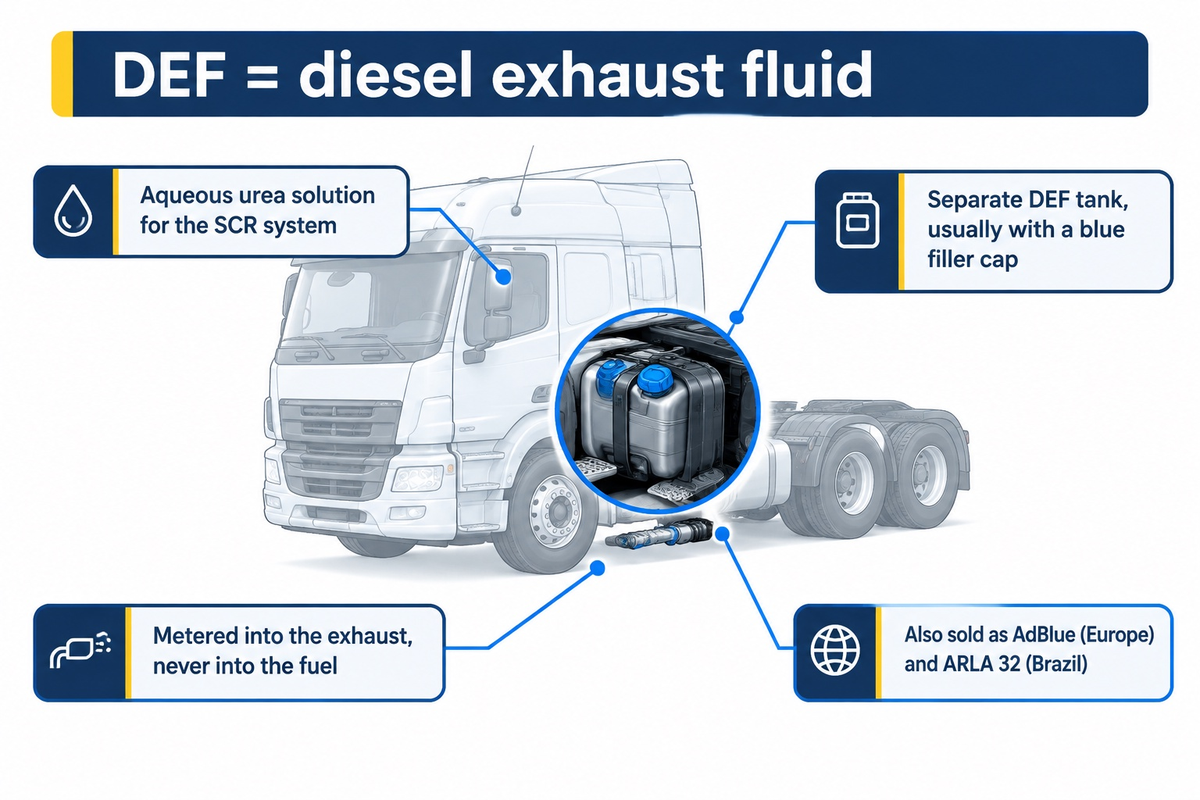
DEF, short for diesel exhaust fluid, is an aqueous urea solution that a diesel engine’s selective catalytic reduction system needs to reduce harmful emissions of nitrogen oxides. The engine carries it in a separate DEF tank, usually with a blue filler cap, and the DEF pump meters it into the exhaust, never into the fuel or the combustion process.
The American Petroleum Institute describes DEF as a 32.5% solution of technically pure urea in purified water, and API-licensed fluid must meet the most recent edition of ISO 22241, NOx reduction agent AUS 32. The same fluid is sold as AdBlue in Europe and ARLA 32 in Brazil. According to the U.S. Environmental Protection Agency’s DEF page, nearly all on-road diesel trucks since 2010, plus many tractors and construction machines, use DEF with SCR. Gasoline engines do not need it.
A new diesel pickup, a Class 8 truck and a Tier 4 Final tractor all use the same fluid. What changes between them is the DEF needed per tank of fuel and how the machine reacts when it has to run without DEF.
32.5%urea in deionized water
11–12 °Ffreeze point (−11.5 °C)
2–3%of diesel volume dosed
86 °Flong-term storage ceiling
What DEF is made of: urea, deionized water and ISO 22241
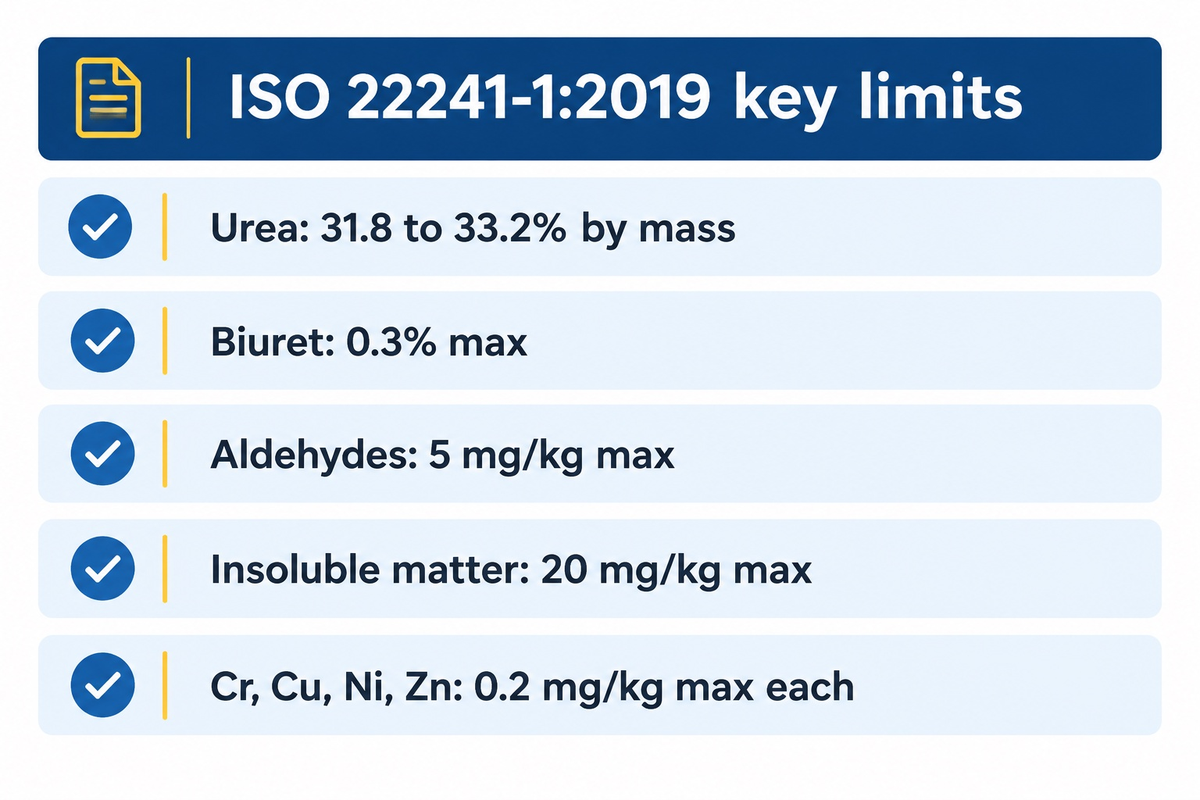
Diesel exhaust fluid is a blend of urea and deionized water, 32.5% urea by mass and 67.5% water, and ISO 22241-1 allows the urea content to sit anywhere from 31.8 to 33.2%. Everything else in the tank counts as contamination, and the fluid has to stay free of contaminants down to milligrams per kilogram, which is why the limits are set in mg/kg in the standard rather than percent.
The 32.5% figure is not arbitrary. Published summaries of ISO 22241-1 list the onset of crystallization at −11.5 °C for this blend, and an EPA guidance letter of March 2026 notes that SCR systems are calibrated to the 32.5 percent urea concentration. A weaker mix makes the engine inject DEF at a higher rate to hit the same NOx target; the same EPA letter uses DEF diluted to 26% urea as the point where the engine’s emissions might exceed its NOx standard.
| Property (ISO 22241-1:2019) | Limit | What a failure points to |
|---|---|---|
| Urea content | 31.8 to 33.2% by mass | Dilution with water or evaporation in a vented container |
| Refractive index at 20 °C | 1.3814 to 1.3843 | Same as urea content; this is what a refractometer reads |
| Density at 20 °C | 1,087 to 1,093 kg/m³ | Wrong concentration |
| Alkalinity as NH3 | 0.2% max | Urea breakdown from long storage above 30 °C |
| Biuret | 0.3% max | Fertilizer-grade urea or overheating |
| Aldehydes | 5 mg/kg max | Anti-caking agents used on fertilizer urea |
| Insoluble matter | 20 mg/kg max | Dust, rust or debris from open transfer |
| Phosphate (PO4) | 0.5 mg/kg max | Detergent residue in reused containers |
| Al, Ca, Fe, K, Mg, Na | 0.5 mg/kg max each | Tap water, hard water or aluminum fittings |
| Cr, Cu, Ni, Zn | 0.2 mg/kg max each | Brass, copper or galvanized parts in the pump path |
| Crystallization onset | −11.5 °C (11.3 °F), informative | Not a pass/fail item; sets the storage plan |
Limits as summarized from ISO 22241-1:2019 by the standards distributor iTeh, not read from the full standard. A third edition of the standard passed its final ISO vote on September 24, 2026 and is being published, according to the ISO project page; until it appears, check which edition a supplier’s certificate cites.
Is DEF the same as AdBlue?
Yes. AdBlue, DEF, AUS 32 and ARLA 32 are trade or regional names for one product: the 32.5% aqueous urea solution defined by ISO 22241-1. A tank labeled AdBlue on a European van takes the same API-licensed DEF sold at a U.S. truck stop, and the reverse is also true, because both meet the same quality limits.
Brands can be mixed in one tank as long as each meets ISO 22241-1. What matters is the date code and how the fluid was stored, which the next sections cover.
How DEF works inside an SCR system
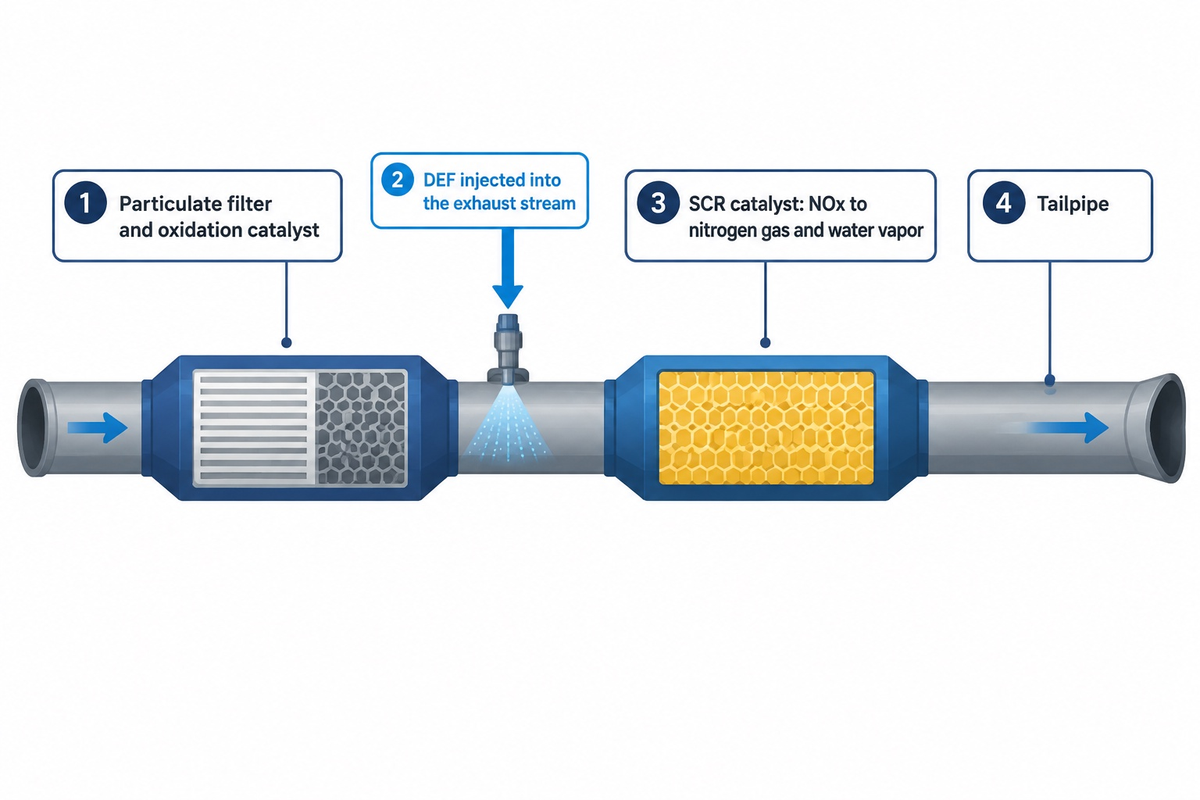
DEF works by turning into ammonia in the hot exhaust gas, and on the SCR catalyst that ammonia helps convert toxic nitrogen oxides into harmless nitrogen gas and water vapor. The U.S. Department of Energy’s Alternative Fuels Data Center places this step in the exhaust system after the diesel particulate filter and the oxidation catalyst, before the tailpipe.
The chemical reaction runs in two steps. Heat first splits each urea molecule into ammonia and carbon dioxide, so one molecule of urea, CO(NH2)2, produces two molecules of NH3 and one of CO2. In the main reaction, 4 NO + 4 NH3 + O2 -> 4 N2 + 6 H2O. On the catalyst, the ammonia is there to reduce the concentration of NOx. The SCR system doesn’t touch soot. That’s the job of the diesel particulate filter (DPF), which is why a clogged DPF and a DEF fault show up as different warning messages.
Where is DEF injected?
DEF is injected into the exhaust stream between the diesel particulate filter and the SCR catalyst, through a dosing injector fed by the DEF pump in or near the tank. The urea-water mixture is injected downstream of the engine, and it’s only added to the exhaust after combustion, so it never gets inside your engine’s cylinders or the fuel system and doesn’t change how the engine burns diesel.
Because the injector sits in a hot pipe, fluid left in the nozzle can dry into white urea crystals. Forum reports from owners of Ram and Cummins engines describe clearing those crystals with warm water; on a modern engine the controller purges the line at shutdown to limit this.
📐 Worked example: ammonia in one gallon of DEF
Assumed inputs: 1 US gallon = 3.785 L; density 1.090 kg/L (midpoint of the ISO range); 32.5% urea; urea 60.06 g/mol; ammonia 17.03 g/mol.
One gallon weighs 3.785 × 1.090 = 4.13 kg, of which 4.13 × 0.325 = 1.34 kg is urea. That is 1,342 ÷ 60.06 = 22.3 mol of urea, which releases 2 × 22.3 = 44.7 mol of ammonia, or 44.7 × 17.03 = 761 g. In theory, with full conversion, each gallon of DEF can therefore release up to about 0.76 kg (1.7 lb) of ammonia, plus about 0.98 kg of carbon dioxide; how much reaches the catalyst depends on exhaust temperature and dosing.
How much DEF a diesel uses and what happens when it runs out
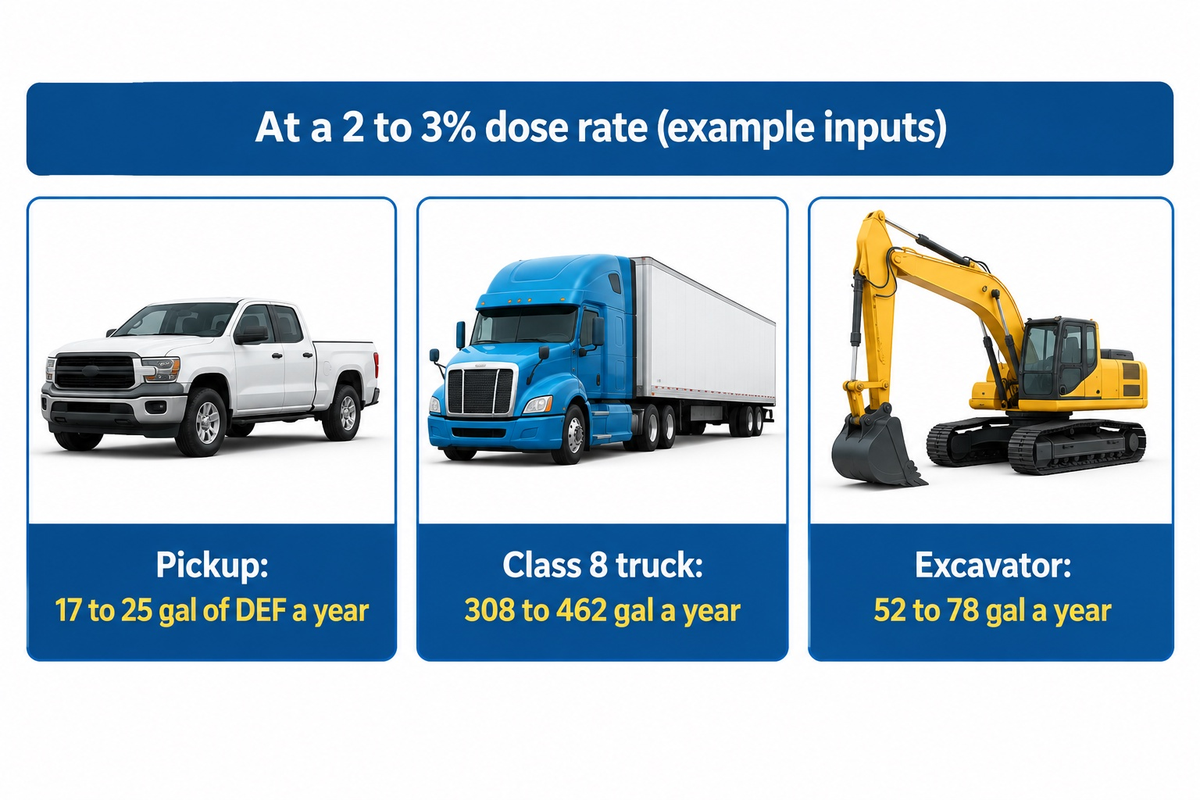
Most modern diesel engines on the road burn 2 to 3 gallons of DEF for every 100 gallons of diesel fuel, the dosing range given by engine makers when SCR trucks arrived. In a 2011 Heavy Duty Trucking report, DEF distributor Mansfield Oil said fleets it polled reported close to 3%, and a truck stop chain that sells DEF saw 3 to 4% on its customers’ trucks. On heavy-duty diesel vehicles, heavy loads, towing and hot weather push the amount of DEF up because the engine makes more NOx.
| Example machine | Diesel per year | DEF per year | Package that fits |
|---|---|---|---|
| Pickup, 15,000 mi at 18 mpg | 833 gal | 17 to 25 gal | 7 to 10 jugs of 2.5 gal |
| Class 8 truck, 100,000 mi at 6.5 mpg | 15,385 gal | 308 to 462 gal | 1.1 to 1.7 totes of 275 gal |
| Excavator, 50-gal fuel tank refilled weekly | 2,600 gal | 52 to 78 gal | 1 to 2 drums of 55 gal |
Estimate your DEF usage by multiplying your yearly diesel usage by 0.02 and 0.03 and using your fuel records instead of the annual miles example, fuel mileage in miles per gallon, and 52 weekly fills. The excavator row’s ratio borrows from the EPA’s March 2026 letter, which describes a 50-gallon diesel tank coupled with a 2-gallon DEF tank, so one DEF fill covers one to two fuel fills at a 2 to 3% dose. Order on that range to keep enough DEF on hand between deliveries.
What happens if my truck runs out of DEF fluid?
A truck that runs out of DEF first shows a warning, then limits engine performance; before the August 2025 guidance, the EPA says, a derate could cut speed to as little as 5 mph within hours. Under the EPA’s August 2025 guidance, heavy-duty trucks with updated software get a warning for 650 miles or 10 hours, then a mild derate with no speed limit for up to 4,200 miles. The same guidance gives chassis-certified vehicles a separate schedule: no early derate, then a 45 mph limit after 4,200 miles or 80 hours, so ask your dealer which schedule a diesel pickup follows.
Only after about four work weeks does the speed fall to 25 mph, according to the EPA’s March 27, 2026 news release; nonroad equipment sees no effect for the first 36 hours. The catch is the word “updated”: the EPA can’t mandate field fixes on in-use vehicles, so an older truck keeps its original limp mode until the manufacturer releases new software and a dealer installs it. Ask your dealer whether the DEF update has been loaded on your specific engine before you count on the longer warning period. Putting on-spec DEF in the tank is always the first fix; then follow the dash message, because how quickly the warning clears depends on the engine software.
DEF storage temperature, shelf life and containers
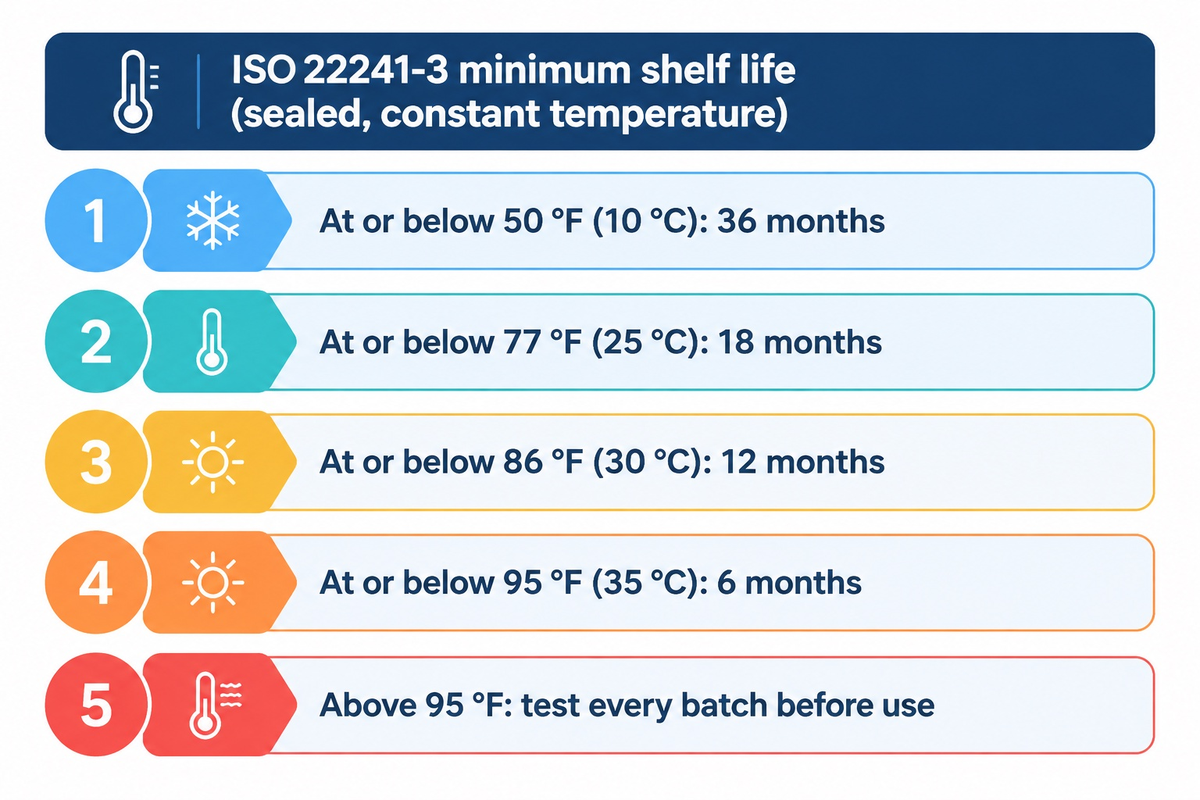
The shelf life of DEF in a sealed container is at least 18 months at a constant 77 °F (25 °C) and 12 months at a constant 86 °F (30 °C), according to the shelf-life table in ISO 22241-3:2017, the handling and storage part of the standard. Heat, not age alone, is what shortens it, because urea slowly breaks down into ammonia and raises the fluid’s alkalinity.
| Constant storage temperature | Minimum shelf life |
|---|---|
| At or below 10 °C (50 °F) | 36 months |
| At or below 25 °C (77 °F) | 18 months |
| At or below 30 °C (86 °F) | 12 months |
| At or below 35 °C (95 °F) | 6 months |
| Above 35 °C (95 °F) | Test every batch before use |
The same standard says to avoid prolonged storage above 30 °C and storage below −5 °C (23 °F), which gives a practical storage window of 23 to 86 °F. Shelf life is counted from the end of production, so a jug that spent a summer in a delivery van has used part of its life before you open it; buy the most recent date code you can. The American Petroleum Institute’s purchasing guide adds that storing DEF above 86 °F will limit its shelf life over time. For a deeper look at seasonal storage ranges, see the DEF storage temperature guide.
Container material matters as much as temperature. ISO 22241-3 lists the metals and plastics that keep DEF within its limits:
| Material | ISO 22241-3 listing | Where it shows up in a DEF setup |
|---|---|---|
| Austenitic stainless steel (304, 304L, 316, 316L) | Recommended | Bulk tanks, pump bodies, nozzles |
| Titanium, Hastelloy C-276 | Recommended | Sensor and valve wetted parts |
| Polyethylene (PE, HDPE) | Recommended, free of harmful additives | Jugs, drums, IBC tote bottles |
| Polypropylene (PP) | Recommended, free of harmful additives | Caps, fittings, filter housings |
| PFA, PTFE, PVDF fluoropolymers | Recommended, free of harmful additives | Seals, hose liners |
| Polyisobutylene (PIB) | Recommended, free of harmful additives | Gaskets and linings |
| Carbon steel, mild iron | Not recommended | Old fuel drums, steel funnels |
| Zinc-coated (galvanized) steel | Not recommended | Farm tanks, galvanized fittings |
| Copper and copper alloys (brass) | Not recommended | Brass hose barbs, fuel-pump fittings |
| Aluminum and aluminum alloys | Not recommended | Aluminum transfer cans and pump housings |
| Zinc, lead, magnesium; lead or silver solders | Not recommended | Soldered joints, die-cast parts |
| Nickel-coated plastics or metals | Not recommended | Plated quick couplers |
Do
- Keep DEF between 23 and 86 °F, out of direct sun
- Transfer DEF only through DEF-only pumps, hoses and nozzles in stainless steel or HDPE
- Rinse shared equipment with distilled or deionized water, then with DEF
- Use the oldest date code first
Don’t
- Refill old jugs or reuse fuel funnels
- Rinse with tap water
- Add antifreeze or any additive to DEF
- Store a full, sealed container where it can freeze
Does DEF freeze? Winter handling for totes and drums
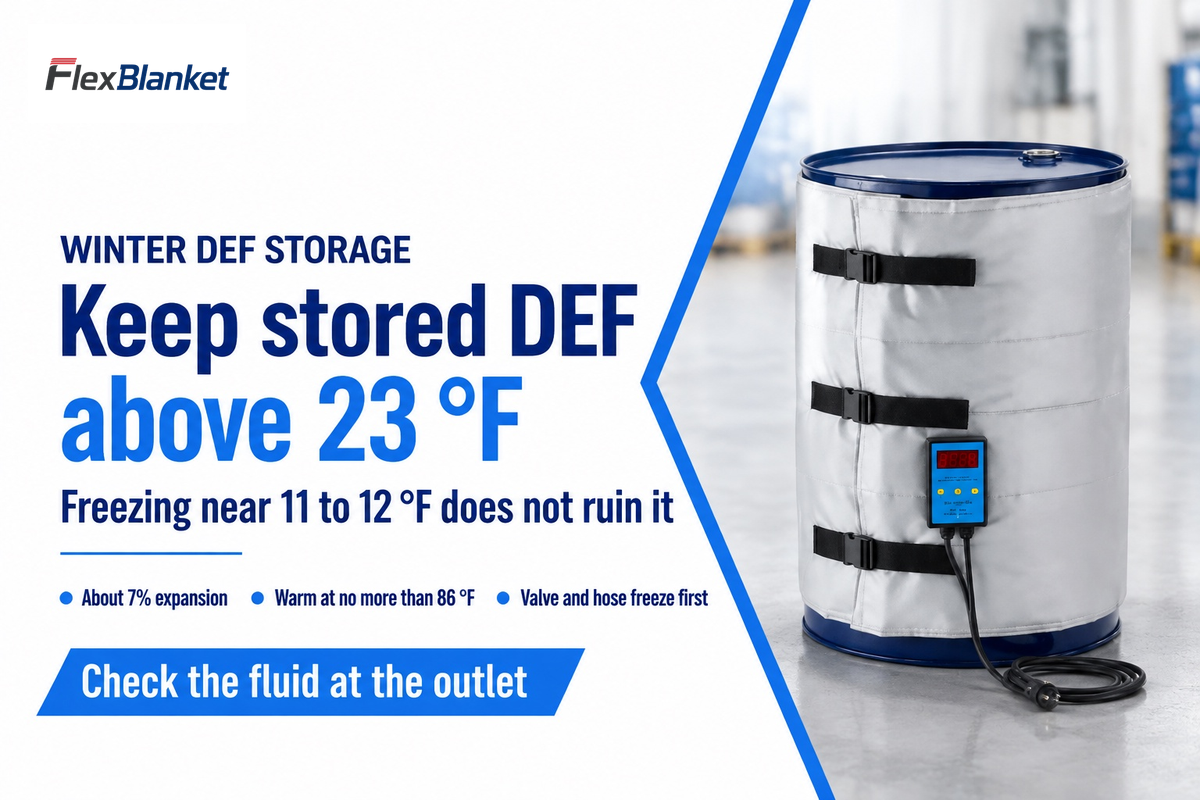
DEF freezes at about 11 to 12 degrees Fahrenheit, starting to crystallize at −11.5 °C (11.3 °F) according to published summaries of ISO 22241-1, and freezing does not ruin it. ISO 22241-3 states that solidified DEF warmed carefully at no more than 30 °C (86 °F) is not impaired in quality and can be used as soon as no solids remain.
The bigger issue with winter is expansion and access. Frozen DEF takes up about 7% more volume, so a full, closed container can split; Farm Progress quotes an AGCO parts manager who says DEF “will begin to ‘slush’ before it freezes.” On the truck, a heater in the DEF tank thaws the fluid after start-up. A tote or drum in a yard has no heater, and on an outdoor tote the outlet valve and the hose freeze before the bulk does because they hold so little liquid.
| Coldest site temperature | What happens to DEF | Protection to use |
|---|---|---|
| Stays above 23 °F (−5 °C) | Inside the ISO storage window | Shed or insulated cover; pallet off frozen ground |
| Dips to 11 to 23 °F (−11.5 to −5 °C) | Below the ISO storage floor; crystals start to form as it nears 11 °F | Heating blanket on a thermostat plus an insulated top cover |
| Below 11 °F (−11.5 °C) for days, or outdoor dispensing | Solid freeze; valve and hose block first | Blanket, top cover and bottom heater, with the valve and hose insulated or heat-traced; or move the tote into a heated room |
Start the heater controller at 41 to 50 °F (5 to 10 °C). That sits 18 to 27 °F above the −5 °C storage floor and well below the 86 °F (30 °C) warming limit; it is our starting point worked out from the two ISO limits, not a number the standard itself gives, so check the fluid with a probe thermometer at the outlet after the first cold night. Cap any high-limit at 86 °F, because a heater’s own range can run much higher: FlexBlanket’s IBC tote heaters, for example, list a −20 to 130 °C operating range, two independent heating zones and 3,000 W at 230 VAC (1,500 W at 120 VAC) for 275- and 330-gallon totes. Remember that a thermostat reads the wall where its sensor sits, not the middle of the tote; a Cummins patent on DEF tank heating, US11506100B2, makes the same point for large DEF tanks. For 55-gallon drums, drum heating blankets such as the 200 L model run 2,000 W at 230 V. A step-by-step comparison of wrap, base and immersion heating is in the guide on how to choose an IBC tote heater, controller placement is covered in temperature controller settings for heating blankets, and lines and valves are covered in freeze protection for tanks and lines. Leave headspace in any container that might freeze, and never add antifreeze: DEF must stay pure.
Need a heater specific to your tote, drum or pail? FlexBlanket builds container heaters to your specs.
DEF quality: ISO 22241, API certification and a field check
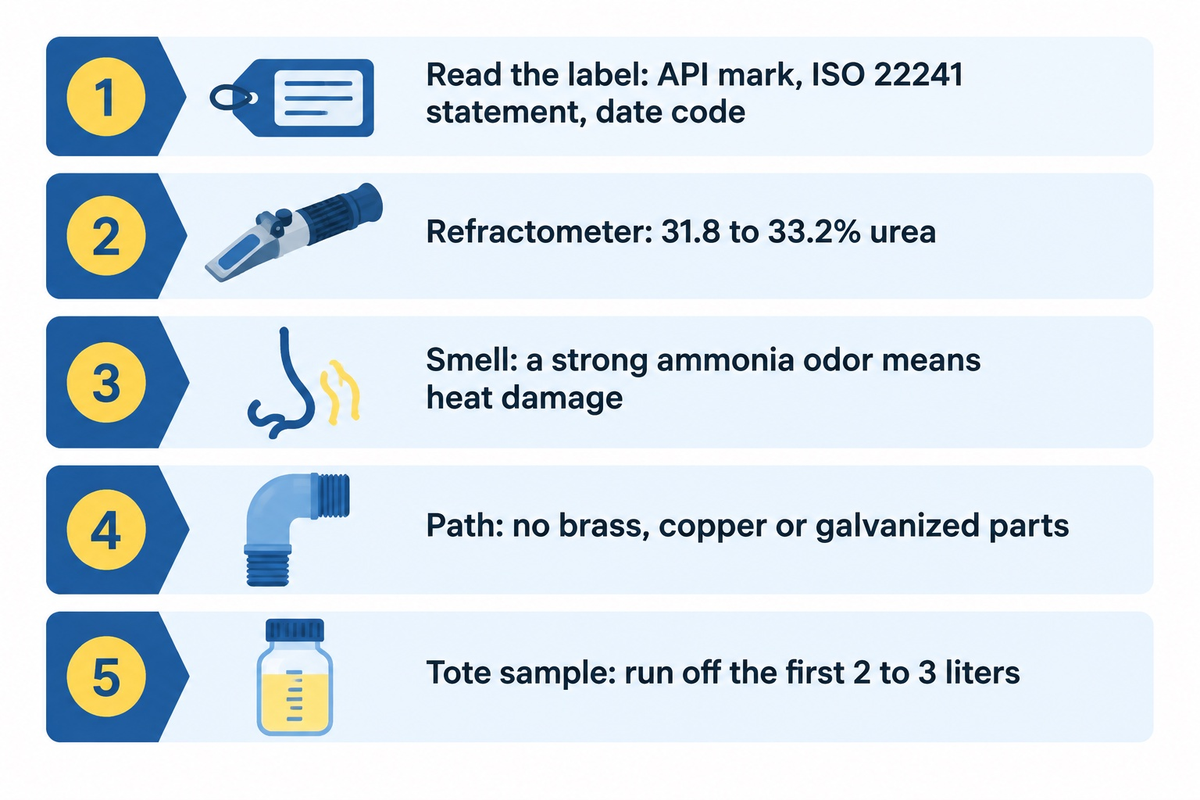
Good DEF carries the API Diesel Exhaust Fluid Certification Mark or a supplier certificate showing it meets ISO 22241-1, and a field refractometer reading between 31.8 and 33.2% urea. Concentration is only one of many limits in the standard, though, so a correct reading does not prove the fluid is clean.
“API has found that the biggest misconception by fleet managers is the belief that if the urea concentration of their DEF is on spec, then the DEF meets the required quality.”
American Petroleum Institute, How to Purchase, Store and Handle Diesel Exhaust Fluid
For bulk deliveries, ask for a certificate of analysis with every load that covers all ISO 22241-1 items. Licenses for brand names change, so search the brand name in API’s DEF licensee directory, available from API’s DEF program web page, prior to purchase. Once on site, run a quick test:
- Read the label. Look for the API mark, an ISO 22241 statement and a date code; reject unlabeled, cloudy or colored fluid.
- Refractometer. A DEF scale should read 31.8 to 33.2% urea, or a refractive index of 1.3814 to 1.3843 at 20 °C.
- Smell and look. Fresh DEF is clear with a faint smell; a strong ammonia odor means heat damage.
- Check the path. Confirm the pump, hose and nozzle are DEF-only and free of brass, copper or galvanized parts.
- Take the right sample. To judge what is in a tote, run off the first 2 to 3 liters (about 0.5 to 0.8 gallon) before you sample; to judge a dispenser that has sat idle, sample the first 3 liters out of the nozzle, as ISO 22241-3 section 5.2 describes.
Can you use fertilizer urea or make your own DEF?
No. Fertilizer-grade urea carries biuret, anti-caking agents and metals above the ISO 22241-1 limits of 0.3% biuret and 5 mg/kg aldehydes, and tap water adds calcium, magnesium and sodium above the 0.5 mg/kg cap. API’s purchasing guide warns that agricultural-grade urea or untreated public water can introduce contaminants that shorten SCR life and reduce its ability to cut NOx.
A homemade batch of urea and water may read 32.5% on a refractometer and still fail on purity, which is exactly the misconception API describes. The catalyst damage builds up over months with no early warning, so certified fluid is the cheap way to protect your engine’s SCR system.
Buying DEF: package sizes, price per gallon and the Shelf-Life-to-Package Matrix
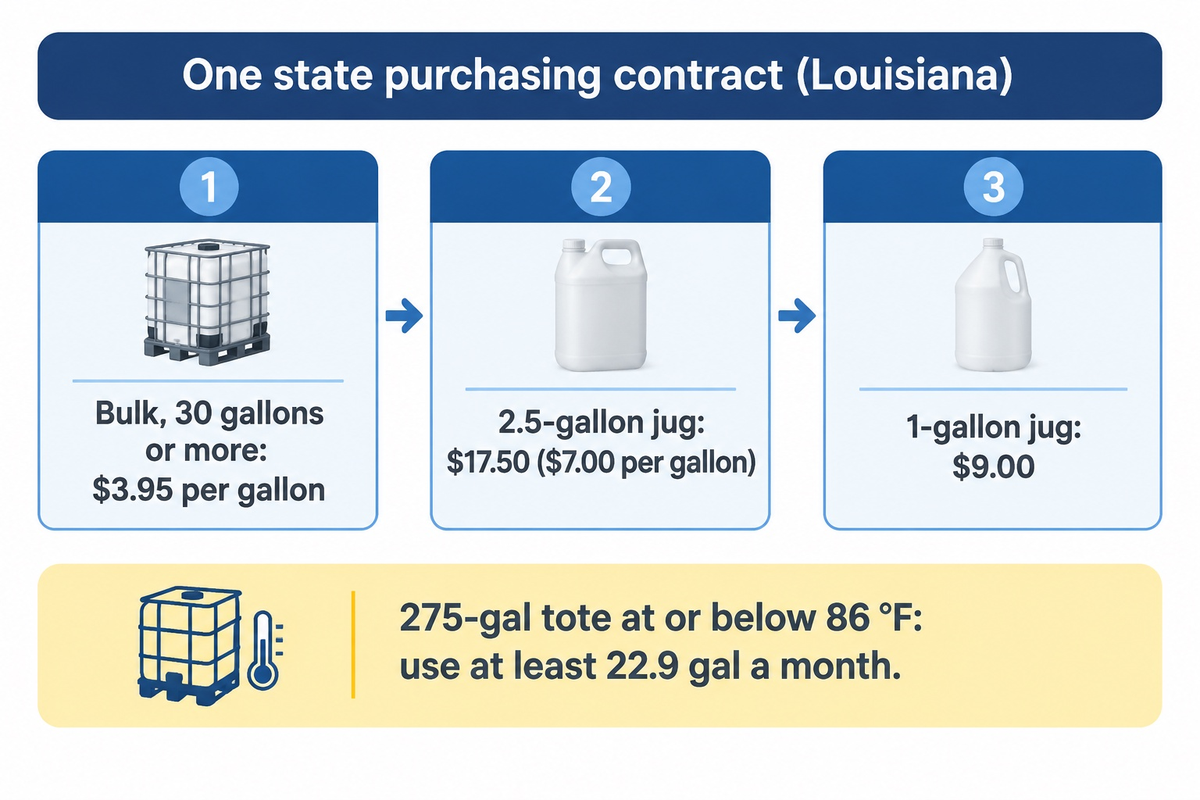
DEF costs least per gallon in bulk and most in small jugs. A Louisiana statewide purchasing contract, No. 4400035012, lists DEF at $3.95 per gallon for 30 gallons or more, against $17.50 for a 2.5-gallon jug ($7.00 per gallon) and $9.00 for a 1-gallon jug. The contract has no separate drum or tote line, so ask suppliers for a delivered per-gallon price at those sizes. Retail prices vary by region and month, but the order rarely changes: delivered totes and bulk cost least per gallon, pump DEF sits in the middle and jugs cost most, and all of them move with urea, which is made from natural gas.
The cheapest package is only the cheapest if used before it ages out. That is where package size and storage temperature meet.
Shelf-Life-to-Package Matrix
This matrix shows the minimum monthly DEF use needed to empty each package within its ISO 22241-3 shelf life at a given storage temperature.
| Package | Stored ≤50 °F (36 mo) | ≤77 °F (18 mo) | ≤86 °F (12 mo) | ≤95 °F (6 mo) |
|---|---|---|---|---|
| 2.5-gal jug | 0.07 gal/mo | 0.14 gal/mo | 0.21 gal/mo | 0.42 gal/mo |
| 55-gal drum | 1.5 gal/mo | 3.1 gal/mo | 4.6 gal/mo | 9.2 gal/mo |
| 275-gal tote | 7.6 gal/mo | 15.3 gal/mo | 22.9 gal/mo | 45.8 gal/mo |
| 330-gal tote | 9.2 gal/mo | 18.3 gal/mo | 27.5 gal/mo | 55.0 gal/mo |
| 1,000-gal bulk tank | 27.8 gal/mo | 55.6 gal/mo | 83.3 gal/mo | 166.7 gal/mo |
Read it by how quickly your DEF gets used up. The Class 8 truck in the previous table burns 26 to 39 gallons a month, so a 275-gallon tote works in a shop kept under 86 °F, but is too big for a hot yard near 95 °F. The pickup at 1.4 to 2.1 gallons a month should stick to jugs; even a drum kept below 50 °F needs about 1.5 gallons a month, which only the upper part of that range reaches. Each cell divides the volume of the package by the months of shelf life at a constant storage temperature, and that shelf life starts at the time of production, so shorten it by the months it spent in transit and by any hot spells; dimensions of drums are listed in 55-gallon drum dimensions and tote weights follow from how many pounds a gallon of liquid weighs at about 9.1 lb per gallon of DEF.
Industry outlook: what the 2025 to 2026 EPA DEF changes mean
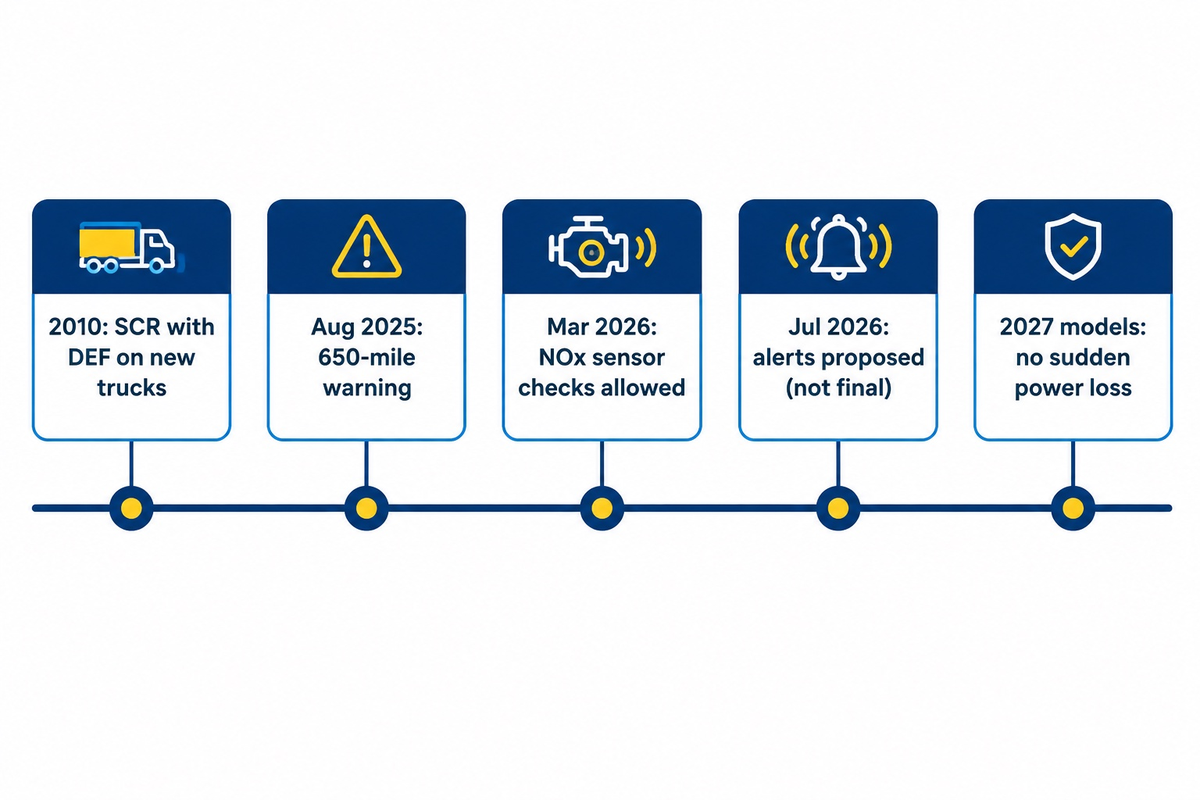
DEF isn’t going away; what’s changing is how engines punish a DEF problem. The EPA said on March 27, 2026 that its new sensor guidance “does not weaken or remove emissions standards,” and every SCR diesel still needs on-spec fluid. The rules still exist to reduce air pollution from diesel exhaust; the relief is in derates and sensors, and most of it depends on software updates.
| Date | Action | What it means for a DEF buyer |
|---|---|---|
| 2010 | Nearly all new on-road diesel trucks adopt SCR with DEF | Trucks from 2010 on need a DEF supply |
| 2014 | Final rule on SCR maintenance and emergency relief for nonroad engines | Minimum DEF refill intervals set |
| 2022 | Revised inducement strategy for model year 2027 heavy-duty engines | More diagnostic data for owners and repair shops |
| Aug 11, 2025 | EPA guidance asks makers to update in-use DEF software | Updated trucks: 650-mile warning, then up to 4,200 miles without a speed cap |
| Feb 3, 2026 | EPA demands DEF failure data from 14 manufacturers that make over 80% of the products used in DEF systems | Data behind the next steps |
| Mar 26 to 27, 2026 | Urea quality sensors may be replaced by NOx-sensor checks | Fewer false “poor DEF quality” faults on updated engines |
| Jul 14, 2026 | Proposed rule would replace derates with audible or visible alerts on new engines | Not final; comments closed Aug 29, 2026 |
| Model year 2027 | New on-road trucks must avoid sudden, severe power loss after running out of DEF | Running dry still triggers alerts and refills |
| Sep 24, 2026 | Third edition of ISO 22241-1 passes its final vote and goes to publication | Ask suppliers which edition their certificate cites |
The EPA’s own news release recognizes the distress the old derates caused. In its words, derates “caused needless frustration, operational delays, and real economic hardship for operators.” The July 2026 proposal only applies to newly manufactured engines and vehicles. Trade coverage of the March guidance by DieselNet notes that since 2016 to 2017 only one engine maker had kept NOx-sensor quality checks, so most fleets will see the change through software updates rather than new hardware.
Is the DEF requirement for diesel vehicles going away?
No. The DEF requirement for SCR-equipped diesel vehicles stays in place; the EPA’s 2025 and 2026 actions change how engines react to a DEF fault, not whether they need the fluid. A truck that runs dry still loses NOx control, and starting from model year 2027 it’s required to warn the driver rather than shut down abruptly.
If you are planning 2027 storage, budget for the same fluid volume as today. Tote heaters, dispensers, and DEF contracts stay useful under every version of the rules on the table.
Frequently asked questions about DEF
Q: What does DEF stand for?
DEF stands for diesel exhaust fluid, the 32.5% urea solution that SCR-equipped diesel engines use to reduce emissions of nitrogen oxides.
You may also see it written as AUS 32, which is its name in ISO 22241, or under the trade names AdBlue and ARLA 32. All of them describe the same fluid that goes into the blue-capped tank next to the diesel filler.
Q: How much does it cost to fill up DEF?
On one state purchasing contract, DEF costs about $4 to $7 per gallon in 2026, so 10 gallons runs roughly $40 to $70.
The low end matches the $3.95 per gallon bulk line on Louisiana’s state contract and the high end its $7.00 per gallon jug price. Pump prices at truck stops and some gas stations are not on that contract, so check the posted price. Heavy Duty Trucking reported that a typical DEF purchase at the pump is about 10 gallons, a small amount compared with a diesel fill, so the bill is modest even at jug prices.
Q: Does DEF go bad?
Yes. DEF slowly degrades with heat, keeping at least 18 months at 77 °F but only 6 months at 95 °F under ISO 22241-3.
Above 95 °F, the standard says to test every batch before use. Check the date code on jugs, store them in shade and rotate stock so the oldest fluid goes out first. A strong ammonia smell is a sign that the urea has started to break down.
Q: How do you clean the DEF system?
Clean dried DEF crystals with warm distilled water.
Follow the engine maker’s service manual for the injector, and never use solvents or tap water inside the system.
Q: What is DEF in BS6?
In BS6 vehicles, DEF is the same AUS 32 urea solution, sold in India mostly as AdBlue, that BS6 diesel trucks and buses with SCR inject to meet NOx limits.
BS6, or Bharat Stage VI, is India’s vehicle emission standard. Many BS6 diesel trucks, buses and some larger SUVs use SCR, so they carry a separate DEF tank and need refills just like U.S. trucks. The fluid should meet ISO 22241-1, with 31.8 to 33.2% urea, and the same storage rules apply: keep it shaded, avoid tap water and do not let it overheat in a hot cab or depot. Mixing brands is fine if each meets the standard.
Q: Is DEF toxic or flammable?
DEF is nontoxic and nonflammable, according to Farm Progress.
It’s mildly corrosive to some metals, so it’s important to clean up spills and wash skin after contact.
Q: How often do you need to refill DEF?
Plan on about one gallon of DEF for every 33 to 50 gallons of diesel, which is the 2 to 3% dose rate.
Heavy Duty Trucking reports Yara saying 2.5 gallons of DEF covers over 350 miles on an average truck, and some large fleets have drivers top up DEF on every third fuel stop. Watch the gauge rather than a calendar because towing and heat raise use.
Keep stored DEF liquid this winter
If your DEF lives in 275- or 330-gallon totes, 55-gallon drums or pails outdoors, a thermostatically controlled heating blanket with its high limit capped at 86 °F keeps it within the 23 to 86 °F storage window without overheating it. For a heating layout and quote, send your container size, supply voltage and the lowest site temperature to FlexBlanket.
Request a DEF tote heater quote →
About This Analysis
FlexBlanket builds heating blankets for IBC totes, drums and pails, and its container heater range lists diesel exhaust fluid among the fluids it heats. The urea limits, shelf-life table and freeze figures here come from ISO 22241 and EPA documents rather than our own tests, and the tote heater specifications come from our product pages. Check the cited standards and your equipment manual before changing a storage or heating setup.
References & Sources
- Diesel Exhaust Fluid (DEF) Certification Program, American Petroleum Institute
- Diesel Exhaust Fluid, U.S. Environmental Protection Agency
- DEF Quality Monitoring Using Alternate Sensor Technologies, IACD-2026-05, U.S. Environmental Protection Agency
- ISO 22241-1:2019, Quality requirements for AUS 32, International Organization for Standardization
- How Do Diesel Vehicles Work?, U.S. Department of Energy, Alternative Fuels Data Center
- Don’t Forget to Factor DEF into Fuel Costs, Heavy Duty Trucking
- EPA news release on DEF sensor guidance, March 27, 2026, U.S. Environmental Protection Agency
- ISO 22241-3:2017, Handling, transportation and storage of AUS 32, International Organization for Standardization
- How to Purchase, Store and Handle Diesel Exhaust Fluid, American Petroleum Institute
- 7 tips for handling diesel exhaust fluid this winter, Farm Progress
- US11506100B2, Diesel exhaust fluid tank heating system, Cummins Power Generation Inc.
- Proposed Rule for Model Year 2027 and Later Heavy-Duty Highway Engines and DEF Inducements, U.S. Environmental Protection Agency
- US EPA issues new guidance on DEF quality sensors, DieselNet
- ISO 22241-1, Edition 3 (under publication), International Organization for Standardization